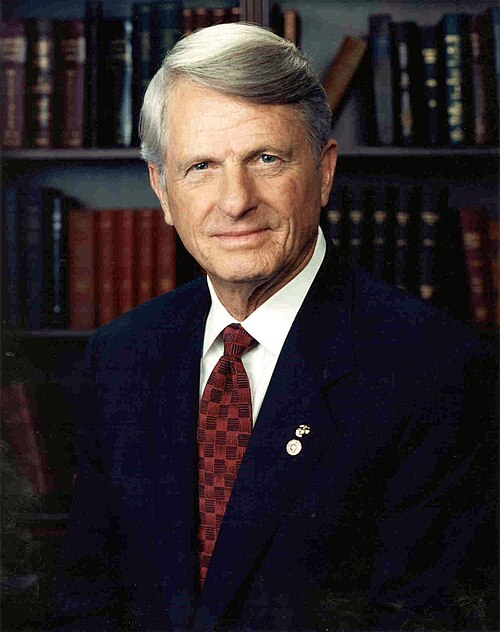
In recent times, less and less is required for the press to count a Democrat as a “moderate” or even “conservative”. The closest one has come in recent years was West Virginia Senator Joe Manchin, but someone who really did fit this bill was Zell Bryan Miller (1932-2018). Miller was always two things: a Democrat and a man of Young Harris, Georgia. He never knew his father, as his father died only 17 days after his birth from cerebral meningitis. He and his sister were raised by their mother in modest circumstances and the fact that she had built the family home with rocks she got from a stream instilled into young Zell the value of rugged independence (Grant). As a young man, Miller attended and graduated from Young Harris College but lacked the discipline to proceed at Emory University. However, he gained the discipline required from his subsequent service in the U.S. Marines (Grant). In 1954, Miller married Shirley Carver and they had two sons, with him continuing his education in 1956 at the University of Georgia, earning Bachelor’s and Master’s degrees in history, learning from prominent historian E. Merton Coulter, a proponent of the Dunning School of historical interpretation of Reconstruction. In 1958, while teaching history and political science at Young Harris College, Miller won his first election to serve as Young Harris’s mayor at the young age of 26. Serving from 1959 to 1960, he was then elected to the Georgia State Senate, serving until 1964. He attempted to win the Democratic nomination for Congress in both 1964 and 1966, and like most Georgia politicians of the time, he ran on a segregationist platform. Although not successful in his bids for Congress, Miller served as executive secretary for Governor Lester Maddox from 1968 to 1971. In this role, he was credited with influencing Maddox to make more appointments of blacks to government positions and to improve higher education (Grant). From 1971 to 1973, Miller served as chairman of the state’s Democratic Party, which set him up for a run in 1974 for lieutenant governor. Miller proved popular in this role, and his time resulted in him considering a run for the Senate.
The 1980 Senate Primary
Although the name Talmadge carried a lot of political heft in Georgia, during his fourth term, Senator Herman Talmadge’s reputation began to suffer. An alcoholic, his drinking got out of hand after the drowning death of his son in 1975, and his publicized divorce was ugly and bitter. In addition, Talmadge was hit with a dishonor that only nine senators have ever suffered, and only one has ever served another term after: he was censured by the Senate (although the term “denounced” was used in his case). Furthermore, his past as a segregationist was not aging well as black participation was increasing in the state’s Democratic Party, thus Zell Miller challenged him for renomination and received endorsements from numerous black political figures, including State Senator Julian Bond and Atlanta Mayor Maynard Jackson (Harris). Talmadge, however, commanded a lot of loyalty in the Democratic Party, his seniority helped, and there were black supporters of him for delivering on certain priorities. Miller fell short in his bid to deny Talmadge renomination by 18 points, but in the general election, he would narrowly lose reelection to Mack Mattingly, chairman of the Georgia Republican Party. Some Democrats believed that Miller’s candidacy made the difference in the general election. in the meantime, he would continue to serve as lieutenant governor. In 1990, Miller decided to move up to governor, successfully gaining the nomination in 1990 and winning against Republican Johnny Isakson by over 8 points.
As governor, he pledged to serve only one term and sought to make the most of the time. Miller focused strongly on education, and proposed an amendment to the state’s constitution to permit a state lottery with the funds going to fund the state’s education system, which the voters passed. He also established the HOPE Scholarship Program, in which every Georgia student who averages a B or better is eligible for a fully paid scholarship to any Georgia state college or university. Miller was keen on both preventative and punitive measures on criminal justice, and got the toughest sentencing guidelines in the country passed, a two strikes law (Grant).
In 1992, Miller gave his strong backing to the candidacy of Bill Clinton and helped him get the Democratic nomination. He delivered a strong keynote speech at the Democratic National Convention, in which he said, “I made it because Franklin Delano Roosevelt energized this nation. I made it because Harry Truman fought for working families like mine. I made it because John Kennedy’s rising tide lifted even our tiny boat. I made it because Lyndon Johnson showed America that people who were born poor didn’t have to die poor” (Stout).
Although Miller was successful in helping Clinton to the White House and carrying Georgia for him, he had his own political future to consider. He had been quite a success as governor, and this motivated him to change his mind and run for a second term. This was far from without controversy, and Georgia voters were souring on the Clinton Administration, which resulted in Miller only winning reelection by two points in 1994. Although on the presidential level, second terms are often considerably worse than first, Miller’s second term as governor was even better than the first. He worked hard to make the state attractive for growth and investment. Miller even established a special program to use private funding to distribute classical music CDs to every family with babies born in Georgia, and by the end of his second term, his approval rating was an astronomical 85% (Grant). Although after his term, Miller sought to continue his education career and taught at Emory, University of Georgia, and of course Young Harris College, the call of political office would come to his doorstep.
Senator Miller
On July 18, 2000, Republican Senator Paul Coverdell died of a cerebral hemorrhage, and Democratic Governor Roy Barnes tapped Miller to serve in the interim. He sought a full term, and for the 2000 special election, he faced Mack Mattingly. However, Miller had recently been an extremely popular governor while Mattingly had been out of elective office since his reelection loss in 1986. The result was a blowout for Miller, winning by 20 points while Republican George W. Bush carried the state by over 11 points. One could interpret this victory as a vindication of Miller’s 1980 candidacy for the Senate. As a senator, Miller’s record started moderate, and he was one of a few Senate Democrats to vote for the Bush tax cuts in 2001. He stated, “I agree with President Bush that the taxpayers are better judges of how to spend their own money than we are” (Stout). His disagreement with Democratic leadership grew when they came out strongly against an amendment he sponsored with Phil Gramm (R-Tex.) to loosen union and personnel rules for the Department of Homeland Security and held up the legislation shortly before the 2002 midterms over the issue, he became a critic of the party’s leadership. Miller saw this as placing the priorities of an interest group (federal employees) over the priority of national security. He blamed the results of the 2002 midterm on the Democratic Senate leadership, stating, “When you bring it down to whether you are for homeland security or for protecting federal employees’ jobs, that is pretty hard to defend” and blamed repeated votes on the issue for the defeats of Max Cleland (D-Ga.) and Jean Carnahan (D-Mo.) (Preston). Miller had campaigned for the former’s reelection. After the 2002 midterms, his record shifted strongly to the right. In 2004, Miller announced that he would not be running for a full term. This freed him to do what he wanted, including introducing a Constitutional amendment repealing the 17th Amendment (direct election of senators) as he believed this lessened the power of states in favor of the federal government. Miller’s separation from the national Democratic Party was complete with his endorsement of George W. Bush. This time, he was a keynote speaker at the Republican National Convention. Miller delivered yet another strong speech,
“Never in the history of the world has any soldier sacrificed more for the freedom and liberty of total strangers than the American soldier.
And, our soldiers don’t just give freedom abroad, they preserve it for us here at home.
For it has been said so truthfully that it is the soldier, not the reporter, who has given us the freedom of the press.
It is the soldier, not the poet, who has given us freedom of speech.
It is the soldier, not the agitator, who has given us the freedom to protest.
It is the soldier who salutes the flag, serves beneath the flag, whose coffin is draped by the flag, who gives that protester the freedom he abuses to burn that flag” (Presidential Rhetoric).
He was also staunchly critical of Senator John Kerry’s (D-Mass.) voting record on defense issues, as he had a history of voting for defense cuts. During his speech, he told the audience, “This is the man who wants to be the commander in chief of the U.S. Armed Forces? U.S. forces armed with what? Spitballs?” (Stout). After the speech, reporters started asking him questions. When correspondent Chris Matthews asked him over a microphone to elaborate on the “spitballs” remark, Miller snapped, “Do you know what a metaphor is? Get out of my face!” and subsequently stated, “I wish we lived in the day when we could challenge someone to a duel,” but expressed regret for the remark (Stout).
Despite his endorsement of Bush, as noted earlier, Miller never switched parties, always seeing the Democratic Party as his home. He made the direct comparison when asked about why he didn’t switch, stating, “I compare it to being in an old house. It’s a house that I’ve lived in for years that’s getting kind of drafty and hard to heat. The plumbing won’t work, and some strangers have moved into the basement, and I don’t know who they are, and there’s no doubt I would be more comfortable in another house. But, you see, I was here first. I’ve lived in this house for years and years. It’s home, and I’m not going to leave” (Stout). With his departure from the Senate on January 3, 2005, was the departure of the last true conservative Democrat of the Senate in this author’s opinion. Miller sided with the liberal Americans for Democratic Action only 23% of the time, while he sided with the American Conservative Union 71% of the time. His DW-Nominate score is a 0.146, which is extremely high for a Democrat. Miller’s storied political life and the various stances he took over his career led some to call him “Zigzag Zell”, and this reflected the mixed feelings people in the Georgia Democratic Party had about him at the end. His successor, interestingly enough, was Johnny Isakson, the man he bested in 1990. President Bush subsequently appointed him to the American Battle Monuments Commission, and in 2008 the University of Georgia honored him by dedicating the Zell B. Miller Learning Center (Grant).
Although in retirement from elective office, Miller did still let his opinions be known, and often supported Republican candidates for public office, such as Saxby Chambliss for reelection to the Senate in 2008 and Governor Nathan Deal. However, he did support Democrats now and again, such as Michelle Nunn in her 2014 Senate run. In 2017, Miller retired from public life due to a diagnosis of Parkinson’s disease and died the next year on March 23rd at 86 in Young Harris. Whatever happened in his life, wherever he politically stood, and whoever he supported, Zell Miller was born a Young Harris Democrat and died a Young Harris Democrat.
References
ADA Voting Records. Americans for Democratic Action.
Retrieved from
Former U.S. Sen. Zell Miller dies at 86; Was 2-term Georgia governor. (2018, March 23). The Florida-Times Union.
Retrieved from
Grant, C. (2018, June 4). Zell Miller. New Georgia Encyclopedia.
Retrieved from
https://www.georgiaencyclopedia.org/articles/government-politics/zell-miller-1932-2018/
Harris, A. (1980, August 23). Drawlin’ and Brawlin’. The Washington Post.
Retrieved from
Miller, Zell Bryan. Voteview.
Retrieved from
https://voteview.com/person/49904/zell-bryan-miller
Preston, M. (2003, February 14). Miller Blames Leaders for ‘02. Roll Call.
Retrieved from
https://rollcall.com/2003/02/14/miller-blames-leaders-for-02/
Speeches from the 2004 Republican National Convention: Zell Miller. (2004, September 1). Presidential Rhetoric.
Retrieved from
http://www.presidentialrhetoric.com/campaign/rncspeeches/miller.html
Stout, D. (2018, March 23). Zell Miller, Feisty Democrat Who Sided With G.O.P., Is Dead at 86. The New York Times.
Retrieved from
 Mad Politics: The Bizarre, Fascinating, and Unknown of American Political History