There is a persistent ideological debate on where to place the Nazis. The American left loves to tar and feather the American right with comparisons to Nazis, and the common designation for Nazis is “far right” and the same people who apply that label I notice apply this label to a growing number of Republican officeholders. The right hits back by claiming that Nazism is a form of socialism, a rival socialism to Marx. The application of the term “Liberal” to Hitler is for most people a bizarre and unthinkable application. After all, Hitler and the Nazis were extremely socially conservative. However, it definitely can be argued that the Nazis’ efforts to undermine Christianity with a state-sponsored “Positive Christianity” go against the social conservatism of the United States, which is overwhelmingly based in Christianity. Joseph P. Kamp argued for Hitler being a liberal, as least a New Deal one, in 1949. But before I dive further into this, a bit of background on the author.
Background on the Author
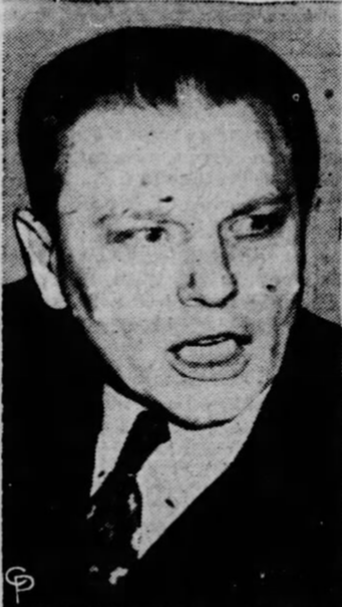
Joseph P. Kamp, 1944.
Joseph Peter Kamp (1900-1993) was perhaps the most prolific right-wing pamphleteer of the 20th century. He started his activities in 1919 when the Constitutional Educational League was formed. Kamp become the organization’s lead spokesman in 1925, and basically became the League. In 1934, he would collaborate with Harold Lord Varney, Lawrence Dennis, and former Populist Congressman Milford W. Howard of Alabama in launching The Awakener, a newspaper that was strongly opposed to the New Deal and to the growing power of organized labor. Kamp authored numerous provocative pamphlets the Constitutional Educational League and later through Headlines, including Vote CIO and get a Soviet America (1944), We Must Abolish the United States: The Hidden Facts Behind the Crusade for World Government (1950), and Behind the Plot to Sovietize the South (1956). A notable pamphlet attacking Kamp was Joe Kamp: Hero of the Pro-Fascists by the organization Friends of Democracy. He was also regularly accused of anti-Semitism and fascism, including an indictment of the Constitutional Educational League in 1942 for allegedly seeking to undermine the U.S. Army and Navy. He was also indicted twice for contempt of Congress; first over his refusal to answer questions and the second time for refusal to disclose his backers and was convicted for the first time but acquitted the second time. While I think the charge of fascism is highly disputable for him, the anti-Semitism is pretty beyond dispute given what I have read of Kamp, and his association with notorious anti-Semite Willis Carto from the 1960s all the way up to the 1980s as part of Liberty Lobby includes letters the two wrote to each other. There is one in particular demonstrating that he was actively seeking to deny the Holocaust. The damning passage reads, “…I think I wrote to you once that I intended to deal with the allegation that six million Jews are supposed to have been put to death by the Nazis because the ADL now has the Catholic Church spreading this lie. When I get through demolishing the fable I am going to quote a Jewish author who writes that while FIVE million Jews are said to have been liquidated between 1933 and 1945, there were SEVEN million Christians who suffered the same fate” (Kamp, 1968). Kamp here is, ironically for someone on the right, not understanding “per capita” as there were far less Jews than Christians in Europe even if the figures he cites were accurate, as well as papering over that Jews were targeted directly for their religion as opposed to Christians who unless they were vocal faith-based dissenters were targeted because they were part of other groups the Nazis were interested in terminating. Simply put, he wished to downplay the impact of what he calls “Hitler’s anti-Jewish terror” (Kamp, 1968). Anyway, on to Kamp’s pamphlet, Hitler Was a Liberal!
Kamp’s (1949) premise is, “Hitler’s ideology and program are shockingly parallel to the philosophy and measures currently expounded and promoted by a powerful clique of Americans who have the effrontery to call themselves “liberals”. This same “liberal” clique hails the results at the polls in the 1948 election as a “liberal” victory and a “mandate” from the American people for a “liberal” legislative program, a program which is strikingly similar to proposals set forth in Hitler’s Mein Kampf”. The paradox is due to the Red political smog which has been systematically exuded over our people to becloud their understanding of this time-honored and deeply-cherished American characteristic” (3-4).
Kamp proceeds to argue that the term “liberal” as commonly applied at the time of writing is a bad misnomer. He defines a traditional liberal as, “…one with generous mental horizons. He is open-minded, looks at both sides of a question. He has foresight as well as hindsight. He knows the past, and resolutely faces the future. He is not rutted in iron-clad tradition, nor given to impractical wishful thinking. He judges an issue in the light of fact and existing circumstance, and is not unduly swayed either be precept or roseate promise. He has common sense, good will and a profound belief in individual rights and liberties” (Kamp, 5).
Kamp considers those who call themselves liberal in 1949 thusly, “For the most part, his “liberalism” is characterized by VIOLENT OPPOSITION TO THE ESTABLISHED ORDER; which, according to him, has plenty of faults and few virtues; he is “all out” for revolutionary change – without a serious thought as to the consequences; he admits that there are two sides to every question – but the other side is always “reactionary;” he claims an open mind on everything – provided that it conforms to his own view” (6).
Kamp (1949) holds that “The real power behind the scenes Is not the Politburo; it is THE PHILOSOPHY OF SOCIALISM. We are inclined to think of the cold war in terms of the Kremlin, and to forget that Russian Communism is but one form of Socialism in action. The history of Soviet Socialism goes back no farther than November, 1917. Marxist Socialism with its plan of world revolution goes back a hundred years. All Socialism springs from the same root and produces the same narcotic to liberty. There is no Socialism of any hue which is not based upon the sacrifice of human rights and liberties for State slavery, and all Socialism is a political pyramid dominated by a dictator and his chosen bureaucrats. Every attempt at applied Socialism in the world has resulted in a dictatorship” (9-10).
His case for Hitler the Liberal?
“If opposition to the conservative social order, the building of a welfare state, wholesale raids on private property and fundamental human rights (all of which the new “liberalism” is promoting in the United States) are the earmarks of a “Liberal”, then Adolf Hitler should be enshrined as one of the mighty heroes of the “liberal movement,” for who more than the paperhanger of Bavaria gave wholeheartedly of his time and genius to the “liberal” cause of destroying governments, property and human rights, and building Socialist – welfare – slave states” (Kamp, 13). He makes his case by comparing points in the Nazi Party’s 25 point program to what New Deal liberals were standing for in 1949.
Kamp’s Comparisons:
“Hitler proposed “nationalization of education to give equality of advantages to all.” Our “liberals” demand Federal Aid to Education – the prelude to “nationalization.”
“Hitler demanded “equal rights for all German citizens.” Our “liberals” demand an F.E.P.C. law.”
“Hitler promised “old age pensions.” Our “liberals” propose increased old age pensions and expanded Social Security.” (14)
“Hitler sponsored “nationalization of public health service.” Our “liberals” are backing Socialized Medicine.”
“Hitler demanded the “nationalization of trusts.” Our “liberals” want 19 more TVAs and the right to “nationalize” our steel industry as a starter.”
“Hitler was for “a strong central state power.” Our “liberals” want all Government power to be concentrated in a bureaucratized executive department, and to make Congress a “rubber stamp.”
“Hitler did something else that is “happening here.” He concentrated the taxing power in Berlin, and doled back locally collected tax money to local politicians who did his bidding. Thus he broke down local self-government which was in Germany, as it has been in the United States, the bulwark of freedom”. (Kamp, 15)
There are some significant issues here. While all of the NSDAP points he reports are accurate, the context leaves a bit to be desired to put it lightly. First, lets cover the most obvious one, “equal rights for all German citizens” equating to proposed anti-discrimination laws. This point completely neglects that anti-discrimination laws in the United States would cover Jews as religion-based discrimination was to be prohibited, while in Germany Jews were stripped of their citizenship, consistent with another one of these 25 points, thus “equal rights” does not apply to them. This cannot have escaped Kamp given that he clearly read the 25 points.
Second, the point of “nationalization of trusts” has an anti-Semitic basis, in that the owners of major department stores in Germany at the time of the platform were Jewish. Thus, it wasn’t just out of a sense of left-wing populism that Nazis went against “trusts”.
Third, Hitler’s proposed “nationalization of public health service” was not the equivalent of single-payer healthcare. Single-payer healthcare was a post-World War II phenomenon, not something that arose in Nazi Germany. Kamp seeks to tie New Deal liberalism together with the totalitarianism of Hitler and call both forms of socialism.
Some points that I find have greater accuracy are:
The comparison of “old age pensions”. Something to note is that Germany had already set up a social insurance system for invalidity and old age under Otto von Bismarck, and although the Nazi regime did plan on an expanded old age pension scheme to be paid for by “plutocrats”, the plan was shelved in 1940 until the war was to be won (The New York Times). This is a bit more accurate on Kamp’s part because the Nazis did intend on this to happen, although their focus was far more on war preparation.
The comparison of states and federal control. Nazi Germany outright replaced the authority of German states with party district leaders, who reported directly to Hitler. This destroyed sovereignty of individual German states. Kamp’s comparison between liberal efforts to expand and concentrate federal authority in the United States and Germany’s knocking out of sovereignty of individual states, although hyperbolic, is admittedly in the same direction of power orientation that modern liberals since at least the New Deal have sought. Democrats seek to consolidate power in the federal, and the Nazis sought to consolidate power on Germany’s national level.
Despite some actual points, the validity of comparisons have significant limitations. For one thing, the staunch social liberalism would find little to no place in the Nazi agenda save for pushes against traditional religions. Although there is a point to be had about parties making lofty promises for providing a lot and then providing dictatorship. Although Kamp points to federalization as a potential threat to freedom and I think there are substantial arguments behind this, he engages in hyperbole and regarding Hitler and “equal rights”, gross distortion.
References
Kamp, J.P. (1968, December 31). Letter to Willis Carto.
Retrieved from
Kamp, J.P. (1949). Hitler was a Liberal. New York, NY: Constitutional Educational League.
Retrieved from
Nazis Seen Shelving Old-Age Pension Plan. (1940, April 4). The New York Times.
Retrieved from
Stapp, A. (2019, March 11). Tim Wu’s Bad History: Big Business and the Rise of Fascism. Niskanen Center.
Retrieved from
Retrieved from
https://www.niskanencenter.org/big-business-rise-fascism-bad-history-tim-wu/
 Mad Politics: The Bizarre, Fascinating, and Unknown of American Political History