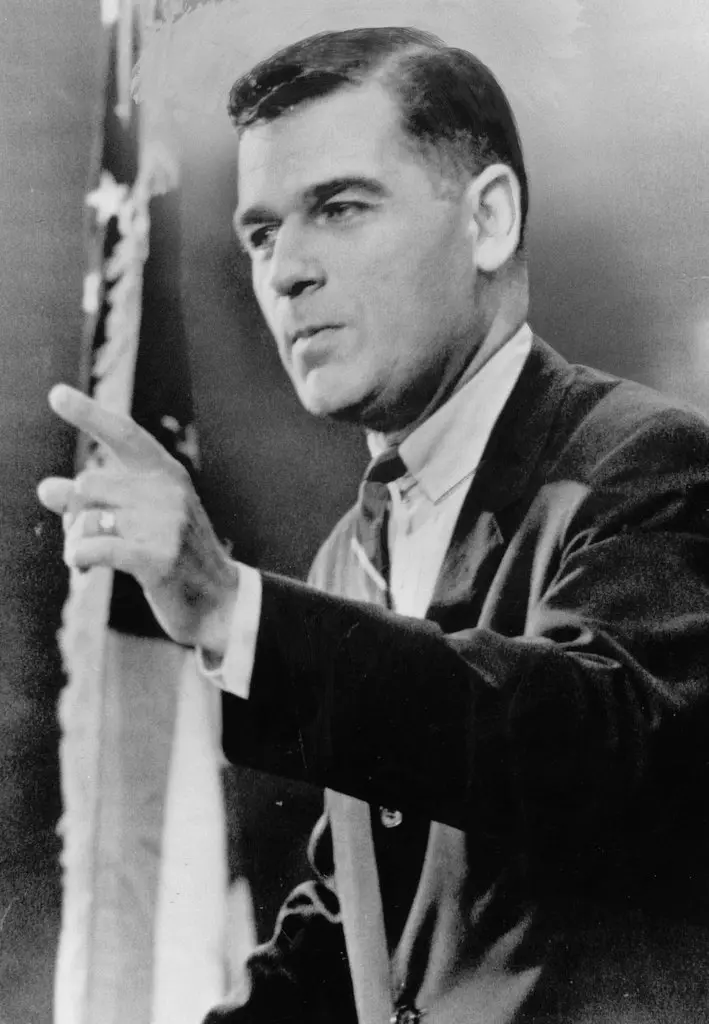
Senator Mark Hatfield (R-Ore.)
In 1970, the Vietnam War isn’t just still going on, US combat forces have expanded into Laos and Cambodia to stop Viet Cong incursions, and anti-Vietnam War protests are ever-present. Congress is pushing back on the Executive, and the Senate votes for the Cooper-Church Amendment, which if enacted would have removed US troops from Cambodia and Laos. In the midst of legislative battling over the Vietnam War, a curious duo comes together to replace the draft with an idea for an all-volunteer army starting in 1971, which was endorsed by President Nixon’s Commission on an All Volunteer Armed Force: Barry Goldwater of Arizona and Mark Hatfield of Oregon. These men represent very different wings of the Republican Party. Hatfield is of the liberal wing of the party and was even backed over the Democratic candidate in 1966 by Senator Wayne Morse over the issue of Vietnam. Hatfield sponsored with Senator George McGovern (D-S.D.) the “End the War” amendment and voted for Cooper-Church. Goldwater, on the other hand, was the face of conservatism in the Republican Party at the time and had opposed both the “End the War” Amendment and Cooper-Church. This proposal met with the opposition of President Nixon, who despite stating his support at different times for the concept of an all-volunteer army cited cost and poor timing (Rosenbaum). Senators had different arguments regarding this proposal. Senator Marlow Cook (R-Ky.), for instance, supported the idea of raising military pay and saw this measure as a way to boost the prospects of the poor and others argued that the draft would never be equitable and that it was “involuntary servitude” (Rosenbaum). This echoed a number of past arguments about the draft. The Senate vote on this proposal was 35-52 (D 15-34, R 20-18) on August 25, 1970, and it reveals some interesting divisions.
The vote can be seen here, with lifetime agreement scores with the conservative Americans for Constitutional Action for the senators. Republicans are in bold and italicized while Democrats are in plain font. A checkmark and an “x” mean paired for or expressed support or paired against or expressed opposition respectively:
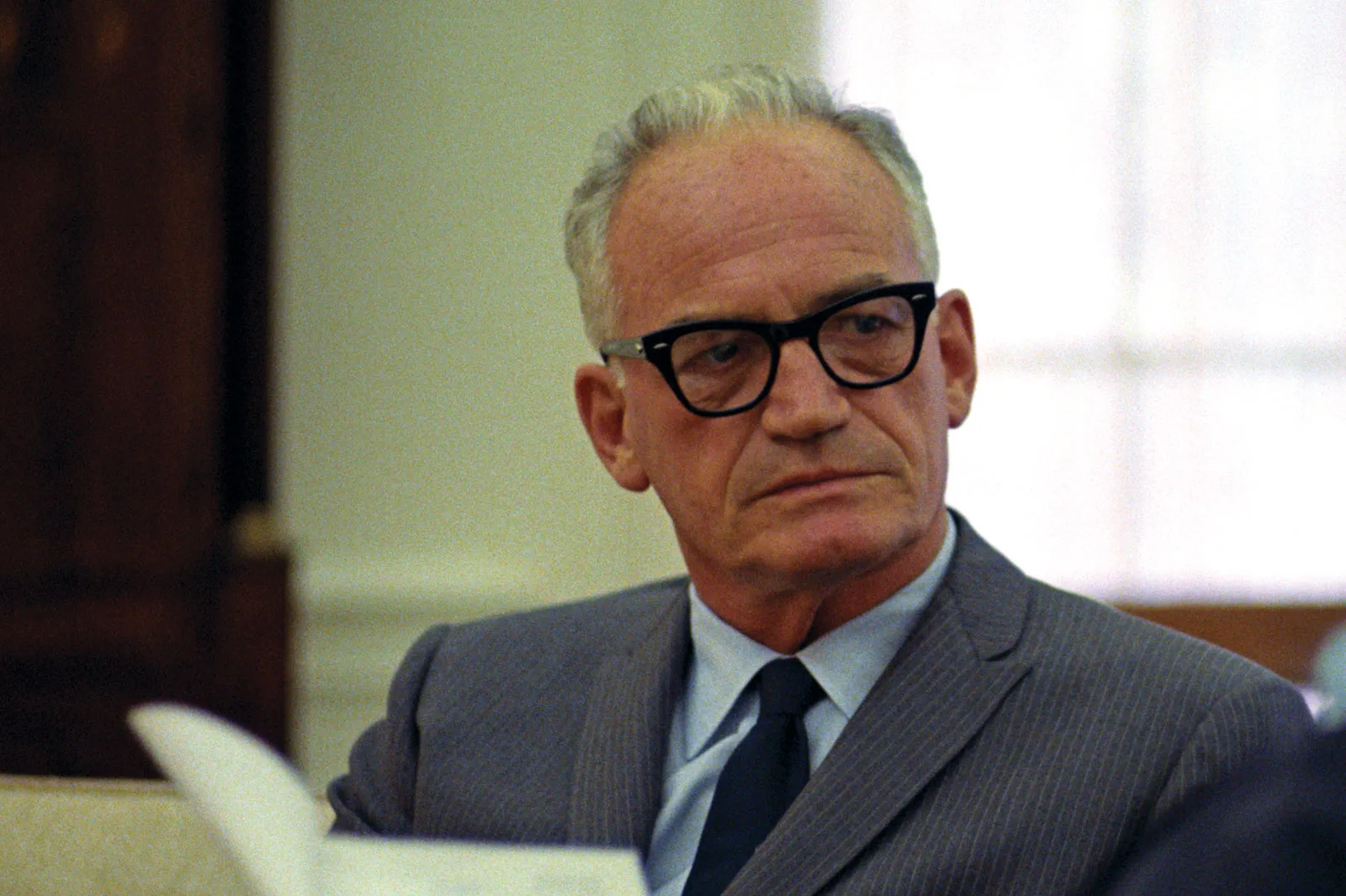
Senator Barry Goldwater (R-Ariz.)
Notably, all conservative Southern Democrats are against. Among legislators from the former Confederacy, only Republicans Edward Gurney of Florida and Howard Baker Jr. of Tennessee as well as Democrat Ralph Yarborough of Texas are in support. This vote also splits Cooper and Church, with John Sherman Cooper (R-Ky.) against and Frank Church (D-Idaho) for. Even the leadership of the parties is split: Majority Leader Mike Mansfield (D-Mont.) is for, while Majority Whip Ted Kennedy (D-Mass.) is against. Minority Leader Hugh Scott (R-Penn.) is for, while Minority Whip Robert Griffin (R-Mich.) is against.There is also a notable contingent of liberals against, including anti-war Democratic candidate Eugene McCarthy of Minnesota. The liberal critique of ending the draft, voiced most prominently by Senator Kennedy, is that the burden of the war ultimately fall upon the poor, as the wealthy youth were not regarded as likely to volunteer, and per the New York Times it likely tipped the balance against the measure (Rosenbaum). If it were not for the unity of Southern Democrats against, this vote would seem absolutely all over the place; 1972 presidential contender George McGovern (D-S.D.) votes for, 1984 contender Walter Mondale (D-Minn.) votes against, and 1996 presidential contender Bob Dole (R-Kan.) votes for. Furthermore, per DW-Nominate, the four most liberal senators are for this amendment while three of the four most conservative senators are for as well. President Nixon would eventually institute an all-volunteer army, but it would be on July 1, 1973, after the United States had agreed to make a gradual withdrawal from Vietnam.
References
Rosenbaum, D. (1970, August 26). Senate Bars Plan Designed to Bring Volunteer Army. The New York Times.
Retrieved from
To Amend H.R. 17123 So as to Provide for an All-Volunteer Military Service. Voteview.
Retrieved from
 Mad Politics: The Bizarre, Fascinating, and Unknown of American Political History