Rather recently, I have covered how Utah was not always the red state we think of it as. Indeed, their voters sent Elbert Thomas, a faithful New Dealer, to the Senate for three terms. The man who ended Thomas’s career was Wallace Foster Bennett (1898-1993). Born only two years after Utah’s admission as a state in Salt Lake City, this would always be home for him. Bennett was a Mormon and very close with their leadership. After all, he married the daughter of the LDS President Heber J. Grant. After service in World War I, Bennett earned his Bachelor of Arts and in 1920, he began his long career in business at his father’s company, Bennett’s Paint and Glass Company. In addition to heading up the company after his father’s death in 1938, he established a Ford dealership in the Bennett Motor Company and had numerous other leading positions in other businesses. He was active in the LDS Church, and even authored two books on the subject, Faith and Freedom (1950) and Why I am a Mormon (1958).
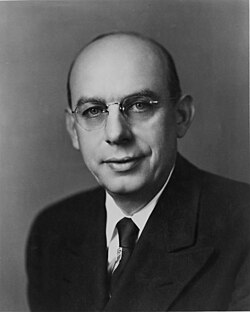
As one of Salt Lake City’s most prominent citizens, in 1949 he started his political career at the age of 51 by heading the National Association of Manufacturers. He followed this up by running against Democrat Elbert Thomas in 1950, running against his record and comparing his positions to those of communists, and was among the beneficiaries of the conservative atmosphere of that election year, winning by 8 points. That seat has not again had a Democratic occupant.
In office, Bennett supported investigating communists in the United States, but also cautioned against indulging in “personalities and propaganda” in the process, showing that he was not a fan of how Joseph McCarthy conducted himself. Indeed, he would be among the senators to vote his censure in 1954 (Bernick). Although Utah had quite a number of farmers, Bennett spoke in defense of the agricultural policies of Eisenhower’s Secretary of Agriculture, Ezra Taft Benson, which were moving agricultural policy in a free market direction. He did look out for Utah’s constituents in other ways, such as securing funding for the Central Utah Project, which although it took longer and perhaps spent more than he was comfortable with, it provides drinking water for residents of the Salt Lake Valley (Bernick). Bennett was a watchdog for free enterprise and opposed to inflationary policies. He was well-placed to address such issues as a member of the Senate Finance Committee, where he was regarded as an expert on economic issues. Although Bennett’s record was conservative, in 1958, he cast a controversial vote within the GOP when after he voted against killing the Anti-Preemption bill, he voted to kill it. The reason for this was Majority Leader Lyndon B. Johnson’s (D-Tex.) adept maneuvering. He had managed to get enough senators to either switch their votes or stay off the Senate floor so that if Bennett had voted against tabling it, the vote would have been tied and forced Vice President Nixon to cast a tie-breaking vote to table, as President Eisenhower opposed the Anti-Preemption bill (Kilpatrick). Such a vote from Nixon would have had potential to cause him difficulty among conservatives in the 1960 election. In 1959, Bennett voted for admitting Hawaii as a state, and reasoned that granting it statehood was part of pushing back against the rise of Asian communism (Bernick). During the 1960s, he would prove a consistent foe of major New Frontier and Great Society measures. He voted against aid to colleges, educational television, the Economic Opportunity Act, the Elementary and Secondary Education Act, and Medicare. His Democratic colleague, Frank Moss, noted “He was right straight up front with what he believed and didn’t believe” (L.A. Times). This earnest approach certainly was of help to him never losing an election, and he wasn’t afraid of taking an unpopular position. Bennett also was one of 19 senators to vote against the Partial Nuclear Test Ban Treaty in 1963. He did work with the Johnson Administration in getting the Coinage Act of 1965 passed.
On foreign aid, although Bennett could back spending cuts and supported anti-communist amendments, he was generally supportive of foreign aid measures. On civil rights, he voted for the Civil Rights Act of 1957, indeed all Republican senators who cast votes voted for it, but he also supported the Aiken-Anderson-Case Amendment to strike 14th Amendment implementation. Bennett did side with the Eisenhower Administration in opposing a jury trial amendment, which was regarded as weakening the bill. On the Civil Rights Act of 1964, there were reasons at the time that Bennett’s vote on the measure was doubtful. He had voted for both Sam Ervin’s (D-N.C.) and Robert Byrd’s (D-W.V.) amendments striking the employment discrimination and public accommodations section respectively and had voted “nay” on the critical vote to end the filibuster. However, Bennett was among the 28 Republicans to vote for passage. He followed up with a vote for the Voting Rights Act the next year.
During the Nixon Administration, Bennett continued his conservative record, and was a consistent supporter of the Nixon Administration’s approach on the Vietnam War. He also backed a few foreign aid measures during this time as well as bailing out Lockheed Martin. In 1972, Bennett was one of eight senators to vote against the Equal Rights Amendment. Well into his seventies, he opted not to run for another term in 1974, and resigned on December 20th to give his successor, Jake Garn, an edge in seniority. Bennett only sided with the liberal Americans for Democratic Action 8% of the time while he sided with the conservative Americans for Constitutional Action 85% of the time. His DW-Nominate score is a 0.447. In retirement, Bennett did not emphasize that he had been a senator. Indeed, regarded his four terms thusly, “That was just a job I did for a while. It is not who I am” (Bernick). Many Americans like to define themselves by what they do for a living, but Bennett saw himself outside of that. Bennett lived long enough to see his son, Robert, get elected to the Senate and attended his victory party in a wheelchair. Bennett died in his sleep shortly after a fall at his home on December 19, 1993 at the age of 95.
References
ADA Voting Records. Americans for Democratic Action.
Retrieved from
Bennett, Wallace Foster. Voteview.
Retrieved from
https://voteview.com/person/645/wallace-foster-bennett
Bernick, B. (1993, December 20). Wallace F. Bennett Dies in His Sleep. Deseret News.
https://www.deseret.com/1993/12/20/19082620/wallace-f-bennett-dies-in-his-sleep/
Kilpatrick, J.J. (1960, October 14). LBJ: Counterfeit Confederate. Human Events.
Wallace Bennett; Longtime GOP Utah Senator. (1993, December 20). Los Angeles Times.
Retrieved from
https://www.latimes.com/archives/la-xpm-1993-12-20-mn-3748-story.html
 Mad Politics: The Bizarre, Fascinating, and Unknown of American Political History