As I have written about before, Vermont used to not just be a solidly Republican state, but also a solidly conservative state. This declined over the years as more New Yorkers moved to Vermont and the politics shifted away from the politics of its favorite son president, Calvin Coolidge. One of the prominent Republicans who was part of this move away was Robert Stafford (1913-2006).
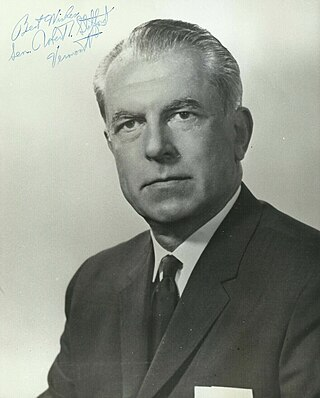
Stafford’s rise in state politics was in itself a sign that Vermont was a changing state. He rose up from deputy attorney general to being elected attorney general in 1954 and then elected lieutenant governor in 1956. That he moved up from lieutenant governor to governor in 1958 would have previously been considered a violation of the “Mountain Rule”, in which major statewide offices were alternated between the east and west sides of the Green Mountains. However, Vermonters identifying themselves as being of one side of the mountain or the other was declining. Another sign was that Stafford’s gubernatorial win was unusually narrow, only winning with 50.3% of the vote. Republican candidate Harold J. Arthur, a conservative, had lost his bid for the House that year to Democrat William Meyer, the first time this had happened since the Republican Party’s foundation. As governor, Stafford sought to make government more efficient while funding roads and providing scholarships for Vermonters who attended Vermont colleges.
In 1960, Stafford opted to challenge Meyer. William Meyer was a socialist who would later be a founder of the socialist Liberty Party that a young Bernie Sanders would join. Meyer’s stances for nuclear disarmament, halting of nuclear testing, and recognition of Red China were too much for Vermonters of the time and Stafford bested him by 14.5% in 1960. He proved a popular representative who while in the House was in the political center. Although Vermont voters strongly rejected Barry Goldwater’s candidacy in 1964, straight-ticket voting was not as prevalent in that time than it is today and Vermont voters knew that Stafford was a different sort of Republican than Goldwater; he was returned to office by over 15%.
Although Stafford had a reputation later in his career as an environmentalist, while in the House he voted against the 1963 Clean Air Act. However, he was from an early time a supporter of more federal funding for sewage plants to treat water pollution. Stafford also voted for a number of critical Great Society measures, including the 1964 Economic Opportunity Act, Medicare, and federal aid to education. However, Stafford also opposed repealing the “right to work” section of the Taft-Hartley Act and rent subsidies. Although he had sided with the conservative establishment when he opposed expanding the Rules Committee in 1961, in 1963 he voted for continuing this expansion. Stafford similarly voted against adopting the 21-Day rule in 1965 for discharging a bill from the Rules Committee but voted against repealing it in 1967. During the Nixon Administration, he voted for the 1970 Cooper-Church Amendment to delete funds for military forces in Cambodia but voted against the 1971 Nedzi-Whalen Amendment to halt funds for troops in Vietnam on January 1, 1972. If Stafford’s career had merely consisted of how he voted in the House, I wouldn’t have included him on the RINO list.
The Senate
On September 10, 1971, Senator Winston Prouty, who had preceded Stafford in the House, died of gastric cancer, and Stafford was appointed as his replacement and would win an election to complete his term. When in the Senate, Stafford was known for his advocacy of funding for education as well as previously mentioned for environmental protection. His record was increasingly liberal during the Nixon Administration. For instance, in 1974, Stafford only voted with the conservative Americans for Constitutional Action on 2 of 19 issues they counted for the Senate that year. Although he was quite the departure from the politics of Calvin Coolidge, he was about as vocal as Coolidge, which made journalist Philip Shabecoff (1988) of the New York Times regard him as possibly “the worst interview” in Washington. Stafford did tend to support military spending but was also quite internationalist, and this included his votes for the Panama Canal Treaties in 1978. The following year, he voted for the creation of the Department of Education.
During the Reagan Administration, although he gave support to a number of its early initiatives as well as initially supporting funding for arms for the Contras, he often butted heads on social and environmental policy. Stafford also played a key role in overriding President Reagan’s veto of a stronger Water Pollution Act. He commented on the matter, “I didn’t particularly enjoy finding myself at odds with the President, but it had to be done. I was not popular at the White House” (Shabecoff). Indeed, he proved challenging for the Reagan Administration as the chairman of the Senate Environment and Public Works Committee from 1981 to 1987. However, when Stafford supported Reagan it could prove challenging for him; in March 1984, a group of 44 protestors known as Winooski 44 held a three-day sit-in protest in his Winooski office over his support of selling arms to the Contras. After this, Stafford would vote for key proposals curbing aid to the Contras.
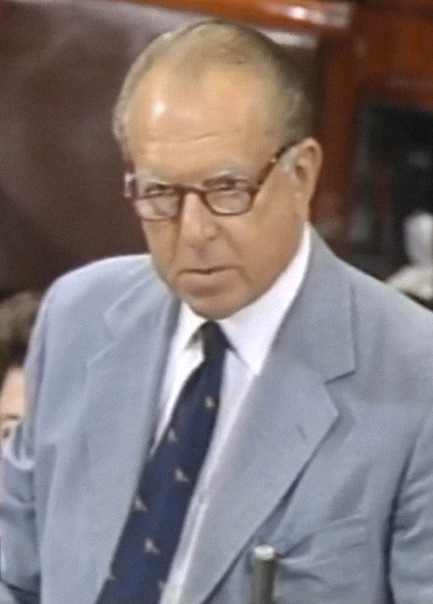
Stafford, 1986
Perhaps the thing Robert Stafford is most famous for is the creation of the Stafford Loan, which was effective from 1988 to 2010 and provided subsidized and un-subsidized low-interest loans for college students. It has since been replaced with the Ford Federal Direct Student Loan Program. He also sponsored the Disaster Relief and Emergency Assistance Act of 1988 (aka the Stafford Act), which presidents use in cases of natural disasters and that both Presidents Trump and Biden used during the COVID-19 pandemic. By the end of the Reagan years, Stafford was voting the liberal position most of the time. He agreed with ADA’s position on 16 of 20 votes in 1987 and 16 of 19 votes in 1988. Stafford’s DW-Nominate score was a 0.055, while he sided with ACA’s position 36% of the time from 1961 to 1984 and ADA’s position 55% of the time.
After his retirement, Stafford wouldn’t offer much commentary on the issues, although he gave the message that Republican Jack McMullen was too unfamiliar with Vermont and unknown to Vermonters to run for the Senate in 1998 and expressed support for the state’s legalization of same-sex civil unions in 2000. Stafford died on December 23, 2006 at the age of 93. On the year of his death, 14 million Stafford loans were granted (NBC News).
References
ADA Voting Records. Americans for Democratic Action.
Retrieved from
Former Vermont Sen. Robert Stafford dies at 93. NBC News.
Retrieved from
https://www.nbcnews.com/id/wbna16338752
Shabecoff, P. (1988, December 28). Washington Talk: The Senate; Quiet Vermonter Who Makes His Words Count. The New York Times.
Retrieved from
Stafford, Robert Theodore. Voteview.
Retrieved from
 Mad Politics: The Bizarre, Fascinating, and Unknown of American Political History