When you think of Democratic states, Utah is not a name that comes to mind, but the state was not always the Republican bastion it is today. Indeed, in the first presidential election it participated in its voters overwhelmingly voted for Democrat William Jennings Bryan given his stance for free coinage of silver. Democrats could in many cases win handily statewide, and its longest-serving senator was William Henry King (1863-1949).
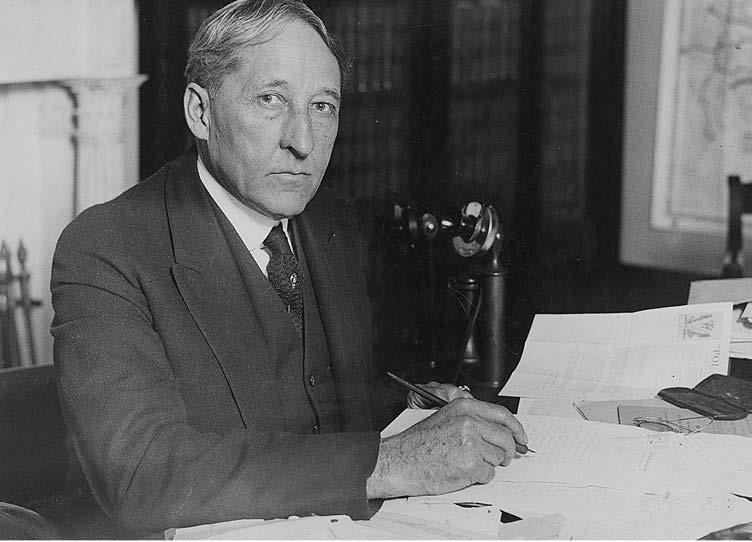
Born in the Utah territory, King’s career began all the way back in the early days of statehood. In 1894, President Grover Cleveland tapped King to be an associate justice of the Supreme Court of the Utah Territory. He was the first person to serve a full term in the House from Utah, succeeding Republican Clarence E. Allen in the 1896 election. In 1898, the Democrats nominated Brigham H. Roberts, who won the seat but there was a problem: Roberts was a polygamist. This was not something that Congress, which had refused to admit Utah until Mormons dropped polygamy, could accept and he was not seated. King was elected instead to complete his term. By 1900, however, Republicans had gotten much more popular as the economy had recovered by this time and the Spanish-American War was a resounding military victory, and he lost reelection to conservative Republican George Sutherland. King’s effort to get back into Congress in 1902 was rebuffed, and indeed Democrats had a tough time in Utah for a while. He was also the pick of Democrats for the Senate in 1905 and 1909, but to no avail. Indeed, the voters of the state opted to reelect William Howard Taft in 1912, one of only two states to do so. However, among numerous people and groups President Woodrow Wilson became increasingly popular, and this was most dramatically true in Utah. In 1916, King easily defeated incumbent Sutherland for reelection that came with Wilson’s resounding win in the state.
Although King was often regarded as a progressive, his record was actually quite independent and he could be fiscally conservative. From 1918 to 1919, he served on the Overman Committee, which investigated foreign propaganda and subversion, which was the first committee to cover communism in its investigations. King would be a staunch foe of communism throughout his career and he was also a staunch supporter of the Versailles Treaty. Indeed, he would be consistent in support for his party on foreign policy. During the Republican administrations of the 1920s, King opposed some key Republican proposals, such as high tariffs, but his fiscal conservatism showed in his votes to uphold presidential vetoes of veterans bonus bills. He would also do so during the Roosevelt Administration. King was strongly opposed to American interventions in Latin America, and was recognized by the government of Haiti for his efforts (Sillitoe). Interestingly, this was quite a turnaround for Haiti, as the government had previously thought him as “undesirable” (Hill). He was sufficiently popular to not only survive the 1928 election, but win by nearly 12 points while Herbert Hoover won the state by 8 points.
King initially supported the New Deal, voting for most key measures such as the National Industrial Recovery Act, the Tennessee Valley Authority, and the Agricultural Adjustment Act. In 1934, he handily won reelection as a supporter of FDR and the New Deal. However, King started having significant disagreements with the Roosevelt Administration. He opposed the death sentence clause of the Public Utilities Holding Company bill and voted against the Bituminous Coal Act in 1935. By 1936, he could be counted among the foes of FDR’s domestic policy, labeling himself a “Constitutional Democrat” (Sillitoe). In 1937, Senate Majority leader Joseph Robinson (D-Ark.) dropped dead from a heart attack, and the top two candidates to succeed him were Alben W. Barkley of Kentucky and Pat Harrison of Mississippi. Although both were known as friends of the New Deal, the fact that Harrison was the chairman of the Senate Appropriations Committee and that King was next in line was a motivating factor for Democrats to prefer Barkley. Ultimately, Harrison lost the post by only one vote. King remained loyal to FDR on foreign policy, but his opposition to the New Deal was not playing well in Utah, which at the time was strongly supportive of both FDR and the New Deal. Due to both his age of 77 and his stance as a dissenter, he was vulnerable to a challenge and he got one in Abe Murdock, the 1st district representative who was 30 years his junior and who pledged to be a 100% New Dealer. Indeed, Murdock almost never disagreed with Roosevelt. In the Democratic primary, Murdock prevailed on a 2-1 margin, which ended King’s career. Although he was expected to lose the primary, the high margin of his loss was unexpected (Hill). King’s DW-Nominate score stands at a -0.224, accounting for his earlier progressiveness but also his turn against the New Deal. The Salt Lake Tribune wrote in praise of King’s career and considered his loss “less a reflection on him than a tribute to his successor and an evidence of the change in political philosophies of the people” (Hill). He resumed practicing law until 1947, when he chose to retire to Utah. King did not have long to enjoy his retirement, as in 1948 he suffered a heart attack and his health declined until his death on November 27, 1949. King’s son, David, would serve three terms in the House.
References
King, William Henry. Voteview.
Retrieved from
https://voteview.com/person/5274/william-henry-king
Hill, R. (2024, March 31). Utah Maverick: William H. King. The Knoxville Focus.
Retrieved from
Sillitoe, J. (1994). William H. King. Utah History Encyclopedia.
Retrieved from
 Mad Politics: The Bizarre, Fascinating, and Unknown of American Political History