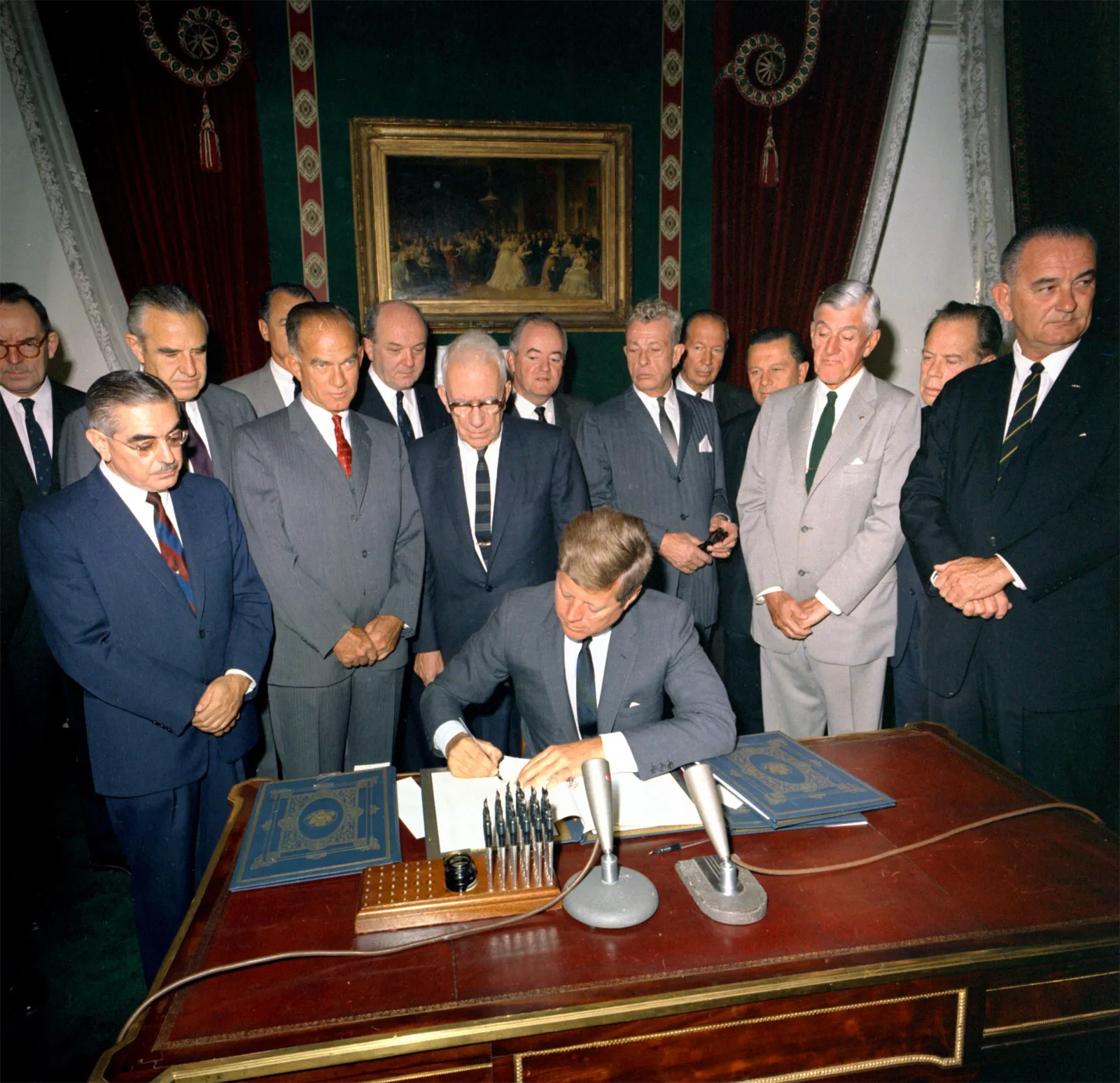
President Donald Trump recently caused a stir (which is pretty much a daily occurrence now) when he announced the resumption of nuclear weapons testing. Such an announcement made people think at minimum of underground testing or even more dramatic, above-ground testing, the latter which the US hasn’t done since Operation Dominic Tightrope on November 4, 1962. His energy secretary has since stated that these tests would be non-explosive, rather testing to make sure our weapons remain effective, and indeed what “nuclear testing” could mean does vary. This little controversy reminds me of our first ever nuclear arms limitation treaty with the Soviets, which was championed by President Kennedy. This treaty banned testing in the atmosphere, outer space, and underwater. Today’s post is about the process of getting this historic treaty enacted.
In 1961, President Kennedy proposed and Congress enacted the Arms Control and Disarmament Act of 1961, which created the Arms Control and Disarmament Agency. This was the first agency dedicated to limiting the proliferation of nuclear weapons. Although President Kennedy had started on the legislative of slowing down the arms race, it was President Eisenhower who had first sought to open a discussion on a test ban in 1958, which was followed by a Soviet announcement that they were stopping tests. The push for this effort was bolstered by an expert finding that nuclear weapons tests could be detected, thus making a treaty easily enforceable, and discussions began between the US, USSR, and Great Britain. On August 5, 1963, the US, USSR, and Great Britain signed the Partial Nuclear Test Ban Treaty. Although the Democrats had 68 senators to ratify thus by modern understanding of politics no Republican support was needed, the reality of the politics of the 1960s was that Democrats had a considerable moderate to conservative wing, most of them from this time being in the South. On the plus side for the Democrats, Republicans also had a moderate to liberal wing and this wing was stronger in the Senate than in the House. To ensure that 2/3’s vote was secured, Republican support was necessary, and what’s more, it was good for sustaining the idea of bipartisan postwar foreign policy.
Winning Over Dirksen
Although Republicans never held a majority in either legislative chamber of Congress during the 1960s, Minority Leader Everett Dirksen (R-Ill.) punched a bit above his weight in power, as he could not only sway the votes of Republicans but also conservative Democrats. Thus, winning his support for measures that required 2/3’s of the vote was rather crucial, and Dirksen relished in this role. Dirksen initially expressed skepticism, but the Joint Chiefs of Staff persuaded him to support the treaty (CQ Almanac). It also didn’t hurt in persuading him and other Republicans that both former President Eisenhower and former Vice President Richard Nixon publicly announced their support. Dirksen endorsed the treaty and corralled other Republicans in favor because to not do so would “place us in an awkward and difficult position” and that to do so would counter Soviet propaganda about a warlike US, adding that it would “divest the unremitting effort to paint us as warmongers before the nations of the world and would lose much of its force” (CQ Almanac).
Support
The Democratic Senate leadership as well as the previously mentioned Republican leadership favored, thus you could say the internationalist establishment favored the treaty (or as some modern-day readers might say, “globalist”). This position also had the support of some prominent scientists. Dr. Harold Brown, chief civilian scientist of the Defense Department and Dr. N.E. Bradbury, head of Los Alamos Scientific Laboratory, supported (CQ Almanac). Best yet for Kennedy was not the support of scientists or politicians, but the American public. A Gallup poll of the time revealed that Americans supported the treaty 63-17 (CQ Almanac). The Senate outcome would not be that much different, but for the sake of interest, let’s look at the opposition.
Opposition
One of the most prominent opponents was Dr. Edward Teller, the lead scientist in the development of the Hydrogen Bomb, who believed, along with other Senate opponents, that the treaty would give an edge to the Soviets. He was joined by Dr. John S. Foster who headed the Lawrence Radiation Laboratory, who shared Dr. Teller’s concerns. On the more political side, conservative Reverend Carl McIntire spoke against it as did Stanley M. Andrews, who headed Liberty Lobby’s “Americans for National Security”.
The Tower-Long Reservation
Although several amendments were proposed to the treaty, the one that got the most support was sponsored by John Tower (R-Tex.) and Russell Long (D-La.), both who would vote against the treaty, that would add an “understanding” (opponents claimed it was actually a reservation) that the treaty would not serve to bar the use of nuclear weapons in armed conflicts. Majority Leader Mike Mansfield (D-Mont.) managed to successfully table the proposal 61-33 on September 23rd. Although Democrats voted to table 46-16, the Republican vote was 15-17. The rejection of this understanding was not a dealbreaker, as on that same day the treaty was approved on a vote of 80-19, 14 votes above what was needed for treaties.
Dirksen was able to deliver all but eight of his fellow Republicans on this matter, and of the Democratic dissenters nine were from the South. 1964 presidential candidate Barry Goldwater of Arizona was among the dissenters, and this would not be the last time, nor the most famous time, he dissented from Dirksen on a major bipartisan issue. Perhaps the most unusual dissenter was Maine’s Margaret Chase Smith, who was a bona fide centrist. Another notable dissenter was West Virginia’s Robert Byrd, who would also differ from Democratic leadership on the same monumental issue Goldwater did with Republican leadership (as you might have guessed, it was the Civil Rights Act of 1964). Interestingly, Byrd was around for the debate on the Comprehensive Test Ban Treaty in 1999, in which he voted “present”. That debate was much different in that all other Democrats voted for while only four Republicans crossed the aisle. Although the USSR and Great Britain had signed on to the treaty, France and China declined to do so. President Kennedy himself acknowledged that the treaty was not a panacea for the troubles of the Cold War, stating that it was a “victory for mankind” but “not the millennium” and that “it will not resolve all conflicts, or cause the Communists to forego their ambitions, or eliminate the dangers of war” and “it will not reduce our need for arms or allies or programs of assistance to others. But it is an important first step– a step toward peace – a step toward reason – a step away from war” (CQ Almanac 1963).
References
ADA Voting Records. (1963). Americans for Democratic Action.
Retrieved from
Nuclear Test Ban Treaty. CQ Almanac 1963.
Retrieved from
https://library.cqpress.com/cqalmanac/document.php?id=cqal63-1317011#_
Shelley, T. (2022, October 18). How a bipartisan foreign policy approach helped stave off a nuclear crisis six decades ago. WCBU.
Retrieved from
The Limited Test Ban Treaty, 1963. Department of State Office of the Historian.
Retrieved from
 Mad Politics: The Bizarre, Fascinating, and Unknown of American Political History