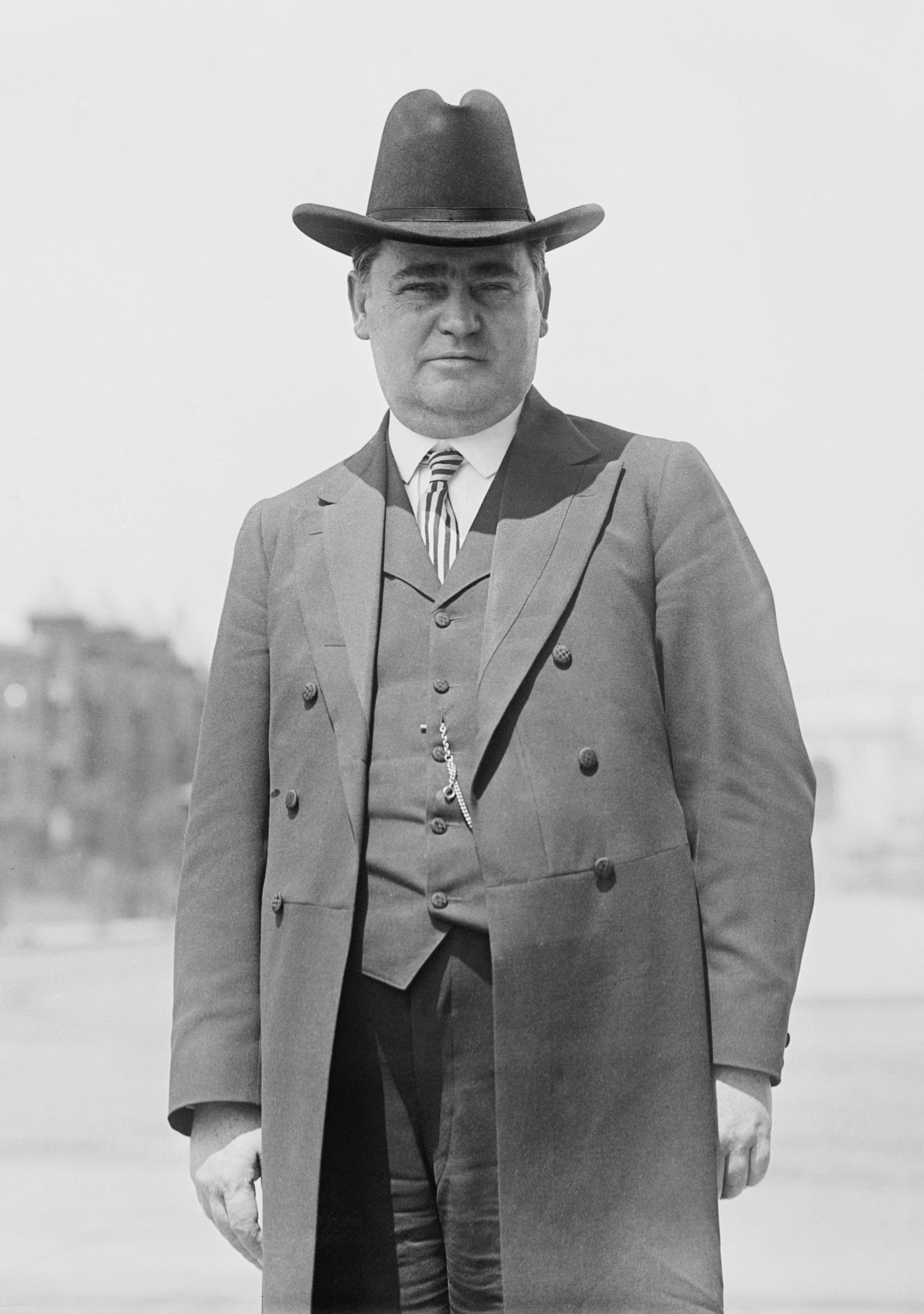
Democrats were largely out of power in the late 19th century and early 20th century, and one figure who became prominent in the time of Republican dominance from 1895 to 1913 was Joseph Weldon Bailey (1862-1929). Born in Crystal Springs, Mississippi, Bailey got his start in politics after earning his law degree, and he quickly waded into controversy. Indeed, his career would be one full of controversy. In January 1884, Bailey was called to testify by the Senate over an allegation that he was among the leaders of a faction of the Democratic Party that had engaged in violent intimidation of Republican voters in the 1883 local elections, but he wouldn’t show as he refused to perjure himself (Holcomb, Bailey). Nothing came of this matter, and in 1885 he married and moved to Texas, where he continued his legal and political career.
Congressman Bailey
1890 was an excellent year for Democrats, and among the Congressional freshmen was Bailey. He quickly stood out as a talented parliamentarian as well as for his powerful oratory which he employed to advocate for Jeffersonian democracy, for state’s rights, against protective tariffs, against American expansionism, for free coinage of silver, and for increased railroad regulation. Bailey became a rising star in the Democratic Party, and this as well as his strong support for the candidacy of William Jennings Bryan in 1896 got him the post of House Minority Leader in 1897, at the mere age of 34. Few in politics have had as meteoric of a rise as that of Bailey. A strong partisan Democrat, Bailey had some trouble unifying the Democratic caucus and he controversially held that it was unconstitutional for members of Congress to accept commissions to serve in the army while serving as members of Congress, a cause that he couldn’t get a majority in his own party to support. After this loss, Bailey announced that he would not be a candidate for party leader. In 1901, he was elected to the Senate, replacing the retiring Horace Chilton.
Senator Bailey
Bailey continued to stand for the causes he supported while in the House, and although he seemed promising to lead there too, his reputation suffered after he, a fairly large man, lunged at Senator Albert Beveridge (R-Ind.) on the Senate floor in response to his heckling and threatened him with serious bodily harm. Although Bailey supported numerous causes that would place him on the political left of his time, he started to have troubles with progressives when he was one of the senators who muckraker David Graham Phillips accused of carrying water for private interests in his 1906 Cosmopolitan expose, Treason of the Senate. Although Bailey’s reputation survived this expose, it was nonetheless true that he had accepted hefty fees for legal services from multiple prominent businesses and individuals, and this expose would not be the only one of his problems.
Bailey considered himself a staunch Jeffersonian Democrat, and these beliefs from time to time placed him at odds with progressive causes. For example, many progressives supported Prohibition, and indeed Bailey supported amending the Texas Constitution in 1887 to enact it, but he opposed amending the U.S. Constitution for Prohibition. Bailey also found himself strongly against initiative, referendum, and recall. His opposition to such reform measures was the reason that he and two other Democrats joined President Taft and conservative Republicans in opposition to the admission of Arizona as the state had such provisions in its constitution. President Taft would accept admission of Arizona once the most offensive of the provisions to him, the recall of judges, was removed. Bailey was so floored that all but two of his fellow Democrats supported Arizona’s strongly progressive constitution that he resigned the Senate on March 4, 1911, but he withdrew it before the day was out on the urgings of Texas’s governor as well as the state legislature (The New York Times, 1911). Bailey also, contrary to most in his party, would support the seatings of Senators William Lorimer (R-Ill.) and Isaac Stephenson (R-Wis.), who faced controversies about the natures of their elections. Lorimer, the “blonde boss of Chicago”, would be denied his seat while Stephenson kept his. Bailey also proved an immovable foe of women’s suffrage, again on Jeffersonian grounds. There was also certainly a racial element in this opposition, and many Southerners would oppose women’s suffrage because the 19th Amendment provided for women’s suffrage regardless of race. Bailey would still support some positions that aligned with progressive pushes, such as opposition to high protective tariffs, a tax on corporations, and supporting direct election of senators. Bailey, however, suffered serious reputational damage when he was alleged to have illegally represented Waters-Pierce Oil Company while they were being charged with anti-trust violations in 1900. He had managed to secure Waters-Pierce being able to do business in Texas as an independent corporation, but in 1906 a lawsuit by the state of Missouri revealed that Waters-Pierce was still a subsidiary of Standard Oil, and their permit to do business in Texas was canceled with a $1,623,000 fine which was sustained by the Supreme Court (Holcomb, Waters-Pierce). Matters got worse for Bailey as not all had been disclosed about Bailey’s relationship with Waters-Pierce. Although he had officially not received a fee for his services from Waters-Pierce, it was revealed that he had not disclosed a $13,300 loan from the company at the time (Holcomb, Waters-Pierce). Support for Bailey getting another term was deteriorating, and on January 3, 1913, he resigned, being succeeded by Congressman Morris Sheppard, who was more willing to support emerging progressive causes. Bailey’s rise had come at a young age with his election to Congress at 28, and his political career was over at 50. The Marxist theoretician Daniel De Leon (1913) wrote of him upon his exit, “…Joseph Weldon Bailey, whose voice once rang sympathetically for the underdog in society, now earns his last Judas pence by acting as a mouthpiece of and Senator for the State of Oil”. Although Bailey had a bit of a conservative turn later in his career, his record beforehand shows in his DW-Nominate score, which was a -0.63. He became increasingly antagonistic to the prevailing Democratic politics and claimed that President Wilson was a “socialist”. As The New York Times (1929) noted in their obituary of him that he was “not tolerant of party opinion which seemed to him veering toward Republicanism or socialism”. Although Bailey attempted a comeback in 1920 by running for governor, Texas Democrats were no longer in the mood for him, preferring progressive Pat M. Neff, a strong supporter of Prohibition.
In his final years, he would practice law in Dallas, and on April 13, 1929, Bailey delivered an argument in a case in Sherman, Texas, and sat down. He never stood back up, having suffered a fatal heart attack. Bailey’s son and namesake, Joseph Weldon Bailey, Jr., would also have a political career, serving a term in the House at the start of the Roosevelt Administration in which he would oppose some New Deal measures and would endorse Republican Wendell Willkie in 1940 (Melugin). Bailey’s change later in his career as well as his son coming out against FDR makes me consider the elder Bailey to be one of the earliest indicators of the future shift of Texas politics. I think part of it was that progressive means were increasingly differing from traditional Jeffersonianism, but Bailey did become more of a creature of the establishment. Something I must note that I find curious about Bailey is that Sam Rayburn, staunch New Dealer and the leader of the House Democrats from 1940 to 1961 as well as their longest serving House speaker, was a lifelong friend and personal hero (Holcomb, Bailey). Rayburn, who I have examined before, strikes me as more able to adjust his views on the means to attain Jeffersonian ends than Bailey was.
References
Bailey, Joseph Weldon. Voteview.
Retrieved from
https://voteview.com/person/347/joseph-weldon-bailey
Bailey Resigns, Then Reconsiders. (1911, March 5). The New York Times.
Retrieved from
De Leon, Daniel. (1913, January 10). Joseph Weldon Bailey. Daily People, 13(194).
Retrieved from
Holcomb, B.C. (1952). Joseph Weldon Bailey: A Political Biography. Texas State Historical Association.
Retrieved from
https://www.tshaonline.org/handbook/entries/bailey-joseph-weldon
Holcomb, B.C. (1952). The Waters-Pierce Case: A Landmark Antitrust Suit in Texas. Texas State Historical Association.
Retrieved from
https://www.tshaonline.org/handbook/entries/waters-pierce-case
Joseph W. Bailey. (1929, April 15). The New York Times.
Retrieved from
Melugin, R.W. (1952). Joseph Weldon Bailey Jr.: A Legacy in Texas Politics. Texas State Historical Association.
Retrieved fromhttps://www.tshaonline.org/handbook/entries/bailey-joseph-weldon-jr
 Mad Politics: The Bizarre, Fascinating, and Unknown of American Political History