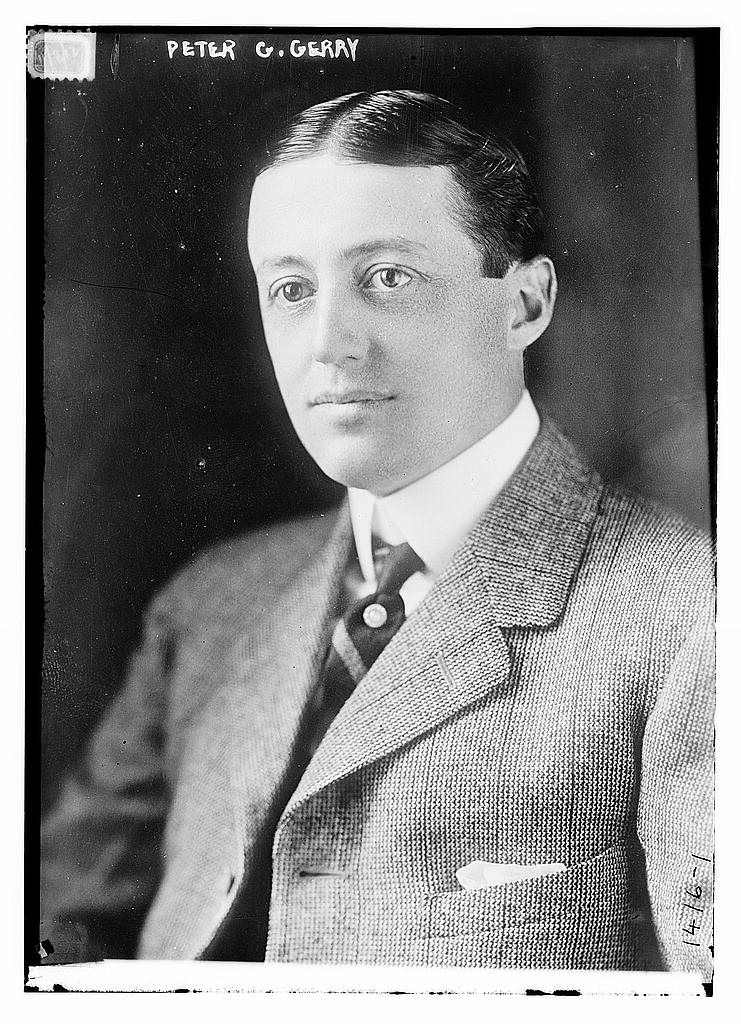
Peter G. Gerry was a clear beneficiary of the 17th Amendment. Had it not been enacted, Republican incumbent Henry Lippitt would have been a shoo-in for reelection in 1916 given the composition of the state legislature.
Every once in a blue moon we will hear a conservative call for the return of election of senators by state legislatures, although there will be no serious concerted movement towards this end, as it would require a constitutional change, and there is only one amendment that has ever been repealed in American history. After the Senate adopted the 17th Amendment, pushed strongly by progressives, it was ratified in 1913. Thus, the first Senate elections that would fall under the popular vote were in 1914. A question that came to my mind was did this have a significant ideological impact in the first elections?
In order to make this determination, I had to find out what party controlled the legislatures of these states, something that was a bit more difficult to accomplish than you might think and involved a mix of finding out who state House speakers were and who Senate presidents or pro tems were through Wikipedia or sources provided by state governments. Although it was by and large true that the voters of the states voted in the same party direction as their state legislatures would have, it is also true that the differences happened primarily in one direction: towards the Democrats. The only case I could find in which this arrangement benefited Republicans was the 1916 election in Maryland. A borderline case was the 1916 election in Delaware, which was won by Democrat Josiah O. Wolcott. The state House was Democratic, but the Senate was Republican at the time they would have been able to vote on a senator. Thus, whether the victor would have been a Democrat or Republican under the old rules is up to conjecture. However, I have my doubts that Republican incumbent Henry du Pont would have survived this process given that whoever got in would have likely been a compromise candidate, and it is unlikely that du Pont was someone that Democrats would have agreed to.
The 1914 Midterm: The Popular Vote Has Its Impact
Despite 1914 being a good midterm for Republicans in the House, the 17th Amendment resulted in Republicans losing rather than winning seats in that chamber. Democratic gains attributable to the 17th Amendment include the elections of James Phelan in California, Charles Thomas in Colorado, Francis Newlands in Nevada, George Chamberlain in Oregon, Edwin Johnson in South Dakota, and Paul Husting in Wisconsin. Had Senate elections remained with state legislatures, Republicans would have had a net gain of 3 rather than a net loss of 3. There is also a question surrounding the election in Illinois, as Republican Lawrence Sherman prevails, but the Illinois legislature is divided. Thus, whether Republicans would have won with the old system in this case is questionable. Also of issue in this is that the Progressive Party was running candidates and thus splitting elections for Republicans. Had the Progressive Party been taken out of the equation, it is hard to say what the results would have been.
The 1916 Midterms:
The 1916 midterms resulted in a net gain of 2 for Democrats because of the 17th Amendment. They achieved what they couldn’t in state legislatures with Andrieus Jones of New Mexico, Peter Gerry of Rhode Island, and John B. Kendrick of Wyoming, and only possibly Josiah O. Wolcott in Delaware given the divided legislature. Republicans made their gain with Maryland’s Joseph France.
The 1918 Midterms:
The impact of the 1918 midterms was +2 for Democrats in Massachusetts with David I. Walsh and Montana with Thomas J. Walsh and +1 in a special election in Idaho with John F. Nugent.
The 17th Amendment had an intention as well as its impact, that was at least in part to increase the power of progressives (in this case it was Wilsonian progressives). However, it did not turn out of office some of the conservatives proponents most wanted out, such as Republican leader Jacob Gallinger of New Hampshire and Pennsylvania’s Republican boss Boies Penrose in 1914. Indeed, although the latter had opposed the change, he found himself having an easier time with voters than his fellow politicians. After yet another win in 1920, he said to a reformer friend, “Give me the People, every time! Look at me! No legislature would ever have dared to elect me in the Senate, not even at Harrisburg. But the People, the dear People, elected me by a bigger majority than my opponent’s total vote of half a million. You and your ‘reformer’ friends thought direct election would turn men like me out of the Senate! Give me the People, every time!” (Kennedy)
References
Kennedy, J.F. (1956, February 21). Remarks of Senator John F. Kennedy at the New York Herald Tribune Luncheon. New York, New York. John F. Kennedy Presidential Library and Museum.
Retrieved from
 Mad Politics: The Bizarre, Fascinating, and Unknown of American Political History