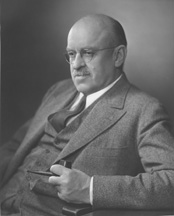
Although Bernie Sanders is actually an Independent, the truth is that he mostly votes with the Democrats. One of Vermont’s most independent-minded men of yesteryear was Republican Ralph Flanders (1880-1970). Although he did not have the highest education, having only been through public school, he made himself a success in business, specifically the manufacturing of machine tools and even had several patents through his innovations. Thus, Flanders was a prominent citizen of Vermont as well as an active Republican. During the 1930s, he held multiple government positions, including the Business Advisory Council and the industrial advisory board of the National Recovery Administration. In the former post, he opposed the imposition of an excess profits tax as serving to limit investment and in the latter opposed a requirement that businesses cut worker hours by 10% and raise wages by 10% for spreading out employment (Flanders, 179-180, 175-178). He would later be tapped to state positions by Governor George Aiken as well as serve on the boards of multiple corporations.
Flanders at first tried to win the Republican nomination for the Senate in 1940, made vacant by the death of Ernest W. Gibson. His battle was uphill as it was against Governor George Aiken, who was popular. The campaign became rather nasty, with Aiken’s side accusing Flanders of selling arms to Nazi Germany while Flanders’ campaign held that Aiken was excessively influenced by a pretty 24-year-old administrative assistant who was hungry for power (Porter & Terry). However, Flanders made a key mistake when he had a picture taken of himself in a suit holding a piglet. This is the picture:
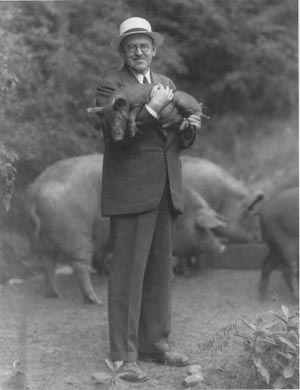
This picture gave Vermonters, many who were farmers, the impression that Flanders lacked sense as he was wearing his Sunday best, and it contributed to his loss in the primary by about 10 points. From 1941 to 1946, he would serve on the Federal Reserve Board of Boston and from 1944 to 1946, he would be its president. Under his leadership the board would help establish the Boston Port Authority to help revitalize New England’s shipping industry (Flanders, 187). Flanders would get another opportunity at the Senate with the resignation of Warren Austin in 1946 to accept the post of Ambassador to the United Nations. He ran a better campaign this time and was elected. Flanders was in many ways like his predecessor in that he was an internationalist but also, largely domestically conservative particularly fiscally, although he did make some exceptions. For instance, he opposed the Knowland Amendment to the 1950 Social Security legislation which limited federal authority for determining the standards of unemployment compensation and he supported a 1950 measure to make it easier to procure credit for housing co-ops. Nonetheless, Flanders’ more favorable record on issues impacting business, such as his opposition to extending rent control in 1950 and support for legalizing “basing point” pricing (allow firms to charge base price as well as shipping costs) made Vermont businessmen much prefer him to his colleague George Aiken, a maverick who supported a lot of President Truman’s domestic policies. For foreign policy, not only did he support the Marshall Plan and aid to Greece and Turkey but also Point IV aid to poor nations in 1950 and most notably against the Bricker Amendment in 1954, which if adopted would have placed substantial limitations on the president’s ability to make executive agreements.
Ralph Flanders vs. Joseph McCarthy
Although Flanders supported several anti-communist measures and was not one of the Republican senators who joined Margaret Chase Smith (R-Me.) in her 1950 “Declaration of Conscience” against McCarthy’s methods, he increasingly came to regard them as objectionable and made his displeasure known during the Eisenhower Administration. Flanders had developed a great respect for senatorial courtesy, and he saw McCarthy as repeatedly violating the spirit of the rules of such courtesy (U.S. Senate). He came to vote against McCarthy’s pushes, such as his effort against the confirmation of Charles Bohlen as Ambassador to the USSR (the nomination was overwhelmingly approved). Another vote that was indicative of Flanders’ opposition to McCarthy was his pair against the confirmation of McCarthy supporter Robert E. Lee to the Federal Communications Commission in 1954. Among Republicans, only George Aiken of Vermont and Margaret Chase Smith of Maine joined him in his objection. On June 11th, Flanders introduced the resolution to censure Joseph McCarthy on numerous grounds, which would end up including McCarthy’s contempt for the committee looking into censuring him. His effort was quietly supported by President Eisenhower, who was sick of having to deal with McCarthy, and he was censured 67-22, with all present Democrats voting for and Republicans split evenly. He would have likely avoided censure if he had issued an apology for his behavior and not called the Democratic Party the “party of treason”. McCarthy’s influence dwindled after the censure, and although nationally celebrated for his role, the reaction in Vermont was “sour” (Porter & Terry).
Flanders During the Eisenhower Administration
During the Eisenhower Administration, Flanders seemed to move to the right on domestic policy and continued his support for increasing foreign aid. However, he also strongly opposed foreign aid for communist nations, including Yugoslavia and Soviet satellites. On economic issues, he took a market approach, including supporting stripping the Federal Power Commission of the authority to regulate the price of oil and gas and supporting flexible price supports (price floors) for agriculture. Flanders also supported most efforts to curb organized labor’s power in 1958 with revelations of union corruption from the McClellan Committee. On civil rights, Flanders was mostly favorable. He had supported ending debate on fair employment practices legislation in 1950 and opposed a Southern effort to compromise army desegregation as well as voted for the Civil Rights Act of 1957 and against the jury trial amendment added to it. However, Flanders also supported the Aiken-Anderson-Case Amendment, which denied the attorney general authority to initiate lawsuits to enforce the 14th Amendment. By 1958, he was 78 years old and ready to hang up his hat. Flanders was succeeded by Congressman Winston Prouty. The most reliable assessments of him place him from moderate to moderately conservative. He agreed with the liberal Americans for Democratic Action 35% of the time, the conservative Americans for Constitutional Action 77% of the time from 1955 to 1958, and his DW-Nominate score was a 0.175. Flanders wrote and published his memoirs in 1961, titled simply, Senator from Vermont. He died on February 19, 1970, at the age of 89.
References
ADA Voting Records. Americans for Democratic Action.
Retrieved from
Flanders, Ralph Edward. Voteview.
https://voteview.com/person/3206/ralph-edward-flanders
Flanders, R.E. (1961). Senator from Vermont. Boston, MA: Little, Brown.
Idea of the Senate. U.S. Senate.
Retrieved from
https://www.senate.gov/about/origins-foundations/idea-of-the-senate/1961Flanders.htm
Porter, B. & Terry, S.C. (1990, September 9). Down & Dirty – The Aiken-Flanders Primary of 1940. Vermont Sunday Magazine, Rutland Herald and Barre-Montpelier Times Argus.
 Mad Politics: The Bizarre, Fascinating, and Unknown of American Political History