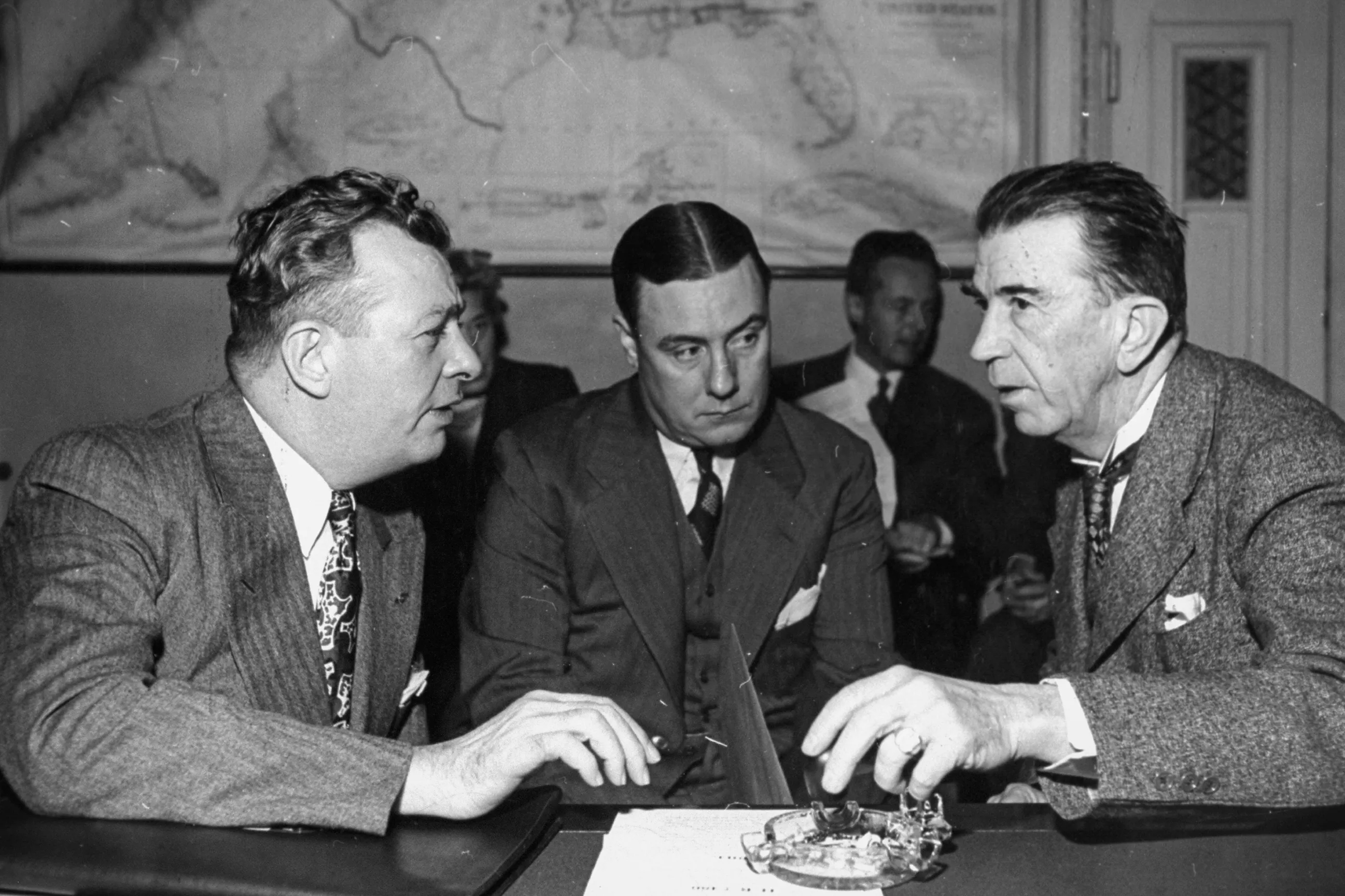
Representatives Everett Dirksen, Roger Slaughter, and Howard W. Smith.
In 1938, President Roosevelt learned a hard lesson about the politics of the time: voters did not appreciate interference from the president in their state primaries. This is the opposite of true today, as numerous Republicans who have crossed Trump can tell you. However, his successor, President Truman, thought that he could throw his weight around in primaries. One notable figure he publicly supported was Montana Senator Burton K. Wheeler, who was facing a left-wing challenger in Leif Erickson in the primary. However, Wheeler was hit for his foreign policy views before World War II and his voting record not being regarded as sufficiently progressive and he lost the primary. Truman tried again to interfere in primaries, but this time it was on his home turf of Kansas City. For decades, the city had been ruled by the Democratic Party, and the contest was between two factions: the Goats and the Rabbits. The Goats were part of the machine of Tom Pendergast, and the Rabbits were led by Congressman Joe Shannon. However, by 1942 Shannon was long past his prime in power and 75 years old, and thus he opted not to run again. He was succeeded by Roger Slaughter. Slaughter, a Rabbit like Shannon, would not only prove different from faction to President Truman, who was a Goat, but would also have numerous fundamental disagreements with him on policy, and this was not only a pain for Truman because he was from Kansas City but also that he sat on the powerful House Rules Committee. Perhaps the most controversial part of Truman’s political career was how he advanced, through the corrupt Pendergast machine, and the Rabbits were sort of frenemies to them by this point. One key matter Slaughter differed from Truman on was organized labor. Slaughter was strongly supportive of legislation curbing the power of organized labor and once said, “The President of the United States is a prisoner of the C.I.O.-P.A.C.” (Time Magazine, 1946). He also had also opposed reporting out fair employment practices legislation backed by the Truman Administration and consistently voted against civil rights legislation. By 1946, Truman was sick of having an opponent in his backyard and he sought the aid of the head of the Pendergast machine, Jim. Jim Pendergast was a nephew of the now deceased Tom Pendergast, and he sought to get Enos Axtell, a 37-year-old lawyer and newcomer, elected to office rather than Slaughter. Truman thought of this primary race as an important test for his power, and said regarding Slaughter, “If he’s right, I’m wrong” and although he claimed to know Axtell all his life in endorsing him, he also had trouble recalling his first name (Time Magazine). The Pendergast machine went to work on the day of the primary, and in the process, engaged in some of the old tricks of the machine under Tom Pendergast. The result was a 54-46 win for Axtell. However, the result immediately provoked suspicion, and this resulted in investigations by the House Campaign Expenditures Committee and the Kansas City Star, which found convincing evidence that voter fraud in Axtell’s favor had indeed occurred. A grand jury in Jackson County thought the same. They found from the examination of ballots in 34 of 255 precincts that a “deliberate, calculated, and premeditated plan” to commit extensive voter fraud had existed, with them concluding, “It is our belief that Slaughter was deprived of the nomination by a fraudulent miscount of votes and other types of fraud” (Time Magazine, 1947). It looked like a substantive case was going to be moving forward against the Pendergast machine, but…
KABOOM! There Goes the Evidence!
Although the grand jury had made its finding, certain actors had other ideas. The night of the grand jury’s finding, a group of unidentified burglars broke into the Kansas City courthouse, blew up the vault of the election board with nitroglycerin, and absconded with most of the evidence in the case (Time Magazine, 1947). This included poll books, ballots, and vote tallies. This was a major blow to the case.
Truman’s attorney general, Tom Clark, was not exactly keen to act. Although he had cited the FBI report as justification not to act on allegations of vote deprivation, he had limited the FBI’s use of evidence for its report to the Kansas City Star’s reporting and the findings of four Kansas City election commissioners (Time Magazine, 1947). The president’s critics bemoaned that this was so, and President Truman called for a full investigation. The suspect result of the Democratic primary plus the general national fatigue with the Democrats produced the victory of Republican Albert Reeves, Jr. in the district. I suppose for Truman if he had to have an opponent representing his home turf better it be a Republican than someone in his own party.
The End Results
After all, this victory for the Republicans would be short-lived, as in 1948 Reeves would be defeated for reelection by young anti-Pendergast liberal Richard Bolling, who was perfectly satisfactory by Truman. The Pendergast machine also went down in this election to candidates backed by mobster Charles Bonaggio. However, there were Pendergast officials who were prosecuted for voter fraud in the 1946 election, and another jury concluded in 1947 that the existing fraud had not been sufficient to have changed the outcome in the primary (Knowles). Slaughter would become a lobbyist after his defeat, but Truman’s beef with him hadn’t finished. His Justice Department indicted him for alleged violations of federal lobbying laws, but he was acquitted in 1950 (Lawrence).
References
Burnes, B. A. (2020, September 9). Sordid History of Kansas City Election Fraud. Flatland Kansas City.
Retrieved from
Hill, R. James P. Kem of Missouri. The Knoxville Focus.
Retrieved from
https://www.knoxfocus.com/archives/this-weeks-focus/james-p-kem-of-missouri/
Knowles, C. (1947, December 19). Kansas City Vote Is Upheld By Jury. The New York Times.
Retrieved from
Lawrence, W.H. (1950, April 18). Slaughter Freed in Lobbying Trial. The New York Times.
Retrieved from
Political Notes: Home to Roost? (1947, June 16). Time Magazine.
Retrieved from
https://time.com/archive/6793206/political-notes-home-to-roost/
Slaughter, Roger Caldwell. Voteview.
Retrieved from
https://voteview.com/person/8569/roger-caldwell-slaughter
The Presidency: If He’s Right, I’m Wrong. (1946, July 29). Time Magazine.
Retrieved from
https://content.time.com/time/subscriber/article/0,33009,776913,00.html
 Mad Politics: The Bizarre, Fascinating, and Unknown of American Political History