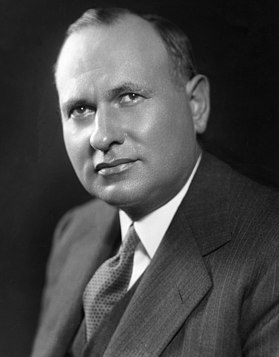
Beardsley Ruml
All American workers are used to the idea that their taxes are withheld from their income rather than them having to worry about paying a big tax bill on tax day, that is if you are not an independent contractor. However, from 1913 until 1943 income taxes were indeed paid in this way…you’d be paying for your last year of income. By 1942, the US was in a total war economy and that year the Revenue Act of 1942 was passed, a massive tax measure to fund the war, and with this the income tax came to not be a mere class tax, rather a tax that hit taxpayers across the board. The tax revenue that came from this measure, even though a lot, was not enough to fund the war effort as noted by Secretary of the Treasury Henry Morgenthau. The next revenue bill was going to be a sea-change in tax law as it was widely agreed upon that current-year taxation would be for the best. However, what would happen in the first year of implementation is that many people would get hit with taxes for both 1942 and 1943, making 1943 a really hard tax year for many. Ways and Means Committee Chairman Bob Doughton (D-N.C.) lamented the difficulty of changing the tax system, “We are dealing with the most hateful, difficult problem that ever came along in the annals of mankind” (Time Magazine). Enter Beardsley Ruml (1894-1960).
Ruml was an economist and the head of the New York Federal Reserve Bank and he had an idea of how to mitigate the difficulty of this change: forgive 1942 tax liability. As you might have expected, Republicans embraced Ruml’s push, but Democrats, who had a Congressional majority, were opposed. This forgiveness would largely benefit upper income taxpayers, and providing such a benefit for upper income taxpayers went directly against the political ethos of President Roosevelt and New Dealers. Interestingly, Southerners by and large objected to the Ruml Plan, at least at 100% forgiveness. Doughton, for instance, was strongly opposed to 100% forgiveness, considering it “the biggest outrage ever attempted to be perpetrated upon the people of the United States” (Thorndike, March 24). However, he would prove willing to accept a lower level of forgiveness. After all, tax relief was popular among voters and Republicans knew it! House Minority Leader Joe Martin (R-Mass.), for instance, strongly pushed this measure, stating of the majority Democrats on this issue, “They’ll know they’ve been in a fight” (Time Magazine). On March 30, 1943, the full implementation, pushed by Rep. Frank Carlson (R-Kan.), was voted down 198-215 although Congress opted to shelve the Ways and Means Committee bill 248-168 on the same day, resulting in an impasse. The House eventually passed 60% forgiveness 313-95 on May 4, 1943, but the Senate had different ideas and on May 14th voted for the Ruml Plan 49-30. This was unacceptable for President Roosevelt, who wrote to Congressional leaders, “This cancellation would result in a highly inequitable distribution of the cost of the war and in an unjust and discriminatory enrichment of thousands of taxpayers in the upper income groups. Such groups would be enriched by the cancellation of taxes already owing by them” (Thorndike, March 24).
Resolution
A compromise version of what became known as the Current Taxpayer Act was adopted 257-114 on June 1st. The Senate agreed to the measure 62-19 the next day. President Roosevelt would sign the bill into law on June 9th. The final law forgave 75% of the lower figure of either 1942 or 1943 tax liability and instituted withholding of the income tax at 20% automatically. Interestingly, the matter that had the longest and most consequential impact was the least controversial of the issues in tax withholding and the most controversial thing was a matter that is easily forgotten. Also of note, although Ruml’s full plan was embraced mostly by conservative Republicans, Ruml himself was something of a political enigma. Although a registered Republican, he more often supported Democrats than Republicans for public office, and in 1952 he backed and helped raise funds for Democrat Adlai Stevenson over Republican Dwight Eisenhower (The New York Times). There likely isn’t a soul working today who knows a tax system before withholding, unless there’s a working 100-year-old out there who wishes to contradict me. Feel free to leave a message if so!
Beardsley Ruml, 65, Tax Planner, Dead. (1960, April 19). The New York Times.
Retrieved from
The Congress: Tax Soliloquy. (1943, March 22). Time Magazine.
Retrieved from
https://time.com/archive/6598446/the-congress-tax-soliloquy/
Thorndike, J.J. (2024, March 4). Tax History: Beardsley Ruml: The Man Who Invented Withholding – Sort Of. Tax Notes.
Retrieved from
Thorndike, J.J. (2024, March 25). Tax History: Compromising on the Current Tax Payment Act of 1943. Tax Notes.
Retrieved from
 Mad Politics: The Bizarre, Fascinating, and Unknown of American Political History