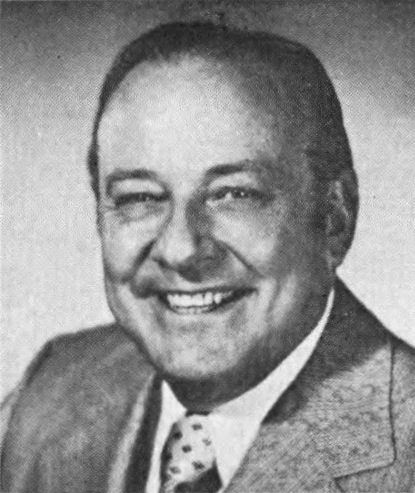
On September 16, 1961, longtime Democratic Congressman Overton Brooks died in office. Brooks had been in office long enough to be among the legislators who shifted from supporting FDR’s liberalism to being of the conservative wing of the Democratic Party, Joe Waggonner (1918-2007) of Plain Dealing had already planned on challenging him in the 1962 primary over what was seen as insufficient conservatism. Waggonner was a leader in the state’s White Citizens Council and had refused to support John F. Kennedy in 1960, instead serving as an elector for the State’s Rights Party which was backing Virginia Senator Harry F. Byrd. One key point of contention for Waggonner was Brooks’ 1961 vote to expand the Rules Committee, thus weakening the obstructive power of conservative chairman Howard W. Smith (D-Va.). However, with Brooks six feet under, Waggonner had a clear path to run to succeed him, and his opponent would be oilman Charlton Lyons, who had only the previous year switched from Democrat to Republican. Both were in truth highly similar men differentiated mostly in party affiliation. Both were strongly conservative, and both were outspoken segregationists. Party affiliation won the day in Louisiana, with Waggonner prevailing by 10 points in the special election. Lyons’ 45% of the vote was, however, a strong showing for a Republican in that day, and it was the closest contest of Waggonner’s career.
Waggonner vs. National Democrats
Although a Democrat, as I mentioned before, Waggonner was strongly anti-Kennedy, and on most questions of importance, he voted with conservative Republicans. He even voted against some of the most popular proposals backed by Kennedy, such as educational television and job training programs. Indeed, in his first full year of Congress, Waggonnner got a 100% from Americans for Constitutional Action and a 0% by Americans for Democratic Action. The only major Kennedy measure of ideological salience that he backed was his tax reduction legislation. Waggonner likewise proved a strong opponent of President Johnson and the Great Society, voting against most key measures. However, in 1966, he did oppose multiple Republican efforts at budget reduction in certain departments in 1966, 1967, and 1968. He saw himself as something of an ambassador of conservatism in Congress, and by his own account spent a good deal of time trying to persuade liberals to see things his way. He stated, “The trend to socialism is not accidental, but reflects the attitude of the majority, or it would not be the prevailing trend. I spend all of my time talking to the liberals in Congress, doing all I can to persuade them of the rightness of our views, not to conservatives who already share our philosophy” (Minden Press, 1). Waggonner was not without positions on foreign policy, and on April 5, 1966, he voiced support for Ian Smith’s minority white government in Rhodesia and commented, “Three generations ago, a group of resourceful white men went into the jungle of what is now Rhodesia and carved a civilized land by the sheer force of their brains and management ability. The lesson of history was crystal clear then as it is now: the natives were not capable of producing any semblance of what we call civilization. Now that the white man had led them out of savagery, the Socialist, left-wing camp is up in arms to turn the country back to them. This is, of course, a not too subtle way of building a Socialist bridge from Democracy to Communism” (Lake, 119). He was of course uncompromising in his opposition to the civil rights legislation of the 1960s. Waggonner was not just an ideologue, however, he also was able to secure federal funds for his district, for instance for getting Interstate 49 between Lafayette and Shreveport constructed (WAFB 9).
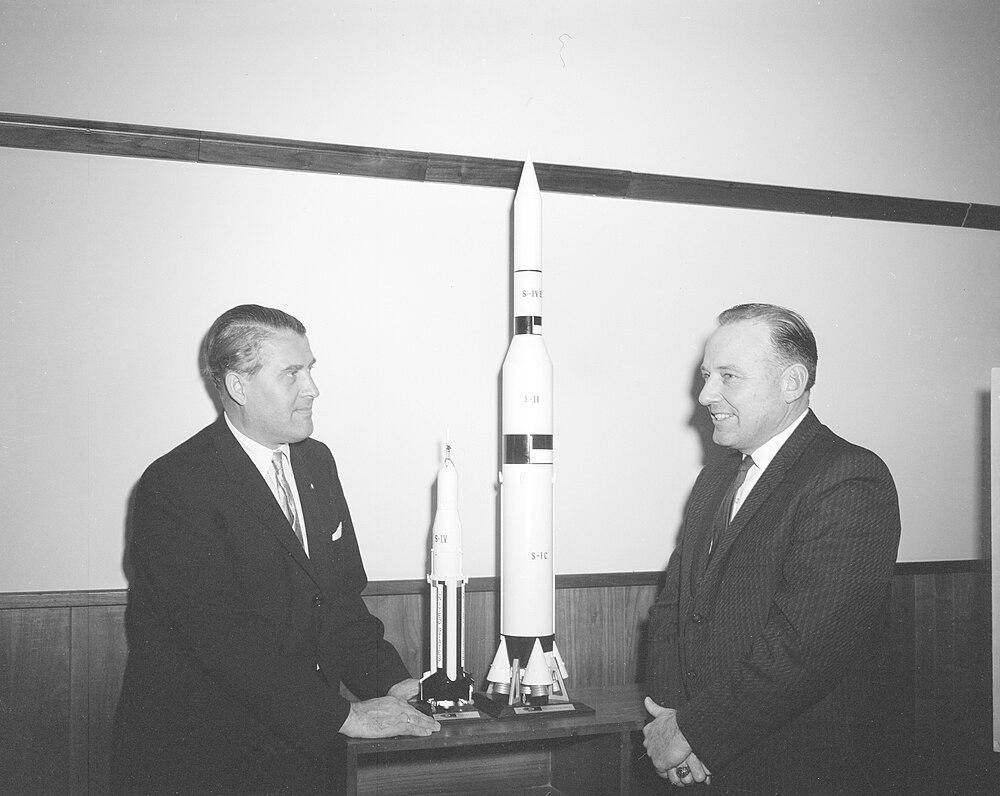
Waggonner having a chat with Wernher von Braun.
New President, New Day
Although Waggonner had not gotten on with Kennedy and Johnson, he got on exceptionally well with Richard Nixon and was often of assistance even if at times he thought Nixon was too friendly to civil rights. In 1970, Waggonner cosponsored Gerald Ford’s (R-Mich.) resolution to impeach Justice William O. Douglas, in part as a retaliatory move for the Senate rejecting Supreme Court nominees Clement Haynsworth and G. Harrold Carswell. However, this failed to gain traction. He marshalled Southern Democrats to support much of Nixon’s agenda, strongly supported him on the Vietnam War, and even became a personal friend. Waggonner’s stances on civil rights during this time seemed to ease up a bit since, being a savvy politician, he sensed the changing times. The Shreveport Times (1978) noted that by the early 1970s most people were not associating Waggonner with his earlier strong segregation stances, and that unlike some of the old segregationists, his popularity increased with time (16). One of the great elements of his success was not just his savviness, but also his attentiveness to his constituents. As The Shreveport Times (1978) noted upon Waggonner’s announcement of his retirement, “Rarely, if ever, did a letter from a constituent go unanswered. If a favor could be done for a voter, it got done. For thousands of people, he has been a very personal line to the top level of government” (16).
During the summer of 1974, Nixon looked to him to give reports on where Congressional support stood on impeachment on the Democratic side, and a motivating factor for him to resign was Waggonner reporting that his support was crumbling among Southern Democrats. The Shreveport Journal (1976) noted, “On a personal level, he was among Richard Nixon’s closest friends and shared some of his most dramatic and emotional last experiences in the White House and he has continued that close relationship. During the past weeks, Waggonner has traveled to San Clemente for a long personal discussion with the former president” (13). He would also be a friend and political ally of Gerald Ford’s, although not quite as close as he was with Nixon.
A Scandal That Changed the Rules
Like his fellow Louisianan Otto Passman, Waggonner faced a scandal in 1976, although it was not for alleged bribery. The 1970s were an interesting time in political journalism, since before the press was willing to cover for politicians carrying on affairs, but with multiple political sex scandals making the news, this cover has since been gone. In June 1976, The New York Post revealed that Waggonner was arrested for solicitation of sex from an undercover female officer earlier in the year. He claimed entrapment, and because members of Congress had been immune from prosecution for misdemeanors in Washington D.C. for a century, Waggonner had not been prosecuted. In July 1976, this non-prosecution policy was scrapped. Waggonner was also in something of a difficult position that year, as he was clearly far more in alignment on policy with President Gerald Ford than Jimmy Carter, but the Democrats had more power to deny seniority for those who broke party line. Despite the aforementioned difficulties, he easily won reelection.
Waggonner’s Last Term
Joe Waggonner’s record on Carter was quite similar to his record with the previous Democratic president. In January 1978, he was interviewed and one of the subjects was on his stance on segregation. Waggonner did not disavow his previous political positions on segregation or on his votes against the civil rights legislation of the 1960s. He continued to express his opposition to the Voting Rights Act as it was, but expressed that if the law was applied throughout the nation rather than just the South and certain counties, he would support it (Flournoy). The year 1978 constituted a bit of an end of an era in the South, as numerous prominent legacy politicians were not running for reelection, such as Senators John Sparkman of Alabama and James Eastland of Mississippi, Congressmen Bob Poage and George Mahon of Texas, and Waggonner joined them. However, he didn’t do so before securing the construction of a new General Motors plant in Shreveport (The Shreveport Times, 16). In the Democratic primary for his successor, he endorsed Buddy Leach over future Republican Buddy Roemer over the latter’s criticism of the Red River navigation program. Although Leach would win in 1978, the other Buddy would win the 1980 primary. In his career, Waggonner sided with ACA 83% of the time and the liberal Americans for Democratic Action a mere 3% of the time. His DW-Nominate score didn’t seem to reflect this, as he got a 0.015, which is high for a Democrat.
After Congress
Waggonner was a man who wore multiple hats while in Congress, and he was highly knowledgeable on Social Security. President Ronald Reagan thus appointed him to be part of the commission to investigate the long-term feasibility of Social Security. The commission’s recommendations informed the legislation passed in 1983 to save Social Security, or at the very least buy it time. In his later years, Waggonner expressed opposition to Louisiana conservatives moving into the Republican Party, but he nonetheless would at times back Republican candidates for public office, such as Bob Dole for president in 1996. In 1994, Waggonner attended Richard Nixon’s funeral. He would join Nixon in death in October 7, 2007 at the age of 89.
References
ADA Voting Records. Americans for Democratic Action.
Retrieved from
Flournoy, C. (1978, January 17). Waggonner Has Mellowed on Segregation. The Shreveport Journal, 19.
Retrieved from
https://www.newspapers.com/image/602215909/
Former Congressman Waggoner dies. (2007, October 9). WAFB 9.
Retrieved from
https://www.wafb.com/story/7180968/former-congressman-waggoner-dies/
Joe Waggonner in a Political Vise. (1976, October 27). The Shreveport Journal, 13.
Retrieved from
https://www.newspapers.com/image/602091876/
Lake, A. (1976). The “tar baby” option: American policy toward Southern Rhodesia. New York, NY: Columbia University Press.
Langeveld, D. (2012, May 6). Joe Waggonner: solicitation immunity. The Downfall Dictionary.
Retrieved from
https://downfalldictionary.blogspot.com/search/label/Joe%20D.%20Waggonner
Mitchell, T. (1978, February 11). Rep. Waggonner Will Not Seek Reelection. The Shreveport Journal, 13.
Retrieved from
https://www.newspapers.com/image/602215206/
Says Waggonner, Missionary Work Among Liberals Is Necessary. (1963, June 3). Minden Press, 1.
Waggonner, Joseph David, Jr. Voteview.
Retrieved from
https://voteview.com/person/10567/joseph-david-waggonner-jr
Waggonner’s retirement: Power loss. (1978, February 12). The Shreveport Times, 16.
Retrieved from
 Mad Politics: The Bizarre, Fascinating, and Unknown of American Political History