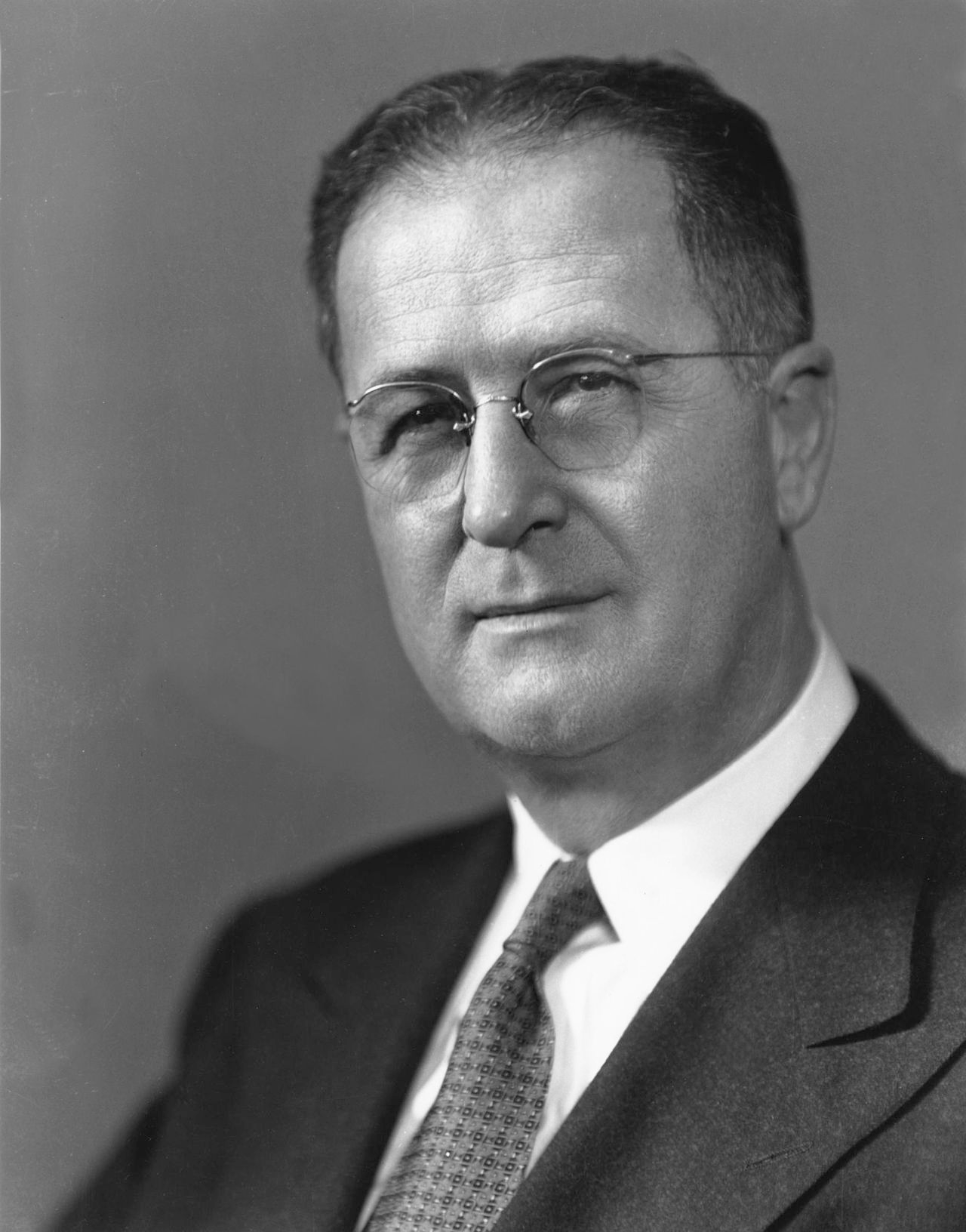
In October 1917, 22-year-old South Dakotan Clinton Presba Anderson reports for duty to serve his nation for World War I. What he didn’t know was that he was suffering from advanced tuberculosis, and this was diagnosed by the army doctors, who gave him 6 months to live. Since antibiotics hadn’t been discovered yet, it was a common practice of those who suffered from tuberculosis to move to a hot and dry climate to recover or die, and he moved to Albuquerque, New Mexico, spending time in a sanitarium. Initially, it looked like the army doctors were going to be right, as Anderson’s lungs were hemorrhaging, and the doctors gave him less than five days to live. However, five days passed by, and he was still holding on. Then six months passed by, and he had still eluded the grim reaper. In nine months, Anderson (1895-1975) was well enough to start a career in journalism, and by 1919 he had recovered, but he would often struggle with his health throughout his life. While a journalist, Anderson developed a passion for politics in New Mexico. Republicans held the governorship from 1917 to 1923, and Anderson didn’t like how they were running the state, so he joined the Democratic Party and during the 1920s the party started to see significant successes; in 1922, they won the governorship, and in 1924 they won a Senate seat and maintained their hold of the governorship. Anderson was also involved in public health, having worked for the New Mexico Public Health Association starting in 1919, where he sought to improve the public health system, and in 1923, he entered the insurance business, starting his own firm in 1925. Given his health difficulties as well as his background in public health and insurance, it makes sense that his later career would be characterized by pushing for the expansion of health insurance. In 1928, Anderson became the head of the state’s Democratic Party, and they made long-term gains during the Great Depression, which were completed after the death of progressive Republican Senator Bronson Cutting in an airplane crash in 1935. Ultimately, from 1935 to 1962 there would be no federal Republican officeholders. In 1933, Anderson was elected Treasurer, and in 1934 he became the head of the state’s relief administration.
In 1940, Congressman John J. Dempsey was deprived from running again due to a dispute within the Democratic Party, and in his place, Clinton Anderson was elected. Although without doubt a supporter of FDR and backing numerous key policies such as Lend Lease, his voting record was not staunchly liberal, rather moderately liberal. In 1945, Anderson headed up a committee to investigate food production in postwar United States, and President Truman was so impressed with his report and recommendations that he nominated him to be his Secretary of Agriculture, a post in which he sought to move the US agricultural economy from wartime to peace time as well as addressing the food shortage in the postwar world. Anderson was one of the key people, working closely with President Truman and former President Herbert Hoover, in getting people in war-torn areas fed. Hoover would craft plans, and Anderson would implement them. However, in 1948, by which time the postwar food situation was stable, he resigned to run for the Senate after Carl Hatch announced his retirement. The Republicans picked former Secretary of War Patrick J. Hurley, but this year was good for the Democrats, and Anderson prevailed by 15 points. In the Senate, he strongly supported President Truman’s agenda. Although Republicans were starting to make gains in New Mexico, most notably with the election of Ed Mechem as governor, Anderson was more than capable of hanging on, and in 1954, he won reelection against Mechem by nearly 15 points. Republicans would only get within single digits of defeating him in 1966, and that was a backlash election against the Johnson Administration.
Anderson and Eisenhower
As Secretary of Agriculture, Anderson had come to believe that flexible price floors were the right approach for agriculture and thus supported Ezra Taft Benson in his efforts to push agriculture more to a market-based system, which was not popular in rural areas. As a New Mexican, he supported the oil industry and in 1950 and 1956 he voted for legislation prohibiting the Federal Power Commission from regulating the price of oil. Anderson also supported maintaining the 27.5% oil depletion allowance. However, there were ways in which he waved his partisan flag. For example, Anderson had come to strongly dislike Lewis Strauss when he headed the Atomic Energy Commission. A key issue that the men fought on was public power generation and distribution; Strauss opposed, Anderson supported. Strauss had also once insulted Anderson when he said that he, the chairman of the Joint Committee on Atomic Energy, had “a limited understanding of what is involved” in Cold War atomic energy policy (U.S. Senate). Although Anderson never forgave Strauss for that insult, he initially decided to put politics out of the way when in 1958 President Eisenhower made clear that he wanted him to be Secretary of Commerce. However, this was not stuck to as in the 1958 election Democrats won 12 seats, the issue of Strauss’s involvement in the revoking of J. Robert Oppenheimer’s security clearance came up, and Strauss came off badly in hearings as arrogant, combative, and condescending to the Senate. On this matter, he was his own worst enemy, and Anderson now put his full energy into calling for his nomination to be voted down, and it was, 46-49, on June 19th, Strauss being one of the few cabinet nominees in history to be voted down by the Senate. This event is notably portrayed in the 2023 film Oppenheimer. He was also known during his time in the Senate as a scholarly figure who had a hobby of collecting and reading old books about the American West, and this resulted in him having one of the finest personal libraries in New Mexico.
Anderson and Civil Rights
Although Senator Anderson generally supported civil rights and backed the major laws on final passage, he also supported Majority Leader Lyndon B. Johnson (D-Tex.) in his successful efforts to water down the Civil Rights Acts of 1957 and 1960 to ease them for passage. Indeed, he sponsored with Senators George Aiken (R-Vt.) and Francis Case (R-S.D.) the amendment striking 14th Amendment implementation from the 1957 law. Anderson can be seen as both a supporter of civil rights but also a Senate institutionalist.
Advocacy for Medicare
Senator Anderson was one of the principal politicians, along with Albert Gore of Tennessee and Representative Cecil King of California, to push for the adoption of Medicare. President Kennedy had specifically designated Anderson as the leader of adopting the measure. Anderson would write on his role, “Perhaps a man who has spent much of his life fighting off the effects of illness acquires…an understanding of the importance of professional health care to all people” (U.S. Senate). Although the Senate rejected Medicare proposals in 1960 and 1962, in 1964, Anderson succeeded in getting the Senate to adopt a Medicare amendment to the pending Social Security legislation. However, in the course of doing so, he strained his health and found himself managing the measure from his hospital bed. Because the House and Senate could not agree upon a final version of the Social Security measure, Medicare would have to wait until the next Congress, which had more of the president’s supporters elected to the Senate and especially the House. After Anderson managed to get Medicare passed in the Senate in 1965, President Johnson invited him to the signing ceremony in which former President Truman and his wife, Bess, were given the first Medicare cards. Medicare would not be the only cause in which he specialized, as he also was the Senate’s leading advocate for wilderness conservation. Anderson wrote on the matter, “There is a spiritual value to conservation, and wilderness typifies this. Wilderness is a demonstration by our people that we can put aside a portion of this which we have as a tribute to the Maker and say–this we will leave as we found it” (Wilderness Connect). Anderson also supported most other Great Society proposals, but he proved more conservative on law-and-order issues. He supported several proposals to weaken the impact of Supreme Court decisions on criminal defendant rights, but did not support the Nixon Administration’s efforts to enact “no knock” warrants for drug cases. Anderson also supported efforts to withdraw from the Vietnam War, including the Cooper-Church Amendment in 1970 and the Mansfield Amendment in 1971. Despite his support for withdrawal, he tended to support increasing military spending for key missile delivery systems as well as taking a hardline stance on the USSR.
By 1972, Anderson’s health was clearly declining, and he chose not to run again. Throughout his Senate career, he agreed with the liberal Americans for Democratic Action 66% of the time, the conservative Americans for Constitutional Action 23% of the time from 1955 to 1972, and his DW-Nominate score was a -0.201. In retirement, he continued his hobby of collecting and reading old books on the American West. Anderson was wise to have opted to retire, as on November 11, 1975, his 58-year streak of eluding the grim reaper came to an end with a massive stroke at the age of 80.
References
ADA Voting Records. Americans for Democratic Action.
Retrieved from
Anderson, Clinton Presba. Voteview.
Retrieved from
https://voteview.com/person/165/clinton-presba-anderson
Clinton Anderson. Wilderness Connect.
https://wilderness.net/learn-about-wilderness/people/clinton-anderson.php
Clinton P. Anderson. The Miller Center.
Retrieved from
https://millercenter.org/president/truman/essays/anderson-1945-secretary-of-agriculture
Clinton P. Anderson Dead; Ex-Senator Was in Cabinet. (1975, November 12). The New York Times.
Retrieved from
Medicare Signed Into Law. United States Senate.
Retrieved from
https://www.senate.gov/artandhistory/history/minute/Medicare_Signed_Into_Law.htm
Simmons, M. (2014, December 26). Trail Dust: Clinton P. Anderson went from newsman to senator. Santa Fe New Mexican.
Retrieved from
The Administration: The Strauss Affair. (1959, June 15). Time Magazine.
Retrieved from
https://content.time.com/time/subscriber/article/0,33009,892639,00.html
 Mad Politics: The Bizarre, Fascinating, and Unknown of American Political History