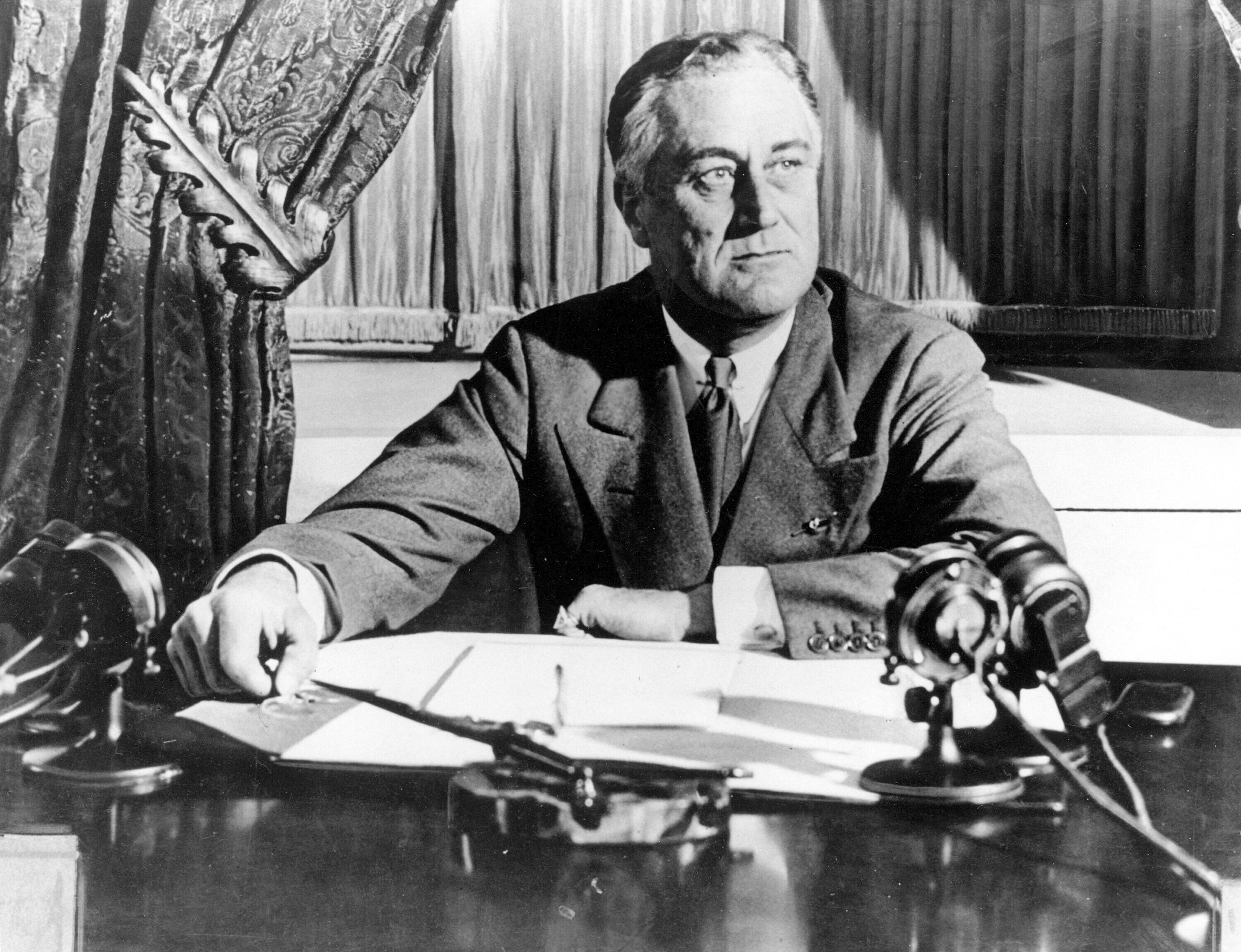
The Republican Party was in terrible trouble in 1932. President Herbert Hoover was deeply unpopular and for multiple reasons; an economy in depression with over 20% unemployment and rising and a president who appeared to many voters as doing little, Hoover stubbornly clinging to Prohibition while public opinion was strongly souring on it, and the cherry on top was the disastrous dispersing of the bonus marchers. The news only seemed to be getting worse over the months. The 1930 midterms had already been bad for the GOP, with the House becoming Democratically controlled after the deaths of 14 representatives, including Speaker of the House Nicholas Longworth (R-Ohio).
On the presidential level, Democratic candidate Franklin D. Roosevelt soundly defeated Herbert Hoover, winning all but six states with 472 electoral votes and 57.4% of the popular vote, with Hoover only holding on in Connecticut, Delaware, Maine, New Hampshire, Pennsylvania, and Vermont. Only William Howard Taft’s loss in 1912 was worse for a Republican candidate. He would be on the outs in the political scene until after FDR’s death, and he was able to serve as an elder statesman.
The losses Republicans sustained in Congress were arguably more disastrous than the presidential election, with them losing a whopping 101 seats. This gave Democrats 313 seats in the House, outnumbering Republicans by nearly 200. In Colorado, Idaho, Indiana, Oklahoma, Missouri, Montana, Nebraska, Rhode Island, South Dakota, Utah, Virginia, Washington, and West Virginia Republicans suffered a complete wipeout, with all House seats going to the Democrats. Delaware’s and Nevada’s only House seats went Democratic too. Democrats had their largest gains in Illinois (seven seats), Iowa (five seats), Michigan (six seats), Ohio (seven seats), and Pennsylvania (net of seven seats). Further helping Democratic gains was the population growth in the cities, which were voting increasingly Democratic.
Some of the most notable House freshmen in this election included Republican Everett Dirksen of Illinois, Democrat Guy Gillette of Iowa, Democrat John Dingell Sr. of Michigan, Democrat William M. Colmer of Mississippi, Republican Charles Tobey of New Hampshire, Republican William Lemke of North Dakota (Union Party candidate for president in 1936), Democrat Stephen Young of Ohio, Democrat Francis E. Walter of Pennsylvania, Democrat James P. Richards of South Carolina, Democrat Willis Robertson of Virginia, and Democrat Jennings Randolph of West Virginia.
In the Senate, Democrats won 12 seats from Republicans, a glorious result for the former and a catastrophic one for the latter. This would also be the last time Democrats ever won a Senate seat from Kansas. Notable victories for Democrats included former Secretary of the Treasury William G. McAdoo in California over incumbent Republican Samuel Shortridge, Democrat Elbert Thomas besting Republican Reed Smoot (as in, “Smoot-Hawley Tariff”) in Utah, Fred Brown narrowly dispatching stalwart conservative incumbent George Moses in New Hampshire, future Senate powerhouse Pat McCarran knocking out popular incumbent Tasker Oddie in Nevada, and Fred Van Nuys ending the career of Senate Majority Leader James Watson of Indiana. Democrat Joe Robinson of Arkansas, who had been the vice-presidential candidate in 1928, was now elevated to majority leader and would loyally shepherd the passage of major New Deal legislation in the Senate. Notable Senate freshmen included McAdoo of California and McCarran of Nevada. Democrat Hattie Caraway of Arkansas, first appointed by Arkansas’ governor after her husband’s death, was elected to a full term, the first time a woman was elected to the Senate. Of the Republicans who lost in the Senate in this election, only John Thomas of Idaho would return. With 59 senators and 313 representatives, the Democrats were more than well-positioned to enact newly elected President Roosevelt’s New Deal agenda. This was the single greatest election for the Democrats in their history, and the last one in which the House shifted by over 100 seats.
The 1932 election marked a sea change in the direction of politics in the United States. The legacy of FDR not only with numerous groundbreaking policies but also his navigation through two different major crises proved endearing, and he was highly successful at courting union workers and black voters in his direction while keeping Southern whites in the party. This would be known as the New Deal coalition, and it would hold for over three decades. Until 1994, Republicans would only win the House in two elections and the Senate in five elections and although the New Deal coalition was cracked in 1968, the Democratic brand remained solid even when their presidential candidates lost in landslides. Many people could just as easily vote for the Republican presidential candidate as they did their Democratic representative or senator.
References
1932 United States House of Representatives elections. Wikipedia.
Retrieved from
https://en.wikipedia.org/wiki/1932_United_States_House_of_Representatives_elections
1932 United States presidential election. Wikipedia.
Retrieved from
https://en.wikipedia.org/wiki/1932_United_States_presidential_election
1932 United States Senate elections. Wikipedia.
Retrieved from
https://en.wikipedia.org/wiki/1932_United_States_Senate_elections
 Mad Politics: The Bizarre, Fascinating, and Unknown of American Political History