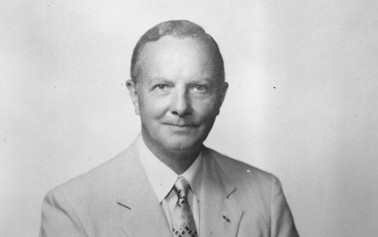
As a state, Ohio has had a long history as a swing state in politics, and Stephen Marvin Young (1889-1984) had a long career in which he benefited from and was harmed by such shifts.
Young, a lawyer by profession, launched his political career in 1912, winning a seat in the Ohio House of Representatives in the same year that Woodrow Wilson was elected president. He would serve until 1917, when he was called to fight in World War I. The 1920s would be the political doldrums for him, as he lost a state attorney general election in 1922 and lost the Democratic primary for governor in 1930.
In 1932, Young was elected to Congress, representing the entirety of Ohio as an at-large representative. Although a supporter overall of FDR’s New Deal who voted for much of it including the Agricultural Adjustment Act, the Tennessee Valley Authority, and the National Industrial Recovery Act, he was more moderate in his voting in his early years in Congress than he would be later, indeed Congressional Quarterly described him during this time as a “moderate New Deal Democrat” (CQ Almanac, 1958). He also took a stand against popular opinion in his opposition to the Patman Bonus bill for veterans on fiscal grounds, and this would be far from the last time he would be unafraid to stand against public opinion. In 1936, Young opted to run for the Democratic gubernatorial nomination but lost to incumbent Martin Davey.
Young sought to win back one of Ohio’s at-large seats in 1938, but the winners for the two seats were Republicans George Bender and L.L. Marshall. However, in 1940 he ran again and with Bender was one of the top two. Time Magazine (1942) described him as a “New Deal enthusiast” and as Ohio’s top vote-getter for the Democrats. However, even in this “enthusiast” stage, Young nonetheless didn’t always vote in line with what New Dealers wanted, and this included his vote for the Vinson Anti-Strike Bill in 1941 and his vote against continuing the Civilian Conservation Corps in 1942. The former vote contrasts greatly with his strong pro-union record later in his career. In the 1942 election, the number of at-large seats was reduced to one, and with that year being a good one for Republicans, Young lost the election to Bender. He proceeded to resume his military service, serving from 1943 to 1946, rising in rank from major to lieutenant colonel. And he wasn’t a staff officer either; like also in his fifties Paul Howard Douglas. At the war’s end, Young was serving as military governor of the Province of Reggio Emilia in Italy.
In 1948, Young came back to Congress again by defeating Bender, as this year went sideways for the Republicans. In the 81st Congress, as a veteran of both world wars, he furiously denounced Veterans Committee Chairman John Rankin’s (D-Miss.) effort to scuttle President Truman’s proposed expansion of Social Security through a big veterans’ pension bill. Young proved a strong supporter of President Truman’s agenda, both on domestic and foreign policy. However, in 1950 the winds would shift back to the GOP, and Ohio’s at-large seat to Bender. Young would run for state attorney general in 1956, but lost to Republican William B. Saxbe, who would later serve in the Senate and briefly as the U.S. attorney general. The 1950s would also be a time in which Young would start to suffer several personal tragedies in life. In 1952, his wife of 41 years, Ruby, died of lung cancer, and one of his sons, Stephen Jr., followed in 1958 at the age of 46. His other son, Richard, would die seven years later at 42. His second wife, Rachel, who was 23 years younger than him, would nonetheless precede him in death by two years due to a car accident.
The 1958 Election: The Fall of the House of Bricker
In 1958, many Senate Republicans were up for reelection, and one of them was Ohio’s John W. Bricker. Bricker was a big name in Ohio, as he had been a popular and successful governor from 1939 to 1945, Thomas E. Dewey’s running mate in 1944, and had served in the Senate since 1946. Bricker was in many ways the antithesis of Young. He had written a proposed amendment to the Constitution, known as the Bricker Amendment, which if enacted would have considerably weakened the president’s ability to enact executive agreements. He was one of the most conservative senators; he sided with the liberal Americans for Democratic Action only 7% of the time, the conservative Americans for Constitutional Action 98% of the time from 1955 to 1958, and had a DW-Nominate score of 0.528, which made him the 4th most conservative senator in the 85th Congress (1957-1959). Many Democrats passed on running against him because they thought he was unbeatable, that is, except Stephen Young. Young had some incentive to run for the Senate in addition to his ideological opposition to Bricker; he was 69 years old, and this was likely his last chance to continue his political career.
A lot of people underestimated Young in the 1958 election because of his age and as mentioned before, Bricker was popular. Indeed, only one statewide newspaper endorsed Young. However, a “right to work” amendment, backed by Senator Bricker, was on the ballot for the state constitution, and unions went into overdrive in campaigning against it. Another favorable development for Young was him getting former President Harry S. Truman to campaign for him. Truman took a great liking to Young as he saw him as a kindred spirit; a liberal who calls a spade a spade. This, combined with the generally unfavorable environment for the Republicans in the 1958 midterms, resulted in Young’s win by 5 points.
Senator Young
In the Senate, Young had a liberal record and did not get on well with his fellow Buckeye Democrat in the Senate, Frank Lausche. Lausche, the most conservative Senate Democrat north of the Mason-Dixon line, hadn’t backed his 1958 run. Thus, Young refused to abide by the senatorial custom of having the senior senator walk the junior senator down the aisle to be sworn in to office. As Time Magazine (1962) reported, Young said of Lausche, “If Senator Lausche supported me for election, it was a well-guarded secret.”
Young was known for his acerbic answers to constituent letters that he considered abusive, stupid, ignorant, or generally repugnant. Such answers included,
“Dear Sir: It appears to me that you have been grossly misinformed, or are exceedingly stupid. Which is it?” (Lardner)
“Buster, your insults show that you are the east end of a horse going west” (Rasky).
After a constituent wrote him a nasty letter in which he finished with, “I would welcome the opportunity to have intercourse [as in discussion] with you”, he responded, “you sir, can have intercourse with yourself” (Crass).
In response to a constituent letter defending the Ohio National Guard’s conduct in killing four students at Kent State University protests, he wrote, “Only a cruel ignoramus would take the position that these four students – not one of whom was rioting or throwing stones – deserved to be killed. Also, you are a stupid, cruel jerk” (Buchanan).
He also wrote to one Ohio voter that he was “a low-down skunk and a liar” and to another that he was “lower than a snake’s tail in a wagon rut” (Buchanan).
Young also went after some prominent targets for criticism. In response to Ohio American Legion posts censuring him for speaking before the Emergency Civil Liberties Committee (a left-wing group), he responded by calling them “puffed-up patriots” and “publicity-seeking professional veterans” (Time Magazine, 1962).
Young was not afraid of blowback from these responses, rather he publicized them! It was his view that no matter who was going after him, it was fair game for him to defend himself. In 1963, he voted for the Partial Nuclear Test Ban Treaty, which banned atmospheric testing of nuclear weapons. Young considered this the single most important vote of his career. He was also greatly concerned with the less fortunate in society and thus strongly supported nearly all New Frontier legislation as well as backed Medicare every time it came up for a vote. However, he sometimes would support a cut in government spending, particularly on foreign aid. Sometimes international agencies could attract his scorn, once declaring, “The Agency for International Development must have far in excess of the usual quota of dimwits” (Rasky). One of the few exceptions he made to domestic legislation as a senator was his vote against the Domestic Service Corps in 1963. Young also opposed government subsidies to industries. This included his votes against fishing vessels in 1959 and 1960 and drydock subsidies in 1959.
Young and Civil Rights
As both a representative and a senator, Young supported civil rights legislation, including supporting strengthening amendments that weren’t adopted in the Civil Rights Act of 1960 and supported the passage of the Civil Rights Act of 1964 with no weakening amendments. However, this didn’t mean that he agreed with all the tactics of the activists of the civil rights movement. In a speech he delivered before the Senate on July 11, 1963, he expressed his strong opposition to a proposal for a mass sit-in at the offices of members of Congress by civil rights demonstrators, stating, “Citizens have a right to petition and to lobby. However, a mass invasion and demonstration is unwise and is a disorderly way to dramatize any cause. It would probably lead to rioting. Any such sit-in in the Senate Office Building or the Capitol would demonstrate contempt for the Congress and a lack of confidence in senatorial powers to reason and deliberate. It would recklessly demonstrate disregard for the dignity and integrity of the legislative branch of our Government” (Congressional Record, 11745). Ultimately, the March on Washington did occur, with Martin Luther King Jr. delivering his “I Have a Dream” speech but without the proposed sit-ins as the activists reached the same conclusion Young did about the wisdom of such tactics. The next year, Congress would pass the comprehensive Civil Rights Act of 1964.
The 1964 Election
Young was in a vulnerable position for reelection. His poison pen rubbed some voters the wrong way and his voting record was certainly to the left of the average Ohio voter. He was even at risk in the Democratic primary, as a compelling challenger stepped forward in astronaut John Glenn. However, he slipped and fell in a bathtub and suffered a head injury that forced him to bow out to recover. Glenn would be elected to the Senate in 1974. Furthermore, Republicans picked a strong contender to defeat him in at-large Republican Congressman Robert Taft Jr. Taft’s center-right politics were probably closer to the views of Ohioans than Young’s and certainly more appealing to the electorate than Goldwater’s ultra-conservatism, and the general consensus was that he was going to win the election. However, Goldwater at the top of the ticket dragged down the candidacies of numerous Republicans down ticket given his outspokenness and his uncompromising nature. Indeed, at the time only one senator exceeded him in conservatism according to the DW-Nominate scale. Goldwater ran behind many other Republicans down ticket and his candidacy likely resulted in victories for Democrats in key races that they would have otherwise lost. The Senate races in Ohio as well as Nevada were major examples, and Young prevailed by less than a point. By contrast, Johnson won in Ohio with 63% of the vote, the best performance a Democrat ever had running for president in the state.
Young: All the Way with LBJ?
Young was a strong supporter of President Johnson’s Great Society programs, voting for the Economic Opportunity Act of 1964, the Social Security Act Amendments of 1965 (established Medicare and Medicaid), federal aid to education, and the Housing and Urban Development Act. He also opposed both of Senator Dirksen’s (R-Ill.) proposed amendments to the Constitution, which if adopted would have permitted states to have one legislature proportioned based on factors other than population and permitted voluntary school prayer in schools and other public buildings.
However, Young was not always on board with President Johnson. He became an early critic of the Vietnam War in part based on inconsistencies with what he saw when he visited Vietnam and what the Johnson Administration was saying. Young also had a level of skepticism when it came to foreign policy that made his vote not guaranteed for the Kennedy and Johnson Administrations. In 1968, Young stood as a “favorite son” candidate for president but recognizing that he had no chance to win, he only submitted his name for the Ohio primary.
Young was a strong opponent of the Nixon Administration and opposed “no knock” warrants in drug cases as well as the unsuccessful Supreme Court nominations of Clement Haynsworth and G. Harrold Carswell. He also led the opposition to Nixon’s nomination of conservative Otto Otepka to the Subversive Activities Control Board, who had had a controversial tenure as the Deputy Director of the State Department’s Office of Security until he was fired by the Kennedy Administration in 1963. In 1970, Young decided that it was time to hang up his hat. Although still in good health at 81, he believed it was time for someone younger to succeed him. Young agreed with the liberal group Americans for Democratic Action, which had covered his term in the House during the Truman Administration and his Senate record, 90% of the time while he agreed with the conservative group Americans for Constitutional Action which covered his Senate record 14% of the time. Young’s DW-Nominate score, which covers his entire career, was a -0.351, which accounts for his early record as a moderate New Deal supporter and his stronger liberal record later in his career. Young’s successor was none other than the man he bested in 1964, Taft Jr. He had endorsed Taft’s opponent, Howard Metzenbaum, who had managed his 1958 Senate campaign. Young lived to see Metzenbaum defeat Taft Jr. in 1976.
Young had a strong spirit and a commitment to work that he maintained after the Senate as he believed it kept him alive. This, in addition to his daily workouts at the gym and possibly some excellent genetics from his mother (who lived to be 95), got him 95 years of life, dying on December 1, 1984, from a blood disorder. He outlived all of his siblings, and his daughter only survived him by three years.
Bonus:
Three ads in which former President Truman expresses his support for Young in 1958, ads produced by the General Pictures Corporation and provided by the Harry S. Truman Library:
References
ADA Voting Records. Americans for Democratic Action.
Retrieved from
Biographies of Newly Elected Senators. CQ Almanac 1958. Washington, D.C.: Congressional Quarterly.
Retrieved from
https://library.cqpress.com/cqalmanac/document.php?id=cqal58-1340461#_=_
Bricker, John William. Voteview.
Retrieved from
https://voteview.com/person/1024/john-william-bricker
Buchanan, T. (2021, January 28). History Thursday: Pugnacious Ohio senator was unafraid to insult critics. Ohio Capital Journal.
Retrieved from
Crass, S. (2015, August 31). Statesmen and mischief makers: officeholders and their contributions to history from Kennedy to Reagan. Bloomington, IN: Xlibris Corporation.
Democrats: Mighty Steve Young. (1962, December 21). Time Magazine.
Retrieved from
https://time.com/archive/6873226/democrats-mighty-steve-young/
Lardner, J. (1966, March 10). Senator Stephen M. Young. The Harvard Crimson.
Retrieved from
https://www.thecrimson.com/article/1966/3/10/senator-stephen-m-young-pwhen-the/
Rachel Bell Young, Wife of Ex-Senator, Active in Red Cross. (1982, June 29). The Washington Post.
Retrieved from
Rasky, S.F. (1984, December 2). Stephen Young Dies; Served Two Terms in Senate from Ohio. The New York Times.
Retrieved from
Stephen Marvin Young Jr. FamilySearch.
Retrieved from
https://ancestors.familysearch.org/en/K8RX-HT8/stephen-marvin-young-jr-1889-1984
U.S. At War: Revolution in Ohio. (1942, November 16). Time Magazine.
Retrieved from
https://time.com/archive/6865963/u-s-at-war-revolution-in-ohio/
Young, S.M. (1963, July 11). Proposed Mass Sit-In at Capitol Should Not Be Tolerated. Congressional Record. Congressional Printing Office.
Retrieved from
Young, Stephen Marvin. Voteview.
Retrieved fromhttps://voteview.com/person/10454/stephen-marvin-young
 Mad Politics: The Bizarre, Fascinating, and Unknown of American Political History