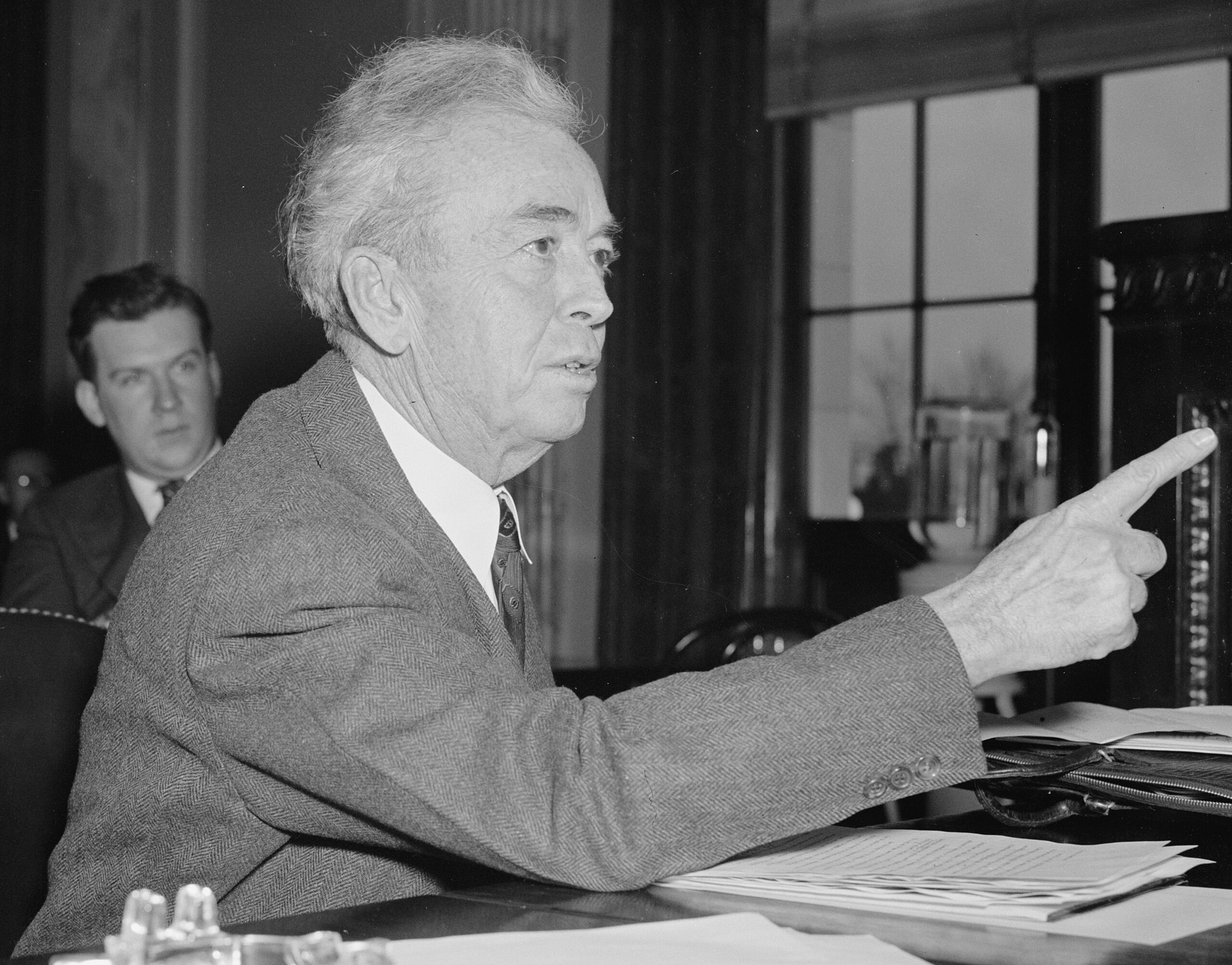
Representative John Elliott Rankin (D-Miss.) had a storied career in Washington. Although he voted with his party most of the time in the 1920s as he was a rural progressive at the time, by the Truman Administration, he was a frequent dissenter from its policies. During his first session of Congress (1921-1923), for instance, he voted with his party 87% of the time, but during the 81st Congress (1949-1951) he voted with his party only 48% of the time. Rankin’s open expressions of bigotry against numerous groups had also increased over time, which made him a lightning rod of controversy and resulted in his favor declining in a party that was increasingly supporting civil rights measures and courting black voters. In 1948, he along with many Mississippi Democrats, backed the State’s Rights Party ticket, or Dixiecrat ticket, in response to Truman’s ordering of the desegregation of the army as well as his embrace of civil rights. At the start of the next Congress, Rankin paid for his support of Strom Thurmond over Harry S. Truman as well as his bigoted conduct by being removed from the House Committee on Un-American Activities, which he had introduced the resolution to make permanent four years earlier. Rankin was now completely out of favor, but he was still by seniority rules the chairman of the Veterans Affairs Committee, and with that position as well as taking advantage of another one of the changes that occurred with the new Congress, he could potentially deal an embarrassing blow to President Truman and give the middle finger to Democratic leadership.
One of the planks that President Truman campaigned on for his 1948 election was for an expansion of the Social Security. Indeed, one of the Democratic Party planks at the Democratic National Convention reads, “We favor the extension of the Social Security program established under Democratic leadership, to provide additional protection against the hazards of old age, disability, disease or death. We believe that this program should include:
Increases in old-age and survivors’ insurance benefits by at least 50 percent, and reduction of the eligibility age for women from 65 to 60 years; extension of old-age survivors’ and unemployment insurance to all workers not now covered; insurance against loss of earnings on account of illness or disability; improved public assistance for the needy” (The American Presidency Project). Rankin saw an opportunity to scuttle this proposed expansion, and do so by a proposal that was hard for his fellow representatives to vote against: veterans’ pensions.
On January 3, 1949, Congress passed a rules change that President Truman had sought, which allowed the chairman of a committee to bring a bill to the floor that had been approved by said committee if the Rules Committee held said measure past 21 days without voting on a rule for consideration. Rankin introduced a measure that would have covered both World War I and World War II veterans that would have provided for, starting at 65, a $90 a month pension regardless of need, as well as $42 a month minimum for widows of veterans, which if enacted was estimated to have come to cost a total of $200 billion (in 1949 dollars), which was four times the amount the U.S. paid out to veterans from Revolution to 1948 (Time Magazine). The Rules Committee at the time was chaired by Adolph J. Sabath (D-Ill.), a staunch liberal and ally of the Truman Administration and he had no interest in this bill going to the floor. Thus, Rankin was able to use the rules change to bring the bill directly to the floor. This put Democrats and Republicans alike in a bind, as no member wanted to be seen as voting against veterans. As the Harvard Crimson (1949) noted, “Democratic leaders cannot require their forces to oppose the pension bill, unless they want a full-scale mutiny on their hands. The GOP is similarly tied, although Republicans can hardly deny some satisfaction at the sight of the Administration taking a licking”. Had World War I veterans only been covered, it is believed the measure would have easily passed. But adding all these World War II veterans set up the United States to pay large sums towards them for many years to come. The New Republic (1949) described the political consequences for this measure being adopted, “Had Rankin’s extravagant proposal of $90 monthly pensions for all 65-year-old veterans of World Wars I and II been approved, President Truman’s program for equitable social security could not have been considered” (7). Many Republicans certainly saw it, as did many Dixiecrats, as an opportunity to put the Truman Administration between a rock and a hard place. Despite their stated commitment to low spending, the top three House Republicans, Joe Martin of Massachusetts, Charles Halleck of Indiana, and Les Arends of Illinois were all in favor of this measure. House Ways and Means Committee ranking Republican, Dan Reed (R-N.Y.), was also for it despite his highly fiscally conservative record which had included voting against Social Security. For the measure to go down and to permit consideration of Truman’s proposed Social Security expansion, World War II veterans would need to speak against this measure, and speak against this measure several of them did. John W. Byrnes (R-Wis.) declared that “This legislation is dishonest…In ten years, our veterans will be shouldering half the nation’s tax burden…I am unalterably opposed to this bill. It is no hot potato as far as this member is concerned” (Time Magazine). The Rankin bill was substantially amended overtime from its original proposal, including only permitting such benefits for veterans who were honorably discharged. Rankin justified the expense of his bill by making a dig at foreign aid spending, “If we can spend untold billions of dollars on other countries, feeding and clothing every lazy lout from Tokyo to Timbuctu – then we can take care of our aged veterans when they are unable to care for themselves” (Time Magazine). Other members of Congress had their takes on this proposed measure:
In favor:
Edith Rogers (R-Mass.), Rankin’s Republican counterpart on the Veterans Affairs Committee, stated “I am distressed to feel that there seems to be a pushing aside of the veterans today. The war is over, but we have not taken care of them; we are not taking care of them, not for a large amount. I agree with the gentleman that this is our last opportunity, perhaps ever, to pass a pension bill for World War I veterans” (Congressional Record, 3110).
William M. Colmer (D-Miss.) stated, “It is all quite apparent now, from the debate, the motions and the amendments that are being offered by the so-called liberal bloc in this House, that their real purpose is to pull the veterans of this country into the pattern which they hope to weave for the country or the so-called Fair Deal program. It must be apparent to all now, from the utterances of these leaders of the so-called liberal bloc, that they want to put the veterans of this country into the same class as the indigent, the poor, the ne’er-do-wells, and that unfortunate class of our people generally who are forced to seek alms at the hands of their Government. They would place the veteran who risked his very life, and bared his breast in defense of his country, under social security. They would do away with the system of pensions for the veterans of the wars which has prevailed in this country since the days of the Revolutionary War. In other words, they would make no distinction whatever between the veterans and the nonveterans,” and went on to state, “…I must confess, if this constitutes liberalism, then I am just a plain old fogey who still believes that it is right, proper, and just that a country give separate, different, and distinct treatment and preference to those who are torn by their Government from their homes and families and required to risk their all as a living sacrifice upon the altar of their country” (Congressional Record, 3111).
Against:
Peter F. Mack (D-Ill.) protested the circumstances under which the bill was brought to the floor, “…I am one of the seven members who walked out of the Veterans’ Committee in the interest of the welfare of the many veterans of this country. My action was in protest against the undemocratic principles being employed in conducting the Committee on Veterans’ Affairs” and went on to state, “The Rankin bill, which was voted out of the Committee on Veterans’ Affairs, was not given adequate hearings and was discussed for only 7 minutes in the committee” (Congressional Record, 3111).
Donald Jackson (R-Calif.) noted how a rules change enabled this bill to be brought forward, “In curbing the power of the Rules Committee it appears that the administration also cut the bonds of the Frankenstein monster which lay strapped on the legislative table, a monster which now appears, licking its chops when committee chairmen sound their whistles” (Congressional Record, 3112).
Stephen M. Young (D-Ohio) stated, “…I will vote against a pension grab of this magnitude. This is the most outrageous, shameful, and untimely bill to be considered in the House of Representatives within my memory. At this time when the Soviet Union is threatening the peace of the world as an aggressor in the Hitler pattern, at a time when this Congress is compelled to appropriate $15,000,000,000 each year for our Air Force, Army, and Navy to defend this Nation, at a time when this Congress is forced to appropriate additional billions for European aid to prevent Communist infiltration into the nations of western Europe, at a time when we are all striving mightily, and spending huge sums of money to maintain the peace of the world, it is outrageous and unthinkable to give serious consideration to this stupendous pension grab” (Congressional Record, 3113).
Liberal Democrat John Carroll of Colorado, a veteran of both World Wars, took on a leading role in opposing this measure, and motioned to kill the bill. Although there was agreement to do so in private, when a public vote was demanded the motion failed. Again, many representatives were afraid of being seen as voting against veterans. The opponents of this measure did find a perfect representative to go up against Rankin; war hero Olin “Tiger” Teague (D-Tex.). Only Audie Murphy was more decorated in World War II than Teague, and it sure didn’t hurt that Teague was a Southern Democrat and not a liberal. He motioned to send Rankin’s bill back to committee for study. Teague’s motion was passed by one vote, 208-207 on March 24th. Democrats voted to kill 151-100 while Republicans voted 57-106, and the American Labor Party’s Vito Marcantonio of New York voted against killing it. Votes to kill the measure included three future presidents in Richard Nixon (R-Calif.), John F. Kennedy (D-Mass.), and Gerald Ford (R-Mich.). Although many conservatives voted to stick it to the Truman Administration, there were those old anti-New Deal hardliners who would not go along with this scheme, including Clare Hoffman (R-Mich.), James Wadsworth (R-N.Y.), John Taber (R-N.Y.), and Robert F. Rich (R-Penn.). Among Rankin’s Mississippi colleagues, only William Whittington, who was the most favorable to the Truman Administration of the representatives yet had fiscally conservative leanings, opposed his pension bill. All four Republicans had opposed Social Security in 1935. Although it was largely considered liberal to line up against this measure and thus save Truman’s Social Security expansion and not have veterans as a separate and special group among Americans, there were liberals who supported Rankin’s bill despite voting liberal on other key measures in 1949, including Cecil King (D-Calif.), who would become the House’s leading advocate for Medicare, future Senator Abe Ribicoff (D-Conn.), and future Majority Leader Mike Mansfield (D-Mont.).
The New Republic (1949) wrote after this episode, “The final vote was not the issue of pensions. It was straight party politics. John Rankin, bitterest of Dixiecrats, is eternally eager to embarrass President Truman in every way possible. This time his opposite extreme, Vito Marcantonio (ALP, N.Y.), presumably with the same intent, lined up with him. And the House Republican leadership saw the Rankin pension-grab bill a fine opportunity to put the Administration in an impossible position. Minority Whip Charlie Halleck and the ranking Republican member of the House Ways and Means Committee, Daniel Reed (R-N.Y.), both voted for the pension. When Rankin rose to speak for his boodle bill he addressed his remarks, significantly, to the Republican side of the House. The GOP, which is committed on the record to (a) a contributory social-insurance program and (b) economy, followed his lead by voting in bloc for (c), a pension program which would have ruled out both (a) and (b)” (7).
This perspective was held not only by liberals, but also some Republicans. Kentucky Irish American (1949) reported that Representative Thruston Morton (R-Ky.) had made the same allegation that Rankin and Republicans were simply out to embarrass President Truman (1). Instead of the Rankin pension bill, in 1950 the Social Security Act Amendments were passed, which increased Social Security benefits, expanded coverage, and established aid to the disabled among other provisions.
References
1948 Democratic Party Platform. The American Presidency Project.
Retrieved from
https://www.presidency.ucsb.edu/documents/1948-democratic-party-platform
HR 2681. Motion to Recommit for Further Study. Govtrack.
Retrieved from
https://www.govtrack.us/congress/votes/81-1949/h27
Pensions for Veterans of World War I and World War II. (1949, March 24). The Congressional Record, 3110-3115. Washington, D.C.: Government Printing Office.
Retrieved from
Rankin’s Folly. (1949, March 25). The Harvard Crimson.
Retrieved from
https://www.thecrimson.com/article/1949/3/25/rankins-folly-prepresentative-rankins-pension-plan/
The Congress: Rankin’s Revenge. (1949, February 28). Time Magazine.
Retrieved from
https://time.com/archive/6602178/the-congress-rankins-revenge/
House Stages Farce. (1949, April 2). Kentucky Irish American.
Retrieved from
https://www.newspapers.com/image/1137684085/
Rankin, John Elliott. Voteview.
Retrieved from
https://voteview.com/person/7731/john-elliott-rankin
The Week. (1949, April 4). The New Republic.
Retrieved from
 Mad Politics: The Bizarre, Fascinating, and Unknown of American Political History