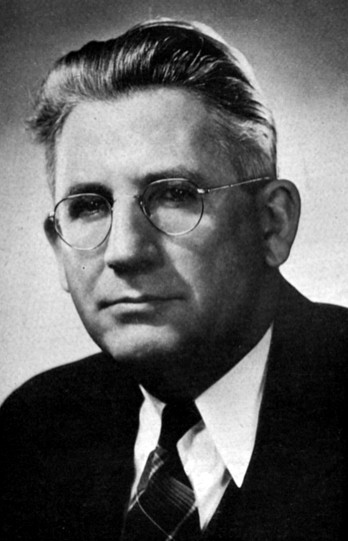
Although the most famous “Senator Douglas” from Illinois is Stephen Douglas, Abraham Lincoln’s opponent in the 1858 Senate election and 1860 presidential election who advocated for popular sovereignty on the issue of slavery and sponsored the infamous Kansas-Nebraska Act in 1854, a more recent “Senator Douglas”, one that contemporary Democrats would feel they have much more in common with, was Paul Howard Douglas (1892-1976).
As a youth, Douglas had grown up in Maine, a staunchly Republican and conservative state, and from a young age he was a rebel against such politics. Indeed, he was considered quite radical. One of his classmates at Bowdoin College, Sumner Pike, who served on the Atomic Energy Commission, recalled him as “rather to the left of Eugene V. Debs, who was tried for something about once every four years. Douglas was a radical campus leader in almost everything. If he could find a minority, he would go with it” (Time Magazine). Douglas was inspired by multiple muckrakers. His longstanding opposition to corruption derived from Lincoln Steffens’ The Shame of the Cities, his strong support for civil rights from Ray Stannard Baker’s Following the Color Line, Upton Sinclair’s The Jungle inspired his later support for consumer protection laws, and Jacob Riis’ How the Other Half Lives inspired his support for economic regulations as buffers for the working class (Bergman). Douglas advanced through academia, spending two years at Columbia and two years at Harvard. He taught at several universities before settling on the University of Chicago in 1920, where he became a popular instructor. Douglas’s lessons were highly memorable. For instance, Rose Friedman, one of his students, recalled that he demonstrated the concept of marginal utility by bringing a bag of oranges to class and toss them to his students one by one until they yelled “no more” (Bergman). His time in academia grounded his radicalism into thinking about real-world application, and he wanted to do so scientifically. In 1934, he authored his most notable work in economics in The Theory of Wages and in 1947 he would be elected president of the American Economics Association. As an economist, he was a Georgist, believing in a land tax, and he did not affiliate himself with a major political party for much of his life. Douglas found the Republican Party too conservative and the Democratic Party too corrupt. However, he advised both Republican Governor Gifford Pinchot of Pennsylvania and Democratic Governor Franklin Delano Roosevelt of New York on the issue of unemployment and would draft pension and old-age insurance laws for Illinois (Time Magazine). Although Douglas would eventually find his home in the Democratic Party, he was not there yet in the 1920s. He even wrote, “There is indeed no logical place in American life for the Democratic Party” (Time Magazine). Douglas also made a key connection with progressive Chicago attorney Harold Ickes. Together, they protested against public utilities magnate Samuel Insull for his stock manipulations (Time Magazine). In May 1930, Douglas was staunchly opposed to the Smoot-Hawley Tariff. He thus with other economists who initiated a petition, signed by 1,028 economists, urging President Herbert Hoover not to sign the Smoot-Hawley Tariff bill (Econ Journal Watch). Prioritizing party orthodoxy, Hoover did not heed the petition.
The New Deal Warms Douglas to the Democrats
Although Douglas had been an advisor to FDR, he still stuck to his socialist guns and voted for perennial Socialist presidential candidate Norman Thomas in 1932. However, Douglas would find much to like about the New Deal. He indeed found that a lot of what was in the New Deal had originated from socialist thinking (Time Magazine). Secretary of the Interior Harold Ickes would get Douglas appointed to the Consumers’ Advisory Board of the National Recovery Administration, but this was dismantled after the Supreme Court struck down the National Industrial Recovery Act in ALA Schechter Poultry Corp. v. U.S. (1935). He was involved in drafting After Douglas and his second wife, Emily Taft Douglas, visited Italy, he came to strongly oppose fascism and like much of the Western world was aghast at Mussolini’s invasion of Ethiopia, which made him drop pacifism. Interestingly, despite serving in a Democratic administration, Douglas tried to win the Republican nomination for city council and then campaigned for the winner of the primary. However, in 1939, Douglas was approached to run for the city council post as a Democrat. He agreed to do so as long as Mayor Ed Kelly respected his independence. There were many men on the city council who could already be expected to do Kelly’s bidding, and he thought supporting Douglas would benefit his credibility, thus this arrangement was acceptable. Kelly told him, “We need an anchor man on the council, someone who can inject some thought into it” (Time Magazine). Douglas attracted a lot of the university and the black vote, and won the election.
Douglas was often a gadfly on the Chicago City Council, calling for numerous reforms, including to the corrupt public school system, which other aldermen stymied. Indeed, this was often the fate of his efforts at reform, and he would tell his friends, “I have three degrees. I have been associated with intelligent and intellectual people for many years. Some of these aldermen haven’t gone through the fifth grade. But they’re the smartest bunch of bastards I ever saw grouped together” (Time Magazine). If there was a vote on the City Council in which there was one dissenter, it was most likely Douglas. In 1942, he sought the Democratic nomination for the Senate, but lost as the Kelly-Nash machine preferred someone who could be counted on to follow the machine line in Congressman Raymond McKeough, who won the primary thanks to a massive vote for him in Chicago. McKeough lost the election to incumbent Republican Senator C. Wayland “Curly” Brooks. After his primary loss, Douglas resigned from the Chicago City Council to serve in World War II, entering as a private in the Marines despite being 50 years old and having been rejected for service during World War I due to poor eyesight thanks to obtaining numerous waivers by Navy Secretary Frank Knox. He would end the war as a lieutenant colonel and won two purple hearts. Interestingly, Emily Taft Douglas managed to get elected to Federal office before he did, with her defeating At-Large Republican Congressman Stephen A. Day, who I covered in the last post.
In 1948, Douglas was interested in running for governor, but the Democratic Party organization dreaded the impact he could have on state patronage, being an independent reformer and all, thus they had him run for Senate while Adlai Stevenson III ran for governor. Initially, Douglas was not given much of a chance against the popular Senator Brooks. Brooks had a well-deserved reputation as a conservative and a non-interventionist, and such politics still had significant traction in Illinois. His record was almost down-the-line support for the Republican 80th Congress on domestic issues and he had voted against both aid to Greece and Turkey and the Marshall Plan. Douglas decided to campaign all over the state in a jeep station wagon with a loudspeaker, making 1,100 speeches over six months (Time Magazine). He campaigned against the Taft-Hartley Act (which Brooks voted for), for the Marshall Plan, for civil rights (Brooks had voted favorably on such measures), public housing (Brooks had voted against killing the Taft-Ellender-Wagner Bill, one of his few liberal turns). Brooks, believing he was too far ahead of Douglas to need to debate, dismissed his request for a Lincoln-Douglas style debate. Thus, Douglas, having no Lincoln in Senator Brooks, held the debate himself, talking to an empty chair. While talking to an empty chair has quite the potential for backfiring as it did when Clint Eastwood tried it at the 2012 Republican National Convention, it worked here. The public liked the honesty and sincerity of the man they saw on the stage. As one steelworker who witnessed the debate said of him, “That guy’s no politician. He doesn’t try to con you” (Time Magazine). Douglas pulled off what was regarded as a major upset, as he defeated Brooks by over 10 points, running ahead of President Truman.
Senator Douglas
Senator Douglas immediately became known as a liberal maverick. His most admired senators were not Democrats, rather Republican maverick Charles Tobey of New Hampshire and conservative Robert Taft of Ohio (he respected the latter’s intellect and honesty even if he often disagreed with his conclusions) and did not support President Truman’s backing of the Wagner-Murray-Dingell bill, which if enacted would have established the equivalent of Britain’s National Health Service, believing he was trying to accomplish too much at once (Time Magazine). However, from a liberal perspective, Douglas’s voting record was outstanding. He agreed with the position of the liberal Americans for Democratic Action a remarkable 96% of the time, and his DW-Nominate score was a -0.58, making him one of the most liberal senators of his day. Douglas also sided with the conservative Americans for Constitutional Action 13% of the time from 1955 and 1966. His score is a bit higher with them than you might have expected from the conservative standpoint, and this was due to him sometimes supporting spending reductions proposed by conservatives and his consistent opposition to subsidizing industries. Douglas said regarding backing a 5% spending cut across the board, “This is not a matter of liberalism v. conservatism. To be a liberal one does not have to be a wastrel”, but still considered himself a “90 percent” Fair Dealer (Time Magazine). Douglas was one of those senators who could not be swayed by Majority Leader Lyndon B. Johnson’s (D-Tex.) support for the Senate filibuster nor his weakening amendments to pass civil rights legislation. He would be involved in the crafting of Medicare, the Elementary and Secondary Education Act of 1965, the Area Redevelopment Act, and fought against conservative efforts to undo “one man, one vote” established by the Warren Court by Constitutional amendment. He would also advocate for the 18-year old vote, which was ratified in 1971. Douglas had staying power, although this was partially due to his first two elections being in good Democratic years. He was also a strong supporter of the New Frontier and Great Society programs, but this also came with a significant disagreement with liberals in his continuing support of the Vietnam War, and he would defend it after his time in the Senate. Speaking of…
The 1966 Election: Backlash
In 1966, the Democrats were facing headwinds due to both how the Vietnam War was turning but also a backlash to President Johnson’s Great Society. Furthermore, despite the most far-reaching civil rights laws having been passed since Reconstruction, there were numerous urban riots which had a negative impact on public opinion on the subject. Worse yet for Douglas, Republicans managed to score a top recruit for the 1966 midterms in the highly successful businessman Chuck Percy, who had once been one of his students.
Although Percy was also staunchly pro-civil rights and favored a good deal of the Great Society, he was seen as a preferable alternative. The age contrast couldn’t have helped Douglas either; he was now 74 years old and Percy was a comparatively young 47, highly telegenic, and his presentation was polished and intelligent. He won the election by 11.1%, an even bigger defeat for Douglas than he had handed Senator Brooks in 1948. Percy had almost certainly gotten some sympathy vote after the brutal murder of his daughter, Valerie. Percy, who I have also already covered in my RINOs series, would, like Senator Douglas, serve three terms before losing reelection. Douglas would subsequently accept a post teaching at The New School in New York City. In 1968, he sparred on the subject of limited government with Conservative MP Enoch Powell in an American Enterprise Institute hosted debate. However, his public life was curbed when he suffered his first stroke in 1969. Douglas would nonetheless manage to get his autobiography, In the Fullness of Time, published in 1972. He would suffer two more strokes before his death on September 24, 1976, at the age of 84. Senator Douglas was a figure that even if you have fundamental disagreements with his politics, you can still respect him as an honest broker who could not be bought or bossed, and if you have the cynical views that many seem to express on politics these days, that’s worth its weight in gold.
References
ADA Voting Records. Americans for Democratic Action.
Retrieved from
Bergman, W. (2023). Paul H. Douglas (1892-1976). The Palgrave Companion to Chicago Economics, 249-273.
Retrieved from
Douglas, Paul Howard. Voteview.
Retrieved from
https://voteview.com/person/2691/paul-howard-douglas
Douglas, P. & Powell, J.E. (1968). How Big Should Government Be? American Enterprise Institute Press.
Retrieved from
Economists Against Smoot-Hawley. (2007, September). Econ Journal Watch, 4(3), 345-358.
Retrieved from
https://econjwatch.org/articles/economists-against-smoot-hawley
Ex-Senator Douglas Dies. (1976, September 25). The Evening Times, 1.
Retrieved from
https://www.newspapers.com/image/71651412/
The Congress: The Making of a Maverick. (1950, January 16). Time Magazine.
Retrieved from
https://time.com/archive/6614037/the-congress-the-making-of-a-maverick/
 Mad Politics: The Bizarre, Fascinating, and Unknown of American Political History