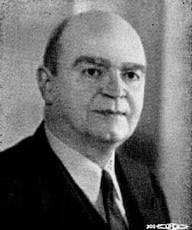
In the period before World War II, the Midwest was the heartland of non-interventionism and Chicago was regarded as the capital. One of the more notable and controversial figures from the state in this period was Stephen Albion Day (1882-1950).
Day was on track to have a career in politics from the time of his birth. His father was William Rufus Day, who would become prominent as acting Secretary of State and then briefly holding the role under President William McKinley. His most prominent position was as a Supreme Court justice, having been nominated by President Theodore Roosevelt. Through his father, he was able to get a position assisting Chief Justice Melville Fuller. From 1908 until his death, Day would practice law, and he considered himself a student of the Constitution. He was also a staunch foe of the Treaty of Versailles.
In the 1920s, Day sought a political career, but what held him back was that he was a foe of Prohibition, and had been a foe as early as 1922 when he organized the Anti-Prohibition League (The Belleville News-Democrat). He stated, “I was never for the eighteenth amendment. I felt that a mandate on private morality had no place in the constitution. It broke down respect for the basic law of the land” (The Dispatch). Thus, his repeated efforts to get elected to Congress as a Republican flopped.
In 1933, Day wired his congratulations to Adolf Hitler after his election as chancellor, a questionable move at best even in that time. It is possible that he did so out of his opposition to Germany’s treatment under the Treaty of Versailles and saw Hitler as a figure who rebelled against the nation’s harshly imposed reparations. Something else to bear in mind is that Mein Kampf was available in the United States at the time but only in a censored format that excised explicitly anti-Semitic and militaristic passages, as I covered in my 2022 article, “Who Censored Mein Kampf in America?”.
In 1936, Day ran for the Republican nomination for president, although he knew he had no chance of clinching it, stating afterwards that “it was a gesture to emphasize the necessity of upholding the constitution and preserving the integrity of the Supreme Court of the United States” (The Newark Advocate). He saw that the court was potentially under threat by the Roosevelt Administration, as it had struck down numerous New Deal laws, including the Agricultural Adjustment Act and the National Industrial Recovery Act. Day’s concerns were correctly placed, as Roosevelt attempted to get “court-packing legislation” enacted, but even the strongly Democratic Senate would not accede to it in the end.
On September 7th at the Lena, Illinois festival Day predicted that if elected for a third term, FDR would get the US into war in Europe two weeks after the election and accused him of being “greedy for power” for running for a third term, and that his request for $5 billion for national defense purposes was an effort to divert attention from domestic issues (Freeport Journal-Standard). Although Roosevelt won reelection as well as Illinois, a figure who won even bigger was Republican Dwight Green, who won the gubernatorial race in a landslide and he had coattails, from which Day among others benefited. He and fellow non-interventionist Republican William G. Stratton were elected at-Large.
At the start of his time in Congress, Day pledged to support adequate defense of the United States and to oppose involvement in World War II (The Dispatch). Whether he was supportive of “adequate defense” is questionable given what his record would be, but to be sure, he was an unfailing opponent of the latter until Pearl Harbor. Day was also a foe of the New Deal, and it was hard to find a stronger opponent of FDR’s foreign policy. However, he also voted against the Vinson Anti-Strike Bill in 1941. Day was also a strong supporter of the Dies Committee out of his staunch anti-communism. The Daily Worker, the Communist Party’s newspaper, accused him of making a “Nazi speech” with anti-Semitic remarks to an audience of 2,000 on September 4, 1941 (Lapin). A non-communist source, Detroit Evening Times, had a different description of this speech. Rather than a “Nazi speech” with anti-Semitic remarks, they characterized it as an attack on Soviet Russia, President Roosevelt, and Lend-Lease Aid to the Soviets, with Day declaring, “Internationalism has become bonder and bolder. Like a serpent it has crawled into our midst. By the recent actions of our President we have been brought face to face with the most dangerous attack that has ever been made upon the welfare of the American people and their continued right to live under the blessings of our American Constitution. This serpent of international socialism is known as communism. It is the established political and economic philosophy of the Soviet Union – that same Soviet Union which has recently formed an active alliance with Britain. We shall be asked to extend that alliance to include the United States of America, at least to the extent of providing billions of dollars of the money of American taxpayers to make gifts to this same Soviet Union” (Detroit Evening Times). He and others in Congress were trying to push an amendment to eliminate aid to the USSR from Lend-Lease, but the effort overwhelmingly failed. In his pursuit of the non-interventionist cause, he got into some trouble due to his carelessness in his associations.
The Flanders Hall Connection
On August 4, 1941, reporters Drew Pearson and Robert S. Allen reported in their column The Washington Merry-Go-Round that Day had published a non-interventionist book titled “We Must Save Our Republic”. The problem? It was published through the small publisher Flanders Hall of Scotch Plains, New Jersey, an entity run by Sigfrid Hauck and financed by George Sylvester Viereck, a registered agent who received $1000 a month from Nazi Germany (Pearson and Allen). Unless Day had somehow forgotten what he was told in Pearson and Allen’s interview with him about the Nazi connections of the firm he had had about a month prior to the book’s publishing, he had done so with his eyes open (Pearson and Allen, September 1941).

They also reported that a speech that Day delivered on June 15th inspired the book, in which he called on Britain to repay its war debts. Interestingly, this speech was mimeographed and sent to newspapers from Columbia Press Service, which publicized for Viereck (Pearson and Allen). It is impossible to the escape the conclusion that Day at minimum exercised terrible judgment on this matter. The publishing rights to the book were, according to Sigfrid Hauck, sold to another firm three weeks after its publication and Flanders Hall shuttered in November 1941 (The Courier-News). Despite this unsavory connection, Day was reelected to his at-Large House seat in 1942.
During the 78th Congress, he supported banning the poll tax and although he introduced such a measure in 1943, he hadn’t done what was needed to get it considered as the Marcantonio bill was what proponents rallied behind (St. Paul Recorder). Day voted for the Marcantonio bill. He also warned against internationalism and most notably was one of 29 representatives to vote against the Fulbright Resolution in 1943, which expressed the House’s support for establishing an international peacekeeping body after the war, which would become the United Nations. On September 7th, Day condemned the push towards internationalism, stating, “internationalists are trying to edge us up to a commitment from which we cannot recede” (Freeport Journal-Standard, 1943). He supported overriding President Roosevelt’s vetoes of anti-subsidy legislation and tax relief and relentlessly opposed price controls, but also voted to sustain his veto of the Smith-Connally Act which provided a mechanism for stopping wartime strikes. Day’s overall record was in many ways staunchly to the right and extremely nationalist but was friendly to organized labor and he supported more benefits for workers in domestic war industries. His DW-Nominate score was a 0.443. 1944 was a good year for President Roosevelt in many ways; in addition to his reelection victory several outspoken foes lost reelection, and Day was one of them, losing to Democrat Emily Taft Douglas, wife of future Senator Paul Howard Douglas. Day continued his legal career, and died on January 5, 1950, after a two-month illness.
References
2,000 Hear Day Attack Russia and President. (1941, September 5). Detroit Evening Times, p. 3.
Retrieved from
https://www.newspapers.com/image/874698961/
Anti-Poll Tax Bill Is Introduced in Congress By New York Member. (1943, March 12). St. Paul Recorder, p. 1.
Retrieved from
https://www.newspapers.com/image/884209638/
Day Says America Must Preserve Its Independent Destiny. (1943, September 7). Freeport Journal-Standard, p. 1.
Retrieved from
https://www.newspapers.com/image/3119931/
Day, Stephen Albion. Voteview.
Retrieved from
https://voteview.com/person/2435/stephen-albion-day
Ex-Congressman Ohio Native, Dies. (1950, January 6). The Newark Advocate, p. 8.
Retrieved from
https://www.newspapers.com/image/288101424/
Gabbett, H.E. (1942, February 19). Viereck Used 5 in Congress, Juror Told. Times Herald, p. 1.
Retrieved from
https://www.newspapers.com/image/1037992308/
Hauck Publishing Firm Folds Up in Scotch Plains. (1941, November 17). The Courier-News, p. 1
Retrieved from
https://www.newspapers.com/image/219742340/
Introducing – Stephen A. Day, William G. Stratton, Congressmen. (1941, January 8). The Dispatch (Moline, Illinois).
Retrieved from
https://www.newspapers.com/image/341694933/
Lapin, A. (1942, May 20). Rep. Day: Writer of Fascist Book, Darling of 5th Column. The Daily Worker, p. 4.
Retrieved from
https://www.newspapers.com/image/1144048037/
Pearson, D. & Allen, R.S. (1941, August 4). Petoskey News-Review, p. 1.
Retrieved from
https://www.newspapers.com/image/554637816/
Pearson, D. & Allen, R.S. (1941, September 1). Spokane Chronicle, p. 1.
Retrieved from
https://www.newspapers.com/image/562792632/
Predicts F.D.R. Will Involve U.S. In European War. Freeport Journal-Standard, p. 12.
Retrieved from
https://www.newspapers.com/image/38721303/
Stephen Day Dies; Former Congressman. (1950, January 6). The Belleville News-Democrat, p. 9.
Retrieved from
https://www.newspapers.com/image/769529256/
Stephen A. Day, Ex-Member of Congress, Dies. (1950, January 6). Chicago Tribune, p. 16.
Retrieved from
 Mad Politics: The Bizarre, Fascinating, and Unknown of American Political History