Grand Rapids, Michigan, although currently represented by a Democrat due to the 2020 redistricting, has a long history of Republican representation in Congress with few Democratic breaks in between. Its most famous politician of all time of course is Gerald Ford, and as so many others who make it to the top, he had to overcome a hurdle to get his start. This hurdle was Bartel John “Barney” Jonkman (1884-1955). On December 12, 1939, Grand Rapids’ longtime Congressman Carl Mapes (R-Mich.), died, and elected in his place in 1940 was Jonkman, an attorney who had previously served as the prosecuting attorney of Kent County.
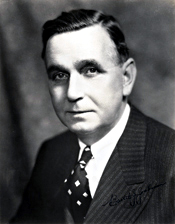
Jonkman, much like Michigan’s senior senator Arthur Vandenberg was among the numerous Americans of Dutch heritage in the state; his father, Reverend John B. Jonkman, had immigrated to the US with his wife Sarah from the Netherlands in 1882. The district he represented even had a strongly Dutch portion known as “Little Netherlands”, which would regularly vote strongly for him (Time Magazine). On domestic issues, Jonkman was a strong Republican, staunchly opposing economic controls, New Deal programs, and seldom supporting significant liberal measures, with his vote for a school lunch program in 1946 being one of the few exceptions he made. On civil rights, Jonkman voted to ban the poll tax four times. As a member of the House Foreign Affairs Committee, he was before Pearl Harbor a voice for non-interventionism; indeed, Michiganders in general were against American involvement in World War II and the Republicans were unified against it. A competent partisan, his views were among the more relevant in Congress as a member of the Foreign Affairs Committee, and he was the subject of an analysis by Isaiah Berlin in 1943 for the British Foreign Office, who described him as “ the fourth of the Republican Opposition group on the committee. An agreeable man, shrewd, capable and very determined in his opposition to the Administration in both its foreign and domestic policies. Pure Isolationist before Pearl Harbor, and, in fact, typical of the Michigan Republican Bloc (whose most notorious member is Clare Hoffman). Seems convinced America is playing Santa Claus again in this war, and is doing his best to obtain facts and figures which will show up this fact. A Methodist; age 59. Nationalist” (Hachey).
Although Jonkman did support the idea of an international peacekeeping body after World War II, supported aid to Greece and Turkey, and supported the Marshall Plan, he was opposed to anything further. In 1946, Jonkman voted against a loan to Great Britain and the following year when the Republicans were in the majority, he pushed a cut in postwar aid to Europe that passed the House. However, the Senate overwhelmingly turned it down, with even some who were normally critics of foreign aid going against the cut. The House then agreed to the Senate’s restoration. Jonkman also voted against a bill in December 1947 providing interim aid to Europe, which Congress commandingly voted for. Despite his vote for the Marshall Plan, he would criticize the European Recovery Program (ERP), frequently referring to it as “burp” (Time Magazine). Ideologically, he sided with the liberal Americans for Democratic Action 12% of the time and his DW-Nominate score was a 0.394. While he was not a man of zero compromise like fellow Michigander Clare Hoffman, his foreign policy views attracted the opposition of 34-year old World War II veteran Gerald Ford.
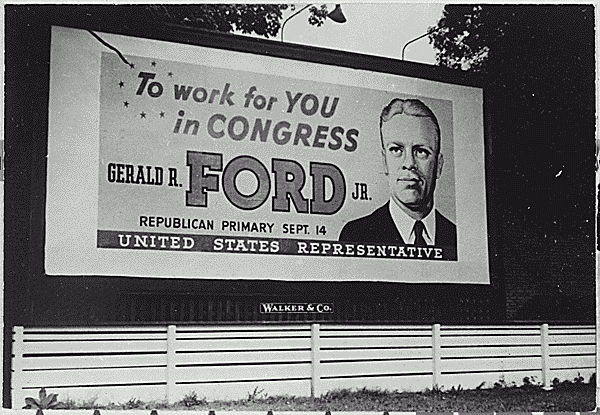
In 1948, Ford, who had dropped his non-interventionist ways while serving in World War II, challenged Jonkman for renomination, running on an internationalist platform, much like his mentor and political hero Senator Arthur Vandenberg. Both Ford and Vandenberg had been on the same page as Jonkman before Pearl Harbor; Vandenberg was one of the most notable Senate spokesmen for the non-interventionist cause and Ford was a member of the America First Committee. They had changed, and while Jonkman had too, he had not done so nearly as much. He repeatedly refused calls by Ford to debate him on foreign policy and generally dismissed his campaign (Time Magazine). This turned out to be a catastrophic underestimation of the young man, as he ran a highly effective campaign of hundreds of volunteers canvassing neighborhoods to promote his candidacy. Ford won the Republican primary by a 2-1 margin. Times had changed in Michigan, once one of the most non-interventionist states in the nation. Jonkman returned to practicing law in Grand Rapids, doing so until his death on June 13, 1955. Jonkman would not be the only man Ford would topple in Republican politics; he would win a vote to supplant Congressman Charles Hoeven of Iowa for the post of chairman of the House Republican Conference (the third highest post in House Republican leadership) in 1963 and after the 1964 election he would win a vote to oust Minority Leader Charles Halleck of Indiana from his post. This put him in the leadership position necessary to be considered for vice president with the resignation of Spiro Agnew in 1973.
References
ADA Voting Records. Americans for Democratic Action.
Retrieved from
Armed Forces: In the Semi-Finals. (1948, September 27). Time Magazine.
Retrieved from
https://time.com/archive/6776438/armed-forces-in-the-semi-finals/
Bartel J. Jonkman. Heritage Hall, Hekman Library (Calvin University).
Retrieved from
Hachey, T.E. (Winter 1973-1974). American Profiles on Capitol Hill: A Confidential Study for the British Foreign Office, 1943. The Wisconsin Magazine of History, 57(2), pp. 141-153.
Retrieved from
Jonkman, Bartel John. Voteview.
Retrieved from
 Mad Politics: The Bizarre, Fascinating, and Unknown of American Political History