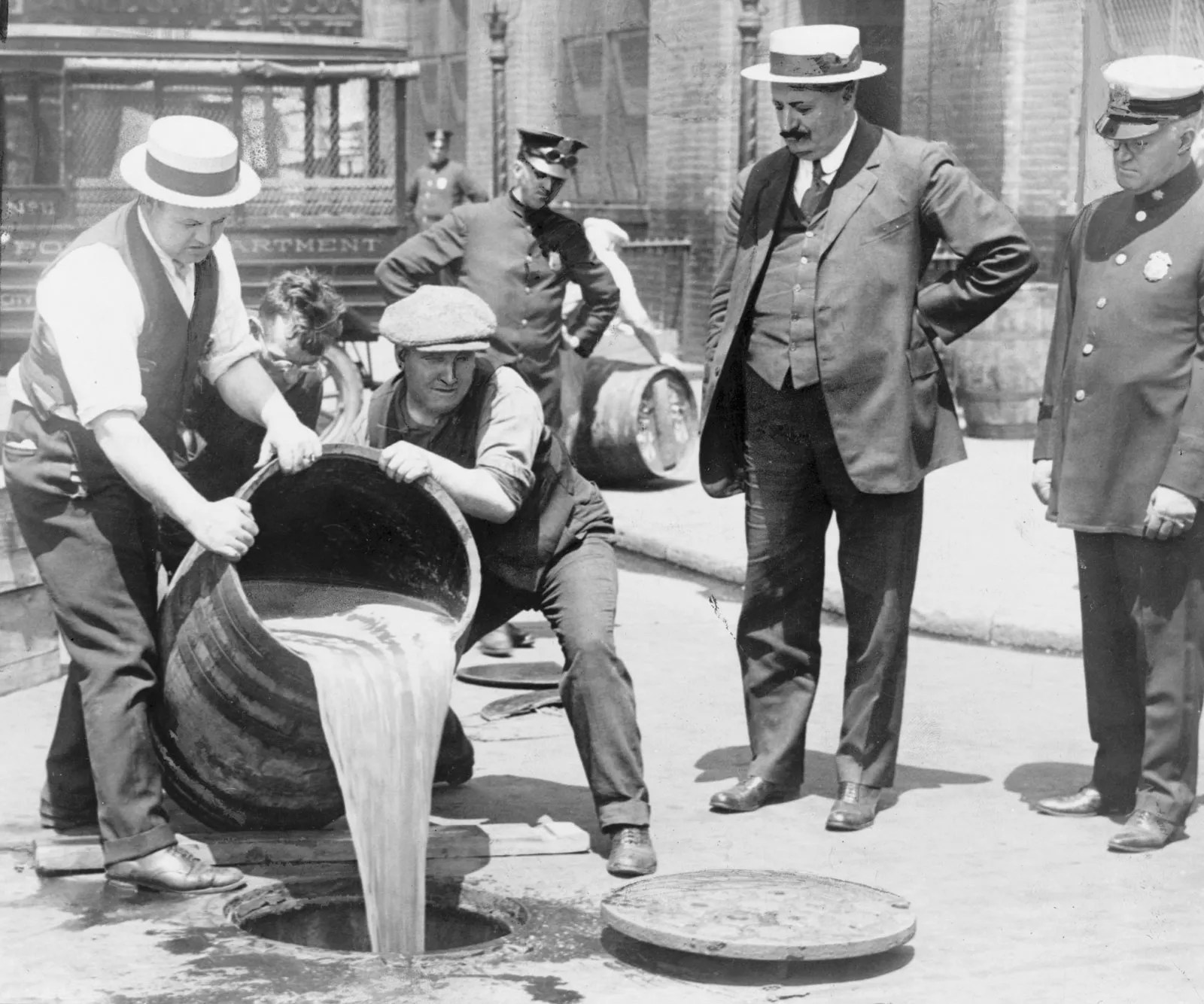
By 1917, the push for Prohibition was at its strongest. Wayne Wheeler of the Anti-Saloon League, a pioneer of lobbying tactics used today, was able to score many election wins across the country. Party didn’t matter to him as long as the individual was for Prohibition, and this plus World War I set the nation for Prohibition and against that which was German. Sauerkraut became temporarily known as “liberty cabbage” and since beer drinking is a strong part of the German culture, that was set upon too. On August 1, 1917, the Senate voted for Senate Joint Resolution 17, sponsored by Senator Morris Sheppard (D-Tex.), proposing a Constitutional amendment to prohibit the production, sale, and transportation of alcohol. The amendment was adopted 65-20 (D 36-12, R 29-8). The House followed up on December 17th, with the House side of the resolution sponsored by Charles Carlin (D-Va.) The amendment was adopted 282-128 (D 140-64, R 138-62, Prog. 2-1; Soc. 0-1; IR 1-0, Proh. 1-0). The different parties listed are Progressive, Socialist, Independent Republican, and Prohibitionist.
There was a strong rural vs. urban character to the vote on Prohibition, with major cities overwhelmingly voting against it. Although many conservatives voted for, there were a significant number of dissenters. Rural liberals were easily in favor, while urban liberals were always against. A few interesting nay votes came from Alabama, including that of Tom Heflin, who was known to favor Prohibition. Some of the votes against came out of a sense of state’s rights rather than opposition to what Prohibition was aiming to achieve. Interestingly, the most notable progressive Republicans, such as Borah, Norris, and La Follette, were supportive. Prohibition stands as a bit of an issue that can be supported or opposed from the left and right for different reasons. Indeed, alcohol does have a cost to society and progressives of the time were committed to using the forces of government to improve society, but conservatives could see this as a moralistic issue and also as a means of improving efficiency. After all, a sober worker is a productive worker. Democrats of the Jeffersonian school could see this as both treading on the states and an intrusion upon personal liberty. To examine how the votes stack up with ideology, at least as defined by DW-Nominate scaling, click the documents below. A checkmark means paired for and an “X” means paired against, bold italics means Republican, and plain text means Democrat.
Senate Prohibition Vote, Details:
House Prohibition Vote, Details:
 Mad Politics: The Bizarre, Fascinating, and Unknown of American Political History