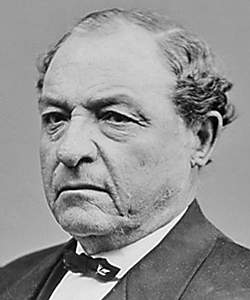
Trump is president for a second time, and while there hasn’t been anyone with his exact last name in Federal office before, there was an oddly named fellow named Philadelph Van Trump (1810-1874), although unlike Trump he was never a Republican.
The mid-19th century was a strange time in American politics. Before the existence of the Republican Party the major rival of the Democratic Party was the Whig Party. The Whigs were a broad coalition of politicians who had come together in opposition to President Andrew Jackson and his groundbreaking use of executive power. Indeed, in 1850 you could find Abraham Lincoln in the same party as Alexander Stephens, who would be vice president of the Confederacy. However, over time the differences within this coalition only grew. The most vital of these issues was of slavery, with an increasingly intractable divide between “conscience Whigs” and “cotton Whigs”. Van Trump started in the Whig Party and in 1852 he participated in last Whig National Convention, which nominated General Winfield Scott. However, the Whigs tried too hard to appeal to everyone and thus ended up having little appeal; the ticket only won the states of Massachusetts, Kentucky, Tennessee, and Vermont, a result that, with the enactment of the Kansas-Nebraska Act, spelled the death of the Whig Party. Many Whigs flocked to the rapidly growing American (“Know Nothing”) Party, as did Van Trump, and in 1856 he ran for governor of Ohio on the American Party ticket. However, this made the gubernatorial race three-way, splitting the Democratic vote and resulting in the election of Republican Salmon P. Chase. In 1860, Van Trump strongly supported the Constitutional Union Party’s ticket which ran John Bell for president and Edward Everett as vice president. The platform was maintaining the union but leaving slavery alone. Van Trump’s movement between parties is one way in which he actually was similar to current President Donald Trump, as Trump has in the past been in the Democratic Party as well as in the Reform Party for when he was running for that party’s nomination for president in 2000.
During the War of the Rebellion, Van Trump was a staunch opponent of President Lincoln and the Republicans. From 1862 to 1867, he served as a judge of the court of common pleas, commanding a lot of respect in this role for acting as he saw fit under the law even under threat of imprisonment. As the newspaper The Stark County Democrat described in his obituary, “His career as a Judge was a marked one, and perhaps no jurist ever more completely commanded respect of the bar. He was profoundly learned in the law, possessed iron firmness and the greatest suavity. The celebrated kidnapping case of Dr. [E. B.] Olds came before him, but he fearlessly enforced the law, although surrounded with bayonets and himself threatened with military arrest and imprisonment. But for the hasty intervention of the Supreme Court, he would have imprisoned Gov. [David] Tod under the kidnapping act” (DiBacco). For context, Dr. Olds was considered among the leading Copperheads of Ohio, or those who wanted a peace agreement with the Confederacy for an amicable break. Governor Tod had recommended him for arrest for his activities, which were regarded as siding with Confederates, and he was himself arrested for kidnapping briefly until freed by the Supreme Court (Roseboom & Wisenburger, 190-192). His efforts at higher judicial office met with little success, as he thrice lost elections to the Ohio Supreme Court. Instead of again seeking a post on the court, in 1866 Van Trump ran for Congress and won in the at-the-time Democratic 12th district.
Congressman Van Trump
During his time in office, Van Trump not only opposed the impeachment of President Andrew Johnson but also delivered a speech against it in Congress. As a member of the Committee on Railroads, he was a consistent opponent of the Republican policy of generous land grants to railroads. Van Trump was also consistently against high tariffs, an economic bread and butter policy of the GOP at the time. However, during his time in office he developed heart disease, and he did not seek reelection in 1872. Van Trump’s DW-Nominate score was -0.591, or one of the most liberal per that system in his time. He did not live long in retirement, dying on July 31, 1874. Van Trump also has a rather interesting connection to Washington State, where I live, in that his son, Philemon Beecher Van Trump, was the first person to document climbing Mt. Rainier in 1870.
Van Trump was different in many ways than current President Trump, and yet another one of those was in his riches. As his obituary in The Stark County Democrat read, “he died comparatively poor because he was too generous to accumulate wealth” (DiBacco).
References
DiBacco, T.V. (2018, May 4). The other Trump in history. Orlando Sentinel.
Retrieved from
Roseboom, E.H. & Weisenburger, F.P. (1961). A history of Ohio. Columbus, OH: Ohio Historical Society.
Van Trump, Philadelph. Voteview.
Retrieved from
 Mad Politics: The Bizarre, Fascinating, and Unknown of American Political History