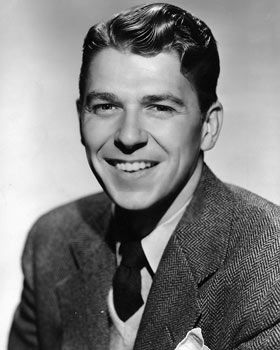
Let me get this out of the way…no this is not a post alleging that Ronald Reagan was a liberal or a RINO as president or any other such half-baked revisionism. This is about the early phase of Ronald Reagan’s public life, when Reagan was in fact a liberal.
Reagan’s Early Life
Ronald Reagan’s early upbringing was influenced by the politics and religion of his parents. His mother was a devoutly religious woman and his father, Jack, a traveling salesman, was a staunchly populistic Democrat who supported the progressive causes of his day, strongly opposed the KKK and racial and religious bigotry, and would support the New Deal. As a young man, Ronald Reagan would let black college football players stay at his folks’ place when no establishment in his town would let them stay the night. Reagan’s experiences in young adulthood motivated him to stick with a liberal Democratic philosophy; after all, President Roosevelt’s work relief programs had provided his father and older brother with jobs (Cannon). In 1934, Reagan started his work as a sports radio announcer for WHO in Iowa. Interestingly, heading up the news section at WHO was H.R. Gross, would later become a notorious skinflint in Congress and support Reagan’s rise in politics. When asked in 1984 at a visit from President Reagan if he thought that Reagan had the chops to be president at the time, he responded, “No. He was a Democrat. He belonged to the wrong party” (UPI). After his time in radio, Reagan would move to Los Angeles and got a contract with Warner Brothers after a successful screen test. His enthusiasm for liberal causes was strong but it was based in a strong idealism and the personal magnetism of FDR appealed to him greatly. Writer Howard Fast even claimed that Reagan attempted to join the Communist Party in 1938, but was turned down as he was thought to be a lightweight and unreliable (Geller). This story is, however, disputed.
Reagan remained committed to FDR during his presidency and voted for him every time. By 1946, he concluded that the communists were a force of evil to be reckoned with much like the Nazis had been, but this approach was not well-received by many of the actors who had previously been in full support of his positions. He worked with actress Olivia de Havilland to counter communists in the Independent Citizens’ Committee of the Arts, Sciences, and Professions, which was ostensibly a pro-FDR group, but was headed by secret communist Hannah Dorner who with the communist leadership made the organization always side with the USSR despite a primarily non-communist membership (Fund). Ultimately, Reagan, de Havilland, Roosevelt, and other prominent figures who lent credibility through their membership to the communist leaders left the organization, rendering the committee influentially inert.
The following year, he became president of the Screen Actors’ Guild and to this day he is the only president to have ever led a union. Reagan became a member of the newly established liberal Americans for Democratic Action (which would staunchly oppose his presidency) as well as United World Federalists. As president of the Screen Actor’s Guild he clashed with communists and pro-Communists in Hollywood, who were using underhanded methods to gain control of unions and had been trying to destroy the Stagehand’s Union (which was an anti-communist bulwark). He would testify before the House Committee on Un-American Activities as a friendly witness in 1949. In 1948, Reagan campaigned for the election of Harry S. Truman for a full term and Hubert Humphrey for the Senate. In a 1948 speech for the pair, he criticized the Republican 80th Congress’s performance, condemning the Taft-Hartley Labor Bill and citing the Congress’s blocking an expansion of Social Security and failure to enact civil rights legislation as among their shortcomings (YouTube).
Although Ronald Reagan was initially supportive of liberal Rep. Helen Gahagan Dougals’s bid for the Senate in California in 1950 and contributed $50, his attitude shifted during the election. Towards the end of the election, he switched his support to Rep. Richard Nixon (Nixon Foundation). By this point, Reagan was although not a dyed-in-the-wool conservative, not the strong liberal he had once been. In 1952, he again broke from his party in his decision to support Dwight Eisenhower in 1952. Reagan’s increasing conservatism would develop throughout his time hosting the General Electric Theater anthology series from 1954 to 1962, as he would often talk politics with conservative GE executives, who would persuade him to take up the conservative mantle. In 1962, Reagan officially switched his party registration to Republican. Reagan’s biographer Lou Cannon summed up Reagan’s transformation from liberal to conservative as being due to “ increased wealth, and the higher taxes that accompanied it; conflicts with leftist union leaders as an official of the Screen Actros Guild, and exposure in his General Electric days to a growing view that the federal government, epitomized by the New Deal, was stifling economic growth and individual freedom”.
References
Cannon, L. Ronald Reagan: Life in Brief. UVA Miller Center.
Retrieved from
https://millercenter.org/president/reagan/life-in-brief
Fund. J. (2020, August 2). How Olivia de Havilland and Ronald Reagan Beat the Hollywood Communists. National Review.
Retrieved from
Geller, A. (1999, September 26). Commies Rated Ron Too Dim to be a Red Star: Buddy Says Reagan Was Rejected By the Party. The New York Post.
Retrieved from
Meroney, J. (2010, December 12). Was Ronald Reagan a secret snitch? The Los Angeles Times.
Retrieved from
https://www.latimes.com/archives/la-xpm-2010-dec-12-la-oe-meroney-reagan-20101212-story.html
Reagan Campaigns for Truman in 1948. YouTube.
Retrieved from
Reagan reminisces of days at WHO. (1984, February 21). UPI.
Retrieved from
https://www.upi.com/Archives/1984/02/21/Reagan-reminisces-of-days-at-WHO/6619446187600/
RN Helped Switch RR. (2011, February 8). Nixon Foundation.
Retrieved fromhttps://www.nixonfoundation.org/2011/02/rn-helped-switch-rr/
 Mad Politics: The Bizarre, Fascinating, and Unknown of American Political History