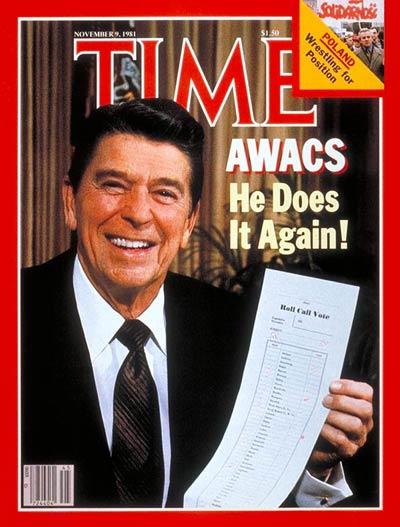
President Carter had controversy over his sales of F-15s to Egypt, Israel, and Saudi Arabia, but the disapproval effort failed in a bipartisan vote. Israel and its advocates in the United States were against this sale, which was seen as part of diplomatic efforts in the Middle East. President Reagan, however, took it a step further in his sale of Airborne Warning and Control System (AWACS) radar planes to Saudi Arabia in his first year of office. This was, at the time, the largest arms sale in history to another country, and it attracted even more opposition than Carter’s sale had. Although Israel didn’t like this, they didn’t make major efforts against this sale since Reagan had offered the nation $600 million in credits, the sale of 15 more F-15s, and relaxing export restrictions on Israel’s Kfir planes (Bard). By 1981, Israel was the only strategic asset in the Middle East after the fall of the Shah of Iran, and the US was looking to strengthen ties with other nations in the region, and one of those was the oil-rich Saudi Arabia, a vital priority given the US’s oil troubles in the 1970s. Cold War considerations motivated the US to make such arms sales to Saudi Arabia as well.
The American public was, after the Iran hostage crisis, hostile to the sale of arms to any other nation, with 52% polled against any sales and only 19% of the public supported this sale (US-Saudi Business). The giving away of the Panama Canal, which had been politically devastating for numerous Democrats, had better polling numbers than this proposal. The opponents of this sale argued that Israel would face greater threat from a nation that had declared “holy war” on it, that this sale would not be effective in deterring any potential Soviet attack, and questioned whether the secrets behind the development of AWACS could be protected (CQ Almanac). This seemed an easy issue for Democrats to oppose President Reagan on given that numerous Republicans were dissenting as well. Senator Joe Biden (D-Del.), while acknowledging as valid concerns that US-Saudi relations could be damaged if the sale failed, saw the alternative as worse, stating, “I’m afraid we’re in a position here where we are limiting damage” (CQ Almanac). There were also fears at the time that the Saudi royal family would fall in a coup like in Iran, and thus the AWACS technology could fall into hostile hands. Senator Alan Cranston (D-Calif.), who had clashed with Reagan before in California state politics, cheekily stated “I would like to paraphrase the words of Ronald Reagan when he opposed President Carter on the Panama Canal issue. ‘We built the AWACS. We paid for them. We should keep them” (CQ Almanac).
Round One: The House
The Reagan Administration started to lobby the House to back the sale and they had not only the power of the office behind them but also the active support of all three living former presidents: Nixon, Ford, and Carter, although the former did some harm to this effort when he remarked that “parts of the American Jewish community” were holding up the sale and possibly “embarrassing and undermining the authority of their indispensable friend in the White House” (Bard). The Saudis had intensely lobbied numerous American businesses to support the sale, and they did. One event that had some potential to build support was the assassination of Egypt’s Anwar Sadat on October 6th, which postponed the vote on blocking the AWACS sale and permitted Reagan to argue that the US was down a friend in the Arab world and that they needed Saudi Arabia more than before (CQ Almanac).
Despite the assassination of Sadat and the efforts of Reagan and former presidents, the House on October 14, 1981, voted to disapprove, and the vote was strongly bipartisan at 301-111. Democrats voted for the resolution 193-33 while Republicans voted for 108-78. Even some conservative hardliners in Congress who were almost always on board with Reagan voted for this, including John Rousselot of California and John Ashbrook of Ohio. Ron Paul of Texas was also another notable vote for.
Round Two: The Senate
Round one of this battle had ended badly for the Reagan Administration and it looked like the sale at the outset was set to go down in the Senate, as the resolution to disapprove had 50 Senate sponsors. Reagan secured the help of Majority Leader Howard Baker (R-Tenn.) to get the deal. Baker asserted that “Anyone who believes the security of Israel will be enhanced by reducing our influence in the Arab world is fundamentally wrong” (CQ Almanac). The measure also received the backing of Foreign Relations Committee Chairman Charles Percy (R-Ill.), who initially advised President Reagan to postpone the sale (Bard). The leading opponent on the Republican side was Oregon’s Bob Packwood, a moderate. However, the Reagan Administration went full on the offensive in securing support, including securing private meetings with 22 Republican senators and 22 Democratic senators. Reagan managed to persuade 14 of the 22 Republicans to vote for the sale and 10 of the 22 Democratic senators (Bard). Some of these votes were secured only the day before the vote, and in some cases, downright horse trading occurred. The Reagan Administration, for instance, won Senator John Melcher’s (D-Mont.) vote by pledging support for a coal-conversion facility near Butte as well as a letter of support for the sale from his predecessor and Ambassador to Japan Mike Mansfield (Bard). The Reagan Administration did not only offer carrots but also sticks in its approach. Iowa’s Roger Jepsen, who had been one of the Senate sponsors of the resolution to disapprove of the sale, was subject to the threat of sticks. The Reagan Administration painted a bleak picture of his political future were he to vote for the resolution, that he would be politically frozen out from the Reagan White House, especially since Iowa’s other Republican senator, Charles Grassley, had come to support the sale (Bard). However, horse trading and threats were not required in many cases. Arguments that Reagan’s influence and credibility in the Middle East would be damaged were sufficient for numerous Republicans to switch their positions (CQ Almanac). There were also some real consequences for Republican senators who opposed the sale. After Rudy Boschwitz (R-Minn.) voted against the sale in committee, he found out that an air force base in Duluth was to be shut down (Bard). The intense lobbying efforts, it turns out, did the trick. On October 28th, the Senate rejected the resolution disapproving of the sale, with 48 senators voting to disapprove and 52 voting against (Mohr). Republicans voted against disapproval 12-41 and Democrats voted to disapprove 36-11. And just in case you were of the impression that a senator being Jewish meant support for this resolution, only 57% of the Senate’s Jews voted for it, with Senators William Cohen (R-Me.), Ed Zorinsky (D-Neb.), and Warren Rudman (R-N.H.) voting against disapproving the sale.
Although Reagan got his sale, he did not attempt more arms sales to Arab nations in the Middle East. Thus, although lobbying efforts against it did not prevent this sale, it did deter the Reagan Administration from pushing for more. Although there has been more talk about the Israel lobby since the October 7, 2023, attack from Hamas and the war that resulted, this is an example of when the Israel lobby didn’t get its way. Indeed, according to a study conducted by Mitchell Bard, in 782 American policy decisions between 1945 and 1984 Israel got its way 60% of the time, and when the president supported Israel’s position, it won 95% of the time, but Israel also won 27% of the time that the president opposed its position (Bard, 2009). The lobbies of Israel and its US-based supporters are indeed powerful, but where the president stands is of tremendous importance to whether Israel gets its way.
References
Bard, M. (1981). How Reagan Snatched Victory from the Jaws of Defeat On AWACS. Jewish Virtual Library.
Retrieved from
https://www.jewishvirtuallibrary.org/how-reagan-snatched-victory-from-the-jaws-of-defeat-on-awacs
Bard, M. (2009). The Pro-Israel & Pro-Arab Lobbies. Jewish Virtual Library.
Retrieved from
https://www.jewishvirtuallibrary.org/the-pro-israel-and-pro-arab-lobbies
Mohr, C. (1981, October 29). Senate, 52-48, Supports Reagan on AWACS Jet Sale to Saudis; Heavy Lobbying Tips Key Votes. The New York Times.
Retrieved from
Senate Supports Reagan on AWACS Sale. CQ Almanac.
Retrieved from
https://library.cqpress.com/cqalmanac/document.php?id=cqal81-1171966#_=_
The vote by which the House, on a 301-111 vote, rejected the sale of AWACS aircraft to Saudi Arabia. (1981, October 14). UPI.
Retrieved from
https://www.upi.com/Archives/1981/10/14/The-vote-by-which-the-House-on-a-301/7088371880000/
US military business export to Saudi Arabia. US-Saudi Business.
Retrieved from
 Mad Politics: The Bizarre, Fascinating, and Unknown of American Political History