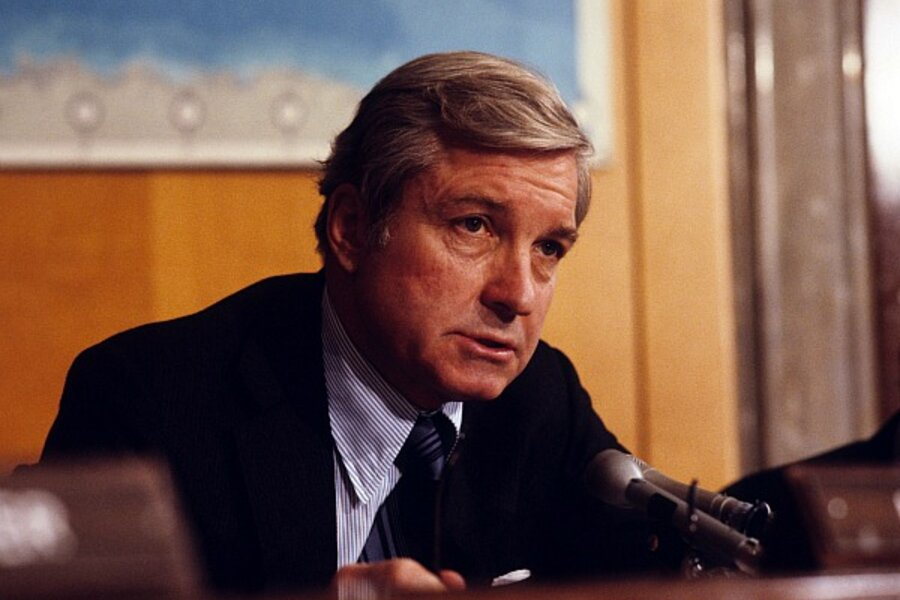
The state of Illinois is not exactly the friendliest ground for Republicans these days, but Illinois’ prominent Republican figures was Charles Harting Percy (1919-2011), who was a big name in Rockefeller Republican circles. His life before politics was a series of great successes. At the age of 30, after working for the Bell & Howell Corporation for several years (with an interruption for service in the Navy from 1942 to 1945), he became its president. He served for 15 years, and Percy proved an astute businessman, growing the company and multiplying revenues by 32 and the number of employees by 12 and making the company go public (The San Diego Union-Tribune). The Bell & Howell Corporation, which makes cameras, camera lenses, and other film equipment, still exists today. During his time as president, he became involved in politics, supporting President Dwight Eisenhower, who encouraged him to write Decisions for a Better America, a book outlining policies for Republicans to promote for the future.
In 1964, Percy resigned his post to run for governor, but the national environment weighed too heavily with Barry Goldwater’s unpopularity and his endorsement of him and he narrowly lost to Democratic incumbent Otto Kerner. The 1966 campaign would prove more successful for him. Percy ran against 74-year old Senator Paul Howard Douglas, long a prominent and principled independent liberal voice in Illinois. He benefited from a backlash to the Johnson Administration’s social policies, including support for a fair housing law. Although Percy also favored a fair housing law and civil rights legislation overall, some voters saw voting for him as a way to stick it to the Johnson Administration. Percy also received sympathetic support because of the brutal murder of his 21-year-old daughter and campaign manager, Valerie, by a home intruder. The case remains officially unsolved. Percy won the election by 11 points, and he was almost immediately considered a strong candidate for a possible future presidential run, with many seeing him as Kennedy-esque. In late 1967, a Louis Harris poll placed Percy ahead of Lyndon B. Johnson for the 1968 election (Clymer). Johnson was not the only big name who Percy was a potential threat. Richard Nixon thought him a potential threat in the Republican primary in 1968, noting, “Percy and Nixon are two to one…Percy has a good forum in Washington and he’s smart, but he doesn’t have a delegate base” (Chicago Tribune). However, Percy did not think himself sufficiently experienced to run for president, and endorsed Nelson Rockefeller. Nixon gave Percy some consideration as a running mate, but he did not land on his list of finalists due to him having endorsed Rockefeller during the primary. In 1968, he sponsored a proposal to permit communities to use federal law enforcement grants to recruit, train, and pay young people to aid the police in community relations, which attracted the support of many moderate and liberal Republicans. Percy was a rising star among Rockefeller Republicans to the point that he was considered a contender for the Republican nomination for president in 1968. His record in the Senate reflected his moderate liberalism. The Chicago Tribune (1985) wrote in a retrospective of his career, “As a Senator, Percy was good but not great. Early in his legislative career, Ralph Nader’s Congress Project described Percy as “one of the most diligent, well-prepared and effective men in the Senate””. Percy was effective in altering how federal judges were picked in Illinois, considering selection on a merit basis, to the consternation of Illinois Republican leaders (Chicago Tribune).
Like Percy did with many Republicans in Illinois, he also crossed President Nixon on numerous occasions. He voted against the nominations of both Clement Haynsworth and G. Harrold Carswell to the Supreme Court, but he did vote for William Rehnquist in 1971. Percy also supported both the Cooper-Church Amendment in 1970 to pull out of Laos and Cambodia but he also opposed the McGovern-Hatfield “End the War” Amendment, the first to establish a timetable for withdrawal from Vietnam. In 1972, Percy decided to leave the Appropriations Committee for the Foreign Relations Committee, seeing this as a more optimal committee for which to boost himself for a presidential run. On the Foreign Relations Committee, Percy advocated for pulling out of Vietnam and in support of détente (Chicago Tribune). Despite all the talk of him being president, he only seriously considered running once, and that was in 1973 when he formed an exploratory committee for the 1976 presidential election. That year, Percy sponsored a resolution for an independent prosecutor to investigate the Watergate break-in and called on President Nixon to “tell the whole truth” about Watergate (Naughton). However, Nixon’s resignation and Ford’s succession to the presidency ended Percy’s presidential ambitions. He would instead endorse Ford for a full term. Americans for Constitutional Action regarded Percy poorly, with him supporting their positions only 34% of the time during his career, with him at worst backing ACA positions only 7% of the time in 1969 and 71% at most in 1984. The liberal group Americans for Democratic Action, on the contrary, found a good deal more to like about him. He agreed with them on the issues 57% of the time and his agreement ranged from 35% in 1981 to 79% in 1968. DW-Nominate scores him at 0.099, lower than any Republicans serving in Congress today. Percy described himself as “a conservative on money issues but a liberal on people issues” (Hawkins, 2011).
In 1974, Percy introduced legislation to make 55 miles per hour the limit for national freeways as a fuel conservation measure and this became law in 1975, lasting until 1987. In 1975, Percy recommended John Paul Stevens for the Supreme Court to President Ford. Stevens was Ford’s only pick for the Supreme Court. In 1978, Percy, at first thought to have an easy road to reelection, was surprised when relatively unknown Democrat Alex Seith proved to be a more formidable challenger than he thought. Polling had originally put Percy at 20 points ahead of Seith, but Seith embraced some hardline anti-communist stances and fiscal conservatism, which resulted in some conservative defections and a Chicago Sun-Times poll had Seith up by seven points in the week before the election. Percy had to campaign hard in the last week, airing a blitz of TV ads and using his own money to fund his reelection (Time Magazine). Percy pulled through by roughly the reverse of the Chicago Sun-Times poll.
Final Term
Although often a liberal on foreign policy including voting for the Panama Canal Treaties, he also tried to push through an amendment to make clear to China in 1979 that aggression to Taiwan would be considered against the interests of U.S. national security. The amendment failed to pass, but Percy’s pushing of this amendment was a clear indicator that he at least wanted to appear tougher on the international stage. The 1980 election would elevate him to the chairmanship of the Foreign Relations Committee. Despite his chairmanship, his historical approach to foreign relations was considerably different from that of the Reagan Administration, and President Reagan often went to Majority Leader Howard Baker (R-Tenn.) instead for help on his foreign policy initiatives. Percy, perhaps seeing the writing on the wall of the party’s direction, was a bit more accommodating to Reagan Republicanism than he would have been in the past. However, he maintained a significant degree of independence, and in 1981 he spearheaded opposition to the construction of the Tennessee-Tombigbee Waterway, a project that Reagan had gotten behind and environmentalists had gone against. Ironically, one of the ways in which he did help Reagan harmed him when he sought reelection. In 1981, Percy had voted for President Reagan’s sale of Airborne Warning and Control Systems radar planes to Saudi Arabia, which supporters of Israel had opposed as a potential threat to the nation’s security. Percy also crossed Israel and its supporters the next year when he condemned Israel’s invasion of Lebanon (Broder). Due to Percy’s sometimes critical stance on Israel, he was now a target for defeat. It also didn’t help that Percy had once described Yasser Arafat as a “relative moderate” (Cornwell). Despite President Reagan coming to Illinois to campaign for him, the Israel factor as well as Illinois having a weak economy and becoming an increasingly Democratic state, resulted in his narrow 1984 defeat for reelection by liberal Democratic Congressman Paul Simon. Percy, like the man he beat for reelection, had served three terms. Percy’s loss has been interpreted by some as having significant future implications as it showed the power of the pro-Israel lobby.
References
Broder, J. (2003, December 10). The battle of the Mideast lobbies. NBC News.
Retrieved from
https://www.nbcnews.com/id/wbna3071599
Clymer, A. (2011, September 17). Charles Percy, Former Ill. Senator, Is Dead at 91. The New York Times.
Retrieved from
Cornwell, R. (2011, September 22). Charles Percy: Politician hailed early in his career as the Republicans’ answer to John F. Kennedy. The Independent.
Retrieved from
Former Illinois Sen. Charles Percy dies at 91. (2011, September 17). The San Diego Union-Tribune.
Retrieved from
Hawkins, K. (2011, September 17). Former US Sen. Charles Percy of Illinois was ‘fervently moderate’. The Christian Science Monitor.
Retrieved from
Nation: Percy’s Problem. (1978, November 6). Time Magazine.
Retrieved from
Naughton, J.M. (1973, June 3). Percy Calls on Nixon to Tell Truth About Watergate. The New York Times.
Retrieved from
Percy, Charles Harting. Voteview.
Retrieved from
https://voteview.com/person/11205/charles-harting-percy
Percy Endured and Endeared, But Was Nagged By Career as Might-Have-Been. (1985, January 13). Chicago Tribune.
Retrieved from
To Agree to That Portion of a Percy Amendment to S. 917 Which Adds to the Stated Purpose of Grants to Improve Law Enforcement the Purpose of Recruiting and Training of Community Service Officers to Assist Police in Discharge of Certain Duties. Voteview.
Retrieved from
https://www.voteview.com/rollcall/RS0900414
To Amend S. 245 By Stating That the Security Interests of the U.S. Would Be Threatened if Taiwan Were To Be Attacked. (Motion Failed). Voteview.
Retrieved from
 Mad Politics: The Bizarre, Fascinating, and Unknown of American Political History