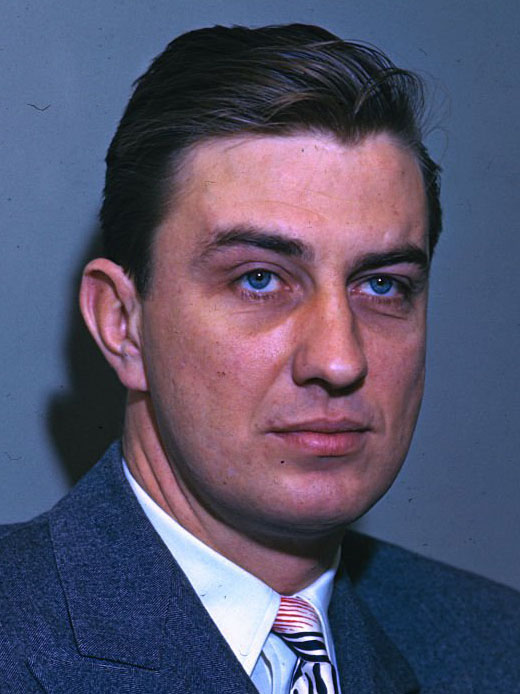
Although there is no royalty in the United States and never can be as a matter of constitutionality (unless we decide to repeal that part of the Constitution for reasons that escape me), there have been political families who have been tremendously influential: the Kennedys, the Bushes, and the Roosevelts. Two of FDR’s sons had political careers of their own in FDR Jr. and James Roosevelt. Today I will be writing about the former, who fell far from the tree of his father in terms of political acumen.
When it came to war service, President Roosevelt was no hypocrite, and Franklin Delano Roosevelt Jr. (1914-1988) served in the war and he did so with honor. In his personal life, however, Roosevelt Jr. had issues, being married a grand total of five times. In 1948, he sought to recruit Dwight Eisenhower for the Democratic nomination, not knowing that his true sympathies lay with the Republicans. His time for public office would come in 1949.
Congressional Career
In 1949, longtime Congressman Sol Bloom, who had been chairman of the House Foreign Affairs Committee, died, and Roosevelt Jr. ran to succeed him, managing to defeat the Tammany Hall picked candidate as the Liberal candidate. Roosevelt Jr., who would win his subsequent reelections as a Democrat, was per Americans for Democratic Action a perfect liberal during his time in Congress, never having voted against a single one of the issues they regarded as a key vote. He supported public housing, price controls, foreign aid, reciprocal trade, public power, more immigration, and opposed the McCarran Internal Security Act. His DW-Nominate score was quite a low -0.619. Although Roosevelt Jr. was a perfect liberal by the standards of Americans for Democratic Action, he proved a poor member of Congress for laziness and general lack of enthusiasm for the job. Speaker Sam Rayburn of Texas would tell his brother James upon his entrance into Congress in 1955 to “not waste our time like your brother did”, and James himself would recount that Jr. “had a dreadful record in Congress. He was smart, but not smart enough. He had good ideas and the power of persuasion, but he did not put them to good use. He coasted instead of working at his job, considering it beneath him, while he aimed for higher positions. He may have had the worst attendance record of any member of those days, and it cost him those higher positions” (Roosevelt, 314). Instead of running for reelection for Congress, Roosevelt Jr. ran for attorney general, but was defeated by fellow Congressman Jacob Javits, thus being the only Democrat to lose a statewide election that year.
In 1960, he served as something of a bulldog for his friend John F. Kennedy’s campaign in the hopes that he could revive his faltering political career, and falsely insinuated during the West Virginia primary that Senator Hubert Humphrey (D-Minn.), who was also running for the nomination, had been a draft-dodger during World War II (Time Magazine). The truth was that Humphrey was not allowed to fight due to a disability, and Roosevelt would subsequently apologize. Kennedy’s win in that race tipped the primary decisively for him. Although Kennedy had initially wanted Roosevelt to be Secretary of the Navy, Defense Secretary Robert McNamara nixed the idea. Roosevelt would instead serve as Under Secretary of Commerce from 1963 to 1965. Any hope Roosevelt Jr. had of further rise died with Kennedy, although he did serve in one more federal position as head of the Equal Employment Opportunity Commission from 1965 to 1966. Roosevelt made one last bid for elective office in running for governor on the Liberal Party ticket in 1966, but he didn’t stand a snowball’s chance in hell against the powerhouse of incumbent Nelson Rockefeller.
Roosevelt would pursue business ventures for the remainder of his life, including the distribution of imported cars. He died on August 17, 1988, his 74th birthday, of lung cancer.
References
ADA Voting Records. Americans for Democratic Action.
Retrieved from
Franklin D. Roosevelt Jr. Dies of Lung Cancer at 74. Los Angeles Times.
Retrieved from
https://www.latimes.com/archives/la-xpm-1988-08-17-mn-651-story.html
Franklin Delano Roosevelt, Jr. Columbian College of Arts & Sciences.
Retrieved from
https://erpapers.columbian.gwu.edu/franklin-delano-roosevelt-jr-1914-1988
Roosevelt, Franklin Delano, Jr. Voteview.
Retrieved from
https://voteview.com/person/8050/franklin-delano-roosevelt-jr
Roosevelt, J. (1976). My Parents: A Differing View. Los Angeles, CA: Playboy Press.
The Administration: Roosevelt’s Reward. (1963, February 8). Time Magazine.
Retrieved from https://time.com/archive/6626000/the-administration-roosevelts-reward/
 Mad Politics: The Bizarre, Fascinating, and Unknown of American Political History