
In 1930, Senator Frank Greene died during an operation, and selected to succeed him by Governor John E. Weeks was Frank C. Partridge, a personal friend and longtime presence in Vermont politics. The following year, however, there was to be an election to finish out the term, and prominent attorney Warren Austin (1877-1962) of St. Albans was persuaded to challenge Partridge, announcing shortly before the end of 1930. Although incumbency is often an advantage, in Partridge’s case it was not; he had to attend to the Senate while Austin was free to campaign across the state, delivering 60 speeches (Mazuzan, 130). Austin’s age was also to his advantage as he was 15 years younger than the 68-year old Partridge, and he won the Republican nomination for the election to finish the late Greene’s term. In 1931, winning the Republican nomination was tantamount to election, as Vermont was the Wyoming of its day in Republicanism.
Austin became a quick study of the Senate, and he thought there was some room for procedural change, namely that his fellow senators had too much room to bloviate (Mazuzan, 130-131). He voted like a traditional Republican, with a wariness of a largesse in federal government, spending, and the powers of the executive. This translated to a strong opposition to FDR’s New Deal, with him voting against all major “first 100 days” legislation except the Economy Act. As Austin wrote to his mother, “I am very apprehensive of the arbitrary powers which are being placed in the hands of one man” (Mazuzan, 131). Austin was opposed to measures he saw as intruding on states and localities as well as on individuals, and saw this in the New Deal. In particular, Austin strongly opposed the cancellation of air mail contracts based on ultimately unsubstantiated charges of fraud and collusion, writing “However unfortunate may seem the material and intimate results of the cancellations of the air-mail contracts and the acts which have succeeded that, the poignancy of the event was the grave and serious doubt excited in the minds of men and women of the purpose of the “New Deal” which is neither Republican nor Democratic. Is it an emergency policy? Or is it a permanent departure from free institutions and a surreptitious establishment, without the knowledge or consent of the people of ideas of government which are in conflict with the breeding, the traditions, and the settled purpose of the American people” (Mazuzan, 134). However, the politics of old were under increasing fire, even in Vermont. Austin’s opponent for reelection in 1934 was Fred C. Martin, FDR’s IRS collector for the state, who ran as a New Dealer and challenged Austin’s record as well as touted areas of Vermont that were assisted by New Deal programs. In a portend of Vermont’s future, this message got a lot of traction, particularly in the state’s western portion. In response Austin touted Vermont’s traditions, regarded the administration as pushing “foreign doctrines and socialistic ideas”, and asserted that there was a need for an independent voice from that of the Roosevelt Administration (Mazuzan, 138-139). Although the election result of Austin winning reelection was “business as usual”, he only won with 51% of the vote, and three western counties had voted for Martin. He would not change his ways for the most part in his next term on domestic issues and in 1935 he voted against Social Security. Only seven other senators either voted or paired against. In 1937, Austin would participate in the drafting of the Conservative Manifesto, a ten-point document proposing alternative policies to the New Deal that emphasized private enterprise and state as opposed to federal authority (Moore). In 1939, he was elected assistant minority leader and would serve as acting minority leader while Oregon’s Charles McNary was running for vice president.
Foreign Policy
Austin was well-versed in dissent, but this dissent was not confined to the ruling Democratic Party. Unlike most of his Republican colleagues before World War II, Austin was an internationalist. In 1935, he had voted for the US joining the World Court (one of FDR’s few policy defeats in his first term), and this debate largely portended the internationalist/anti-interventionist divide. Austin would vote for repealing the arms embargo in 1939, vote for the peacetime draft, be the Senate’s strongest supporter of Lend-Lease, and support permitting merchant ships to enter belligerent ports. He was even one of two Senate Republicans to oppose an amendment to the Lend-Lease bill striking aid for the USSR. He was interestingly at odds with his new colleague George Aiken both from right and left, as Aiken was significantly more liberal than him on domestic policy but was opposed to FDR’s foreign policy before World War II and more willing to permit age-based deferments to the draft. Austin strongly supported the creation of the United Nations, but kept national sovereignty in mind when he voted for the Connally Reservation, which excludes domestic disputes from the jurisdiction of the International Court of Justice. During the 1940s, Austin also moderated somewhat on domestic issues, for instance supporting retaining the National Youth Administration in 1943 and his support (albeit limited) of wartime price control. On August 2, 1946, Austin resigned from the Senate as President Truman announced his appointment as Ambassador to the United Nations. Austin’s DW-Nominate score was a 0.106, which seemed to strongly reflect his internationalism given that his record was mostly oppositional to the New Deal.
UN Ambassador
As Ambassador to the UN, Austin became known as a forceful advocate of the West as a cold warrior. During this time, he allegedly gaffed, “I hope Arabs and Jews will settle their differences in a truly Christian spirit”, but his assistant who was present held that what Austin was communicating was that as a Christian he would be impartial towards Muslims and Jews regarding the creation of Israel (Traveling for History). In 1951, Austin presented to the United Nations Security Council a Soviet submachine gun found in possession of captured North Korean troops to demonstrate that the Soviets were providing arms to them.
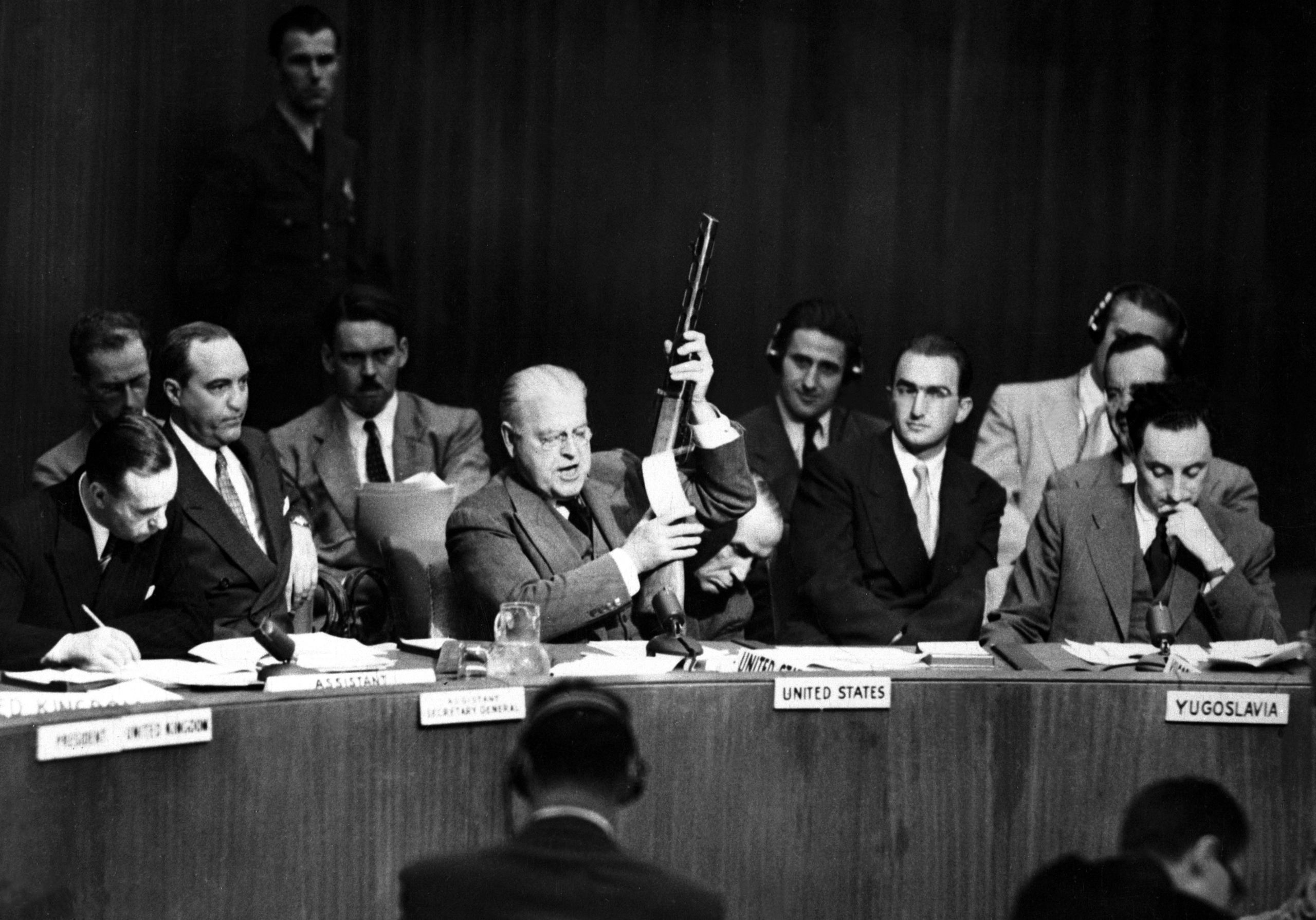
He served until two days after the end of the Truman Administration, with President Eisenhower picking another New England internationalist who had served in the Senate to replace him in Henry Cabot Lodge Jr.
Austin retired from public service after and was forced to curb his activities after suffering a stroke in October 1956. He died on December 25, 1962. Times have changed much in Vermont since he left office in 1946. For instance, his old Senate seat is held by none other than Bernie Sanders, a marked contrast to Austin’s anti-New Deal politics.
References
Austin, Warren Robinson. Voteview.
Retrieved from
https://voteview.com/person/296/warren-robinson-austin
Mazuzan, G.T. (1971). Vermont’s Traditional Republicanism vs. the New Deal: Warren Austin and the Election of 1934. Vermont Historical Society, 39(2).
Retrieved from
Moore, J.R. (1965). Senator Josiah W. Bailey and the “Conservative Manifesto” of 1937. The Journal of Southern History, 31 (1), 21-39.
Retrieved from
https://www.jstor.org/stable/2205008
Warren Robinson Austin: First UN Ambassador Representing US. (2022, May 8). Traveling for History.
Retrieved from
 Mad Politics: The Bizarre, Fascinating, and Unknown of American Political History