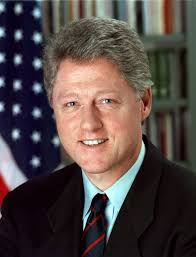
The popular perception of Bill Clinton during his presidency was that he was a moderate, and indeed to liberals looking back, he was that or even a conservative. Indeed, the term “New Democrat” came into being to describe Clinton’s form of Democratic politics and the politics of his supporters. One figure who was not a liberal who echoed this idea of him as a conservative of some sort was conservative David Harsanyi, who wrote, “Despite bringing some big liberal ideas, earthy debauchery and all manner of corruption to the Oval Office”, he “presided over a thriving economy, declared the era of big government over and signed more consequential conservative legislation than any president since – and perhaps, anyone before him” (BBC News). Today I intend to show why this take is wrong, and the traditional view of Clinton as a liberal, not a moderate or conservative, is the accurate one, and what’s more I will do so from the liberal perspective by using the votes selected as ideologically relevant by the liberal lobbying group Americans for Democratic Action.
Issues in which Bill Clinton was liberal included:
Support of and signing into law the Family and Medical Leave Act, the Motor-Voter Law, The Brady Bill, and the National Community and Service Act in 1993.
Support of and signing into law the Goals 2000 Educate America Act, adding funds for education grants to schools.
Opposed an amendment for school choice and reducing overall spending on education in 1994.
Opposing a Republican amendment to reduce domestic spending and protect defense from more cuts in 1994.
Supported banning “assault weapons”, supported an abortion clinic access bill, and a Montana Wilderness bill designating 1.6 million acres as protected wilderness.
Opposed the original welfare reform bill in 1995 (before signing another version in 1996 as it was close to election time), opposed Republican legislation to permit the creation of “company unions” without union presence.
Pro-choice in his record of preferred positions, including his veto of a “partial birth” abortion ban.
Opposition to proposed Balanced Budget and Tax Limitation Constitutional amendments.
Support of the Caesar Chavez Workplace Fairness Act and the admission of Washington D.C. as the state of New Columbia.
Opposed Republican efforts to end the estate tax, gift taxes, and the marriage penalty.
Supported hate crime legislation.
Supported campaign finance reform legislation.
Opposed income tax reduction.
Supported closing the “gun show” loophole in gun control laws.
Supported the Comprehensive Nuclear Test Ban Treaty.
Supported increasing the federal minimum wage.
Opposed the creation of education savings accounts.
Supported preferential treatment for minority-owned businesses by government in 1998.
Issues in which Bill Clinton was conservative included:
He went against ADA’s judgment in his opposition to ending funding for the superconducting super-collider project.
Clinton supported NAFTA, opposed efforts to impose steel tariffs, and supported normalizing trade relations with China.
Although his budget called for defense cuts, he opposed several additional Congressional efforts to do so, such as opposing the deletion of funds for the Trident II submarine missile, opposing cutting the Ballistic Missile Defense program, and opposing cutting funding for U.S. forces in Europe. The trade parts may be considered controversial to consider conservative today, especially in the environment of a Trump-led GOP.
For the Senate, this translates to Clinton supporting the liberal position 56 times out of 60 that he was recorded as having a position on a vote counted by Americans for Democratic Action, while in the House he supported the liberal position 63 times out of 74. The former renders his Senate agreement rate at 93% and the latter his House agreement rate at 84%. When we combine the two, Clinton comes out supporting the liberal position 88% of the time. Not moderate, and not conservative…by liberal standards! Further backing this is Clinton’s DW-Nominate score of -0.438. Something to bear in mind, however, is that DW-Nominate scores are not as reliable for presidents as they are for members of Congress, and Clinton had a lot more selectivity in his selection of legislative issues to register an opinion on than legislators do. But, with the information we have available based on actual votes cast, Clinton comes out a liberal who makes exceptions for trade and national defense. The “New Democrat” still is supportive of unions, still supports tax increases on upper incomes, supports social liberalism, and makes an exception to what is considered liberalism in the United States here and there, primarily on trade and national defense.
References
ADA Voting Records. Americans for Democratic Action.
As a state, Colorado seems to be of two worlds: that of the granola-munchers and the gun-toters. For now, the granola-munchers have the edge; Colorado has not elected a Republican governor since 2002, the last time its voters chose a Republican for president was George W. Bush in 2004, and the last time its voters chose a Republican senator was in 2014. Colorado Democrats have by and large been quite far from a conservative group in recent history and the current crop is going full-bore into social liberalism in this author’s opinion. However, this was not always true of Colorado Democrats, and one figure who was a prime example was Edwin “Big Ed” Johnson (1884-1970).
Johnson grew up in Kansas and went to Nebraska for work, but in 1909, he was diagnosed with tuberculosis and advised to move to Colorado. In an age before antibiotics people were often advised to move to warmer and drier climates in an effort to cure tuberculosis, and this worked for him. He proceeded to start a political career, which started with a loss when he tried for superintendent of Moffat County schools in 1914. This would be the only race he would lose. In 1922, Johnson ran for the Colorado House and won. At the time, the Ku Klux Klan was a powerful force in the state’s politics, and he stood as an opponent. By 1930, the Klan had fallen in influence, and he was elected lieutenant governor. In 1932, Johnson ran for governor and won, serving two terms. As governor, his approach differed a bit from the New Deal, as he pushed his own programs, which included tax reduction, highway construction, balanced budgets, and civil service reform (Colorado State Archives). In 1936, Johnson easily won election to the Senate over Republican Raymond Sauter by 28 points.
As a senator, Johnson was independent of the Roosevelt Administration, and in 1940 he condemned President Roosevelt’s decision to seek a third term. He was a supporter of organized labor but also opposed his foreign policy, voting against repealing the arms embargo in 1939, the peacetime draft in 1940, Lend-Lease in 1941, and permitting both the arming of merchant ships and permitting them to enter belligerent ports just a month before Pearl Harbor. While today, such stances against a president of your party would have put him at great risk for a primary defeat, the truth is that Colorado was moving against the president; in 1940 and 1944 the state’s voters voted for Wendell Willkie and Thomas E. Dewey respectively over Roosevelt. Johnson himself was almost defeated for reelection in 1942 by Republican Governor Ralph Carr, but he had not courted popularity by standing up for the rights of Japanese-Americans, and he won another term by a point. Although often thought of as a conservative Democrat, Johnson went to bat for labor unions in his vote against the Taft-Hartley Act in 1947 and would also do so when he refused to vote to use the Taft-Hartley injunction during steel strikes in 1952. On foreign policy, Johnson’s postwar record was very mixed indeed. He voted against aid to Greece and Turkey in 1947 and only voted for the Marshall Plan the following year after supporting cutting funds. However, he would also support Point Four aid to poor nations in 1950 and at times voted for and against cuts to foreign aid. The 1948 election went much better for him, with Johnson winning almost 67% of the vote.
On March 14, 1950, Johnson denounced the affair of Roberto Rossellini and Ingrid Bergman on the floor of the Senate, and the negative publicity that followed Bergman resulted in her living in Europe for the next few years. He charged that Bergman, who had been his favorite actress, “had perpetrated an assault upon the institution of marriage” and that she was “a powerful influence for evil” and condemned Rossellini as “vile and unspeakable” and a “common love thief” (Hill). Johnson’s fiery condemnations of the two seemed to reflect a personal feeling of betrayal in the image he had of Bergman as a person. He even went as far as to propose legislation to license film performers based on personal morality (Colorado State Archives). Senator Charles Percy (R-Ill.) would apologize on behalf of the Senate for this incident in 1972. In 1952, Johnson endorsed Senator Richard Russell’s (D-Ga.) candidacy for the Democratic nomination for president and headed up his campaign, but Russell got no success outside of the South. On civil rights, he had something of a mixed record. Although he voted against Russell’s effort to undermine army desegregation in 1950, that same year he voted against ending debate on a Fair Employment Practices bill.
In 1953, Johnson was one of only two Democrats to vote against confirming Charles Bohlen as ambassador to the USSR, the push against him being spearheaded by Senator Joseph McCarthy (R-Wis.). Interestingly, he was also among a minority of senators to oppose Eisenhower’s nomination of former Congressman and public housing opponent Albert Cole (R-Kan.) as Housing Administrator. In 1954, Johnson decided against another term in the Senate as his wife, Fern, desired to return to Colorado, but surprised observers when he chose to run for governor again, which he won. In his final address, Johnson warned against committing troops to Vietnam (Colorado State Archives). His last vote as a senator had been to vote to censure Joseph McCarthy. Johnson had sided with the liberal Americans for Democratic Action from 1947 to 1954 40% of the time, and his DW-Nominate score stands as a 0.01, or more conservative than any Democrat serving in Congress today. However, his stint as governor would be limited to one term as a heart attack shortly after winning convinced him that he needed to take it easy. Despite his heart attack, Johnson did well after and persisted as a public figure after his final stint, including campaigning for the reelection of Democratic Congressman Wayne Aspinall in 1964. On May 7, 1970, Johnson was admitted to the hospital for a hernia, and underwent an operation four days later, but his condition deteriorated throughout the month, and he died on May 30th (Hill). Johnson to this day has a unique distinction in Colorado history; being the only person to serve three terms as governor and as senator. He is remembered in Colorado through the Eisenhower-Johnson Memorial Tunnel, a marvel of engineering that runs through Loveland Pass.
References
ADA Voting Records. Americans for Democratic Action.
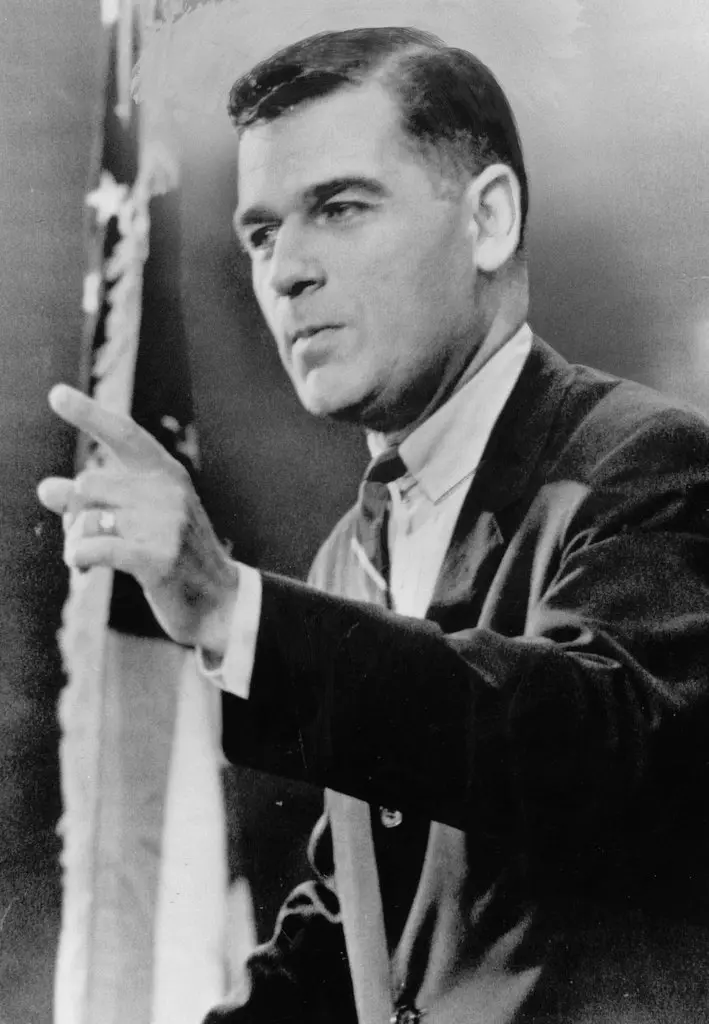
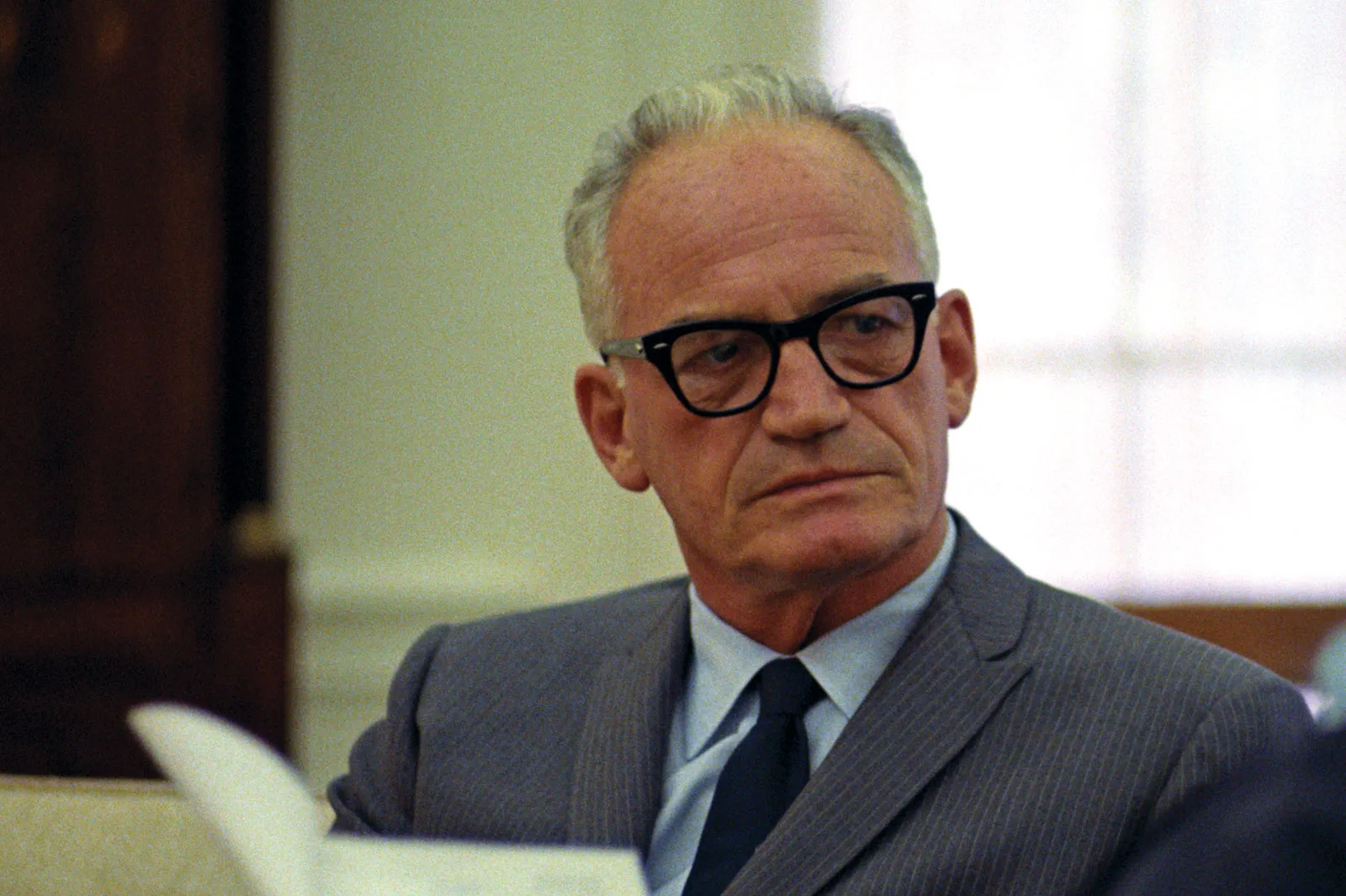
In 1970, the Vietnam War isn’t just still going on, US combat forces have expanded into Laos and Cambodia to stop Viet Cong incursions, and anti-Vietnam War protests are ever-present. Congress is pushing back on the Executive, and the Senate votes for the Cooper-Church Amendment, which if enacted would have removed US troops from Cambodia and Laos. In the midst of legislative battling over the Vietnam War, a curious duo comes together to replace the draft with an idea for an all-volunteer army starting in 1971, which was endorsed by President Nixon’s Commission on an All Volunteer Armed Force: Barry Goldwater of Arizona and Mark Hatfield of Oregon. These men represent very different wings of the Republican Party. Hatfield is of the liberal wing of the party and was even backed over the Democratic candidate in 1966 by Senator Wayne Morse over the issue of Vietnam. Hatfield sponsored with Senator George McGovern (D-S.D.) the “End the War” amendment and voted for Cooper-Church. Goldwater, on the other hand, was the face of conservatism in the Republican Party at the time and had opposed both the “End the War” Amendment and Cooper-Church. This proposal met with the opposition of President Nixon, who despite stating his support at different times for the concept of an all-volunteer army cited cost and poor timing (Rosenbaum). Senators had different arguments regarding this proposal. Senator Marlow Cook (R-Ky.), for instance, supported the idea of raising military pay and saw this measure as a way to boost the prospects of the poor and others argued that the draft would never be equitable and that it was “involuntary servitude” (Rosenbaum). This echoed a number of past arguments about the draft. The Senate vote on this proposal was 35-52 (D 15-34, R 20-18) on August 25, 1970, and it reveals some interesting divisions.
The vote can be seen here, with lifetime agreement scores with the conservative Americans for Constitutional Action for the senators. Republicans are in bold and italicized while Democrats are in plain font. A checkmark and an “x” mean paired for or expressed support or paired against or expressed opposition respectively:
Notably, all conservative Southern Democrats are against. Among legislators from the former Confederacy, only Republicans Edward Gurney of Florida and Howard Baker Jr. of Tennessee as well as Democrat Ralph Yarborough of Texas are in support. This vote also splits Cooper and Church, with John Sherman Cooper (R-Ky.) against and Frank Church (D-Idaho) for. Even the leadership of the parties is split: Majority Leader Mike Mansfield (D-Mont.) is for, while Majority Whip Ted Kennedy (D-Mass.) is against. Minority Leader Hugh Scott (R-Penn.) is for, while Minority Whip Robert Griffin (R-Mich.) is against.There is also a notable contingent of liberals against, including anti-war Democratic candidate Eugene McCarthy of Minnesota. The liberal critique of ending the draft, voiced most prominently by Senator Kennedy, is that the burden of the war ultimately fall upon the poor, as the wealthy youth were not regarded as likely to volunteer, and per the New York Times it likely tipped the balance against the measure (Rosenbaum). If it were not for the unity of Southern Democrats against, this vote would seem absolutely all over the place; 1972 presidential contender George McGovern (D-S.D.) votes for, 1984 contender Walter Mondale (D-Minn.) votes against, and 1996 presidential contender Bob Dole (R-Kan.) votes for. Furthermore, per DW-Nominate, the four most liberal senators are for this amendment while three of the four most conservative senators are for as well. President Nixon would eventually institute an all-volunteer army, but it would be on July 1, 1973, after the United States had agreed to make a gradual withdrawal from Vietnam.
References
Rosenbaum, D. (1970, August 26). Senate Bars Plan Designed to Bring Volunteer Army. The New York Times.
Retrieved from
To Amend H.R. 17123 So as to Provide for an All-Volunteer Military Service. Voteview.
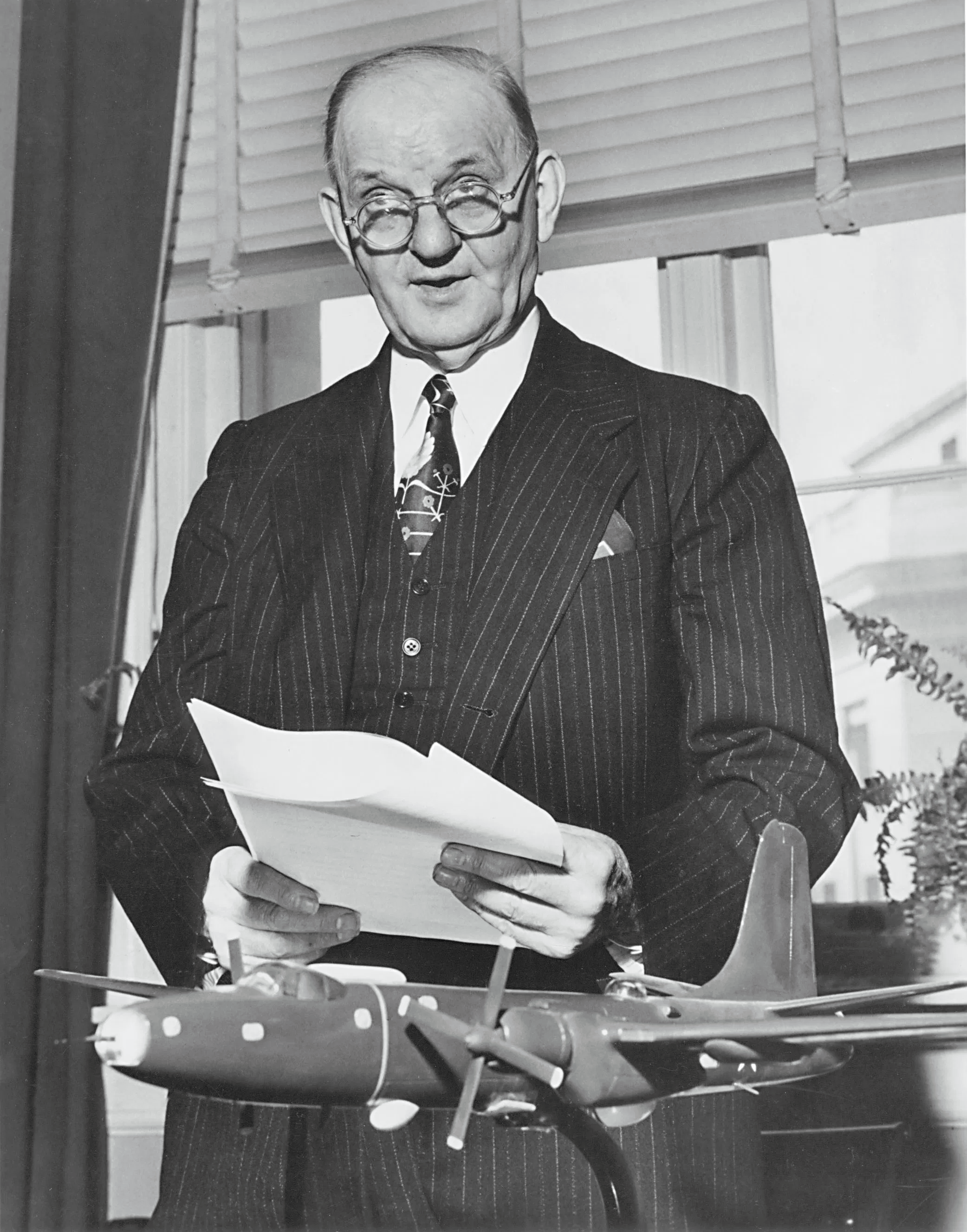
Many who serve in Congress don’t make it their life’s profession, but one who did was Georgia’s Carl Vinson (1883-1981). On February 14, 1914, Georgia Senator Augustus Bacon suddenly and unexpectedly died, and appointed to succeed him was Congressman Thomas W. Hardwick. Enter 30-year old Carl Vinson, a judge of the Baldwin County court who had served two terms in the Georgia House of Representatives, who was elected to succeed him on November 3, 1914. As a young representative, Vinson was a strong supporter of President Woodrow Wilson. After all, Georgia was a strongly Democratic state and indeed until 1964 its people didn’t vote for a Republican for president. Although he initially opposed the Prohibition amendment, it was popular in Georgia and he ended up voting for it. He also opposed women’s suffrage, which was the norm in Georgia politics of the time. In 1918, Vinson had a tough contest for renomination, facing the old Populist leader Thomas E. Watson, but he narrowly prevailed. This would be the last serious challenge to his reelection. Vinson’s specialty would be building up the navy, and although he focused on American presence on the seas, he was not one for international travel. He hated flying, and only once flew out of the country to visit the Panama Canal in the 1920s (Honaker). Indeed, there were a number of ways he was simply different from other people. He smoked or chewed cheap cigars and never learned to drive (Cook). Vinson also preferred simple food over fine dining. On the navy, he was of the belief that “No person representing the American people should ever place the defense of this nation below any other priority” (The New York Times). And indeed, his focus became the creation of a powerful two-ocean navy. Vinson was strongly supportive of the First New Deal but would have more difficulties in supporting the Second New Deal, which included his vote against the Fair Labor Standards Act in 1938. Indeed, he would butt heads with the Roosevelt Administration over the increasing power of organized labor and in 1941 he sponsored a bill to counter strikes. His role in backing the navy had increased with his ascendancy to the chairmanship of the Committee on Naval Affairs in 1931, and would play a significant role in national defense, sponsoring three key measures. These were the Vinson-Trammell Act in 1934, increasing naval construction to the limits of the Washington Naval Treaty of 1922, the Second Vinson Act of 1938 further increasing construction after Japan pulled out of the 1922 agreement, and his sponsorship of the Two-Ocean Navy Act of 1940, which increased the size of the U.S. Navy by 70% (Hutcheson, 1541). All these measures served to create the modern U.S. Navy, and his impact on the strength of our forces in World War II was enormous. Admiral Chester E. Nimitz stated of his role, “I do not know where this country would have been after December 7, 1941, if it had not had the ships and the know-how to build more ships fast, for which one Vinson bill after another was responsible” (Cook). Known as the “swamp fox” for his supervisory role over the Pentagon from Congress, it was serious business when generals and admirals were called to testify before the House Armed Services Committee (Glass). He would serve as chairman until 1947, when the Republicans got into the majority, and in 1949 he would become chairman of the House Armed Services Committee, a post he would hold for the rest of his career with only a two year interruption when Republicans won Congress in the 1952 election. Although at one point he was supposedly being considered for Secretary of Defense by President Truman, Vinson was not interested, stating, “Shucks, I’d rather run the Pentagon from up here” (Glass).
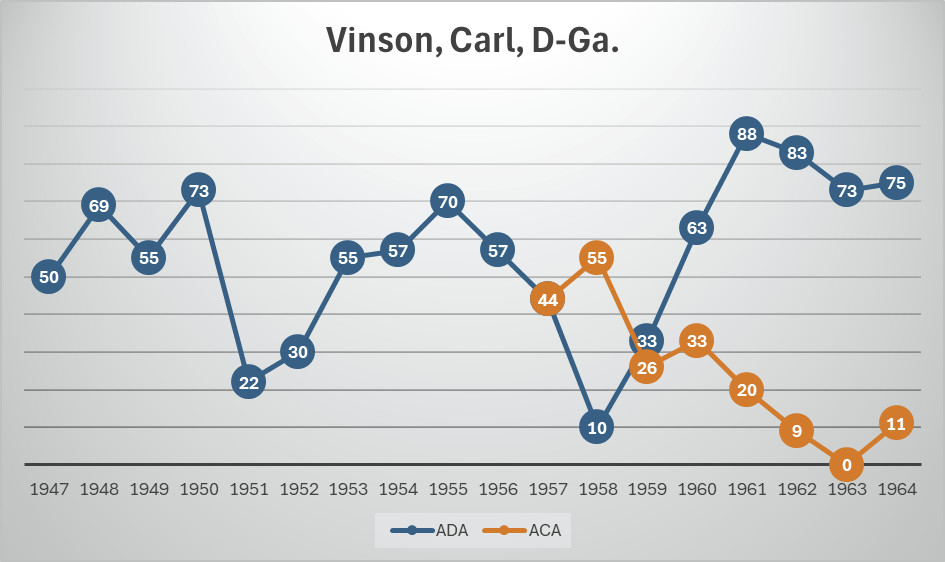
Although often considered part of the Conservative Coalition in Congress, Vinson was not nearly as conservative as you might think. He overall sided with the liberal Americans for Democratic Action 56% of the time from 1947 to 1964, and this is in part due to how he responded to the election of President Kennedy. Kennedy had his second best electoral performance in Georgia, and Vinson saw it as important to support a president who had such a mandate from the voters of his state. On January 31, 1961, he was one of only two Georgians to support enlarging the House Rules Committee, which helped key items of President Kennedy’s agenda reach the House floor, and was the only Georgian to oppose a conservative substitute to that year’s minimum wage bill. This contrasted with his support for Rep. Wingate Lucas’s (D-Tex.) conservative substitute for a minimum wage increase in 1949. Vinson also supported federal aid to education, and the Kennedy Administration’s housing bill. Indeed, he was Kennedy’s foremost champion in Georgia. Senator Sam Nunn, Vinson’s grandnephew, recounted that “One of the people he felt very close to was a young man by the name of John F. Kennedy…” (Shattuck). Vinson’s As I have covered before, the state of Georgia has On civil rights, Vinson had the politics of someone who would have been elected to Congress from the state in 1914.
The ideological Carl Vinson, the blue representing the liberal Americans for Democratic Action (ADA) agreement rates and the bottom representing the conservative Americans for Constitutional Action (ACA) agreement rates.
In 1964, Vinson announced he would not be running for reelection, stating, “My policy is to wear out, not rust out” (Glass). Indeed, there have been many stories of people who stayed in Washington far too long such as Strom Thurmond of South Carolina, James Murray of Montana, and John Sparkman of Alabama. Leaving Washington at age 81, he was the first person to have served 50 years in the House. From 1957 to 1964, Vinson had only sided with the conservative Americans for Constitutional Action 23% of the time and his DW-Nominate score was -0.212. In 1968, he was flown to Washington, D.C. for his 85th birthday and honored by President Johnson, who said of him, “Uncle Carl was my chairman, my tutor and my friend” (The New York Times).
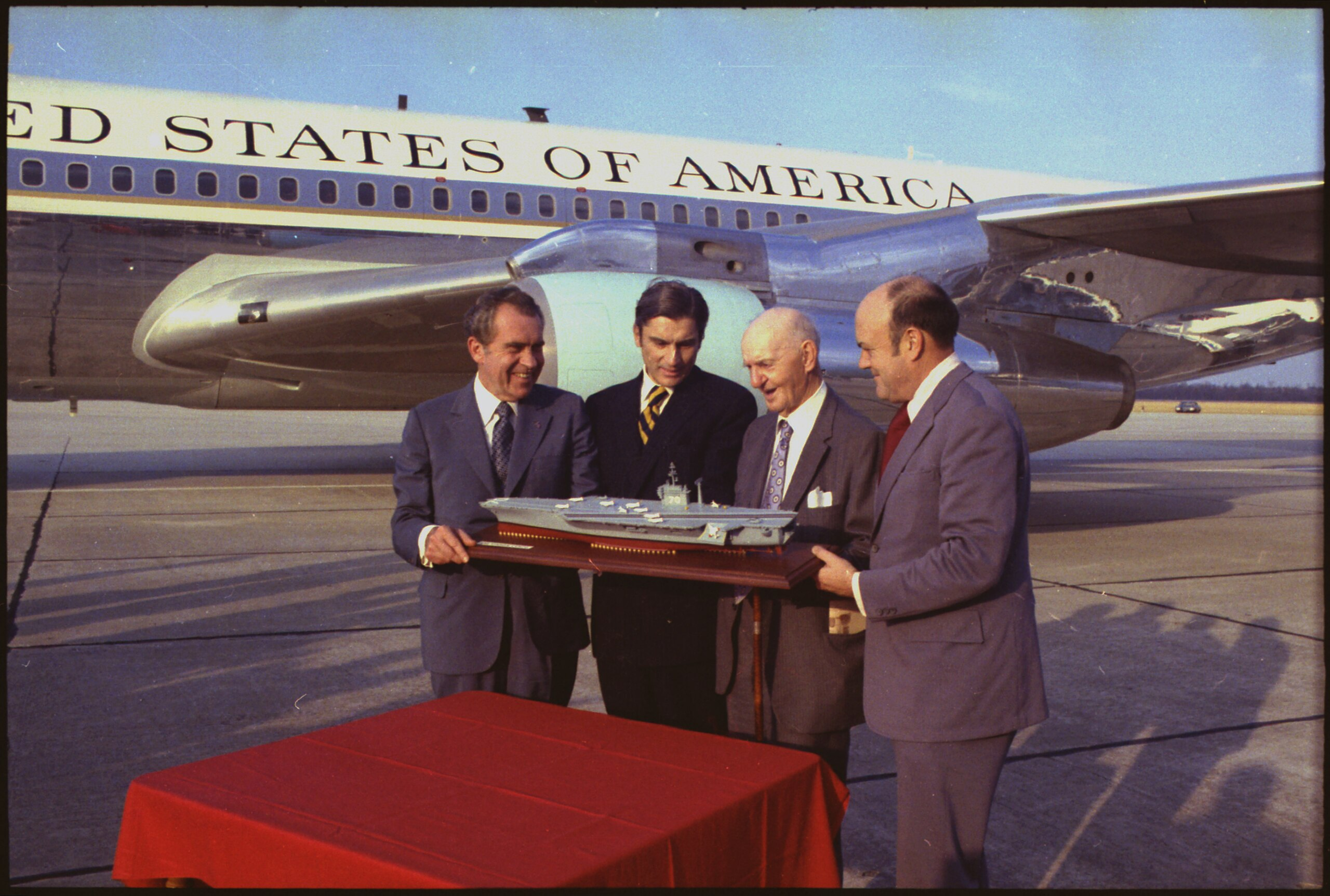
President Nixon, Secretary of the Navy John Warner, Vinson, and Secretary of Defense Melvin Laird with the model of to-be-constructed USS Carl Vinson.
On March 15, 1980, Vinson, who was still alive at 96, was granted an honor that no living person had before, the launching of a navy vessel named after him. The USS Carl Vinson is a Nimitz-class supercarrier that is still in use today, and in 2011 Osama bin Laden was buried at sea from the vessel. He said on the occasion that it was “a fine way to celebrate my youthful age of 96” (The New York Times). Sadly, his wife, Mary, had not lived or thrived nearly as long, having been an invalid for years before her death in 1949. Vinson himself joined her on June 1, 1981, at 97 from congestive heart failure. In Antarctica, the Vinson Massif is named after him.
References
ADA Voting Records. Americans for Democratic Action.
Today Florida is seen as a Republican stronghold, but back in 1962 its voters were loyal to the Democratic Party as a matter of tradition. However, this applied to the state, rather than national Democratic Party which was too liberal for many Floridians. Indeed, Florida voters at that time had thrice in a row rejected the Democratic nominee for president, yet the only Republican they had elected to Congress in the 20th century up to this point was Bill Cramer of St. Petersburg. Republican Edward John Gurney (1914-1996) was well-suited for this environment. He was a war hero who had been severely injured by German machine gun fire, and after earning his law degree he moved to Florida as the warm climate was better for managing the pain of his war wounds as opposed to his home state of Maine. His injuries produced a permanent limp and a lifelong issue with back pain. His fast rise in Florida politics, his personality, and his good looks helped him win by three points in a newly created district. Gurney proved to have staying power and was considered the most conservative member of the Florida delegation; indeed he got nothing wrong per the standards of Americans for Constitutional Action in 1963 and 1964. Gurney also voted against the Civil Rights Act of 1964 and the Voting Rights Act of 1965. Although he was a strong opponent of the Great Society, he bent to vote for the Social Security Act Amendments in 1965, which had Medicare as its centerpiece given Florida’s high population of retirees. After his reelection in 1966, Gurney had his eyes set on the Senate, and with incumbent George Smathers not running again, he got an early start by fundraising in 1967, which helped get him a nearly 12 point victory over former Governor LeRoy Collins. This was in addition to Nixon being popular in Florida and Collins had a liberal reputation on civil rights.
While moving along in his career, Gurney suffered some tragedies. In 1968, his only son, Edward III, committed suicide and in March 1970 his wife Natalie suffered a severe stroke that resulted in her being bedridden until her death in a nursing home eight years later. While in the Senate, Gurney could be counted as a reliable supporter of the Nixon Administration, including a few occasions in which Nixon went against what conservatives wanted, such as voting for bailing out Lockheed Martin in 1971 and revenue sharing in 1972. His record on civil rights also differed a bit in the Senate from the House. Although he supported curbs on busing, he also supported extending the Voting Rights Act for five years in 1970 and supported strengthening enforcement of anti-discrimination laws. Both stances ran contrary to how he had voted while in the House. In 1970, Gurney was involved in party infighting when he sided with Governor Claude Kirk over Congressman Bill Cramer. Cramer wanted to win the Republican nomination for the Senate, while Kirk was backing G. Harrold Carswell, who was Nixon’s second defeated nominee for the Supreme Court. Congressman Cramer won the nomination, but lost the election to Lawton Chiles.
Watergate and Downfall
In 1973, Gurney was tapped to serve on the Senate Watergate Committee and he was President Nixon’s chief defender. It was his accusing Senator Sam Ervin (D-N.C.) of harassing witnesses with his line of questioning that resulted in him responding with his famous, “I’m just an old country lawyer, and I don’t know the finer ways to do it. I just have to do it my own way” (UPI). Gurney also notably grilled witness John Dean. Although Gurney looked well set for another term in the Senate, there was a serious problem: a major fundraiser, Larry Williams, had been pledging public housing contract awards to prominent Florida contractors in exchange for hefty contributions to the Gurney campaign and on January 17, 1974, he was indicted for accepting $10,000 from a Miami builder in exchange for favorable treatment by the Federal Housing Administration following an investigation by a grand jury into allegations that he had raised $300,000 from 1971 to 1972 in exchange for favors to contractors (The New York Times, 1974). The political blowback from this growing scandal may have motivated Gurney’s vote for the Federal Election Campaign Act Amendments in 1974, which he had cast right after voting for Senator James Allen’s (D-Ala.) motion to kill the bill. On May 13, 1974, Gurney testified to a grand jury under oath that he had not known about Williams’ secret fund-raising activities until June 1972 and had not known about their illegality under summer 1973 when he had requested a Justice Department investigation (The New York Times, 1975).
On July 10, 1974, Gurney himself was indicted by a Federal grand jury on seven felony counts in Jacksonville, four of which were for making false statements in his testimony and promptly dropped his reelection campaign. He only sided with the liberal Americans for Democratic Action 3% of the time in his time in Congress, the conservative Americans for Constitutional Action 92% of the time, and his DW-Nominate score was, rather surprisingly given these scores, a 0.306. His trial hinged on, much like President Nixon and Watergate, what did Gurney know and when did he know it?
In June 1975, things appeared bad for him when his administrative assistant, James Groot, pled guilty to conspiracy and provided testimony for the prosecution that contradicted Gurney’s testimony. Numerous contractors testified against Gurney and his co-defendants, while Senators James B. Allen (D-Ala.), Jesse Helms (R-N.C.), and Clifford Hansen (R-Wyo.) were character witnesses for Gurney. On August 6th, he was acquitted of five of the seven charges with the jury deadlocking on the other two; jurors voted 9-3 for conviction on the conspiracy charge and 7-5 for acquittal on making false statements to a grand jury. In September 1976, the prosecution dropped the conspiracy charge for lack of evidence and on October 27th, he was acquitted of perjury. Gurney said after the trial, “They destroyed a United States Senator, blackened my name and besmirched my character” and held that the Justice Department had moved against him based “on flimsy evidence gotten from plea-bargainers” (The New York Times, 1976). Although Gurney avoided prison, four people who worked on his campaigns went to prison for their illegal fundraising methods. Gurney’s media aide, Pete Barr, said of the matter, “A little of him died back then. The guy was a straight arrow. That was the sad thing about the charges against him” (Tampa Bay Times).
Getting Back in the Game
After Natalie Gurney’s death on January 3, 1978, he decided it was time to make a comeback. His successor to Congress, Republican Lou Frey, was not going for another term and the district could elect a Republican yet again. The 1978 race was one of contrasts; Gurney was 64 and running as an experienced, seasoned leader, while Democrat Bill Nelson was 35 and running on being a “fresh face with a clean record” (Peterson). At the time, Nelson was running as a conservative Democrat, taking the wind out of the sails of Gurney potentially trying to tag him as a “liberal”. Gurney also hoped that this race would add to his vindication and said, “You wonder [why] I’m bitter? They destroyed my career” (Peterson). This was in truth his last chance to get back in the game, do or die. However, even in 1978, the Democrats held a 60-40 voter registration advantage in the district, and the voters delivered a verdict that pretty closely reflected this advantage, Nelson winning by 23 points. Gurney did not seek public office again, remarried, and sold stocks and real estate for the remainder of his life. He died in obscurity on May 14, 1996, from what his friends reported was cancer.
References
ADA Voting Records. Americans for Democratic Action.
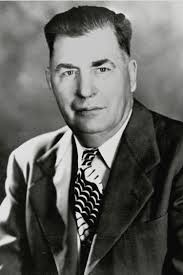
Rather recently, I have covered how Utah was not always the red state we think of it as. Indeed, their voters sent Elbert Thomas, a faithful New Dealer, to the Senate for three terms. The man who ended Thomas’s career was Wallace Foster Bennett (1898-1993). Born only two years after Utah’s admission as a state in Salt Lake City, this would always be home for him. Bennett was a Mormon and very close with their leadership. After all, he married the daughter of the LDS President Heber J. Grant. After service in World War I, Bennett earned his Bachelor of Arts and in 1920, he began his long career in business at his father’s company, Bennett’s Paint and Glass Company. In addition to heading up the company after his father’s death in 1938, he established a Ford dealership in the Bennett Motor Company and had numerous other leading positions in other businesses. He was active in the LDS Church, and even authored two books on the subject, Faith and Freedom (1950) and Why I am a Mormon (1958).
As one of Salt Lake City’s most prominent citizens, in 1949 he started his political career at the age of 51 by heading the National Association of Manufacturers. He followed this up by running against Democrat Elbert Thomas in 1950, running against his record and comparing his positions to those of communists, and was among the beneficiaries of the conservative atmosphere of that election year, winning by 8 points. That seat has not again had a Democratic occupant.
In office, Bennett supported investigating communists in the United States, but also cautioned against indulging in “personalities and propaganda” in the process, showing that he was not a fan of how Joseph McCarthy conducted himself. Indeed, he would be among the senators to vote his censure in 1954 (Bernick). Although Utah had quite a number of farmers, Bennett spoke in defense of the agricultural policies of Eisenhower’s Secretary of Agriculture, Ezra Taft Benson, which were moving agricultural policy in a free market direction. He did look out for Utah’s constituents in other ways, such as securing funding for the Central Utah Project, which although it took longer and perhaps spent more than he was comfortable with, it provides drinking water for residents of the Salt Lake Valley (Bernick). Bennett was a watchdog for free enterprise and opposed to inflationary policies. He was well-placed to address such issues as a member of the Senate Finance Committee, where he was regarded as an expert on economic issues. Although Bennett’s record was conservative, in 1958, he cast a controversial vote within the GOP when after he voted against killing the Anti-Preemption bill, he voted to kill it. The reason for this was Majority Leader Lyndon B. Johnson’s (D-Tex.) adept maneuvering. He had managed to get enough senators to either switch their votes or stay off the Senate floor so that if Bennett had voted against tabling it, the vote would have been tied and forced Vice President Nixon to cast a tie-breaking vote to table, as President Eisenhower opposed the Anti-Preemption bill (Kilpatrick). Such a vote from Nixon would have had potential to cause him difficulty among conservatives in the 1960 election. In 1959, Bennett voted for admitting Hawaii as a state, and reasoned that granting it statehood was part of pushing back against the rise of Asian communism (Bernick). During the 1960s, he would prove a consistent foe of major New Frontier and Great Society measures. He voted against aid to colleges, educational television, the Economic Opportunity Act, the Elementary and Secondary Education Act, and Medicare. His Democratic colleague, Frank Moss, noted “He was right straight up front with what he believed and didn’t believe” (L.A. Times). This earnest approach certainly was of help to him never losing an election, and he wasn’t afraid of taking an unpopular position. Bennett also was one of 19 senators to vote against the Partial Nuclear Test Ban Treaty in 1963. He did work with the Johnson Administration in getting the Coinage Act of 1965 passed.
On foreign aid, although Bennett could back spending cuts and supported anti-communist amendments, he was generally supportive of foreign aid measures. On civil rights, he voted for the Civil Rights Act of 1957, indeed all Republican senators who cast votes voted for it, but he also supported the Aiken-Anderson-Case Amendment to strike 14th Amendment implementation. Bennett did side with the Eisenhower Administration in opposing a jury trial amendment, which was regarded as weakening the bill. On the Civil Rights Act of 1964, there were reasons at the time that Bennett’s vote on the measure was doubtful. He had voted for both Sam Ervin’s (D-N.C.) and Robert Byrd’s (D-W.V.) amendments striking the employment discrimination and public accommodations section respectively and had voted “nay” on the critical vote to end the filibuster. However, Bennett was among the 28 Republicans to vote for passage. He followed up with a vote for the Voting Rights Act the next year.
During the Nixon Administration, Bennett continued his conservative record, and was a consistent supporter of the Nixon Administration’s approach on the Vietnam War. He also backed a few foreign aid measures during this time as well as bailing out Lockheed Martin. In 1972, Bennett was one of eight senators to vote against the Equal Rights Amendment. Well into his seventies, he opted not to run for another term in 1974, and resigned on December 20th to give his successor, Jake Garn, an edge in seniority. Bennett only sided with the liberal Americans for Democratic Action 8% of the time while he sided with the conservative Americans for Constitutional Action 85% of the time. His DW-Nominate score is a 0.447. In retirement, Bennett did not emphasize that he had been a senator. Indeed, regarded his four terms thusly, “That was just a job I did for a while. It is not who I am” (Bernick). Many Americans like to define themselves by what they do for a living, but Bennett saw himself outside of that. Bennett lived long enough to see his son, Robert, get elected to the Senate and attended his victory party in a wheelchair. Bennett died in his sleep shortly after a fall at his home on December 19, 1993 at the age of 95.
References
ADA Voting Records. Americans for Democratic Action.
As I have written about before, Vermont used to not just be a solidly Republican state, but also a solidly conservative state. This declined over the years as more New Yorkers moved to Vermont and the politics shifted away from the politics of its favorite son president, Calvin Coolidge. One of the prominent Republicans who was part of this move away was Robert Stafford (1913-2006).
Stafford’s rise in state politics was in itself a sign that Vermont was a changing state. He rose up from deputy attorney general to being elected attorney general in 1954 and then elected lieutenant governor in 1956. That he moved up from lieutenant governor to governor in 1958 would have previously been considered a violation of the “Mountain Rule”, in which major statewide offices were alternated between the east and west sides of the Green Mountains. However, Vermonters identifying themselves as being of one side of the mountain or the other was declining. Another sign was that Stafford’s gubernatorial win was unusually narrow, only winning with 50.3% of the vote. Republican candidate Harold J. Arthur, a conservative, had lost his bid for the House that year to Democrat William Meyer, the first time this had happened since the Republican Party’s foundation. As governor, Stafford sought to make government more efficient while funding roads and providing scholarships for Vermonters who attended Vermont colleges.
In 1960, Stafford opted to challenge Meyer. William Meyer was a socialist who would later be a founder of the socialist Liberty Party that a young Bernie Sanders would join. Meyer’s stances for nuclear disarmament, halting of nuclear testing, and recognition of Red China were too much for Vermonters of the time and Stafford bested him by 14.5% in 1960. He proved a popular representative who while in the House was in the political center. Although Vermont voters strongly rejected Barry Goldwater’s candidacy in 1964, straight-ticket voting was not as prevalent in that time than it is today and Vermont voters knew that Stafford was a different sort of Republican than Goldwater; he was returned to office by over 15%.
Although Stafford had a reputation later in his career as an environmentalist, while in the House he voted against the 1963 Clean Air Act. However, he was from an early time a supporter of more federal funding for sewage plants to treat water pollution. Stafford also voted for a number of critical Great Society measures, including the 1964 Economic Opportunity Act, Medicare, and federal aid to education. However, Stafford also opposed repealing the “right to work” section of the Taft-Hartley Act and rent subsidies. Although he had sided with the conservative establishment when he opposed expanding the Rules Committee in 1961, in 1963 he voted for continuing this expansion. Stafford similarly voted against adopting the 21-Day rule in 1965 for discharging a bill from the Rules Committee but voted against repealing it in 1967. During the Nixon Administration, he voted for the 1970 Cooper-Church Amendment to delete funds for military forces in Cambodia but voted against the 1971 Nedzi-Whalen Amendment to halt funds for troops in Vietnam on January 1, 1972. If Stafford’s career had merely consisted of how he voted in the House, I wouldn’t have included him on the RINO list.
The Senate
On September 10, 1971, Senator Winston Prouty, who had preceded Stafford in the House, died of gastric cancer, and Stafford was appointed as his replacement and would win an election to complete his term. When in the Senate, Stafford was known for his advocacy of funding for education as well as previously mentioned for environmental protection. His record was increasingly liberal during the Nixon Administration. For instance, in 1974, Stafford only voted with the conservative Americans for Constitutional Action on 2 of 19 issues they counted for the Senate that year. Although he was quite the departure from the politics of Calvin Coolidge, he was about as vocal as Coolidge, which made journalist Philip Shabecoff (1988) of the New York Times regard him as possibly “the worst interview” in Washington. Stafford did tend to support military spending but was also quite internationalist, and this included his votes for the Panama Canal Treaties in 1978. The following year, he voted for the creation of the Department of Education.
During the Reagan Administration, although he gave support to a number of its early initiatives as well as initially supporting funding for arms for the Contras, he often butted heads on social and environmental policy. Stafford also played a key role in overriding President Reagan’s veto of a stronger Water Pollution Act. He commented on the matter, “I didn’t particularly enjoy finding myself at odds with the President, but it had to be done. I was not popular at the White House” (Shabecoff). Indeed, he proved challenging for the Reagan Administration as the chairman of the Senate Environment and Public Works Committee from 1981 to 1987. However, when Stafford supported Reagan it could prove challenging for him; in March 1984, a group of 44 protestors known as Winooski 44 held a three-day sit-in protest in his Winooski office over his support of selling arms to the Contras. After this, Stafford would vote for key proposals curbing aid to the Contras.
Stafford, 1986
Perhaps the thing Robert Stafford is most famous for is the creation of the Stafford Loan, which was effective from 1988 to 2010 and provided subsidized and un-subsidized low-interest loans for college students. It has since been replaced with the Ford Federal Direct Student Loan Program. He also sponsored the Disaster Relief and Emergency Assistance Act of 1988 (aka the Stafford Act), which presidents use in cases of natural disasters and that both Presidents Trump and Biden used during the COVID-19 pandemic. By the end of the Reagan years, Stafford was voting the liberal position most of the time. He agreed with ADA’s position on 16 of 20 votes in 1987 and 16 of 19 votes in 1988. Stafford’s DW-Nominate score was a 0.055, while he sided with ACA’s position 36% of the time from 1961 to 1984 and ADA’s position 55% of the time.
After his retirement, Stafford wouldn’t offer much commentary on the issues, although he gave the message that Republican Jack McMullen was too unfamiliar with Vermont and unknown to Vermonters to run for the Senate in 1998 and expressed support for the state’s legalization of same-sex civil unions in 2000. Stafford died on December 23, 2006 at the age of 93. On the year of his death, 14 million Stafford loans were granted (NBC News).
References
ADA Voting Records. Americans for Democratic Action.
On Saturday, Americans learned that Venezuelan dictator Nicolas Maduro had been taken from Caracas by U.S. forces and flown to Manhattan for trial. The most obvious comparison between the ouster of Maduro by the U.S. is the ouster of General Manuel Noriega of Panama. Although the cases of Maduro and Noriega on their faces do look the same, as in a Latin American dictator is engaged in drug trafficking and is wanted by the United States, there are some significant differences between the circumstances that resulted in Operation Just Cause.
Relations between the U.S. and Panama have had a complicated history, and part of this was the control of the U.S. over the Panama Canal, which they had constructed, and the area they owned called the Panama Canal Zone. Starting in the 1960s, agitation for Panamanian ownership of the Panama Canal began, and U.S. leaders began supporting turning over the Panama Canal to improve relations with Latin America. President Gerald Ford endorsed the idea while Jimmy Carter came around to it once he was president. With the signing of the Panama Canal treaties in 1978, the U.S. and Panama had certain treaty obligations, such as the U.S. reserving the right to militarily intervene if neutrality over the canal was violated. Carter had signed the treaty along with Panama’s leader, Omar Torrijos. However, Torrijos was killed in an air crash in 1981, and the power vacuum that followed was resolved by the rise to power of Manuel Noriega. Noriega was never officially the leader, rather he had puppet presidents.
The U.S. and Noriega: From Friends to Foes
Manuel Noriega had a long and complicated relationship with the United States, which began with his recruitment from the Panamanian military to study at the School of the Americas through the U.S. Department of Defense in the 1950s, which trained many anti-communist fighters in the Western Hemisphere. Noriega rose up through the Panamanian military and in 1968, he bet on the right horse when he backed the coup that deposed President Arnulfo Arias for Omar Torrijos. As a reward, Torrijos made him chief of military intelligence. In 1971, the CIA began paying him for intelligence (Graham). In 1981, however, Torrijos was killed in a mysterious plane crash and out of the power vacuum Noriega became the unofficial leader of Panama. He was never president, rather he had figureheads serve his interests as president. The U.S. was initially supportive of Noriega as an anti-communist leader in Panama, and indeed he provided military support for the Contras in Nicaragua. However, the CIA wasn’t his only outside source of income. In 1982, Noriega cut a deal with Pablo Escobar to allow his cocaine to move through Tocumen International Airport. In return, Noriega would get $1000 per kilo of cocaine that reached the U.S. Although the U.S. knew of this arrangement, they valued him for his providing weapons and funding of Contra rebels in Nicaragua. However, what they didn’t know until later is that the CIA wasn’t the only intelligence agency paying him. Despite his anti-communist stance, Noriega was also a double-agent, accepting money from Cuban intelligence in exchange for information on the U.S. He also became increasingly brutal as a ruler, including beheading political rival Hugo Spadafora in 1985. After the president he had rigged the 1984 election for, Nicolas Ardito Barletta, promised an investigation, Noriega forced his resignation. On February 4, 1988, Noriega was indicted in Miami for drug trafficking and money laundering. In May 1989, Noriega again stole the election, much like Nicolas Maduro had in Venezuela in 2024. Noriega afterwards amped up the hostility to the U.S., including stating that the U.S. and Panama were in a “state of war” and with his forces firing on U.S. marines, killing one, and abducting another marine and his wife, brutally beating him and threatening her with sexual assault. Given that Noriega was acting with such impunity there was certainly an existing risk for the neutrality of the Panama Canal.
On December 20, 1989, Operation Just Cause, or the invasion of Panama, was ordered by President Bush. A tremendous amount of American public support already existed for such an action, unlike the sudden operation and capture of Maduro, which came a bit out of left field for most, as prediction markets showed (the success of this however certainly serves to blunt a lot of criticism). The invasion of Panama proceeded quickly, and Noriega fled to the Vatican’s embassy for diplomatic sanctuary. The US forces proceeded to surround the embassy and blast disturbing chicken sounds and numerous songs including “Give it Up” by K.C., “Welcome to the Jungle” by Guns N’ Roses, “Never Gonna Give You Up” by Rick Astley, “Danger Zone” by Kenny Loggins, and “Panama” by Van Halen as a form of psychological warfare to get Noriega to come out (Myre). Noriega surrendered on January 3, 1990 and he was brought to the U.S. for trial.
Noriega was convicted by a Miami jury and sentenced to 40 years imprisonment for drug trafficking, racketeering, and money laundering. He served 17 years after which he was extradited to France where he was convicted of money laundering in 2010 and then extradited back to Panama where he was imprisoned for murder, corruption, and embezzlement, having previously been convicted in absentia. He died in a Panama City hospital of cancer on May 29, 2017. Some differences that exist between Maduro and Noriega is that although you could say that Venezuela is a national security issue for the U.S. given their relationships with China and Russia and that under Maduro it had become a narco state, there were more clear open hostilities with the U.S. with Panama and the Panama Canal lay in the balance.
References
Graham, D.A. (2017, May 30). The Death of Manuel Noriega – and U.S. Intervention in Latin America. The Atlantic.
The subject of the war powers of the president have again arisen with the Saturday U.S. raid on Caracas and the capturing of Venezuelan dictator Nicolas Maduro and his wife for trial. President Trump did not invoke the War Powers Resolution, although neither did President George H.W. Bush for his invasion of Panama in 1989-1990. The War Powers Resolution is definitely a subject of discussion, though, for this most notable event and today I am looking into the circumstances of the adoption of the War Powers Resolution.
Clement J. Zablocki (D-Wis.) and Nixon.
By 1973, the U.S. was in the process of withdrawing from Vietnam and many members of Congress were critical of how both Presidents Johnson and Nixon had used their war powers. For the latter, it was when Nixon ordered secret bombings of Cambodia without seeking Congressional consent. In the House, Clement J. Zablocki (D-Wis.), chairman of the House Foreign Affairs Committee, introduced the War Powers Resolution. The measure had bipartisan support as well as drafting, with Paul Findley (R-Ill.) being the resolution’s main author. The resolution requires the president to notify Congress within 48 hours of military action and bars forces from remaining for more than 60 days. The first body to vote on this resolution would be the House. On July 18, 1973, they voted for 244-170 (D 171-61, R 73-109). The central architect of the resolution in the Senate was Jacob Javits (R-N.Y.), one of the most liberal members of Nixon’s party who had repeatedly been in opposition to the Nixon Administration on Vietnam. He considered the measure as “a critical departure from the past” (CQ Almanac 1973). However, the measure attracted broad support, and a key senator to come out in favor was the chairman of the Senate Armed Services Committee and known conservative John C. Stennis (D-Miss.), who expressed that “It is of the utmost importance to the future of this nation that we not again slip gradually into a war that does not have the moral support and sanction of the American people” (CQ Almanac 1973). However, the measure did not have the support of another prominent figure from the South, a legal authority on the Constitution, Sam Ervin (D-N.C.). Ervin held that the measure was unconstitutional, stating, “Here is a power and a duty which the Constitution clearly imposes upon the President of the United States, to use the armed forces to protect this country against invasion. And here is a bill which says expressly that the President of the United States cannot perform his constitutional duty and cannot exercise his constitutional power to protect this country against invasion for more than 30 days without the affirmative consent of Congress” (CQ Almanac 1973). There was also a small cadre of liberals who opposed the War Powers Resolution as not being sufficiently strong. Thomas Eagleton (D-Mo.) objected to the absence of a provision disallowing the use of intelligence agencies or other actors to engage in hostilities against other nations (CQ Almanac 1973). On July 20th, the resolution was adopted 72-18 (D 50-4, R 22-14), but because it was different from the House version, the measure had to go into conference. October 10th, the equation did not change in the Senate with a vote of 75-20 (D 49-6, R 26-13, C 0-1), still a veto-proof margin. However, original passage in the House had not been veto-proof. This, however, would not remain so as President Nixon’s popularity was declining from the continuing sore on his presidency that was Watergate.
Majority Leader Tip O’Neill (D-Mass.) argued for the resolution, holding that “If the President can deal with the Arabs, and if he can deal with the Soviets, then he ought to be able and willing to deal with the U.S. Congress. That is all we ask of him” (CQ Almanac 1973). Democratic leadership was united in favor, and Republican leadership was mostly united against. The exception was Senate Minority Leader Hugh Scott (R-Penn.), thus the foremost opponent in the House was Minority Leader Gerald Ford (R-Mich.). Ford, less than a year away from being president, expressed his concerns, “We may be a long ways from being out of the woods. I am very, very concerned that the approval of this legislation over the President’s veto could affect the President’s capability to move forward from cease-fire and to achieve a permanent peace” (CQ Almanac 1973). The resolution passed on October 12th 238-122 (D 163-38, R 75-84). President Nixon, as no one doubted he would, vetoed the resolution. Further eroding Nixon’s popularity, however, between final passage and his veto of the resolution, the “Saturday Night Massacre” had occurred, in which Attorney General Elliot Richardson resigned after refusing Nixon’s order to fire special prosecutor Archibald Cox, and Deputy Attorney General William Ruckelshaus was fired after refusing to fire Cox. Solicitor General Robert Bork ultimately agreed to fire Cox.
The real battle to override the President’s veto occurred in the House, as supporters had more than enough on passage in the Senate to get the resolution through. To achieve an override, eleven opponents of the president had to be lobbied to switch their votes from “nay” to “yea”. Bella Abzug (D-N.Y.), one of the most left-wing members of Congress, had opposed, stating before the conference report that “I shall vote against this bill because it is patently unconstitutional and gives the President power he does not now have…I fear that it does exactly the opposite of what we set out to do: that is, to prevent the President, any president, from usurping the power of Congress to declare war” (CQ Almanac 1973). Speaker Carl Albert (D-Okla.) and the liberal group Americans for Democratic Action actively lobbied these legislators to switch. Their efforts were successful, as eight did so, including Abzug. The House vote of 284-135 (D 197-32, R 87-103) to override on November 7th was four votes above the threshold needed to override President Nixon’s veto.
In the Senate, with an override now inevitable, a few members switched their votes later that day: Republican Howard Baker of Tennessee and Democrats James Allen of Alabama, Harold Hughes of Iowa, and Gaylord Nelson of Wisconsin switched from “nay” to “yea” while Republicans Ted Stevens of Alaska and Henry Bellmon of Oklahoma switched from “yea” to “nay”. The vote was 75-18 (D 50-3, R 25-14, C 0-1). On a side note, the vote on the resolution as reported by Voteview has an error, as Senators Tunney (D-Calif.) and Tower (R-Tex.) have their votes swapped; Tower opposed the War Powers Resolution while Tunney supported. Overall, most of the resolution’s opponents were conservative, but there were some interesting conservative votes in favor on overriding the president’s veto, such as John Ashbrook (R-Ohio), who had run a quixotic primary campaign in 1972 to Nixon’s right, the legendary penny-pincher H.R. Gross (R-Iowa), and John Rousselot (R-Calif.), the only member of the John Birch Society in Congress at the time. In the Senate, conservative Republicans were a bit more unified against with Barry Goldwater (R-Ariz.) and Jesse Helms (R-N.C.) being among the dissenters, but you did have guys like James McClure (R-Idaho) and William Scott (R-Va.) as votes in favor. In another indication of how poorly the Nixon Administration was doing on popularity, among Southern Democrats, a key group that Nixon sought to court support, only Sam Ervin voted against overriding Nixon’s veto.
There have been critics of this resolution, both as being too strong and too weak. Law Professor Robert F. Turner argued in a Fall 2012 journal article that the War Powers Resolution was unwise, unconstitutional, and even resulted in a reduction of American security to the point that it directly contributed to the 9/11 attacks. However, Scott R. Anderson, a fellow of the Brookings Institution, holds that although the War Powers Resolution is imperfect, it was a good undertaking that had a positive result in constraining the executive in getting the US into prolonged wars.
References
Anderson, S.R. (2023, November 9). The Underappreciated Legacy of the War Powers Resolution. Lawfare.
To Agree to the Conference Report on H.J. Res. 542, to Govern the Use of the Armed Forces by the President During the Absence of a Declaration of War. Voteview.
To Override the President’s Veto of H.J. Res. 542, Concerning the War Powers of the Congress and the President Concerning the War Powers of the Congress and the President. Voteview.
To Override the President’s Veto of H.J. Res. 542, to Govern the Use of the Armed Forces by the President During the Absence of a Declaration of War. Voteview.
Turner, R.F. (2012, Fall). The War Powers Resolution at 40: Still an Unconstitutional, Unnecessary, and Unwise Fraud that Contributed Directly to the 9/11 Attacks. Case Western Reserve Journal School of Law, 45(1).
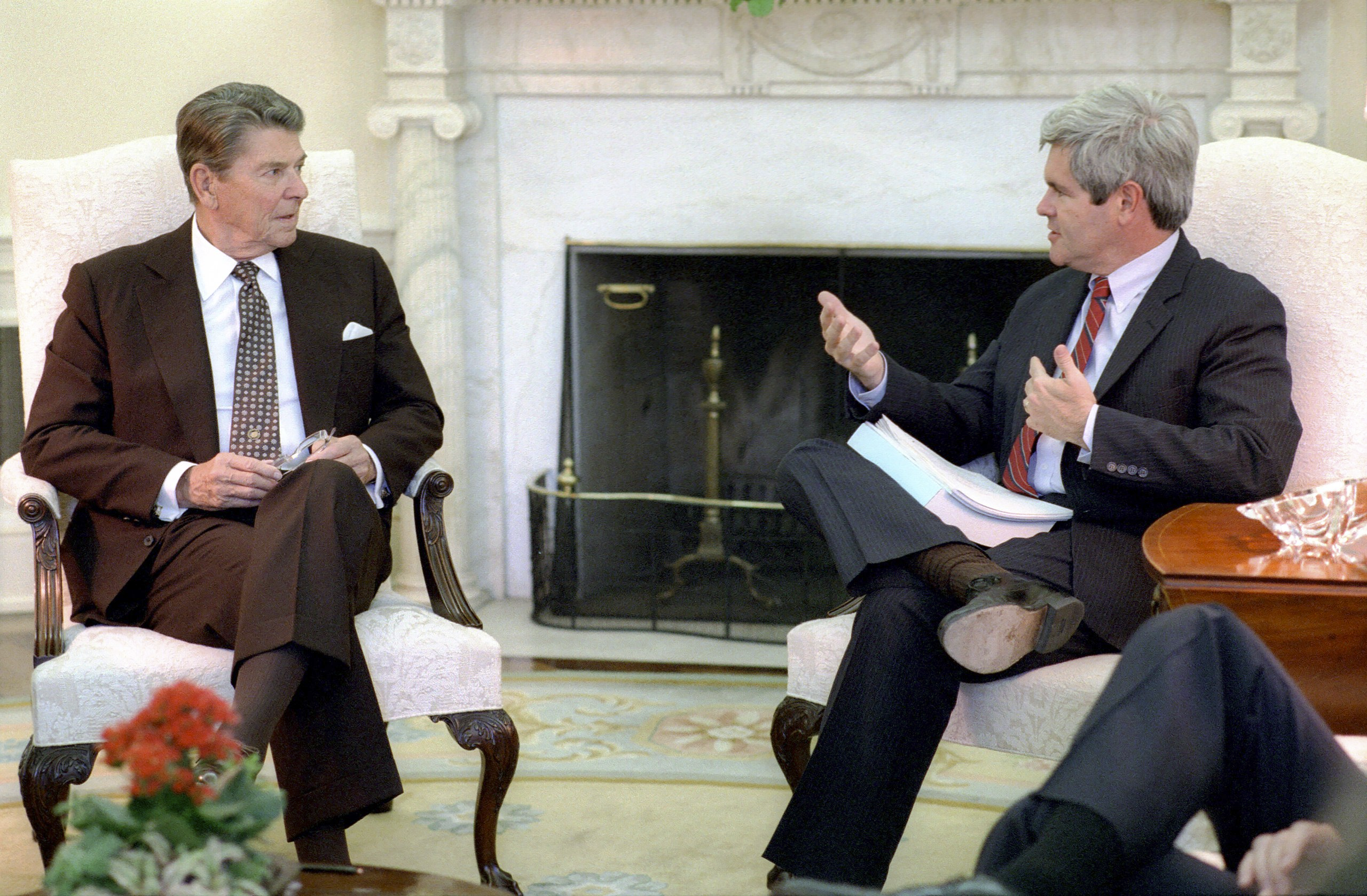
The 1984 election was a blowout for Republicans on the presidential level but just an okay one down ticket. In the House, they gained 16 seats but in the Senate they had a net loss of two. Newt Gingrich had had some influence on President Reagan’s messaging for this election, notably his embrace of Gingrich’s proposed “opportunity society” platform. However, the 1984 election would also raise Gingrich’s profile in another way, that being the most controversial election of the year.
The “Bloody Eighth” Contest
Indiana’s 8th district, known at the time as the “Bloody Eighth”, had since its modern configuration in 1932 been a highly contested district. Up to 1985, the district had been represented by Democrats for 32 years and Republicans for 20 years. Democrat Frank McCloskey was a freshman running for reelection. He had defeated Republican H. Joel Deckard for reelection in 1982, and Republicans believed they had a good chance of retaking the district with Rick McIntyre. On election night, it appeared that they had indeed done so, with McIntyre up by only 34 votes. Indiana’s Secretary of State had given him a certificate of victory, which he presented in Washington. However, House Majority Leader Jim Wright (D-Tex.) objected to McIntyre’s seating, and the certificate had been granted on the basis of the outcome of a recount in only one of the state’s counties (Kruse). Democrats also questioned some of the election practices that occurred. For instance, there were thousands of documented cases of ballots being tossed out on technicalities, such as errors by poll workers (Kruse). Congress initiated an investigative group that had two Democrats and one Republican. The most controversial event to stem from this investigation was the casting of 94 ballots that were not notarized or witnessed from these counties, none of which should legally have been counted, yet 62 were among the count and could not be removed. 32 remained, and since the 62 were counted, the Republicans argued, the 32 should be counted as well. However, Democrat Bill Clay (D-Mo.) argued that to count the next 32 “would be to compound the problem that already exists”, but this ran counter to Democratic rhetoric of the time to count all the ballots (Kruse). The outcome of this investigation was that the committee certified McCloskey the winner by a mere four votes. Republicans regarded this as the Democrats stealing the seat and uniformly opposed McCloskey’s seating, but Democrats had a majority. Even to modern day, the surviving partisans of the event stick to their narratives on the rightness or wrongness of McCloskey’s seating. Newt Gingrich in response vowed that, “We will make it impossible for this House to function. You’ll see literal war in the House” (Kruse). There was indeed a sea change, and the language of Republicans, including ones who had been conciliatory in their language, such as Dick Cheney, changed. Cheney justified his shift, stating, “What choice does a self-respecting Republicans have…except confrontation? If you play by the rules, the Democrats change the rules so they win. There’s absolutely nothing to be gained by cooperating with the Democrats at this point” (Kruse). Republicans called for a redo of the election, but Democrats stuck by their procedure. Even Minority Leader Bob Michel (R-Ill.), golfing buddy of Speaker Tip O’Neill, said, “Things…will never be the same” (Kruse). Republicans uniformly walked out of the House in protest when McCloskey was sworn in. Now, they were far more receptive to Newt Gingrich’s bomb-thrower style. As Gingrich ally Vin Weber (R-Minn.) reflected on this, “It gave Newt credibility. Newt went from being the kind of bomb-throwing back bencher who was going to remain on the fringe of Republican politics and his ideas kept moving him steadily toward the majoritarian position in the House Republican conference. Because they saw, ‘Yeah, he’s basically right. He’s right about them. He’s right about our relationship to them. And he’s probably right about what we have to do” (Kruse). A subsequent investigation by the Evansville Courier would only further provide further fuel for the fire. Their investigation discovered that of the 32 ballots that had not been counted, 26 of the voters had managed to be contacted, and of those 20 stated that they had tried to cast their ballot for McIntyre (Kruse). Had the Democrats stuck to their rhetoric, McIntyre would have won. Republicans came to believe as Cheney did that the Democrats just changed their own rules when it suited them to win.
The Rest of Reagan’s Term
Gingrich, now having the backing of many more of his Republican colleagues, continued his partisan activity. He was unwavering in his support for the Strategic Defense Initiative (“Star Wars”) and backed nearly all of Reagan’s vetoes (South Africa sanctions was an exception). Although Republicans didn’t like Tip O’Neill for his liberalism, they would like his successor, Wright, even less.
Gingrich vs. Speaker Wright
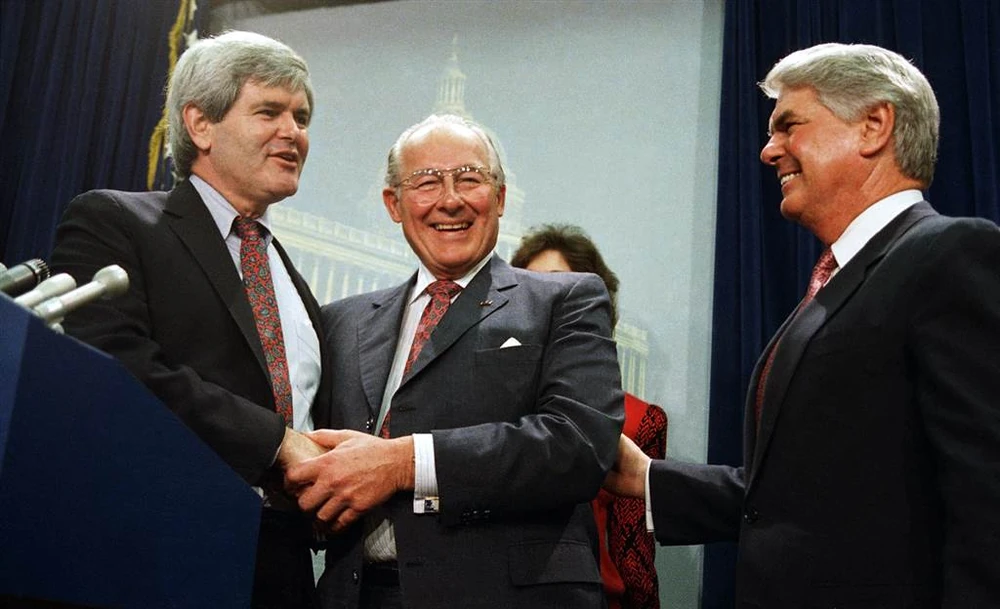
Gingrich shaking hands with Minority Leader Robert Michel (R-Ill.) after winning the post of minority whip.
With the retirement of Tip O’Neill at the end of the 99th Congress, Wright was the new speaker. Speaker Wright took a stronger partisan tone at least in part because he, like many other Democrats, were concerned about Newt Gingrich and his contingent of younger conservatives. His rule of the House was more imperious than past speakers. For example, Wright decided to completely leave out minority Republicans from decision-making and curbing staff positions for them. Rep. Vin Weber (R-Minn.) expressed the Republican discontent over Wright, “The dislike of Speaker O’Neill was ideological…he was really the symbol of northeastern liberalism. The dislike of Speaker Wright is different. Republicans think he is basically and fundamentally unfair; that he does not have the respect for the institution like Tip; that deep down he is a mean-spirited person, ruthless in the truest sense of the word” (Wallach). It also should be noted about Wright that he was mentored by Lyndon B. Johnson, so playing hardball was well within his repertoire. He also angered Republicans for attempting to negotiate with the Contras and Sandinistas despite President Reagan’s refusal and that foreign policy is foremost an executive rather than a legislative function. Gingrich suspected that Wright had skeletons in his closet and had commissioned an investigation into his background. It turns out he had suspected correctly, and in May 1988 he filed an ethics complaint against him. In March 1989, as the investigation was concluding, Gingrich was narrowly party whip to replace Dick Cheney over the considerably more moderate Edward Madigan of Illinois, who had been backed by Minority Leader Robert Michel (R-Ill.).
The Troubles with Jim Wright
There were some significant issues with Wright. The first was his business connection to Fort Worth developer George Mallick. It was alleged that Wright had accepted almost $145,000 in gifts from him since 1979 (Kelley). The second was that Wright had contravened House ethics rules on limitations on speaking fees through selling his 1984 collection of speeches, titled Reflections of a Public Man, and employed Betty to circumvent limitations on gifts. Third, he employed John Mack as his chief of staff. The problem with him? In 1973, Mack had, in a senseless act, smashed a woman on the head five times with a hammer, stabbed her in the shoulder and chest, slit her throat, and then dumped her in her car, leaving her for dead while he went to see a movie (Time Magazine). The woman survived and he had been sentenced to 15 years imprisonment for malicious wounding with intent to kill but only served 27 months in county jail. Why only 27 months? Mack had the good fortune to be the brother of Wright’s son-in-law (Time Magazine). What’s more, he was the executive director of the Democratic Steering and Policy Committee. That Mack had had this felonious episode in his past was known among Washington insiders, but for the public to hear it was shocking to them and this exposure forced Mack to resign on May 11, 1989. This wasn’t all for Wright; on April 17, 1989, he was charged with violating 69 House ethics rules. Furthermore, this was around the time of the Savings & Loan scandal, and Wright’s rise was alleged to have been assisted by S&L fraudsters including the infamous Charles Keating. The deputy head of the Federal Savings and Loan Corporation, William K. Black, alleged that Wright had intervened in favor of S& L executives. However, these allegations were not among them. Things were only going to get worse for Wright, thus he resigned on June 6, 1989, the first speaker ever to do so. Interestingly, Rep. Bill Alexander (D-Ark.) filed an ethics complaint against Gingrich in April 1989, accusing him of violating House rules with a book promotion deal in 1984, and publicly stated, “Mr. Gingrich is a congressional Jimmy Swaggart, who condemns sin while committing hypocrisy” (Los Angeles Times). He would file a second one against him as well, but on March 7, 1990, both complaints were dismissed by the House Ethics Committee as they concluded that Gingrich’s book promotion had not violated House rules or the law. After the ruling, he dismissed the charges as a “political smear…I am glad the committee was thorough, and I am happy the charges have been exposed as politically inspired nonsense” (CQ Almanac, 1990). The committee’s ruling probably saved Gingrich’s reelection, as in 1990 he had a close call for reelection, winning by only 974 votes against Democrat David Worley. However, Gingrich’s focus on ethics for Wright would come back to haunt him later, but that’s going to be in the next Gingrich post. Wright’s successor was Tom Foley (D-Wash.).
Gingrich and the “Gang of Seven”
The 1990 midterms were known as the “election about nothing” and was pretty sedate given that Democrats only gained eight seats in the House and one in the Senate. However, it did send seven new Republicans to Congress who sought to shake things up. This group, which included future Speaker of the House John Boehner of Ohio, was known as the “Gang of Seven”.
In 1992, Gingrich decided to give his tacit blessing to them in their exposure of the mismanagement of the House Bank, as he figured this scandal would do more damage to Democrats than Republicans. The House Banking scandal resulted in the convictions of four former representatives, a former delegate, and the House Sergeant at Arms. The House Ethics Committee singled out 22 representatives for leaving checking accounts overdrawn for at least eight months, and 18 were Democrats. These representatives had between 89 and 996 checks overdrawn. One of the 22, incidentally, was Gingrich antagonist Bill Alexander, who would not run for reelection in 1992. Gingrich himself had 22 overdrawn checks, but his paled in comparison to the number and length of time of the 22 representatives. This was a risky exposure for him, and he faced a significant primary challenger. That year, state legislator Herman Clark challenged Gingrich for renomination, criticizing his overdrawn checks and his use of a chauffeured limousine (The Christian Science Monitor). However, Gingrich narrowly pulled off a victory, winning by 980 votes. There would be yet another scandal with the exposure endorsed by Gingrich by the “Gang of Seven”, and this was the Congressional Post Office scandal, which resulted in Congressional Postmaster Robert Rota pleading guilty to three criminal charges in 1993 and implicating House Ways and Means Committee Chairman Dan Rostenkowski (D-Ill.) and former Representative Joe Kolter (D-Penn.), who were convicted on corruption charges.
The 1994 Election – Contract with America
The 1994 midterms weighed rather heavily on the Clinton Administration for several reasons. There was a backlash against the proposed “Hillarycare”, the Brady Bill was unpopular in a number of rural areas with Democratic incumbents, and Republicans were far more energized to turn out than Democrats. Heavily inspired by President Reagan’s 1985 State of the Union Address, written by Gingrich and Dick Armey (R-Tex.), and with input from the Heritage Foundation, came the Contract with America. This document was a pledge to the American people that if Republicans got a majority they would enact eight institutional reforms as well as bring ten key bills to the floor of Congress for a vote within the first 100 days of Congress. This provided a clear message and platform for the Republicans and although the degree of this document’s impact on the election is certainly debatable, it gave Republicans a solid platform to run on and made the midterm national. Republicans won nearly 9 million more votes than they ever won in midterm elections, while the Democratic vote had shrunk by 1 million from the 1990 midterms (CQ Almanac, 1994). Republicans gained 54 House seats, getting them a 230-204 majority, while they gained 8 seats in the Senate, resulting in 52-48 majority. This was the first time in 40 years that Republicans had held a majority in the House, and they had only held the Senate for 6 of the last 40 years.
Some of the biggest defeats of the 1994 midterms were that of Speaker Tom Foley of Washington, the beleaguered Rostenkowski, and Judiciary Committee chairman Jack Brooks of Texas. As far as Gingrich and the Republicans were concerned, 1994 had granted them a mandate, so how would Gingrich and this “Contract with America” do? That is for the next Gingrich post.


 Mad Politics: The Bizarre, Fascinating, and Unknown of American Political History