The history of Congressional pushback against the Supreme Court for taking the side of the federal government over the states has a much more significant history than simply beginning with the Southern reaction to Brown v. Board of Education (1954). It was also the Supreme Court’s rulings that brought on the Tidelands Controversy after the discovery of oil off the California coast, the Supreme Court hindering the ability of states to enact anti-subversive laws, and it was a Supreme Court decision that resulted in Congress affirming insurance regulation as a state function.
In 1942, the Justice Department sued the South-Eastern Underwriters Association, a group of fire insurance companies in six Southern states, for allegedly being in violation of the Sherman Anti-Trust Act. The South-Eastern Underwriters Association contested the suit on the grounds that insurance did not fall under federal jurisdiction, and they seemed to have a solid precedent to cite in Paul v. Virginia (1869), in which the court unanimously ruled that insurance regulation was the purview of the states. As the case was pending, 35 state attorney generals announced their opposition to insurance being under federal jurisdiction (Wilkes-Barre Times Leader, 1). This was a different Supreme Court, however, and it ruled 4-3 in United States v. South-Eastern Underwriters Association (1944) that the insurance industry was covered by the Sherman Anti-Trust Act of 1890 as they found insurance to be a form of interstate commerce. This overruled the Supreme Court precedent of Paul v. Virginia (1869), which ruled insurance was not interstate commerce and thus its regulation was the jurisdiction of the states. This decision was yet another Supreme Court move in maximizing what was interpreted as interstate commerce under the Commerce Clause. The Supreme Court had in 1942 gone rather far with the interpretation in Wickard v. Filburn (1942) when they ruled that even activities that have indirect impact on interstate commerce count as interstate commerce. The insurance decision attracted widespread opposition in Congress.
House Judiciary Committee Chairman Hatton W. Sumners (D-Tex.) stated, “I do not propose to yield to the Supreme Court and destroy the greatest democracy in the world…I call upon Congress to assume its responsibility” and Representative Walter C. Ploeser (R-Mo.) charged that “power-hungry politicians” were trying to control the insurance business and that it would fall under the regulatory burdens of the Office of Price Administration (Springfield Weekly Republican, 6). Representative Francis Walter (D-Penn.) sponsored House Resolution 422 in response, which would make clear the Congressional intent that insurance be regulated by states. He condemned the court as having not only overturned a 75-year precedent but also having “contemptuously ignored the intent of Congress” and asserted that the insurance companies had been following the laws of their states (Springfield Weekly Republican, 6). There were, however, representatives who defended the Supreme Court’s ruling in Emanuel Celler (D-N.Y.) and Jerry Voorhis (D-Calif.). They expressed opposition to Congress undoing a Supreme Court ruling and Celler held that proponents of this measure were portraying the insurance industry as “pure as the driven snow” and accused insurance companies of playing a “heads I win, tails you lose” game with rate-fixing under federal and state regulations (Springfield Weekly Republican, 6).
On June 22, 1944, the House passed Walter’s resolution by a vote of 283-54 (D 118-51; R 165-1; P 0-1; AL 0-1). The Roosevelt Administration opposed efforts against this decision, but Congress was in an increasingly rebellious mood, evidenced by them overriding his vetoes of the Smith-Connally Act in 1943 and the Revenue Act of 1944, the latter the first time Congress ever overrode a presidential veto of tax legislation. However, the measure didn’t advance to the Senate that year, and the bill would have to wait until the next session. This bill, sponsored by Senators Pat McCarran (D-Nev.) and Homer Ferguson (R-Mich.) was one of the first priorities of the 79th Congress, and it again passed on a strong bipartisan basis, 315-58 (D 150-56; R 165-0; P 0-1; AL 0-1) on February 14, 1945. The Senate followed up two weeks later, passing the bill 68-8 (D 35-8; R 31-0; P 1-0) on February 28th. The vote far beyond the margin of President Roosevelt to veto, he signed the measure into law on March 9th. Interestingly, there was a revision to this law in recent years. In 2020, Congress overwhelmingly passed the Competitive Health Insurance Reform Act that subjected medical and dental insurance to federal anti-trust regulations in response to rising healthcare costs, and it was signed by President Trump on January 13, 2021.
P.S.: My 2022 content is going to be archived come Tuesday.
References
House Exempts Insurance Firms. (1944, June 29). Springfield Weekly Republican, 6.
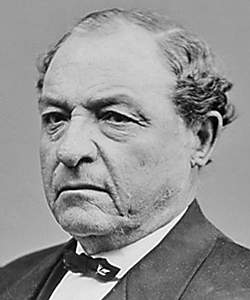
Trump is president for a second time, and while there hasn’t been anyone with his exact last name in Federal office before, there was an oddly named fellow named Philadelph Van Trump (1810-1874), although unlike Trump he was never a Republican.
The mid-19th century was a strange time in American politics. Before the existence of the Republican Party the major rival of the Democratic Party was the Whig Party. The Whigs were a broad coalition of politicians who had come together in opposition to President Andrew Jackson and his groundbreaking use of executive power. Indeed, in 1850 you could find Abraham Lincoln in the same party as Alexander Stephens, who would be vice president of the Confederacy. However, over time the differences within this coalition only grew. The most vital of these issues was of slavery, with an increasingly intractable divide between “conscience Whigs” and “cotton Whigs”. Van Trump started in the Whig Party and in 1852 he participated in last Whig National Convention, which nominated General Winfield Scott. However, the Whigs tried too hard to appeal to everyone and thus ended up having little appeal; the ticket only won the states of Massachusetts, Kentucky, Tennessee, and Vermont, a result that, with the enactment of the Kansas-Nebraska Act, spelled the death of the Whig Party. Many Whigs flocked to the rapidly growing American (“Know Nothing”) Party, as did Van Trump, and in 1856 he ran for governor of Ohio on the American Party ticket. However, this made the gubernatorial race three-way, splitting the Democratic vote and resulting in the election of Republican Salmon P. Chase. In 1860, Van Trump strongly supported the Constitutional Union Party’s ticket which ran John Bell for president and Edward Everett as vice president. The platform was maintaining the union but leaving slavery alone. Van Trump’s movement between parties is one way in which he actually was similar to current President Donald Trump, as Trump has in the past been in the Democratic Party as well as in the Reform Party for when he was running for that party’s nomination for president in 2000.
During the War of the Rebellion, Van Trump was a staunch opponent of President Lincoln and the Republicans. From 1862 to 1867, he served as a judge of the court of common pleas, commanding a lot of respect in this role for acting as he saw fit under the law even under threat of imprisonment. As the newspaper The Stark County Democrat described in his obituary, “His career as a Judge was a marked one, and perhaps no jurist ever more completely commanded respect of the bar. He was profoundly learned in the law, possessed iron firmness and the greatest suavity. The celebrated kidnapping case of Dr. [E. B.] Olds came before him, but he fearlessly enforced the law, although surrounded with bayonets and himself threatened with military arrest and imprisonment. But for the hasty intervention of the Supreme Court, he would have imprisoned Gov. [David] Tod under the kidnapping act” (DiBacco). For context, Dr. Olds was considered among the leading Copperheads of Ohio, or those who wanted a peace agreement with the Confederacy for an amicable break. Governor Tod had recommended him for arrest for his activities, which were regarded as siding with Confederates, and he was himself arrested for kidnapping briefly until freed by the Supreme Court (Roseboom & Wisenburger, 190-192). His efforts at higher judicial office met with little success, as he thrice lost elections to the Ohio Supreme Court. Instead of again seeking a post on the court, in 1866 Van Trump ran for Congress and won in the at-the-time Democratic 12th district.
Congressman Van Trump
During his time in office, Van Trump not only opposed the impeachment of President Andrew Johnson but also delivered a speech against it in Congress. As a member of the Committee on Railroads, he was a consistent opponent of the Republican policy of generous land grants to railroads. Van Trump was also consistently against high tariffs, an economic bread and butter policy of the GOP at the time. However, during his time in office he developed heart disease, and he did not seek reelection in 1872. Van Trump’s DW-Nominate score was -0.591, or one of the most liberal per that system in his time. He did not live long in retirement, dying on July 31, 1874. Van Trump also has a rather interesting connection to Washington State, where I live, in that his son, Philemon Beecher Van Trump, was the first person to document climbing Mt. Rainier in 1870.
Van Trump was different in many ways than current President Trump, and yet another one of those was in his riches. As his obituary in The Stark County Democrat read, “he died comparatively poor because he was too generous to accumulate wealth” (DiBacco).
References
DiBacco, T.V. (2018, May 4). The other Trump in history. Orlando Sentinel.
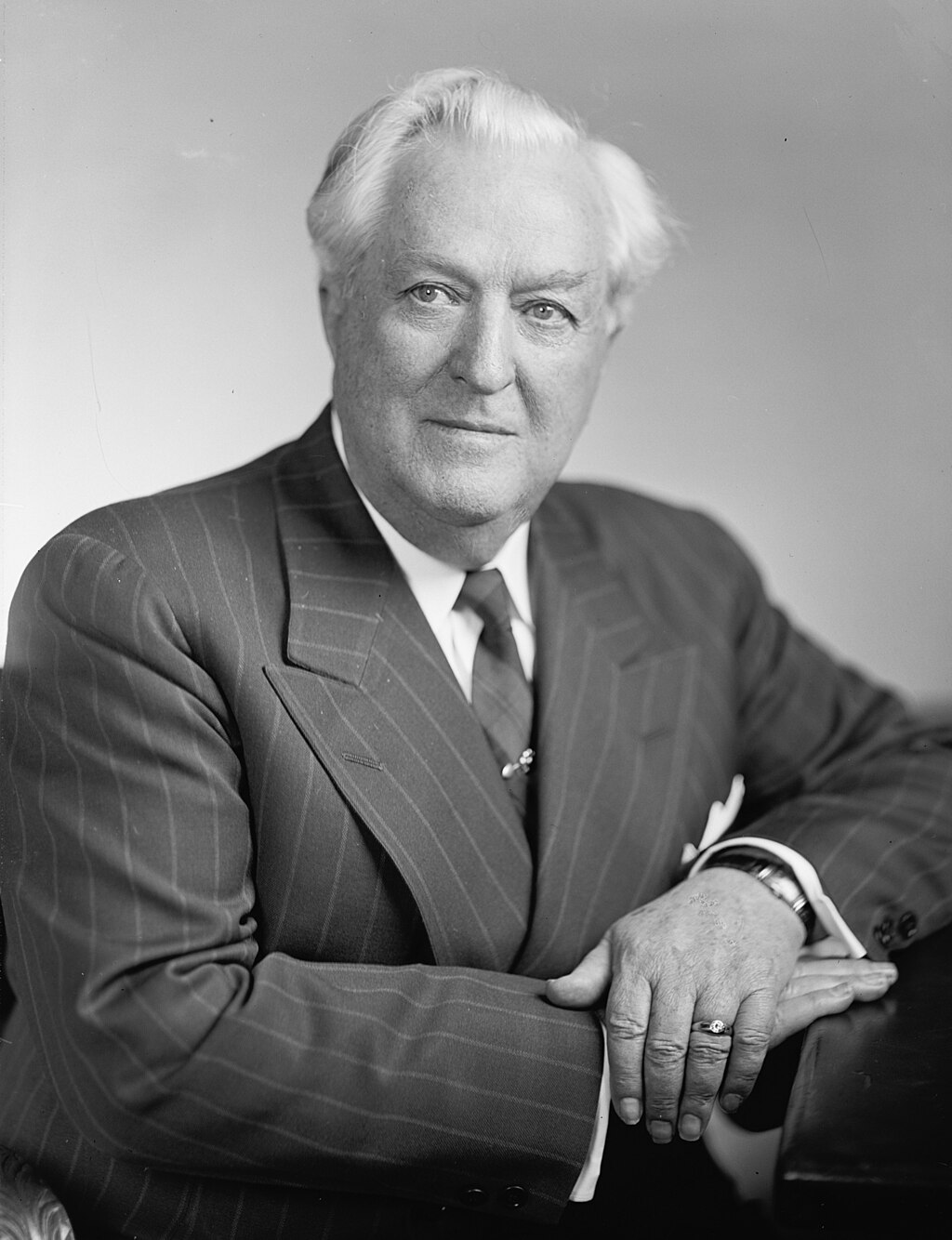
In 1930, Senator Frank Greene died during an operation, and selected to succeed him by Governor John E. Weeks was Frank C. Partridge, a personal friend and longtime presence in Vermont politics. The following year, however, there was to be an election to finish out the term, and prominent attorney Warren Austin (1877-1962) of St. Albans was persuaded to challenge Partridge, announcing shortly before the end of 1930. Although incumbency is often an advantage, in Partridge’s case it was not; he had to attend to the Senate while Austin was free to campaign across the state, delivering 60 speeches (Mazuzan, 130). Austin’s age was also to his advantage as he was 15 years younger than the 68-year old Partridge, and he won the Republican nomination for the election to finish the late Greene’s term. In 1931, winning the Republican nomination was tantamount to election, as Vermont was the Wyoming of its day in Republicanism.
Austin became a quick study of the Senate, and he thought there was some room for procedural change, namely that his fellow senators had too much room to bloviate (Mazuzan, 130-131). He voted like a traditional Republican, with a wariness of a largesse in federal government, spending, and the powers of the executive. This translated to a strong opposition to FDR’s New Deal, with him voting against all major “first 100 days” legislation except the Economy Act. As Austin wrote to his mother, “I am very apprehensive of the arbitrary powers which are being placed in the hands of one man” (Mazuzan, 131). Austin was opposed to measures he saw as intruding on states and localities as well as on individuals, and saw this in the New Deal. In particular, Austin strongly opposed the cancellation of air mail contracts based on ultimately unsubstantiated charges of fraud and collusion, writing “However unfortunate may seem the material and intimate results of the cancellations of the air-mail contracts and the acts which have succeeded that, the poignancy of the event was the grave and serious doubt excited in the minds of men and women of the purpose of the “New Deal” which is neither Republican nor Democratic. Is it an emergency policy? Or is it a permanent departure from free institutions and a surreptitious establishment, without the knowledge or consent of the people of ideas of government which are in conflict with the breeding, the traditions, and the settled purpose of the American people” (Mazuzan, 134). However, the politics of old were under increasing fire, even in Vermont. Austin’s opponent for reelection in 1934 was Fred C. Martin, FDR’s IRS collector for the state, who ran as a New Dealer and challenged Austin’s record as well as touted areas of Vermont that were assisted by New Deal programs. In a portend of Vermont’s future, this message got a lot of traction, particularly in the state’s western portion. In response Austin touted Vermont’s traditions, regarded the administration as pushing “foreign doctrines and socialistic ideas”, and asserted that there was a need for an independent voice from that of the Roosevelt Administration (Mazuzan, 138-139). Although the election result of Austin winning reelection was “business as usual”, he only won with 51% of the vote, and three western counties had voted for Martin. He would not change his ways for the most part in his next term on domestic issues and in 1935 he voted against Social Security. Only seven other senators either voted or paired against. In 1937, Austin would participate in the drafting of the Conservative Manifesto, a ten-point document proposing alternative policies to the New Deal that emphasized private enterprise and state as opposed to federal authority (Moore). In 1939, he was elected assistant minority leader and would serve as acting minority leader while Oregon’s Charles McNary was running for vice president.
Foreign Policy
Austin was well-versed in dissent, but this dissent was not confined to the ruling Democratic Party. Unlike most of his Republican colleagues before World War II, Austin was an internationalist. In 1935, he had voted for the US joining the World Court (one of FDR’s few policy defeats in his first term), and this debate largely portended the internationalist/anti-interventionist divide. Austin would vote for repealing the arms embargo in 1939, vote for the peacetime draft, be the Senate’s strongest supporter of Lend-Lease, and support permitting merchant ships to enter belligerent ports. He was even one of two Senate Republicans to oppose an amendment to the Lend-Lease bill striking aid for the USSR. He was interestingly at odds with his new colleague George Aiken both from right and left, as Aiken was significantly more liberal than him on domestic policy but was opposed to FDR’s foreign policy before World War II and more willing to permit age-based deferments to the draft. Austin strongly supported the creation of the United Nations, but kept national sovereignty in mind when he voted for the Connally Reservation, which excludes domestic disputes from the jurisdiction of the International Court of Justice. During the 1940s, Austin also moderated somewhat on domestic issues, for instance supporting retaining the National Youth Administration in 1943 and his support (albeit limited) of wartime price control. On August 2, 1946, Austin resigned from the Senate as President Truman announced his appointment as Ambassador to the United Nations. Austin’s DW-Nominate score was a 0.106, which seemed to strongly reflect his internationalism given that his record was mostly oppositional to the New Deal.
UN Ambassador
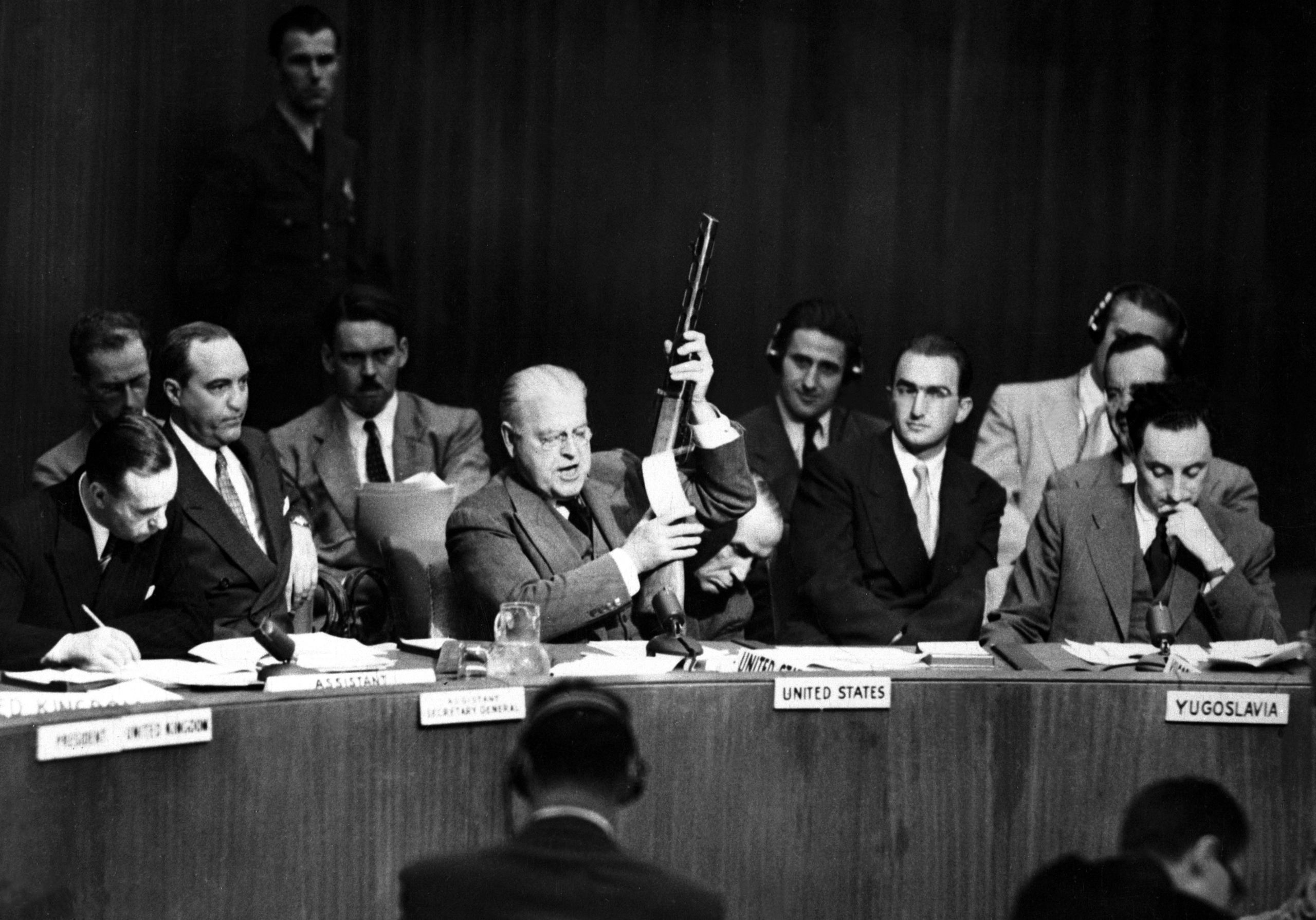
As Ambassador to the UN, Austin became known as a forceful advocate of the West as a cold warrior. During this time, he allegedly gaffed, “I hope Arabs and Jews will settle their differences in a truly Christian spirit”, but his assistant who was present held that what Austin was communicating was that as a Christian he would be impartial towards Muslims and Jews regarding the creation of Israel (Traveling for History). In 1951, Austin presented to the United Nations Security Council a Soviet submachine gun found in possession of captured North Korean troops to demonstrate that the Soviets were providing arms to them.
He served until two days after the end of the Truman Administration, with President Eisenhower picking another New England internationalist who had served in the Senate to replace him in Henry Cabot Lodge Jr.
Austin retired from public service after and was forced to curb his activities after suffering a stroke in October 1956. He died on December 25, 1962. Times have changed much in Vermont since he left office in 1946. For instance, his old Senate seat is held by none other than Bernie Sanders, a marked contrast to Austin’s anti-New Deal politics.
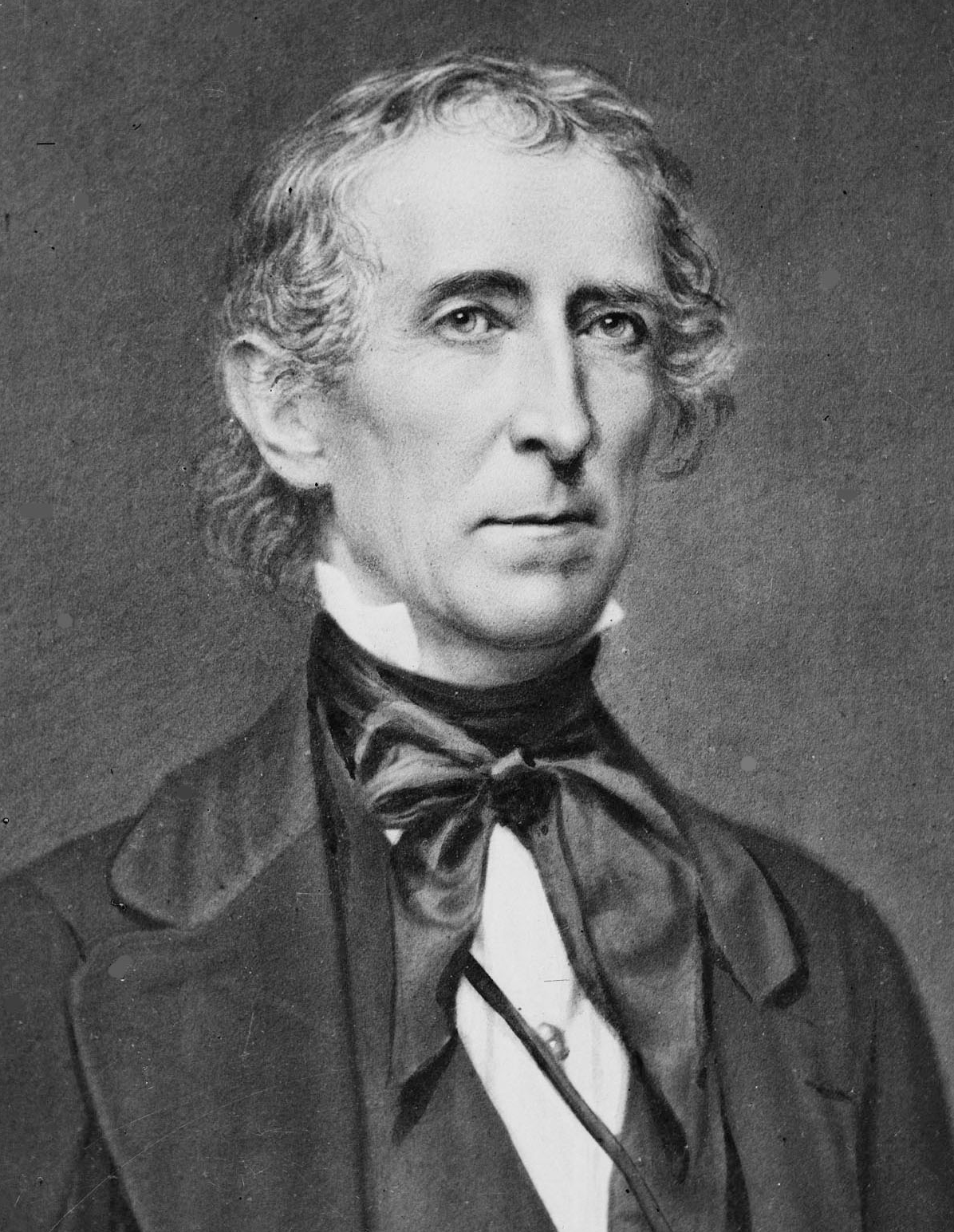
President John Tyler, whose nominees were most rebuked by a vote of the Senate.
At first, the people president-elect Donald Trump announced he would nominate after being sworn in seemed like the sort of picks you’d expect, Marco Rubio for Secretary of State or Elise Stefanik for Ambassador to the UN. However, three of his recent announcements have provoked shock, doubt, and opposition. These are Matt Gaetz for Attorney General, RFK Jr. for Secretary of Health and Human Services, and Tulsi Gabbard for National Intelligence Director. Gaetz has been a bomb-thrower in Congress for Trump and has made many enemies in the GOP for his leading role in the ouster of House Speaker Kevin McCarthy (R-Calif.), not to mention there was a House Ethics Committee report due to be released on his personal conduct before his resignation from the House. Kennedy has had a history of expressing many views that are out there, but most notorious have been his anti-vaccine stances. Furthermore, his personal record regarding marital fidelity makes Donald Trump look like a saint by comparison. Gabbard has in the past expressed support for Syrian President Bashar al-Assad and has previously repeated Russian propaganda surrounding the ongoing Russo-Ukrainian War. These announcements have certainly given some who would otherwise be supporting Trump nominations pause. Leading Senate Republicans have pledged that Trump’s nominees will go through the regular Senate vetting process as opposed to recessing the Senate thereby allowing Trump to install his cabinet for a maximum of nearly two years without Senate scrutiny. Believe it or not, only nine people have ever been rejected for a cabinet post by a vote of the Senate.
The first cabinet nomination in the history of the United States to be rejected was none other than Roger B. Taney, who would be most known as chief justice from 1836 until his death in 1864. Much like Trump is proposing to do, Andrew Jackson used a recess appointment to confirm Attorney General Taney as Secretary of the Treasury. However, as Treasury Secretary Taney was Jackson’s point man for the destruction of the Second Bank of the United States, which included advising transferring funds out of the bank and into state banks and authored a lot of President Jackson’s veto message (Encyclopedia Britannica). In retaliation, the Senate rejected continuing him in this position 18-28 in June 1834.
John Tyler’s Nominees
John Tyler has the dubious distinction of having the most cabinet nominees rejected by a vote of the Senate, with four getting rejected. This is certainly a least in part attributable to him considered by his party to be a rogue president. Indeed, him assuming the presidency instead of simply serving as acting president was considered questionable in his time, and some saw him as illegitimate. Yet, this precedent stuck. As a Whig, Tyler was dissenting on a lot of Whig policy, including vetoing restoring the Second Bank of the United States and vetoing two tariff increases. The defeated were Caleb Cushing for Secretary of the Treasury (who was voted on three times as Tyler stubbornly resubmitted his nomination twice), David Henshaw for Secretary of the Navy, James M. Porter for Secretary of War, and James S. Green for Secretary of the Treasury. The defeats of these candidates can broadly be attributed to President Tyler’s unpopularity.
Henry Stanbery
In 1866, the Senate confirmed Henry Stanbery as Attorney General for the Johnson Administration without fanfare or drama. However, relations between the Senate and Stanbery soured. He had backed President Johnson’s Reconstruction policy that gave no focus on rights for freedmen, and he had helped draft Johnson’s veto message of the first Reconstruction Act and on March 12, 1868 he resigned his post to join the defense team for President Andrew Johnson in the Senate’s impeachment trial. After Johnson was acquitted by one vote, he renominated Stanbery for his old post. The Senate, however, wasn’t having it, and his nomination was rejected 11-29 on June 2nd.
Charles B. Warren
In 1925, President Coolidge nominated Charles B. Warren to replace Attorney General Harlan F. Stone, who had been confirmed to the Supreme Court. Something to be understood about the Republican Party at this time was that although conservatives were strongly in the majority in the party, there was a staunch progressive wing and this wing in particular had clout in the Senate as they were able to team up with Democrats to oppose many policies of the Republican administrations of the 1920s. Warren was seen as too friendly to business interests, especially the “sugar trust”. The vote on this was going to be close, and Vice President Charles G. Dawes was going to be needed. Dawes thought he had time to take a nap at the Willard Hotel as he was told by the Senate leadership that a vote wouldn’t be held that day. However, the Senate abruptly decided to proceed to the vote…while Dawes was napping. Although Dawes was awoken and rushed to the Capitol to cast the tie-breaking vote, it was too late by the time he had arrived, as a senator had changed his mind to opposition with the vote failing 39-41. However, when the vote was held again on March 16th, it was rejected 39-46. President Coolidge was quite put off indeed by his vice president. This is also the last time that the Senate ever voted to reject a president’s nominee when the president’s party was in control.
Lewis Strauss
This rejection is the one that certainly has had the most public attention lately, given that it figured in the film Oppenheimer. Indeed, Strauss’s role in pushing of Oppenheimer out contributed to his defeat. However, there were other factors. Strauss’s competence was not in question, rather it was his polarizing personality that had become clear when he was a member and later chairman of the Atomic Energy Commission…while he had the full confidence and friendship of President Eisenhower, he made numerous enemies. Time Magazine (1959) described the variance of the views on him thusly, “Strauss, by the extraordinary ingredients of his makeup, is one to arouse superlatives of praise and blame, admiration and dislike. In the eyes of friends, he is brilliant, devoted, courageous and, in his more relaxed moments, exceedingly charming. His enemies regard him as arrogant, evasive, suspicious-minded, pride-ridden, and an excessively rough battler”. One of these enemies was Senator Clinton Anderson (D-N.M.), who led the charge against Strauss’s confirmation. Anderson made sure that committee hearings on Strauss went on for weeks, and he admitted that this was a strategy, “I thought if the committee members saw enough of him, he would begin to irritate them, just as he has me” (Time Magazine). Another factor was that Strauss, a staunch conservative, had repeatedly worked against public generation of power, supporting instead private industry. Although his nomination survived in committee by a vote of 9-8, this did not translate to confirmation, especially not in the strongly Democratic Senate. Strauss was rejected on a vote of 46-49, with 15 Democrats in support, and 2 Republicans in opposition. Strauss’s high level of defensiveness, an insistence on addressing every point of contention instead of admitting to a few errors, also harmed his nomination (Time Magazine).
John Tower
In 1989, President Bush nominated John Tower to serve as Secretary of Defense. Tower had served in the Senate from 1961 to 1985 as the first Republican to represent Texas since Reconstruction, and he had become an expert on national defense, serving as the chairman of the Armed Services Committee from 1981 to 1985. He had also served as the lead negotiator in the Strategic Arms Reduction Talks with the USSR and chaired the Tower Commission on Iran-Contra, which had issued a strongly critical report of the Reagan Administration. Tower was not known to suffer fools, and this made numerous senators on the Democratic side less than sanguine about his nomination. However, an unexpected opponent of his nomination came to testify before the Senate in Heritage Foundation’s Paul Weyrich. Weyrich opposed his nomination on the grounds of his moral character, stating, “I have encountered the senator in a condition lacking sobriety as well as with women he was not married to”, and adding to this Tower’s second wife, Lila Burt Cummings, alleged “marital misconduct” in her divorce filing (Los Angeles Times). The nomination became a highly partisan issue, and on March 9, 1989, Tower was rejected 47-53, with three Democrats (Dodd of Connecticut, Heflin of Alabama, and Bentsen of Texas) voting for, and one Republican voting against (Nancy Kassebaum of Kansas). The odd man out in support was Dodd, who although he denied it, it seems likely that he had Tower’s vote against his father’s censure in 1967 in mind. Tower’s defeat by vote of the Senate is the only one to have happened at the start of a president’s time in office.
I find it possible that the Senate rejects one Trump nominee in a vote, but more likely that a far more common event occurs: the nomination is withdrawn, either by Trump or the nominee him or herself. Indeed, there is a long list of announced nominations that were withdrawn during the first Trump Administration, including Andy Puzder for Secretary of Labor and Patrick M. Shanahan for Secretary of Defense. Count on some of those rather than a series of dramatic Senate rejection votes.
References
Conservative Tells of Seeing Tower Drunk: Senate Panel Hears Activist Oppose Defense Nomination. Los Angeles Times.
The 1800 election marked some firsts in American history. For one thing, it was the first time a president lost reelection and the smooth transfer of power in this case was an important precedent in American as well as world history. However, there was a significant complication that could have derailed the public’s will in electing Thomas Jefferson.
Background
When the Constitution was adopted in 1788, the Founding Fathers were largely of the belief that political parties were to be avoided. President George Washington, who never identified with a party, certainly thought so. However, factionalism developed from the beginning with groups we retroactively call the Pro and Anti-Administration factions. The Pro faction of course sided with George Washington and was also supportive of Treasury Secretary Alexander Hamilton and Vice President John Adams, believing in the use of federal power to grow the nation through the funding of internal improvements to grow commerce and imposing tariffs to finance such developments. The Anti faction sided with Secretary of State Thomas Jefferson, who idealized an agrarian society of the people and disliked the Hamiltonian system of government of protective tariffs to fund internal improvements. However, because the Constitution had it that the winner would be president and the runner-up would be vice president, it created a situation in which the president would have a political foe in the vice presidency, as happened with John Adams and Thomas Jefferson. By the 1796 election, America’s first two parties had developed in the Federalist and Republican parties. For the purposes of avoiding confusion, however, historians and others call the latter the Democratic-Republican Party, as today’s Republican Party traces its lineage to the Whigs, which traced their lineage to the Federalists. Despite the wishes of many Founders, the seeds for political parties had been planted from the very beginning. Although both Adams and Jefferson had their picks for vice president, the tickets were not official and the results made it so that under the Constitution Adams was president and Jefferson was vice president, creating a rather awkward situation in the White House. Imagine this applied to recent politics in addition to the greater role of the vice president, and you can imagine how well this would go over. Electors cast two votes each, but there was no distinction as to president and vice president in these votes.
The 1800 Election
In the 1800 election, the Federalist and Democratic-Republican parties officially selected president and vice president. Jefferson’s running mate was New York’s Aaron Burr and Adams’s running mate was South Carolina’s Charles C. Pinckney. In that election, the tides decisively turned against John Adams, with the Administration being unpopular due to numerous factors, including their support of greater relations with Britain, their tariffs, and the Alien and Sedition Acts, now widely regarded as an unconstitutional overreaction to fears about the influence of revolutionary France. Thomas Jefferson won with 60.6% of the vote as opposed to Adams’ 39.4%. The problem was that in the casting of electoral votes, the electors gave Jefferson and Burr 73 electoral votes, and because the electoral votes didn’t distinguish between president and vice president a Burr presidency was now possible! The Adams electors had been careful about this; his VP nominee Charles C. Pinckney received one less electoral vote than Adams, but this didn’t matter as the ticket hadn’t won. The conundrum had to be resolved by Congress, and the Federalists initially sought to make life difficult for Jefferson by voting for Burr and producing a stalemate, resulting in 35 ballots without a winner. Because state delegations were what mattered in the voting for president, this had the result of giving Delaware’s single representative, the staunchly Federalist James A. Bayard, the same power as the considerably more populous Democratic-Republican state of Virginia in determining the president. Burr, ever ambitious and far from the most ethical politician the US has ever had, was during this time accused of campaigning for himself being president as he did not rule himself out as a candidate for president. As a consequence, Burr would be completely frozen out of the Jefferson Administration’s inner circle. However, Alexander Hamilton realized that Jefferson was the preferable president. He didn’t like the idea of Burr being an instrument of the Federalists throughout his career. In 1804, Hamilton’s opinion on Burr reflected his views on him in 1801, asking, “Is he to be used by the Federalists, or is he a two-edged sword, that must not be drawn?” (Thomas Jefferson Monticello) He managed to convince some Federalists to switch their votes to Jefferson, and on the 36th ballot, Delaware’s Bayard cast his vote for Jefferson, thus producing the intended outcome of the people. An election being decided in the House of Representatives is, to say the least, not ideal as Americans would find out in 1824 (the election of the alleged “corrupt bargain”) and 1876, the only time in which a presidential candidate lost who got the majority, as opposed to the plurality, of the popular vote. Thus, Jefferson and his party proposed the 12th Amendment to the Constitution regarding the elections of the president and vice president. This amendment distinguished electoral votes for president and vice president, held whoever should have the greatest number of votes for vice president would be the vice president, and prohibited electors from a state for voting for more than one candidate from their state. The latter has had some relevance in decisions surrounding presidents; in 2000, Dick Cheney had to legally change his residence from Texas to Wyoming to still be Bush’s running mate, and this issue certainly factored in Trump declining to pick Senator Marco Rubio (R-Fla.) as his running mate this year. In a close election year, it is best not to risk loss because Florida’s electors can’t vote for the ticket if there are two Florida residents. The Federalist Party strongly opposed this proposal, as they saw it as a way to benefit Jefferson and his party and to further reduce their influence in politics. Senator Samuel White of Delaware argued that “we have not given it a fair experiment,” that “we should be cautious how we touch it”, and cautioned that the measure had potential to increase corruption, holding that the result would be to “more than double the inducement to those candidates, and their friends, to tamper with the Electors, to exercise intrigue, bribery, and corruption…” (Alder).
However, the Federalist Party was quite weak in representation and the Senate voted for the amendment on December 2, 1803, by a vote of 21-10, with all Federalists opposing and one Democratic-Republican joining them. On December 8, 1803, the House voted to ratify the amendment 84-42, or with 2/3’s of the vote. All Federalists and five Democratic-Republicans voted against, but the Jeffersonian majority was strong enough to ratify. Among the opponents was future President John Quincy Adams.
The 12th Amendment, it is true, did serve Jefferson and the Democratic-Republican Party, but it also adjusted to the reality of the existence of political parties, which with 20/20 hindsight just seems inevitable. That being said, Federalists were understandably self-interested in their opposition to the 12th Amendment, trying to stave off their long-term decline. The 1804 election turned out to be a cakewalk for the popular Jefferson, who had a new running mate in New York’s George Clinton and won in a massive landslide against South Carolina’s Charles C. Pinckney, who only won Connecticut and the staunchly Federalist outpost of Delaware. The Federalist Party would gradually die out, but it would ironically technically outlast the Democratic-Republican Party. The Federalist Party was finally dissolved around 1828 while the Democratic-Republican Party fell victim to its own success as the party’s tent had become far too big and it was split over the candidacy of the populistic General Andrew Jackson, dissolving around 1825. That partisan politics didn’t end with the “Era of Good Feelings” that characterized James Monroe’s administration should be demonstrative that the “end of history” will not come without the end of humanity itself.
References
Alder, C. (2016, March 3). A Far Superior Method – the Original Electoral College. In Search of the American Constitutional Paradigm.
To Concur in the Senate Resolution to Submit for Approval to the Legislatures of the States, an Amendment to the Constitution Regulating the Election of the President and Vice President. (Speaker Voting in the Affirmative). Govtrack.
The 2024 election was an electoral college sweep for Donald Trump, as he won all seven swing states. It turned out that the fear from Democrats on Republicans having a lot more of the early vote was justified. Since the Senate and House are determined to be in Republican control, it is time to look at what has happened. First, how did I do on predictions?
Presidential
I predicted 5 of the 7 swing states, and in that prediction was also a Donald Trump victory, which occurred. The states I thought would go Harris were Michigan and Wisconsin. I also regarded Michigan as the sick man of the swing states, but that was actually a designation that should have gone to Wisconsin, where Trump had his worst swing state performance. I certainly beat the Google AI prediction of a Harris win and her winning 4 of the 7 swing states (she didn’t get Arizona, Georgia, and North Carolina per AI). I never doubted North Carolina would go to Trump, same for Georgia. Nevada was a very close call for me, but I’m glad that I went against the conventional wisdom of Jon Ralston. I pat myself on the head in particular for judging this based on his prediction bias. Some facts and figures that were predictive of this election were that Gallup found this year that there were more self-identified Republicans than Democrats for the first time since it started asking the question, that Republicans led in voter confidence on the top election issue (the economy) per Gallup, that most sitting vice presidents historically don’t succeed the president, and that prediction markets were predicting a Trump win. History has only defied the Gallup voter confidence metric once, and that was in 1948. Furthermore, the prediction markets since 1916 have only been wrong three times. Alan Lichtman’s keys to the presidency has broken whatever way you see it. This election certainly gives weight to Nate Silver’s criticism of a number of his keys as subjective. Another portend I saw for this election that turned out to be valid was that Democratic incumbent senators in swing states were highlighting what they had in common with Trump in their ads. Their internal polling must have indicated something that much of the public didn’t know. After all, if the numbers had been good for Harris, they would have connected themselves with Harris in their ads.
The Senate
I am proud to report that my prediction for the Senate was 100%. I again outperformed the Google AI prediction, which predicted that Republicans would get 51 seats. I predicted that Senators Sherrod Brown of Ohio, Bob Casey of Pennsylvania, and Jon Tester of Montana would lose reelection to Republicans Bernie Moreno, Dave McCormick, and Tim Sheehy respectively and they did. The interesting thing about all three is that they had defeated Republican incumbents in 2006. It is a testament to the political skills of these men, especially in the case of Tester given the nature of his state, that they held on for three terms. For Brown, the state’s politics shifted from under his feet.
Although popular as governor in his state, Republican Larry Hogan couldn’t defeat Democrat Angela Alsobrooks. For Marylanders, the attitude towards Hogan for national office amounts to “nice guy, wrong party”.
Republican Mike Rogers in Michigan came very close, but didn’t quite make it as enough Trump voters split their tickets to put Democrat Elissa Slotkin over the top.
Republican Eric Hovde in Wisconsin came within a point, but Tammy Baldwin’s greater knowledge of farm issues likely put her over the top.
If Republican Sam Brown in Nevada had more buy-in earlier in his Senate race, perhaps he could have toppled Democrat Jacky Rosen, but then again, she did have some crossover appeal among Trump voters.
Republican Kari Lake of Arizona is a bad candidate and GOP primary voters should not choose to run her for a statewide office again; Trump won the state and all of the state’s Congressional Republicans won their reelections, in districts that were mapped out by an independent redistricting commission, but Lake couldn’t win hers.
Democrat Colin Allred, although certainly an appealing candidate, couldn’t cut into Texas’s Republicanism nearly enough to beat incumbent Ted Cruz.
The House
In the name of contrariness, I suppose I muffed this one by predicting Democratic control. However, the House has been close, and although Republicans gained or kept important ground in some places, they have lost in others.
Republican Flips
Gabe Evans toppled incumbent Yadira Caraveo in the truly swing 8th district of Colorado.
Tom Barrett defeated Curtis Hertel to win Michigan’s 7th district, held by outgoing Democrat Elissa Slotkin, now senator-elect.
Due to partisan redistricting, Republicans gained three seats in North Carolina. The new members are Addison McDowell, Brad Knott, and Tim Moore. This setup may change for the 2026 midterms.
Ryan Mckenzie defeated Susan Wild for reelection in Pennsylvania’s 7th district.
Robert Bresnahan defeated Matt Cartwright for reelection in Pennsylvania’s 8th district.
Democratic Flips
Court-ordered redistricting in Alabama resulted in the creation of a new 2nd district, a second black-majority district. Shomari Figures was elected to this seat.
George Whitesides defeated Republican Mike Garcia for reelection in California’s 27th district.
Court-ordered redistricting in Louisiana resulted in the creation of a new 6th district, a second black-majority district. Cleo Fields, whose last term in Congress ended in 1997, made a comeback.
In New York, Democrats so far have made their most impressive showing, winning three seats. Their party organization was in a sorry state in 2022, but this is clearly no longer so.
In the 4th district, Laura Gillen defeated Republican Anthony D’Esposito for reelection.
In the 19th district, Josh Riley defeated Republican Marc Molinaro for reelection.
In the 22nd district, John Mannion defeated Republican Brandon Williams for reelection.
In Oregon, the state’s Republican delegation can once again hold their party caucus in a phone booth, as in the 5th district, Janelle Bynum defeated Lori Chavez-DeRemer for reelection.
Unresolved races include Alaka’s At-Large district, in which Republican Nick Begich is leading over Democratic incumbent Mary Peltola.
Republicans John Duarte and Michelle Steel of California’s 13th district and 45th district may lose reelection when counting ends.
Maine has a ranked-choice system, and Democrat Jared Golden of the 2nd district will almost certainly win reelection.
Overall, I did pretty well this time in predicting the presidential winner and all of the Senate races. The House did stay Republican, but some vulnerable incumbents went down, and the GOP’s current numbers make a Democratic majority in the House quite obtainable from the 2026 midterm elections.
There are overall several takeaways from this election.
President Biden should never have tried for reelection. The Democrats didn’t hold a proper primary, and simply anointing Vice President Harris given the lack of time is a mess the Democrats got themselves into. The seeds of the 2024 defeat were planted in 2020. This being said, dumping Biden was the best of their bad options at that point.
Although certain economic indicators on the surface were good, the purchasing power of many Americans went down under the Biden Administration, and certain policies did the opposite of helping with inflation, namely the American Rescue Plan. Furthermore, the measure that the Biden Administration put forth as combatting inflation, the Inflation Reduction Act, primarily consisted of spending more money on green energy.
The border was a major issue, and whatever measures taken by the Biden Administration to try and clamp down on the situation now, the American people remember that the Biden Administration enacted multiple policies undoing Trump Administration policies on the border, which in sum effectively meant an open border policy, prompting a surge.
Harris was to say the least not a good candidate. She had to consistently dodge based not only on being part of an unpopular administration but also had one of the most left-wing Senate records. The positions she staked out when running for the Democratic nomination in 2020 she also had to walk back, and I believe the 2024 walking back by Harris of her 2020 stances to be as genuine as Obama claiming he was against same-sex marriage when he ran for president in 2008.
Abortion was not the major issue that certain left-wing or left-leaning press outlets were pushing. The shock of the Dobbs decision seems to have worn off after two years and numerous state referendums on abortion policy, so many voters who may have otherwise been motivated on the subject were simply able to vote on the subject in their own state. Unless Republicans should foolishly push for a national abortion ban, this issue is off the federal table save for the matter of federal government funding of abortions.
This election was a referendum on the Biden-Harris Administration, and although Trump certainly figured in people’s minds the voters didn’t forget that he wasn’t the incumbent. The Democrats could run away from Biden, but they could not run away from the fact that they were the incumbent party. The Republicans should not, however, read this as Trump suddenly becoming very personally popular among the American public. Trump was picked by the voters despite having lower personal likability numbers than Harris.
Kamala Harris responding to Sunny Hostin’s question about what she’d do differently than Biden and having no difference of substance was damaging, and I didn’t think that this would be ignored during the election.
Donald Trump had an excellent campaign manager in Susie Wiles, who mostly was able to keep him on focus. Picking her as chief of staff is on point.
J.D. Vance was a far better VP pick than most people thought at the time, and his performance at the VP debate did much to combat portrayals of him as “weird”. Furthermore, he was better at arguing for Trump than Trump was.
Harris probably chose the worst of her options when she picked Tim Walz. By the way, both times Democrats have run women for president they have picked balding upper-middle aged men named Tim from light blue states!
This is the election of the podcast. Podcasts are proving more influential media than declining mainstream media outlets with their packaged thinking talk programs, and as demonstrated by Trump’s appearances on podcasts with young male audiences, most notably the Joe Rogan Experience.
Although this was a secondary factor, far left social issues figured against Democrats, such as “defund the police”, certain trans policies (trans women in women’s sports, state-subsidized sex-change operations, puberty blockers and sex change operations for minors), and racial identity politics.
Trump won the image war. His campaign PR stunts such as his serving food at the drive-thru of a McDonald’s and as a garbageman may be disregarded by some as disingenuous, not real, or unimportant, but everyone knew they were PR stunts, and they were good ones. Furthermore, his narrow brush with death produced a photo that is iconic in American history.
Give the pollsters a break. The outcomes of these elections were well within the RCP poll average margins of error. Some pollsters got it more wrong while others were more on the mark. This is why you look at poll averages to see about where the race is.
Trump’s win in this election changes the narratives about him as well as narratives about where our nation’s politics are at. Grover Cleveland no longer stands alone, to say the least.
This election is from the information available, going to be a coin flip. I hope to do better than a coin flip in these predictions I will make. First thing’s first, however, a history of RealClearPolitics average polling for major races (President, Senator). Gubernatorial races are not figuring prominently this year, and the only close one to speak of worth attention is New Hampshire, where Republican Kelly Ayotte is slightly leading in polling at the moment. The endorsement of Governor Sununu may be sufficient to put her over the top. Before we carry on here, I want to go over some polling history.
Presidency
Presidential Election
2016
Net Bias
2020
State
RCP Average
Actual
RCP Average
Actual
Net Bias
AZ
R +4
R +3.5
R +0.5
D +0.9
D +0.3
D +0.6
GA
R +4.8
R +5.1
D +0.3
R +1
D +0.3
R +1.3
MI
D +3.4
R +0.3
D +3.7
D +4.2
D +2.8
D +1.4
NV
R +0.8
D +2.4
R +3.2
D +2.4
D +2.4
None
NC
R +1
R +3.7
D +2.7
R +0.2
R +1.3
D +1.1
PA
D +1.9
R +0.7
D +2.6
D +1.2
D +1.2
None
WI
D +6.5
R +0.7
D +7.2
D +6.7
D +0.7
D +6
This is indicative of largely Democratic bias over the last two cycles, but 2012 had Republican bias, and as you will see, the 2022 midterms had a considerable Republican bias, but there is a caveat to this one.
Let’s look at some indicators:
Good for Trump:
. Republicans outnumber Democrats nationwide, a new development (Archacki). The independent vote may turn out to be the deciding factor, however.
On November 1st, 538 put Trump at a slight advantage with a 53% chance to win, but greater odds have been overcome, most notably by Trump in 2016.
The betting markets are favoring a Trump victory. The predictive performance of the betting markets since 1916 has only failed thrice: in 1916 itself, 1948 (polling ended two weeks before the election in that one), and the tremendous upset of 2016.
Per Nate Cohn, there isn’t evidence yet that the pollsters’ Trump voter counting problems are fixed.
Nate Silver, formerly of 538, predicted a Trump win up until final projection.
The polling of the election may suffer from a non-response bias that favors Trump (Grover).
Defections from the Democrats in Michigan from Arab American voters, with a possibility that Trump gets more of them than Harris does, with left-wing Arab Americans potentially voting for Green Party candidate Jill Stein.
The Trump campaign, according to Jack Herrera of Politico, has consistently had a stronger ground game in Pennsylvania than the Harris campaign, which could spell victory in the state despite the “garbage island” incident. As someone who has worked in campaigns, I strongly believe in ground game. In 2020, I knew the Democrats were not going to do as well as polls predicted because they were behind on ground game, namely door knocking, and particularly so in Florida. However, although Trump himself survived COVID, his reelection did not.
Kamala Harris is not an inspiring candidate aside from her being a woman and most importantly, not Trump, at least from a standpoint of those not ideologically motivated. Her record in the Senate was one of the most liberal, and she campaigned as a hard California liberal in the 2020 Democratic primary.
Republicans have higher favorability on the economy per Gallup polling. The last time a party’s candidate for president lost when the party had an edge on the top issue, which is the economy this year, it was in 1948. And I’ve mentioned the issue of polling in 1948.
Good for Harris:
Historian Allan Lichtman’s keys to the presidency system has predicted since 1980 the outcomes of all presidential elections except 2000.
The Des Moines Register poll of Iowa actually puts her three points ahead. This is most likely an outlier, but this poll has had some good history behind it, but an Emerson poll also came out that had Trump up in Iowa by ten points and Emerson is a highly reputable firm. If the Iowa poll is indicative of movement towards the Democrats in Iowa, then that doesn’t speak well for Trump’s ability to win less solid states. But one must remember of course that this time their off.
Per 538’s Nate Cohn, pollsters may be overly weary of underestimating the Trump vote, making an undercounting again seemingly unlikely.
Nate Silver’s final projection gives Harris the slightest edge over Trump.
The subject of abortion may be a sleeper factor here that increases Harris’s share considerably with moderate and independent women and wins her the election.
The “island of garbage” line at Trump’s Madison Square Garden rally, which may tip some needed Latino voters in Pennsylvania.
Donald Trump has a lot of baggage to put it mildly, and some older voters may be nervous about him being the more chaotic candidate, again putting it mildly.
Michigan Democrats have a stronger ground game than Republicans. Although Republicans have undergone some course correction after the catastrophic tenure of Kristina Karamo as party chairman and this will help them some, early voting is indicating a trend towards an over 50% turnout from Detroit (Massey & Guillen). A 50%+ turnout is an indicator of a Democratic win.
Now…let’s look at the RCP poll averages from Monday evening for the seven swing states. I know Minnesota and New Hampshire were recently added to tossups, but I doubt this is going to happen.
Arizona – Trump +2.8
Republicans have been making gains in Arizona in registration since 2020, and there is no recent poll that has Trump in a polling deficit. The closest one is Morning Consult, which has a tie. In this final stretch, Arizona is the sick man of the swing states for the Harris campaign and the champion for Trump’s. Trump wins the state.
Georgia – Trump +1.7
Most polls have Trump leading in Georgia, with New York Times/Siena being the only one to indicate a Harris lead. NYT/Siena is a highly credible polling firm, but so is Emerson, which indicates a one-point lead for Trump. I think Trump pulls through in Georgia.
Michigan – Harris +0.5
The numbers in Detroit, as I mentioned in the positives for Harris, make me think that Michigan, despite Arab American defections, will stay blue this time. The polling momentum appears going slightly to Trump, but a flurry of polls late in the game pointed to a GOP wave in 2022 that didn’t materialize in most of the nation. What’s more, the Michigan GOP is still recovering from the disastrous tenure of Kristina Karamo as its party chair. I think ground game matters a lot, and Democrats have a better ground game in Michigan. Much of the ground game right now is through Elon Musk’s America PAC, which is a major push to reach people with a low propensity for voting (LaHut). Harris wins Michigan, the sick man of the swing states for Republicans.
Nevada – Trump +0.6
This one is rather interesting. Although Trump is up, Nevada has had some history of over-polling Republicans. However, it was one of the states in 2020 in which the pollster average was the actual margin of victory for Biden. Nevada political expert Jon Ralston has predicted that Harris will win but by the narrowest of margins with mail-in ballots. Ralston is a credible source, as he predicted the outcome of 2020 in Nevada as well as Republican Joe Lombardo winning in the gubernatorial election in 2022 and Democrat Catherine Cortez Masto winning reelection to the Senate. However, Ralston has also predicted margins of victory, and he has overpredicted Democratic margins in the past. He predicts for this one that Harris will win by 0.3% (Schwartz). In 2020, Ralston predicted a Biden victory in Nevada by four points, but Biden actually won by 2.4%, a difference of 1.6% in favor of Democrats and in 2022 he predicted a 2 point victory for Masto but Masto won with 0.8%. If his being off by 1.2 to 1.6% in favor of Democrats holds up, Trump wins the state. The state’s Democratic registration edge also has declined considerably from 2020 and many of the state’s new residents are from California and may be against their old state’s political leadership. Not good for Harris if true. Ben Margiott of Las Vegas Channel 3 News reports that “Republicans continue to hold a roughly 4% turnout advantage”. I predict a Trump win by the skin of his teeth.
Trump has been leading in most polls in North Carolina, and the early vote looks good for Republicans and not so good for Democrats. That being said, early voting is not necessarily predictive. It is difficult to see how Harris outperforms 2020 Biden, save a considerable enough migration of college-educated whites from four years ago. I predict a Trump win.
Pennsylvania – Trump +0.4
Most agree that this is the must-win of the swing states. The interesting thing about Pennsylvania is it is one of the two states in which the poll average matched the outcome in 2020! Furthermore, the ground game of the GOP in this state has been outperforming that of the Democrats for months (Herrera). However, there has been more elderly Democratic early voting, which may not bode well for the GOP. Democrats, however, have an advantage in early voting shaved by 600,000 votes. With more Republican votes in, this gives them more room for GOTV on Election Day. On balance, I call this one for Trump.
Wisconsin – Harris +0.4
Harris’s numbers look the second best in Wisconsin, and I think the days of polling discrepancies in the state may be over. I think that Harris is favored to win the state based on Democratic ground game, which is stronger than the Republican game in the state.
Senate
Something to bear in mind about Senate polls historically is that there has always been at least one upset every year. An upset is defined in this post as one in which the opposite result occurs from the RCP polling average.
Races in which upsets occurred over the past ten years:
North Carolina, 2014: Tillis vs. Hagan
RCP Projection: D +1.2
Actual Result: R +1.7
Democrats spent the most money on this race to protect Senator Kay Hagan of North Carolina and she led in most polls, but the midterm went the Republicans’ way and Tillis pulled off an upset.
New Hampshire, 2016: Ayotte vs. Hassan
RCP Projection: R +1.5
Actual Result: D +0.2
Senator Kelly Ayotte was leading in most polls up to the election, but as the state voted for Clinton, Governor Maggie Hassan got enough of the vote to pull a squeaker.
Pennsylvania, 2016: McGinty vs. Toomey
RCP Projection: D +2
Actual Result: R +1.6
Senator Pat Toomey of Pennsylvania won a narrow reelection victory even though only poll put him ahead, this tracked with Trump winning the state, although Toomey ran ahead of Trump.
Wisconsin, 2016: Johnson vs. Feingold
RCP Projection: D +2.7
Actual Result: R +3.4
Senator Ron Johnson of Wisconsin was thought at the beginning of 2016 to have a DOA campaign. However, despite grim prognostications throughout the year and most polls of the Senate race putting former Senator Russ Feingold at an advantage, Johnson won by 3.4. Feingold’s RCP average was 2.7 up.
Arizona, 2018: McSally vs. Sinema
RCP Projection: R +1
Actual Result: D +2.3
Republican Senator Martha McSally was facing popularity problems and ran a lackluster campaign. Despite late polls seeming to go her way, Kyrsten Sinema defeated her.
Florida, 2018: Nelson vs. Scott
RCP Projection: D +2.4
Actual Result: R +0.2
Democratic Senator Bill Nelson of Florida after three terms was defeated by Republican Rick Scott. Nelson had led in most polls, but there was an increase in the number of polls that put Scott over the top.
Indiana, 2018: Braun vs. Donnelly
RCP Projection: D +13.
Actual Result: R +5.9
Democratic Senator Joe Donnelly led in the majority of polls in the final stretch, but Republican Mike Braun pulled off a victory in Republican Indiana.
Nevada, 2018: Heller vs. Rosen
RCP Projection: Tie
Actual Result: D +5
This may not technically be considered an upset, but Heller had been leading in two of the three last polls, and the result was one point higher than Emerson’s poll figuring Rosen at +4.
Maine, 2020: Collins vs. Gideon
RCP Projection: N/A, but all polls had Democrat Sara Gideon up, although RCP considered the race a “toss up”.
Actual Result: R +8.6.
Although polling was sparse, this one is scandalous, as the margin of victory for Collins wasn’t even within 5 points.
North Carolina, 2020: Cunningham vs. Tillis
RCP Projection: D +2.6
Actual Result: R +1.8
Chuck Cunningham looked good to defeat Republican incumbent Thom Tillis, who was seen as lackluster. I thought at the time Tillis would pull through a win anyway as polls had underestimated him before and Cunningham had an extramarital affair scandal.
2022 saw four upsets, all upsets were polling that favored Republicans but the seats went to the Democrats. The Republicans had candidate quality issues with the uncharismatic and weird Blake Masters, the personally troubled and questionably coherent Herschel Walker, and the comically out-of-touch Dr. Mehmet Oz. Nevada’s Democratic turnout machine managed to secure a victory for Cortez Masto over Laxalt, who made the poor decision to be loud in support of Trump’s election denial in 2020. I have my doubts the poll bias will be this bad this time around towards Republicans, and much of this bias actually happened in the last week of the campaign as a flurry of bad polls came out, and contrary to popular belief it was more widespread than just Republican pollsters.
Arizona, 2022: Kelly vs. Masters
RCP Projection: R +0.3
Actual Result: D +4.9
Georgia, 2022: Walker vs. Warnock
RCP Projection: R +1.4
Actual Result: D +0.9
Nevada, 2022: Cortez Masto vs. Laxalt
RCP Projection: R +3.4
Actual Result: D +0.9
Pennsylvania, 2022: Fetterman vs. Oz
RCP Projection: R +0.4
Actual Result: D +4.9
2022 is an example of why the polls may be biased towards Republicans this time around rather than the Democrats, as they were from 2014 to 2020. This is a possibility, but I don’t see the bias being this much, perhaps a little on the side of the Democrats, and maybe even a bit to the Republicans once again. Now for the Senate races!
Michigan – Rogers vs. Slotkin, Slotkin +2.3
Democratic Congresswoman Elissa Slotkin has led in all but one poll, and that is from Rasmussen Reports, which although did very well in the 2004 election predictions, it has had a bit of a spottier record since 2012. Republican Mike Rogers was a decent pick, but Democrats are on their game once again in Michigan. Like Harris wins Michigan, Slotkin wins. If she loses, Democrats have had an awful election.
Montana – Sheehy vs. Tester, Sheehy +7.7
Senator Tester will be defeated in the election despite late-game optimism from Democrats. There has been no time in the history of Senate RCP polls in which a candidate was this far ahead in polling and lost. It is a testament to Senator Tester that he managed to serve three terms from a state that has repeatedly voted for Republican presidents.
Nevada – Brown vs. Rosen, Rosen +4.9
Nevada is figuring to be a tight race presidentially, but the polling has put Democrat Jacky Rosen repeatedly up, with Republican Sam Brown only leading by one in a Susquehanna poll, without doubt an outlier. Rosen wins another term.
Ohio – Brown vs. Moreno, Moreno +1.7
Senator Brown has been banking on a number of people voting for Trump and him, but Ohio’s status as a red state and Trump’s coattails look like they are going to push Moreno over the top. Brown was leading up until very recent polls, and it looks like the momentum is on Moreno’s side. I also reason this because split-ticket voting is a less common phenomenon than it used to be. I also don’t see this as a last-minute bad poll flurry as this turn isn’t widespread.
Pennsylvania – Casey vs. McCormick, Casey +1.8
Democratic Senator Bob Casey has been in office since 2007, and this is his toughest race. However, McCormick has been behind in most recent polls although the margins are close. Since every Senate election has had at least one upset, I will boldly offer the prediction that it is this race. Winner: McCormick.
Texas – Allred vs. Cruz, Cruz +4.4
Democrats try again to take down Ted Cruz with Congressman Colin Allred. They have arguably picked better this time than Beto O’Rourke, but Texas’s Republican status is not going to change with this presidential election, and there won’t likely be enough Trump-Allred voters to elect him. Cruz wins another term.
Wisconsin – Baldwin vs. Hovde, Baldwin +1.8
I was torn between this and Pennsylvania as being the shocker, but the ground game is stronger for the GOP in Pennsylvania and they just seem to be polling better. The one hesitancy I have in this is that Wisconsin polls have from 2016 to 2020 underestimated Republican strength. Indeed, Biden won by less than a point in 2020 when he was polled to win by more than six. This being said, the ground game is stronger for Democrats in Wisconsin this year, and I believe in ground game. The days of poll bias for Democrats may just be over, indeed Republican poll bias manifested in 2022, with Senator Ron Johnson of Wisconsin winning by a narrower than expected margin and Governor Tony Evers winning reelection despite RCP poll averages putting Republican Tim Michels, who denied that Trump had actually lost the 2020 election, narrowly on top. Again, candidate quality matters! Although Hovde is a better candidate and he does have the advantage of being able to self-fund, he also didn’t get the endorsement of the Wisconsin Farm Bureau Federation based on his lack of knowledge on farm issues, so I think Baldwin does get another term.
Overall, I predict Republicans end this race with 53 seats in the Senate. As for the House, it is, like the presidency, anyone’s game, but I’m going to make a little bit of a wild prediction here. Democrats narrowly take the House because of Harris coattails in blue state House races. Yes, I’m one of the few who is predicting a mixed result in which Trump does not get unified government. There are a fair number of vulnerable Republican incumbents and the legislative chaos caused by a stubborn minority in the GOP certainly didn’t help their image to govern.
References
Archaki, L. (2024, September 28). For First Time Ever, More Americans Are Republican Than Democrat. The Daily Beast.
Schwartz, I. (2024, November 4). Jon Ralston: Nevada is Going To Be Close, Mail-In Ballots That Come In Late Will Put Kamala Harris Over The Top. Real Clear Politics.
We are now one week away from yet another election which is called the “most important of our lifetimes”, and the third election in which Donald Trump is the Republican nominee. Many observers, myself included, are regularly checking polls and even trying to be so bold as to predict outcomes. The first election that featured Trump, 2016, was the greatest upset in American political history since Truman defeated Dewey in 1948. The worst example of average polling being off was Wisconsin, in which Clinton, per the RealClearPolitics polling average, was up by 6.5, but Trump won by 0.7. None of the latest polls had put Trump on top, including the Republican firm Remington Research, which found Clinton at 8 points ahead. In fact, none of the polls from August until Election Day had Trump up. In the case of 1948, however, polling ended two weeks before the election. The 1936 poll by The Literary Digest, however, takes the cake. The magazine The Literary Digest issued a presidential straw poll every election year, and this had been predictive of the winner since 1916. Yet, their 1936 poll projected Republican Alf Landon as the winner with 57% of the vote and 370 electoral votes. As anyone with even a cursory knowledge about American history should know, we have not had a President Landon. Landon actually only won 37% of the vote and 8 electoral votes; only the voters of Maine and Vermont (they were very different states back then!) saw fit to vote out FDR. The Literary Digest had predicted 1916, which merits credit as it was a close race, but the others were landslides. All this, however, begs the question: how did this publication blow an even bigger landslide? Let’s look at their methodology.
The Literary Digest conducted one election straw poll per year, and they used three lists as sources: phone numbers, drivers’ registrations, and country club memberships (Emory Oxford College). For 1936, they contacted 10 million people for their survey, and from this they got 1,293,669 people who supported Landon and 972,897 people who supported Roosevelt. This approach had multiple methodological problems. The first, the conventional story, is that The Literary Digest had failed to account for the class polarization that came with the Roosevelt Administration…Americans in previous elections had voted more similarly based on class. Many working-class Americans in the North voted Republican in the past elections, and while the 1920s prosperity was part of it, they also supported the GOP’s high tariff platform, a mainstay as old as the party’s 1856 platform. However, FDR’s New Deal programs were highly appealing to many Americans going through hard times, while many in the upper strata had the luxury to think more about FDR’s growing political power as a source of peril and his policies were coming greatly out of their pockets. That the wealthy were overrepresented among those who had telephones, vehicle registrations, and country club memberships should go without saying.
Thus, wealthy people were way overrepresented in the straw poll, as they were disproportionately represented in their opposition to FDR. However, subsequent research pointed the finger at a much more important factor, the response rate to the poll. 10 million people had been sent the poll, but only 2.4 million responded! This constitutes a mere 24% response rate, which is sufficiently low to make the poll worthless. Substantially compromising the class narrative is that a majority of Americans who had telephones and vehicle registrations also supported Roosevelt (Lusinchi). Rather, it was people who were opposed to Roosevelt who had much stronger motivation to respond to the poll. This research partially debunked this traditional narrative, holding that the poor response rate to the poll was sufficient to produce the off result and that the overrepresentation was a secondary factor.
The error was so catastrophic that The Literary Digest folded in 1938. But with the demise of the magazine was the elevation of the Gallup poll. George Gallup was one of the pollsters who got 1936 right, and through his polling predicted an FDR win, albeit with 54% of the vote (PBS). Gallup had nonetheless managed to get the correct outcome by polling a representative sample of 3,000 people as opposed to The Literary Digest’s sample of 2.4 million people. This case illustrates the value of solid methodology in polling. We will not see an error of this magnitude in the polling averages of these races, and it is doubtful we will get something like 2016, which I regard as a black swan event.
References
2016 Wisconsin: Trump vs Clinton. RealClearPolling.



 Mad Politics: The Bizarre, Fascinating, and Unknown of American Political History