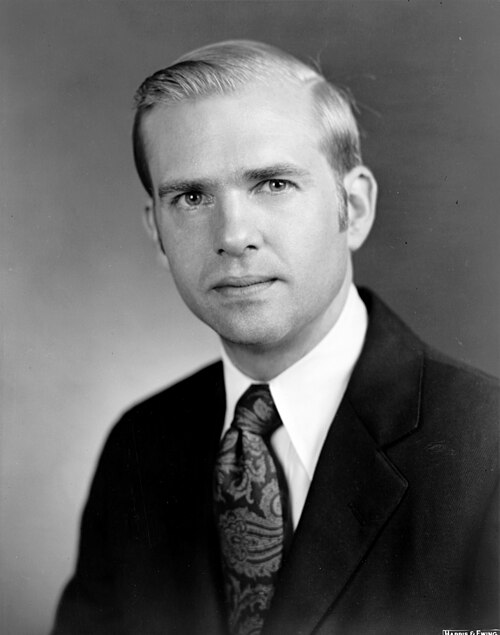
The 1966 election was a comeback for the GOP, which had taken a licking in the 1964 election, and one of their achievements was winning back Wisconsin’s 6th district with Oshkosh’s William Albert Steiger (1938-1978). From the start, Steiger was a go-getter who pursued his dreams. He dreamed of a career in public office, and at the mere age of 22 as a young graduate of his local state representative resigned, and he ran for the seat and won. Steiger’s young age fooled some people into thinking that he was a page. Once, a legislator ordered him to run an errand, and he humorously did so, later observing that he became chairman of the same committee the legislator served on (Miller).
As a member of Congress, Steiger proved to be considerably more moderate, especially on social issues, than his staunchly conservative Republican predecessor William K. Van Pelt, who had voted against the Civil Rights Act of 1964. On civil rights, he was even more liberal than his Democratic predecessor, Abner Race, who had voted against the proposed Civil Rights Act of 1966 for its inclusion of a fair housing provision; Steiger supported fair housing. He believed that there was some need for anti-poverty measures and thus opposed some efforts to curb the Office of Economic Opportunity and food stamps, opposed most anti-busing amendments, voted against a school prayer amendment to the Constitution, was an internationalist, and strongly supported the creation of the Legal Services Corporation. However, Steiger was also conservative on issues of taxes and economic regulation, consistently supported the Nixon Administration on the Vietnam War, and proved strongly opposed to campaign finance legislation, being one of 48 representatives to vote against the Federal Election Campaign Act Amendments in 1974. In 1970, Steiger was the House sponsor of the law creating the Occupational Safety and Health Administration and would oppose subsequent efforts to curb its enforcement on small businesses. He also sponsored legislation providing for environmental protection of the Great Lakes.
In 1978, Steiger called for reducing the capital gains tax from 49% to its pre-1969 level of 25%, arguing that this reduction would stimulate the economy by encouraging investment in the stock market and boosting capital investment, resulting in more jobs (Time Magazine). Through his debating skills and staunch advocacy as well as existing economic concerns, he persuaded the Democratic Congress to pass a capital gains tax cut from 49% to 28%, despite the Carter Administration’s opposition. Carter himself stated in opposition, “I will not tolerate a plan that provides huge windfalls for millionaires and two bits for the average American” (Time Magazine). That year, Steiger won reelection. On December 1st, he announced his plan to introduce legislation for tax-free capital gains accounts, but only three days later died in his sleep of a heart attack at the age of 40. Although Steiger was a diabetic, he was not previously known to have had heart problems and had been good on managing it. The ideological assessments of him differ somewhat. He sided with the conservative Americans for Constitutional Action 62% of the time, the liberal Americans for Democratic Action 31% of the time, and his DW-Nominate score is a 0.336. The latter is interesting because he gets a higher score than people who had stronger conservative reputations and stronger assessments from ACA and weaker assessments from ADA. His fate and the lost potential of it is both sad and reminiscent of Alabama’s Senator James B. Allen, who had died of a heart attack earlier that year. Both men had potential to play significant roles in the Reagan era; Steiger would likely have figured prominently in House debates and crafting of tax reduction legislation. On tax cutting, he was just ahead of his political times. Also, like James B. Allen mentoring Jesse Helms, he mentored a notable man in Dick Cheney, who worked for him as a staffer. Steiger referred him to his colleague, Donald Rumsfeld, who would tap him to work for him in the Office of Economic Opportunity under President Nixon and his roles in government would rise up until he was elected vice president.
References
ADA Voting Records. Americans for Democratic Action.
Retrieved from
Business: Tussle Over a Two-Bit Tax Cut. Time Magazine.
Retrieved from
https://time.com/archive/6879922/business-tussle-over-a-two-bit-tax-cut/
Halloran, R. (1978, December 5). Rep. William A. Steiger, Hailed As New G.O.P. Hope, Dies at 40. The New York Times.
Retrieved from
Miller, J. (1967, May 1). Youthful Trio Acting Like Congress Vets. The Bay City
Times, 3.
Retrieved from
http://www.newspapers.com/image/1185181142/
Sloane, L. (1978, December 2). Tax-Free Capital Gains Proposed. The New York Times.
Retrieved from
Steiger, William Albert. Voteview.
Retrieved from
https://voteview.com/person/11051/william-albert-steiger
To Pass H.R. 14765, the Civil Rights Act of 1966. Voteview.
Retrieved from
https://voteview.com/rollcall/RH0890293
To Pass H.Res. 1100… Voteview.
Retrieved from
 Mad Politics: The Bizarre, Fascinating, and Unknown of American Political History