New York City has had a long history of liberalism since the early 20th century, and Republicans found it more and more difficult as time passed by. There were some enclaves they had, and one of the foremost was the wealthy “silk stocking district”. This area elects Democrats now, but when it elected Republicans it often elected liberal Republicans, and the real first among the liberal Republicans to represent was Joseph Clark Baldwin (1897-1957). Baldwin’s rise to influence started after his service in World War I, becoming a political reporter for the New York Herald Tribune and getting active in the local Republican Party. In 1928, he was elected to the 95-member New York City Board of Aldermen, and from 1932 to 1934 he was the only Republican to serve on the board. Given his lonely position, he seemed to be a voice howling in the wilderness for investigating the corrupt administration of Mayor Jimmy Walker, but his voice was heard and the Seabury Investigation would expose the rot in the Walker Administration and result in numerous corruption prosecutions. In 1934, the Tammany Hall machine would be out of power with the election of liberal Republican Fiorello LaGuardia, a crusader for good government. From 1935 to 1936, Baldwin would be in the State Senate, followed by a return to New York City government, serving as city councilman from 1937 to 1941.
In 1941, opportunity grimly knocked when Representative Kenneth F. Simpson of the 17th Congressional district, the extremely wealthy “silk stocking district” of Manhattan, died of a heart attack after only 22 days in office. Baldwin ran to succeed him and won. Baldwin was a strong internationalist, and on February 13, 1943, he requested President Roosevelt send to Congress legislation to promptly enact the Atlantic Charter, stating, “Delay might prove fatal to the future peace of the world” (Independent). Baldwin was also socially liberal, being a consistent opponent of the House Committee on Un-American Activities. He also opposed legislation that aimed to curb the power of organized labor, including the Smith-Connally Act of 1943, the Hobbs Act, and the Case bill in 1946. He did oppose some New Deal programs, such as a work relief bill in 1942, but he sided more with liberals than conservatives throughout his time in Congress. Indeed, his DW-Nominate score was a -0.041, unusually low for a Republican. Despite his liberalism, Baldwin was most insistent in his brand of Republicanism. He was once quoted as having said, “I would rather die as a Republican than live as a mugwump” (The Waynesburg Republican).
Baldwin was a strong supporter of taking in Jewish refugees from Nazi Germany, and his sympathy for the plight of Jews led him to become the administrative chairman of Political Action Committee for Palestine, Inc. in 1946, with a goal of the establishment of a Jewish state in Palestine. In 1946, Baldwin sought to be reelected, be it whatever ticket he could, thus he cross-filed, running for reelection on the Republican, Democratic, and American Labor Party tickets. He was opposed in the Republican primary by State Senator R. Frederic Coudert, running to his right. Baldwin’s liberalism, which was going especially strong in how he was voting in 1946, was not playing well with the Republican base. He had voted liberal on nearly all major issues that year, including opposing every effort to weaken price control, being one of three Republicans to vote against returning U.S. Employment Service promptly to the states and he lost renomination. Baldwin also lost the Democratic nomination, but he won the American Labor Party nomination. Most of the district’s residents, however, stuck with their party rather than their representative, and Baldwin only won 8.3% of the vote. By contrast, in 1944 Baldwin had won reelection with 52.4% of the vote, with the American Labor candidate getting 8.3%. The Vicksburg Post (1946) noted the general conservative trend in the Republican primaries that year, “The defeat of Congressman Joseph C. Baldwin seeking renomination in the New York city primaries, follows the sensational overthrow of Senator Robert M. LaFollette, Jr., in Wisconsin. Both deviated from the orthodox party line to follow what is commonly known as the liberal viewpoint.”
Baldwin would never run for public office again, rather pursuing a career in public relations, serving as a representative for United Dye and Chemical Corporation and William Recht Co., Inc. He also authored the 1950 book Flowers for the Judge. Baldwin died on October 27, 1957 in the Manhattan Veterans Administration Hospital at the age of 60.
References
Atlantic Charter Legislation Wanted. (1943, February 14). Long Beach Independent, 5.
Although the most theorized assassination in American history is the JFK assassination, there are also theories about the MLK assassination, and these were explored in the special House Committee on Assassinations in the 1970s. Although this committee found that there was likely a conspiracy to kill King, that the conspirators were James Earl Ray’s brothers rather than the government. However, new life was given to MLK conspiracy theories when a man allegedly in on a plot to kill King went public.
In 1993, former Memphis café owner Loyd Jowers claimed in an interview on ABC PrimeTime Live that James Earl Ray was a patsy and that he had been hired to arrange the assassination on behalf of mobster Frank Liberto. The reason Jowers was considered plausible by some is that his café had been located on the first floor of the building that the prosecution claimed James Earl Ray had shot King from. He also named the man who pulled the trigger on King as Memphis Police Lieutenant Earl Clark. Such revelations attracted the attention of the King family, who had for years believed that there was a greater conspiracy. In 1998, they filed a wrongful death lawsuit against Jowers.
On December 8, 1999, the Memphis jury unanimously ruled that Jowers was in on a conspiracy to kill King and that others, including government agencies were involved. Did this prove that there was a vast conspiracy to kill King involving the mob and the government? Truth be told, it turns out that there are serious problems with this narrative.
Before I proceed, there are some things to bear in mind about a civil trial as opposed to a criminal trial. First, the standard is preponderance of the evidence rather than a reasonable doubt for a ruling of liability, meaning that if over 50% of the evidence supports the plaintiff, the plaintiff wins the case. Furthermore, the standard of evidence that is allowed is lower than in a criminal case. What’s more, the defendant in a civil case usually does testify, unlike the defendant in a criminal case.
Major Problems
Before giving his story to ABC PrimeTime, Jowers had long denied having had any role in the King assassination and at the time he went public, he named several people as the trigger man, including “Raoul” who James Earl Ray alleged existed and was the shooter, before sticking with Earl Clark. Another thing to be aware of is that Frank Liberto and Clark were unable to speak in their own defenses as both were conveniently dead by 1993. During the Jowers trial the jury had not been presented with Loyd Jowers’ history of contradictions. Furthermore, we have an issue of standards of evidence. For instance, an acquaintance of Loyd Jowers testified that he had heard of a conversation in a Memphis barbershop in which a man who said he worked for the FBI claimed the CIA was responsible for the King assassination (U.S. Department of Justice). This is double hearsay, which is not usually allowed in civil court and it is not admissible in criminal court. The only eyewitness testimony that was heard was regarding government surveillance of King, not of government involvement in his assassination.
Further adding to the lack of credibility to Jowers is that he never made his allegations under oath, did not testify in King v. Jowers, However, when he had a recorded discussion with a state investigator, Jowers stated that the idea that King was shot with a different rifle and by another man than James Earl Ray was “bullshit”, a key feature of his story (LaCapria). In all, the Loyd Jowers story was a publicity stunt, with him hoping he could get a book deal out of the matter. When a great man is assassinated, it can be hard to accept that a man of such a low stature like James Earl Ray could be responsible. Thus, some people need a greater story than that, a story that involves powerful actors and a grand conspiracy. After all, it only makes sense that a man of great stature would be taken down by people of great stature rather than a loser.
References
LaCapria, K. (2014, January 20). Was the U.S. Government Found Guilty of Assassinating Martin Luther King, Jr.? Snopes.
On August 31, 1940, Farmer-Labor Senator Ernest Lundeen of Minnesota, an outspoken non-interventionist, boards a plane from Washington D.C. to Detroit. Unfortunately for him and everyone on board, this is Flight 19 of Pennsylvania Central Airlines, which crashes near Lovettsville, Virginia, killing all on board in the worst air disaster in US history at the time. It is up to Republican Governor Harold Stassen to appoint a successor. Rather than pick any sort of established figure in Minnesota politics, he picks a 34-year-old journalist with no political experience in Joseph Hurst Ball (1905-1993) to finish Lundeen’s term.
Senator Ball
Ball is the youngest senator at the time and indeed, he is one of the youngest in American history. Where he will stand on the issues is a mystery as he has no track record and did not run an election campaign. However, Ball clears this up when in his first speech he calls for aid to Great Britain. This goes against the political mood of Minnesota, and his interventionist stance makes him highly unpopular for a time. In 1941, he is one of only two officials elected to Congress from Minnesota to vote for Lend-Lease, the other being the Iron Range’s Representative William Pittenger. Ball’s independence won him plaudits after the attack on Pearl Harbor. 1942 is a good year for Republicans, and Ball wins a four-way contest for a full term with 47% of the vote.
In 1943, Ball was tapped to the Truman Committee to investigate wartime expenditures. This committee, strongly bipartisan and full of people that Truman held in high esteem, was quite successful in its aims of bringing accountability to war spending and saving money. Although independence on foreign policy characterizes his career, so does his push against the power of labor unions. Ball, for instance, was a strong supporter of outlawing closed shops (The Vincennes Sun-Commercial). However, what he valued most was foreign policy, and this motivated a decision that stunned his party.
On October 23, 1944, Ball delivered an “October Surprise” to the Dewey-Bricker campaign when he publicly stated that he would be voting for the reelection of President Roosevelt, stating that Dewey had not presented the public with “a workable, constructive program on the domestic issues of taxation and labor relations” and had been too willing to cater to non-interventionists (The New York Times). Although he had not been uncritical of the Roosevelt Administration on the issues, he found its foreign policy preferable. Dewey’s running mate, Bricker, was most disappointed in this development. He stated that he had made a “grievous mistake” and was “doing a great disservice to his country” (Springfield Evening Union).
In 1945, Ball signaled a willingness to cooperate with Roosevelt in his support of the confirmation of Henry Wallace as Secretary of Commerce. However, his record on domestic issues proves quite to the right, such as his consistent support for private ownership as opposed to public ownership and his opposition to price controls.
During the 80th Congress, Ball played a major role in the crafting of the Taft-Hartley Act, which ended the national closed shop. His independence on foreign policy took a rather unexpected turn when on March 13, 1948, he was one of 17 senators to vote against the Marshall Plan, a stance that when Republicans took it, it was mostly out of a sense of non-interventionism. Ball had sponsored an unsuccessful amendment to create an 11-member western military alliance outside of the UN to counter Russian aggression (Daily News). His motives for opposition seem to have been a mix of wanting to take a stronger line against communism and balking at the considerable cost. This issue, in addition to his support for the Taft-Hartley Act, were key points that Hubert Humphrey used in his campaign against him.
Given Humphrey’s popularity as mayor of Minneapolis and his rousing pro-civil rights speech at the Democratic National Convention for the Democratic Party to shift its focus from state’s rights to human rights, he was a favorite to win. Ball may have had a chance if Henry Wallace’s campaign had decided to endorse a third-party candidate and for a time it looked like former Farmer-Labor Governor Elmer Benson would jump into the race (Wilson). If so, the left would have been divided in Minnesota, improving Ball’s chances at another term. However, by late October it was abundantly clear that Humphrey was an easy favorite, and indeed the chances of the Democratic Senate candidates were rising (The Morning Union, 6). This gain in Democratic odds in the Senate really ought to have told many political observers and pundits that President Truman was much better off than commonly thought. Humphrey ran away with the election, winning by 20 points, becoming the first Democrat to win a popular election to the Senate from Minnesota. Humphrey’s election would be part of a general shift in Minnesota politics away from its Republican history. Ball’s DW-Nominate score was a 0.241, indicating moderate conservatism, and he agreed with the liberal Americans for Democratic Action 38% of the time during the 80th Congress.
Ball would never hold elected office again, but unlike the man who appointed him, he would also never run for elected office again. He continued his career as a journalist and in the 1950s he would come to the defense of some individuals his former colleague, Senator Joseph McCarthy (R-Wis.), accused of disloyalty. Ball also spent some time as an executive in the shipping industry, retiring in 1962. Up until his declining health forced him to live in a retirement home, he raised Black Angus cattle in Front Royal, Virginia. Ball died of a stroke on December 18, 1993, outliving many of his contemporaries, including Hubert Humphrey by 15 years. It is clear to me that Ball was an individual for who party loyalty was not a good argument to persuade him to vote in any way and one who could be counted on to vote his conscience. I appreciate such people in politics and yes, with such people there are bound to be disagreements, but they are disagreements in good faith and produced by the conviction of the individual rather than by outer pressure or a supposed obligation.
References
ADA Voting Records. Americans for Democratic Action.
Montgomery Ward Co. CEO Sewell Avery being carried out of his headquarters as the company was being seized by the Roosevelt Administration.
World War II had a way of uniting the nation against the common enemy of the Axis powers and the American Federation of Labor and the Congress of Industrial Organizations as well as United Mine Workers among other unions agreed to a “no strike pledge” for the duration of the war in December 1941 as President Roosevelt wanted. Despite this national unity, there were still political battles at home and with wartime inflation as well as a holding down of wages given FDR’s wage freeze in the Stabilization Act of 1942, the purchasing power of the public decreased and this substantially impacted union laborers. There would be strikes during World War II despite the pledge, and the largest ones were initiated by one of America’s foremost unionists: John L. Lewis. Lewis had been a founder of the Congress of Industrial Organizations and during World War II he was the head of the United Mine Workers. In April 1943, he initiated a strike of 500,000 workers to demand better pay, compensation for travel to and from work, and safer working conditions. Walkouts occurred in April and May, disrupting coal production. For many in Washington this act was an outrage and a threat to the war effort. President Roosevelt ordered the mines seized and operated by government until a settlement could be reached. However, member of Congress wanted new legislation. Two politicians who took notice and opted for quick action were Senator Tom Connally (D-Tex.) and Representative Howard W. Smith (D-Va.). Although in the past Connally had been supportive of most New Deal measures, like many Southerners he had become alarmed at how much power organized labor had and had become more conservative over time. Smith was more hostile to the New Deal and was an arch-foe of left-wing radicalism, his dissent with Roosevelt starting considerably earlier than Connally’s. The Smith-Connally Act outlined conditions in which the president could seize and operate industries crucial to the war effort under the threat of striking and prohibited unions from making campaign contributions. President Roosevelt thought the measure too harsh on labor as did organized labor’s advocates in Congress. However, popular opinion was strongly against strikes during wartime as everyone had to make sacrifices this was the mood in Congress too. On May 5, 1943, the Senate passed its version 63-16 (D 33-11; R 30-4; P 0-1). June 4th, the House passed its version 233-141 (D 100-89; R 133-48; P 0-2; AL 0-1; FL 0-1). President Roosevelt vetoed the conference report, and the House overrode it 244-108 (D 114-67; R 130-37; P 0-2; AL 0-1; FL 0-1) on June 25th and the Senate did so on the same day 56-25 (D 29-19; R 27-5; P 0-1). There were even a few politicians of liberal reputations who voted for this measure such as Florida’s Senator Claude Pepper, who normally opposed legislation curbing organized labor’s power. Indeed, Southern support for this measure was extremely strong; among the representatives of the former Confederate states, only six voted or paired against passage and five voted or paired against overriding President Roosevelt’s veto, and no senators from these states opposed. Interestingly, Senator Harry S. Truman of Missouri voted for the Senate’s original version of the Smith-Connally Act only to vote against overriding President Roosevelt’s veto. For the most part, Truman would be a big backer of organized labor during his presidency.
This would be the first and only time a bill that was strongly opposed by organized labor would be passed over President Roosevelt’s veto. He nonetheless invoked this law multiple times to crack down on strikes. On August 1, 1944, numerous white workers went on a “sick out” for six days over the promotion of black workers to motormen and conductors required by the Fair Employment Practices Committee (these positions had been de facto “whites only”), and Roosevelt broke the strike by sending 8,000 troops to operate the transit system and threatened workers with being drafted if they did not return within 48 hours. This was certainly an ironic consequence of a law sponsored by segregationists. Roosevelt also applied this law to management when on April 25, 1944, and again on December 27th, he had Secretary of War Henry Stimson seize Montgomery Ward Co. after the company refused to abide by a labor agreement that the War Labor Board had hammered out and soldiers physically escorted the defiant 70-year-old CEO Sewell Avery, a staunch conservative, off the premises on April 27th after he refused to leave.
The Smith-Connally Act was an answer to a wartime situation and once the war was over, the law was no longer appropriate. Congressional conservatives sought to enact a peacetime substitute in a bill sponsored by Francis Case (R-S.D.) in 1946, but President Truman considered the measure too harsh and vetoed it. Congress would be even more conservative after the next election and pass the similar Taft-Hartley Act in 1947, this time over President Truman’s veto, which repealed the Smith-Connally Act and established among other things that states could decide whether to be “right to work” or not, a controversial provision that remains law. Although derided as a “slave labor law” at the time by its opponents and thought to be an effort to destroy unions, this did not prove the case. Indeed, union membership increased by three million in the ten years that followed, thus if destroying unions had been the intent of the crafters of Taft-Hartley, the law was a miserable failure.
References
Glass, A. (2016, December 26). FDR seizes control of Montgomery Ward, Dec. 27, 1944. Politico.
All American workers are used to the idea that their taxes are withheld from their income rather than them having to worry about paying a big tax bill on tax day, that is if you are not an independent contractor. However, from 1913 until 1943 income taxes were indeed paid in this way…you’d be paying for your last year of income. By 1942, the US was in a total war economy and that year the Revenue Act of 1942 was passed, a massive tax measure to fund the war, and with this the income tax came to not be a mere class tax, rather a tax that hit taxpayers across the board. The tax revenue that came from this measure, even though a lot, was not enough to fund the war effort as noted by Secretary of the Treasury Henry Morgenthau. The next revenue bill was going to be a sea-change in tax law as it was widely agreed upon that current-year taxation would be for the best. However, what would happen in the first year of implementation is that many people would get hit with taxes for both 1942 and 1943, making 1943 a really hard tax year for many. Ways and Means Committee Chairman Bob Doughton (D-N.C.) lamented the difficulty of changing the tax system, “We are dealing with the most hateful, difficult problem that ever came along in the annals of mankind” (Time Magazine). Enter Beardsley Ruml (1894-1960).
Ruml was an economist and the head of the New York Federal Reserve Bank and he had an idea of how to mitigate the difficulty of this change: forgive 1942 tax liability. As you might have expected, Republicans embraced Ruml’s push, but Democrats, who had a Congressional majority, were opposed. This forgiveness would largely benefit upper income taxpayers, and providing such a benefit for upper income taxpayers went directly against the political ethos of President Roosevelt and New Dealers. Interestingly, Southerners by and large objected to the Ruml Plan, at least at 100% forgiveness. Doughton, for instance, was strongly opposed to 100% forgiveness, considering it “the biggest outrage ever attempted to be perpetrated upon the people of the United States” (Thorndike, March 24). However, he would prove willing to accept a lower level of forgiveness. After all, tax relief was popular among voters and Republicans knew it! House Minority Leader Joe Martin (R-Mass.), for instance, strongly pushed this measure, stating of the majority Democrats on this issue, “They’ll know they’ve been in a fight” (Time Magazine). On March 30, 1943, the full implementation, pushed by Rep. Frank Carlson (R-Kan.), was voted down 198-215 although Congress opted to shelve the Ways and Means Committee bill 248-168 on the same day, resulting in an impasse. The House eventually passed 60% forgiveness 313-95 on May 4, 1943, but the Senate had different ideas and on May 14th voted for the Ruml Plan 49-30. This was unacceptable for President Roosevelt, who wrote to Congressional leaders, “This cancellation would result in a highly inequitable distribution of the cost of the war and in an unjust and discriminatory enrichment of thousands of taxpayers in the upper income groups. Such groups would be enriched by the cancellation of taxes already owing by them” (Thorndike, March 24).
Resolution
A compromise version of what became known as the Current Taxpayer Act was adopted 257-114 on June 1st. The Senate agreed to the measure 62-19 the next day. President Roosevelt would sign the bill into law on June 9th. The final law forgave 75% of the lower figure of either 1942 or 1943 tax liability and instituted withholding of the income tax at 20% automatically. Interestingly, the matter that had the longest and most consequential impact was the least controversial of the issues in tax withholding and the most controversial thing was a matter that is easily forgotten. Also of note, although Ruml’s full plan was embraced mostly by conservative Republicans, Ruml himself was something of a political enigma. Although a registered Republican, he more often supported Democrats than Republicans for public office, and in 1952 he backed and helped raise funds for Democrat Adlai Stevenson over Republican Dwight Eisenhower (The New York Times). There likely isn’t a soul working today who knows a tax system before withholding, unless there’s a working 100-year-old out there who wishes to contradict me. Feel free to leave a message if so!
Beardsley Ruml, 65, Tax Planner, Dead. (1960, April 19). The New York Times.
Retrieved from
The Congress: Tax Soliloquy. (1943, March 22). Time Magazine.
Louisiana’s politics, like the South’s generally, had a considerable shift in the 20th century. One of the figures who proved among the more resistant to the state’s increasing shift to the right was James Hobson Morrison (1908-2000).
Morrison was an attorney by profession who frequently supported organized labor, including creating a union for strawberry pickers. As a young man, he made a critical connection with Huey Long, but Long was assassinated before he could win a major office. Morrison was highly ambitious, unsuccessfully running in the Democratic primary for governor in 1939 and 1944. However, it would be between these runs in which he would have his major successful race.
In 1942, Morrison defeated anti-Long incumbent Jared Y. Sanders, Jr., for renomination. This would be the start of a long career for him, and although he had a reputation over his career as a progressive populist, in truth his earlier record was a bit more mixed. His first Congress was the 78th, in which although Democrats maintained their majority, it acted much like a Republican Congress and Morrison sometimes voted with the Conservative Coalition, including some tax votes and in voting for the Smith-Connally Act to resolve labor disputes over President Roosevelt’s veto. This early vote on labor demonstrated he could be independent from his union background, much like his vote for the Hobbs Act in 1945. However, Morrison was at heart a union man and in 1946 he voted against the proposed Case bill as too harsh on labor. Morrison’s record on price control was mixed, supporting some limitations but supporting the general concept. Morrison also championed highway projects in his Baton Rouge-based district.
At the end of World War II, Morrison controversially sponsored a bill that provided for the relief of Sylvestro “Silver Dollar Sam” Carolla from deportation by making him a naturalized citizen. Carolla was the boss of the New Orleans crime family. This bill did not pass, and he was deported in 1947.
Morrison had a mixed record during the Republican 80th Congress. He voted for several Republican-pushed measures such as tax reduction legislation and the Reed-Bulwinkle Act during the 80th Congress but was also one of the few Southerners to vote against the Taft-Hartley Act. Morrison proved one of the more favorable Southerners to President Truman’s Fair Deal, but it would not be until the Eisenhower Administration in which he was firmly identified with the liberal wing of the Democratic Party.
Morrison proved second only to New Orleans’ Hale Boggs among Louisiana supporters of the Kennedy and Johnson Administrations, supporting most New Frontier and Great Society measures. He voted for accelerated public works, minimum wage legislation, public housing, anti-poverty legislation, federal aid to education, and Medicare. He even bent on an area in which tough to do for his region: civil rights.
Morrison had signed the Southern Manifesto and had not supported a single civil rights measure until his vote for the Voting Rights Act of 1965, being one of two Louisianans to vote for it. His vote for this plus his strong support of the Great Society made him a target for defeat for renomination as LBJ was not popular in his district, which had voted for Barry Goldwater in 1964 (Western Washington University). This opened him up to a primary challenge from segregationist Judge John Rarick. Rarick was a staunchly conservative figure who had a history of racism, once telling a black lawyer who entered his courtroom, “I didn’t know they let you coons practice law” (Time Magazine). Morrison campaigned against Rarick by publicizing his ties with the KKK. Rarick denounced him as a candidate of the “black power voting bloc” (Webb). Morrison had an uphill battle as a strong LBJ supporter as much of his previous support was bleeding away. Rarick had also campaigned against Morrison as a “handmaiden to LBJ” (The Town Talk). The Democratic primary’s first vote resulted in a runoff, which Rarick won. Morrison never ran for public office again, resuming his legal career and raising money for Southeastern Louisiana University. He had agreed with the conservative Americans for Constitutional Action 12% of the time from 1957 to 1966, the liberal Americans for Democratic Action 64% of the time from 1947 to 1966, and his DW-Nominate score was a -0.28.
References
ADA Voting Records. Americans for Democratic Action.
In 1934, Congress passed and FDR signed the Anti-Racketeering Act. This law, aimed at gangsters, contained an exemption for organized labor. The consequences of this would become apparent when members of the Teamsters Union sought to secure wages by rather unsavory means. As Chief Justice Harlan F. Stone wrote, “They [the members of the teamsters’ union], or some of them, lay in wait for trucks passing from New Jersey to New York, forced their way onto the trucks, and by beating or threats of beating the drivers procured payments to themselves from the drivers or their employers of a sum of money for each truck, $9.42 for a large truck and $8.41 for a small one, said to be the equivalent of the union wage scale for a day’s work. In some instances they assisted or offered to assist in unloading the truck and in others they disappeared as soon as the money was paid without rendering or offering to render any service” (The New York Times, 1942). The case against the union, Teamsters Local 807, made its way up to the Supreme Court as incidents had involved interstate commerce, and on March 2, 1942, they ruled 6-1 in United States v. Teamsters Local 807 that workers of the Teamsters Union had not been in violation of the Anti-Racketeering Act. The majority opinion being delivered by Justice James F. Byrnes, the majority’s holdings were:
“1. That the legislative history of the Act shows that it was intended to suppress terroristic activities of professional gangsters, and not to interfere with traditional labor union activities.
2. The exception is not limited to those who had acquired the status of employees prior to the time when they obtained, or attempted or conspired to obtain, the payment.
3. The exception is applicable to an agreement by members of a city union of truck drivers, who, for the purpose of obtaining employment at union wages in connection with “over the road” trucks entering the city, agree to tender their services in good faith to each truck owner and to do the work if he accepts their offer, but agree further that, should he refuse it, they will nevertheless, for the protection of their union interests, require him to pay them the wages, even by resort to threats and violence.
The test of the applicability of the exception in such case is whether the objective of the conspirators was to obtain “the payment of wages by a bona fide employer to a bona fide employee,” and not whether the intent of the truck owner in making payment was to pay for services, rather than for protection.
4. Labor union activities such as those disclosed by the record in this case are not beyond the reach of federal legislative control, and the use of violence such as that here disclosed is subject to the ordinary criminal law.
118 F.2d 684 reversed” (315 U.S. 521).
Given that Justices Owen Roberts and Robert Jackson were not participating in the case, Chief Justice Harlan F. Stone was the sole dissenter. Dissenting even more on this decision was Congress.
This particular act of racketeering by Teamster members unfortunately reflected a wider problem, and Representative Sam Hobbs (D-Ala.) opted to act (Neeley). Hobbs was a close ally of FBI director J. Edgar Hoover who specialized in law enforcement measures, responded by introducing legislation to apply the Anti-Racketeering Act to labor unions, thus prohibiting extortion and robbery in interstate commerce. American Federation of Labor President William Green opposed the legislation as “anti-labor” and argued that “there is no necessity for it” (The New York Times, 1942). The New York Times was for this measure, regarding it as necessary for the reputation of organized labor. Although Hobbs’ bill passed the House in 1943 by a vote of 270-107 (D 115-70, R 154-34, P 0-2, AL 0-1, FL 1-0) (yes there were five parties in the House at the time), it was not taken up in the Senate. Numerous Congressional allies of organized labor in Washington came out strongly against the Hobbs bill as overly broad. Representative Emanuel Celler (D-N.Y.), a frequent champion of liberalism, held that the bill’s definitions were “so broad that as to permit one to drive a coach and six through them” and Representative Luther Patrick (D-Ala.), one of the strongest of the Southern liberals, warned with this law “we are simply burning the house down…to get rid of a few rats” (CQ Almanac). However, there were some liberals who found merit in this measure as a way of improving the reputation of unions. Representative Jerry Voorhis (D-Calif.), normally a voice for liberalism, thought organized labor’s fears about the bill unjustified, stating, “when one attempts to read the bill with care it just is not possible to find in the bill the dangers that are alleged to be there” (CQ Almanac). In the next Congress, the key vote was to approve the rule for consideration, which was adopted 259-108 (D 113-93, R 146-13, P 0-1, AL 01). The Hobbs Act subsequently passed by voice vote in the House and Senate and President Truman found the provisions of this bill sufficiently acceptable to sign it into law the following year. With the exceptions of signing this measure and his bad-tempered push to draft strikers, he was known as a favorable president to organized labor for his pushing for increasing the minimum wage and his vetoes of the 1946 Case bill and the Taft-Hartley Act in 1947. The Hobbs Act is a relevant law to this day.
H. Res. 406. Resolution Providing for the Consideration of HR 32 to Amend the Act Entitle “An Act to Protect Trade and Commerce Against Interference by Violence, Threats, Coercion or Intimidation.”. Govtrack.
The history of Congressional pushback against the Supreme Court for taking the side of the federal government over the states has a much more significant history than simply beginning with the Southern reaction to Brown v. Board of Education (1954). It was also the Supreme Court’s rulings that brought on the Tidelands Controversy after the discovery of oil off the California coast, the Supreme Court hindering the ability of states to enact anti-subversive laws, and it was a Supreme Court decision that resulted in Congress affirming insurance regulation as a state function.
In 1942, the Justice Department sued the South-Eastern Underwriters Association, a group of fire insurance companies in six Southern states, for allegedly being in violation of the Sherman Anti-Trust Act. The South-Eastern Underwriters Association contested the suit on the grounds that insurance did not fall under federal jurisdiction, and they seemed to have a solid precedent to cite in Paul v. Virginia (1869), in which the court unanimously ruled that insurance regulation was the purview of the states. As the case was pending, 35 state attorney generals announced their opposition to insurance being under federal jurisdiction (Wilkes-Barre Times Leader, 1). This was a different Supreme Court, however, and it ruled 4-3 in United States v. South-Eastern Underwriters Association (1944) that the insurance industry was covered by the Sherman Anti-Trust Act of 1890 as they found insurance to be a form of interstate commerce. This overruled the Supreme Court precedent of Paul v. Virginia (1869), which ruled insurance was not interstate commerce and thus its regulation was the jurisdiction of the states. This decision was yet another Supreme Court move in maximizing what was interpreted as interstate commerce under the Commerce Clause. The Supreme Court had in 1942 gone rather far with the interpretation in Wickard v. Filburn (1942) when they ruled that even activities that have indirect impact on interstate commerce count as interstate commerce. The insurance decision attracted widespread opposition in Congress.
House Judiciary Committee Chairman Hatton W. Sumners (D-Tex.) stated, “I do not propose to yield to the Supreme Court and destroy the greatest democracy in the world…I call upon Congress to assume its responsibility” and Representative Walter C. Ploeser (R-Mo.) charged that “power-hungry politicians” were trying to control the insurance business and that it would fall under the regulatory burdens of the Office of Price Administration (Springfield Weekly Republican, 6). Representative Francis Walter (D-Penn.) sponsored House Resolution 422 in response, which would make clear the Congressional intent that insurance be regulated by states. He condemned the court as having not only overturned a 75-year precedent but also having “contemptuously ignored the intent of Congress” and asserted that the insurance companies had been following the laws of their states (Springfield Weekly Republican, 6). There were, however, representatives who defended the Supreme Court’s ruling in Emanuel Celler (D-N.Y.) and Jerry Voorhis (D-Calif.). They expressed opposition to Congress undoing a Supreme Court ruling and Celler held that proponents of this measure were portraying the insurance industry as “pure as the driven snow” and accused insurance companies of playing a “heads I win, tails you lose” game with rate-fixing under federal and state regulations (Springfield Weekly Republican, 6).
On June 22, 1944, the House passed Walter’s resolution by a vote of 283-54 (D 118-51; R 165-1; P 0-1; AL 0-1). The Roosevelt Administration opposed efforts against this decision, but Congress was in an increasingly rebellious mood, evidenced by them overriding his vetoes of the Smith-Connally Act in 1943 and the Revenue Act of 1944, the latter the first time Congress ever overrode a presidential veto of tax legislation. However, the measure didn’t advance to the Senate that year, and the bill would have to wait until the next session. This bill, sponsored by Senators Pat McCarran (D-Nev.) and Homer Ferguson (R-Mich.) was one of the first priorities of the 79th Congress, and it again passed on a strong bipartisan basis, 315-58 (D 150-56; R 165-0; P 0-1; AL 0-1) on February 14, 1945. The Senate followed up two weeks later, passing the bill 68-8 (D 35-8; R 31-0; P 1-0) on February 28th. The vote far beyond the margin of President Roosevelt to veto, he signed the measure into law on March 9th. Interestingly, there was a revision to this law in recent years. In 2020, Congress overwhelmingly passed the Competitive Health Insurance Reform Act that subjected medical and dental insurance to federal anti-trust regulations in response to rising healthcare costs, and it was signed by President Trump on January 13, 2021.
P.S.: My 2022 content is going to be archived come Tuesday.
References
House Exempts Insurance Firms. (1944, June 29). Springfield Weekly Republican, 6.
When we talk about the “party switch” it is very important that we realize what this means, lest we think this means that the parties switched left-right ideologies, or that everything switched in 1964. It means a gradual shift in political philosophy in demographics and regions. Mississippi at one time elected liberal populists such as James K. Vardaman and Theodore Bilbo, men who were committed to white supremacy as well as taking on big businesses and helping poor whites. The career of William Meyers Colmer (pronounced “Calmer”) (1890-1980) is a prime example of the shift of politics in Mississippi and the Deep South as a whole. He was in Congress from the Roosevelt to Nixon Administrations, and the Colmer of 1972 seemed to bear little resemblance to the Colmer of 1932. Indeed, when he was elected in the Roosevelt wave, he was a New Dealer. Mississippi at the time was enamored with FDR, and one of its senators, Pat Harrison, was a key supporter of his first term agenda. Later in life, Colmer readily acknowledged the contrast of his earlier years, telling a friend, “You may not believe it, but I came to Washington as something of a liberal” (Hill). Although even in the first Congress of the Roosevelt Administration there was some foreshadowing of the state’s future with three members of Mississippi’s delegation voting against the National Industrial Recovery Act, Colmer was not among those representatives; he was on board with most of FDR’s agenda, and was the only representative from Mississippi to support the Bituminous Coal Act in 1935 and the Fair Labor Standards Act in 1938 (minimum wage). He would also, like most Southerners, be supportive of FDR’s foreign policies.
Colmer in 1940.
In 1939, Colmer was tapped to be on the powerful Rules Committee, but it would not be long before his record would increasingly move towards conservatism. This was in keeping with the increasing conservatism of his district based in Biloxi (Finney). The South overall had come to dislike how strong unions had become since the Wagner Labor Relations Act of 1935 and were strongly opposed to the staunchly left-wing Congress of Industrial Organizations. It certainly didn’t help matters that this union was racially integrated. The last time in which Colmer was sort of cooperative with the national Democratic Party was in the 80th Congress, in which he voted against a good number of Republican-backed positions. But even there, he was far from the strongest of partisans, with him agreeing with the liberal Americans for Democratic Action’s (ADA) positions in 1947 and 1948 73% and 55% of the time respectively. In 1947, Colmer ran for the Senate to succeed the late Theodore Bilbo, but he was defeated by John C. Stennis and did not try to move up again. After the 1948 election, in which he backed the State’s Rights Party (Dixiecrats) he would be among the most dissenting of Democrats within the party with low ADA scores.
Colmer played a key role in the consideration of legislation in the Rules Committee, which from 1955 to 1967 was chaired by fellow conservative Democrat Howard W. Smith of Virginia, who was a master obstructionist. Liberal legislation would often die in his committee as he, Colmer, and the four Republicans would vote it down, with the committee getting a 6-6 deadlock. Although he was now conservative on the bulk of issues, he did stick with some of his old New Deal positions on agriculture and public power. He opposed efforts by the Eisenhower Administration to institute flexible price floors on agriculture as opposed to rigid and high price floors, and opposed efforts to curb the Tennessee Valley Authority. Colmer was, consistent with the sort of politician his state would elect at the time, a segregationist who signed the Southern Manifesto against school desegregation and opposed all civil rights measures of the 1930s, 1940s, 1950s, and 1960s. Despite this, Colmer was not a racial demagogue and prided himself on having “never made an anti-Negro speech in my life” (The New York Times, 1961). In 1960, Colmer sided with his state in supporting the candidacy of Senator Harry Byrd of Virginia for president, much to the consternation of Democratic leadership as well as many of his fellow Southerners who had stuck their necks out for Kennedy (Finney). This was the second time he had bucked the national Democrats and it threatened to complicate things for Colmer as Kennedy won the election. The following year, Speaker Sam Rayburn (D-Tex.) made his displeasure with Colmer clear and let it be known that he thought of him as “a very inferior man” (Finney). Rayburn attempted, without success, to get Colmer reassigned. What ended up happening was that the Rules Committee was expanded to add two Democrats and one Republican by a vote of 217-212 on January 31st. Although the majority was on paper 8-7 liberal, there were still some defeats that occurred on the Rules Committee as a person or two in the liberal majority would break off. In the next Congress, this expansion was made permanent and was helpful in passing Great Society legislation.
Chairman of the House Rules Committee
In 1966, Chairman Smith lost renomination, and Colmer was next in line. Since he was a think-alike to Smith, liberal Democrats initially thought that his chairmanship of the powerful committee would be like his, but this wasn’t the case. Colmer did not exercise his power further than persuasion through votes to bottle legislation in the committee, and all members appreciated his Southern courtliness and his sense of fair play. This was particularly demonstrated when he made sure that Bella Abuzg (D-N.Y.), very much his political opposite, would get her say in a House debate (Finney).
Mentoring a Prominent Successor and Retirement
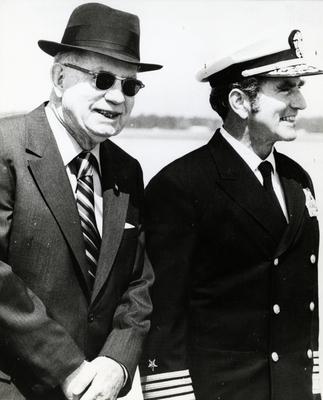
Colmer with Admiral Elmo Zumwalt, April 1971.
In 1968, Colmer hired young lawyer Trent Lott as an administrative assistant, and mentored him in the ways of Washington D.C. to the point that when he decided to call it quits in 1972, he endorsed him as his successor despite him running as a Republican. The party affiliation did not matter for him, as by this time he had been voting with conservative Republicans for many years. It was widely agreed upon that Colmer, at least in his postwar years, was a conservative. He had only sided with ADA 10% of the time from 1947 to 1972 and sided with the conservative Americans for Constitutional Action 86% of the time from 1957 to 1972. Colmer’s DW-Nominate score was a 0.052, which was high for a Democrat. In 1974, Lott would state of his predecessor, “If they’d listened to Bill Colmer 25 years ago, we wouldn’t be in the mess we’re in today” (Hill). He would reach greater heights in the Republican Party than Colmer had reached as a Democrat, serving as House Minority Whip from 1981 to 1989 and as Senate Majority Leader from 1996 to 2002. However, he would resign from the post in a 2002 controversy regarding a speech he delivered for Strom Thurmond’s 100th birthday, in which he said something similar to what he said in 1974 regarding Colmer. In 1976, Colmer again endorsed a Republican candidate when he supported Gerald Ford for president, holding that he had “moral integrity” while the Democrats were pushing “socialist” ideas (Hill). He was far from the only former Democratic representative from Mississippi to back Ford. His colleagues Thomas Abernethy, Charles H. Griffin, and John Bell Williams did so too (Hill). Colmer’s principal political concern in retirement was inflation. He stated, “I do not think we can go on indefinitely with deficit spending without bringing down the house of inflation on us. We must either stop inflation or we are going to lose our cherished form of government” (Hill). For most of his retirement, Colmer appeared to remain in good health, and his demise was mercifully quick compared to many people, dying only a month after the start of his decline on September 9, 1980 at the age of 90.
References
ADA Voting Records. Americans for Democratic Action.
Although the year 1964 is often portrayed as the year the so-called “party switch” happened, it does have significance. While the South didn’t decisively move to the GOP that year, it did make the GOP an actual competitive party in the region. Republicans won an open seat in Georgia, won five of eight of Alabama’s seats, and won one of Mississippi’s seats with chicken farmer and one-time member of the Fish and Game Commission Prentiss Lafayette Walker (1917-1998).
Something to understand about Mississippi is that the state had been in rebellion against the national Democratic Party since 1960, when its voters elected an uncommitted slate of electors who cast their votes for conservative segregationist Senator Harry Byrd of Virginia. Thus, Kennedy was unpopular in Mississippi and his successor, Lyndon B. Johnson, doubled down on the national Democrats’ unpopularity in his signing of the Civil Rights Act of 1964. Johnson’s signing of this law and Senator Barry Goldwater’s vote against it was all the convincing Mississippi voters needed to give the Republican contender 87% of the vote. Congressional Democrats were fortunate that Republicans ran only one candidate that year, as he toppled Democrat W. Arthur Winstead, the first Republican to win a Congressional election in Mississippi in 82 years. There was nothing to indicate that Winstead was any friendlier to civil rights than Walker, and his record was conservative. It was purely a backlash against the national Democratic Party that brought Winstead down. A campaign ad of Walker’s in The Magee Courier of October 29, 1964, read, “Prentiss Walker Promises To Work Toward: 1. Repeal Of The Civil Rights Bill. 2. Stopping Import Of Foreign Beef. 3. Stopping Foreign Aid To Communist Countries. 4. Conservative States Rights Government. 5. Local Control of Schools. The Democratic Party Is Dead! If You Have Truly Had Enough, Go To The Polls Tuesday And Vote for Prentiss Walker” (12). For many Mississippi voters, the Democratic Party was indeed dead, at least in 1964. In 1983, President Ronald Reagan would relate Walker’s humorous story regarding this campaign at a Jackson, Mississippi fundraiser, “He dropped in on a farm and introduced himself as a Republican candidate. And as he tells it, the farmer’s eyes lit up, and then he said, “Wait till I get my wife. We’ve never seen a Republican before.’” [Laughter]
And a few minutes later he was back with his wife, and they asked Prentiss if he wouldn’t give them a speech. Well, he looked around for kind of a podium, something to stand on, and then the only thing available was a pile of that stuff that the late Mrs. Truman said it had taken her 35 years to get Harry to call “fertilizer.” [Laughter] So, he stepped up on that and made his speech. And apparently he won them over. And they told him it was the first time they’d ever heard a Republican. And he says, “That’s okay. That’s the first time I’ve ever given a speech from a Democratic platform.” [Laughter] (Ronald Reagan Presidential Library and Museum).
In Congress, Walker voted as he ran, as an ultra-conservative. The conservative Americans for Constitutional Action found nothing wrong with how he voted in the Great Society Congress and the liberal Americans for Democratic Action found nothing right. Walker’s DW-Nominate score was a 0.516, one of the highest of the representatives in the Great Society Congress. Practically every measure supported by the Johnson Administration had his vote of disapproval, including Medicare and the Constitutional amendment for presidential succession. Walker, like every other Mississippi politician, opposed the Voting Rights Act of 1965. In an early speech, he defended his state while admitting that most Mississippians were conservative and stood for segregation, stating that changes in opinion in the public on such matters would have to come gradually (The Enterprise-Journal). One cause he pushed aside from opposition to civil rights was another issue that he emphasized on his campaign: opposition to foreign aid to communist nations. In 1966, Walker sponsored an amendment to deny funds for communist nations (aimed at Poland and Yugoslavia at the time) under the Food for Freedom Act. Although his proposal got the votes of all but six Republican representatives, it failed in the overwhelmingly Democratic Congress on June 9th, 157-200. At the time, Walker looked like a real start for the Mississippi GOP.
The 1966 Election: Walker Takes a Shot at Big Jim
In 1966, Walker tried to do something bold: run against Senator James Eastland, often known by his opponents as “Big Jim” for his power, perceived and actual. Walker ran on a platform of Eastland being too friendly to the Johnson Administration and Bobby Kennedy. However, he had been in the Senate since the 1940s and had a long history of using his post as chairman of the Judiciary Committee to bury civil rights legislation. For instance, the Senate had to vote to bypass his committee to get the Civil Rights Act of 1964 passed. Despite Walker running to Eastland’s right and as a segregationist, many newly registered black voters saw Walker as preferable. Dr. Douglas Conner of Starkville, Mississippi, stated that “He represents something disgusting to the Negro. It is his image as a great white father, the white plantation owner. It is unthinkable that a Negro would vote for Eastland” (Glass). However, there were a few contradictions surrounding Walker himself. Eastland pointed out that he had attended a meeting of the Americans for the Preservation of the White Race (a KKK front) and that “Walker can’t run as a racist. He appointed a Negro to the Air Force academy. We have the proof” (Glass). However, Walker’s path to victory was a rather difficult one. As columnist Holmes Alexander (1966) pointed out, “To score over Eastland, Walker, an ardent white racist, would have to be the fusion candidate of the Klan, the NAACP, the Goldwater right-wingers, the Nixon middle-roaders, and the AFL-CIO laborites” (4).
In one final ad for the Senate, Walker’s campaign gave its pitch. It touted Walker as in opposition to the “no win policy” in Vietnam, an opponent of the Great Society, an opponent of the “War on Poverty” as giving money to political bosses and civil rights demonstrators rather than the poor, and foreign aid while condemning Eastland for voting for Justice Abe Fortas (which was a unanimous voice vote) and citing multiple votes against anti-communist amendments on foreign aid (Simpson County News). There was truth to the latter, as Eastland had voted against Senator Jenner’s (R-Ind.) amendment to retain bans on trade with communist nations in 1957, opposed the Republican effort to ban stop wheat sales to the USSR and Hungary in 1963, and opposed Senator Tower’s (R-Tex.) amendment to bar Export-Import bank funds for sales to communist nations in 1964. Senator Eastland’s campaign emphasized in its ad the narrative that Mississippi had voted for Goldwater because he was more conservative than Johnson rather than a big shift to the Republican Party and pointed out that Goldwater had delivered a speech in which he stated that Republicans accepted integration while only Southern Democrats were against and that Walker had not said a word against it (The Newton Record). Most of Walker’s charges of Eastland being insufficient, however, relied upon his personal connections with LBJ, and only the anti-communist amendments were votes of substance he could use against Eastland and ultimately, he flew too close to the sun.
“Big Jim” had huge institutional advantages in Mississippi and Mississippi voters just weren’t buying the “Eastland the friend of the liberals” narrative. He regularly bombed in his ratings with Americans for Democratic Action and Americans for Constitutional Action found him conservative on enough issues to satisfy Mississippians, even as they rated Walker a perfect 100% for his whole term. The truth is, Walker didn’t have that much room to move given the disparate groups that he needed to cater to in order to win and he would have likely been better off trying to hold on to his Congressional seat. On most substantive issues, he and Eastland were on the same page, and Walker was hoping that the Republican vote in Mississippi would extend beyond 1964, but old party loyalties held strong, and he lost by nearly 40 points. Although he made no effort to get the black vote, he won a considerable amount of it, but this is because many black voters were dying to cast a vote against Eastland. Worse yet for Walker, the Republican Senatorial Campaign Committee, which was not pleased with outright segregationist candidates, did not pour resources into this election, only giving him token support (Evans and Novak, 35). In 1968, Walker attempted to win back his old seat, but the district was pleased enough with his successor, Sonny Montgomery, and he only got 30% of the vote. That year, to highlight his continued segregationist stance, he had endorsed George Wallace rather than his own party’s nominee, Richard Nixon (Hattiesburg American). Walker would not be the transformational figure in Mississippi politics for the GOP, rather Thad Cochran and Trent Lott, both first elected to Congress in 1972, succeeding retiring Democrats, would serve this role. Walker’s last race for political office was in the 1972 Senate race as an Independent, but he gained little traction. Today, a lake near Walker’s hometown of Mize is named after him. To me, Prentiss Walker represents lost potential. Had he not opted to challenge Eastland, would he have won reelection to the House? And if so, would he have proved in the long run to be a more politically complex figure than his Great Society Congress self like Alabama’s Jack Edwards, Bill Dickinson, and especially John Buchanan, all who voted to sustain the Philadelphia Plan only four years after voting against the Voting Rights Act? Would this chicken farmer have been the guiding light for the GOP in the state like Florida’s Bill Cramer? We will never know.
References
ADA Voting Records. Americans for Democratic Action.




 Mad Politics: The Bizarre, Fascinating, and Unknown of American Political History