How They Voted: The Economic Opportunity Act of 1964 (War on Poverty)


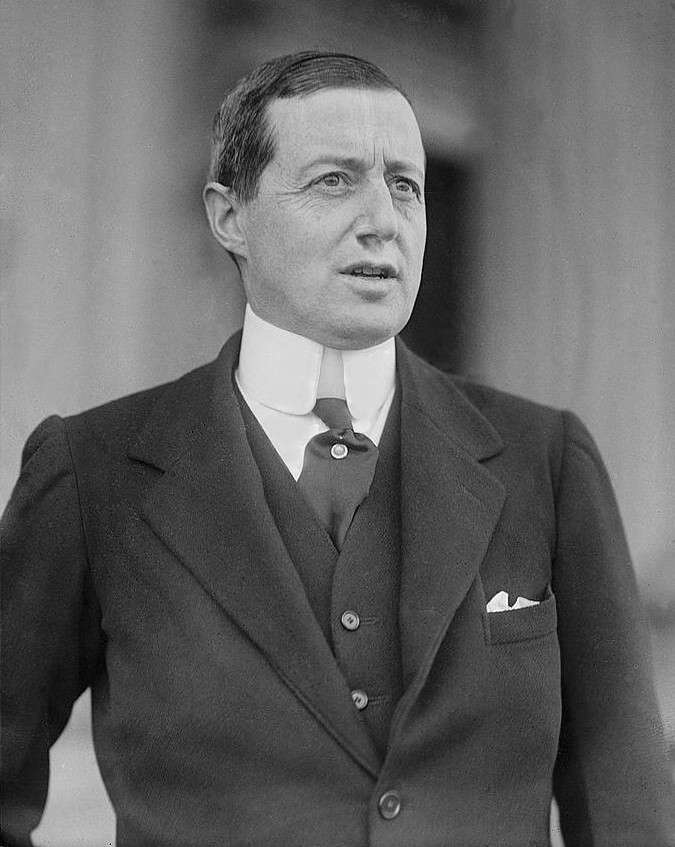
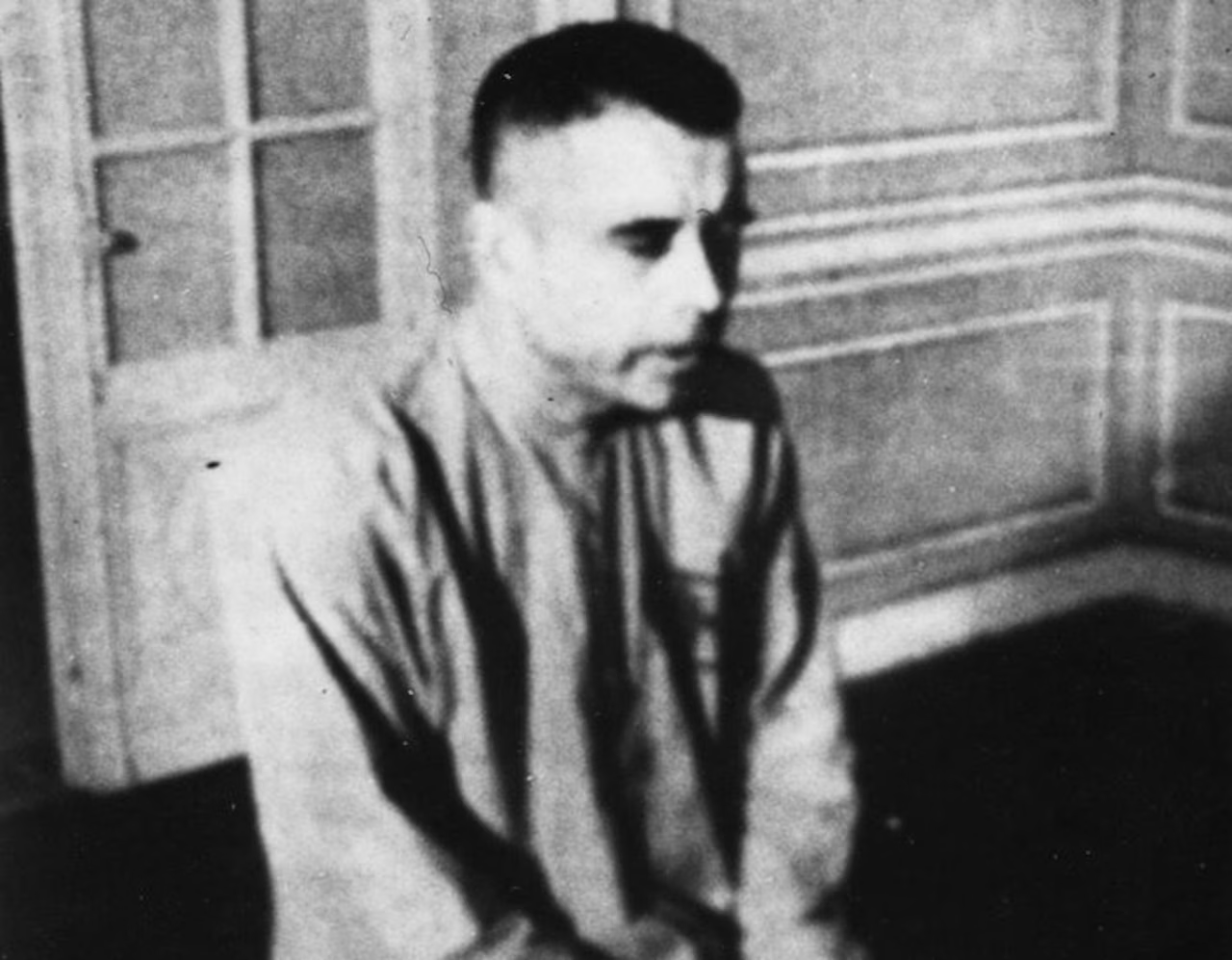
Sargent Shriver, director of the Office of Economic Opportunity.

Sixty years ago, August 20, 1964, the Economic Opportunity Act of 1964, the flagship law of President Lyndon B. Johnson’s “War on Poverty” came into effect. Although the New Deal had worked to alleviate poverty during the Great Depression, it had not constituted a consistent federal commitment to alleviating the roots of poverty. The focus on poverty was renewed with a best-selling book by Democratic Socialists of America founder Michael Harrington, The Other America (1962), in which he argued that the American poverty rate was much higher than was widely believed at the time. President Kennedy became aware of this book and rest assured, had he lived, he too would have pursued anti-poverty legislation. This legislation came in the form of the Economic Opportunity Act, sponsored by Senator Pat McNamara (D-Mich.), an ultra-liberal who was a champion of Walter Reuther and his United Auto Workers. In the House, the sponsor was a bit of a different figure in Representative Phil Landrum (D-Ga.), who had a conservative reputation and indeed had ticked off organized labor for his sponsorship of the Landrum-Griffin Act in 1959, that as part of anti-corruption reforms curbed the ability of labor unions in certain areas. This measure established the Office of Economic Opportunity (OEO), through which anti-poverty programs were to be administered. These programs included among others the Job Corps for job training and basic education for young people, the Neighborhood Youth Corps for young people from poor families, and Volunteers in Service to America to recruit and train volunteers to coordinate with organizations to combat poverty. Most controversially, this measure bypassed states to authorize funds for localities through the OEO director. President Lyndon B. Johnson said of the measure in his State of the Union Address, “This administration today here and now declares unconditional war on poverty in America. I urge this Congress and all Americans to join me in that effort […] Poverty is a national problem, requiring improved national organization and support. But this attack, to be effective, must also be organized at the State and local level. For the war against poverty will not be won here in Washington. It must be won in the field, in every private home, in every public office, from the courthouse to the White House. Very often, a lack of jobs and money is not the cause of poverty, but the symptom. Our aim is not only to relieve the symptoms of poverty but to cure it–and above all, to prevent it. No single piece of legislation, however, is going to suffice” (Lyndon B. Johnson Presidential Library and Museum).  

The vote on the Economic Opportunity Act was achieved after a compromise in which governors were granted a veto over such programs which could be overridden by the Office of Economic Opportunity director. In practice, almost all vetoes issued by governors were overridden by OEO director Sargent Shriver (Merced Community Action Agency). The Senate vote came out 61-34 (D 51-12, R 10-22) on July 23, 1964, with the high margins being helped by the fact that Senate Republicans got slaughtered in the 1958 midterms, all with far more liberal Democratic replacements. The Senate Republicans are also on average more liberal than the House Republicans, thus they oppose by over 2-1 (as opposed to the House), Northern Democrats are almost unified (only Frank Lausche of Ohio votes nay) and Southern Democrats are split. The House vote came out to 226-185 (D 204-40, R 22-145) on August 8, 1964, and was a show of unity from Northern Democrats, who are overwhelmingly liberal, of overwhelming opposition from Republicans, and again, a split among Southern Democrats. This vote demonstrates a more ideologically diverse GOP and Southern Democrats not as monolithically conservative as they frequently are portrayed. Landrum’s sponsorship probably helped move the votes of some Southern Democrats to be in favor. This is also a highly ideologically salient vote, with the most conservative individual supporting the bill being Republican Eugene Siler of Kentucky, who paired for and scores a 0.25 by DW-Nominate. The most liberal individual opposing per DW-Nominate is Democrat Kenneth A. Roberts of Alabama with a -0.282, who was a part of the liberal wing of the Alabama Democratic Party, a faction that retained significance until after the 1964 election. Contrast this with the Civil Rights Act of 1964, whose highest scoring supporter was Republican Senator John J. Williams of Delaware, with a 0.603 and whose lowest scoring opponent was Democratic Congressman Dante Fascell of Florida with a -0.4. Region was a more important deciding factor on the Civil Rights Act of 1964 than ideology, although ideology did play a role in how the vote breakdown occurred in the North. Another notable feature of this vote is the pairing of Massachusetts’ Joe Martin for. Martin was at one time known as a leader of the Conservative Coalition, but by this time his star had fallen since the 1958 midterms, and Massachusetts had changed much since he had started his service in 1925, when it was the state of Calvin Coolidge. However, Martin appears to have been a bit of a reluctant backer, as his votes on the anti-poverty program in the next Congress would be antagonistic. Some of the Southern Democrats who vote for this now would be more antagonistic to anti-poverty programs in the future, and some Republicans who vote against this now would be a bit friendlier. However, in the latter case, Republicans managed to secure significant concessions to these programs after the 1966 midterms. The impacts of this law long-term are disputed, as is the fall in poverty rates that occurred in the decade following.

Below is a document with the House and Senate vote breakdowns along with a modified 1964 Americans for Constitutional Action score for each of the voting legislators:

References

https://voteview.com/rollcall/RH0880182

Economic Opportunity Act of 1964. Merced Community Action Agency.

Retrieved from

https://www.mercedcaa.com/v2/wp-content/uploads/2018/11/Economic_Opportunity_Act_of_1964.pdf

H.R. 7152. Civil Rights Act of 1964. Adoption of a Resolution (H. Res. 789) Providing for House Approval of the Bill as Amended by the Senate. Voteview.

Retrieved from


https://voteview.com/rollcall/RH0880182

H.R. 7152. Passage. Voteview.

Retrieved from

https://voteview.com/rollcall/RS0880409

S. 2642. Passage. Voteview.

Retrieved from

Voteview | Plot Vote: 88th Congress > Senate > 452

S. 2642. Passage of the Anti-Poverty Bill Which Incorporated the Text of H.R. 11377. Voteview.

Retrieved from

Voteview | Plot Vote: 88th Congress > House > 201

President Lyndon B. Johnson’s Annual Message to the Congress on the State of the Union. (1964, January 8). Lyndon Baines Johnson Library and Museum.

Retrieved from

President Lyndon B. Johnson’s Annual Message to the Congress on the State of the Union January 8, 1964 (archive.org)
Furnifold Simmons: Architect of Democratic Dominance in North Carolina


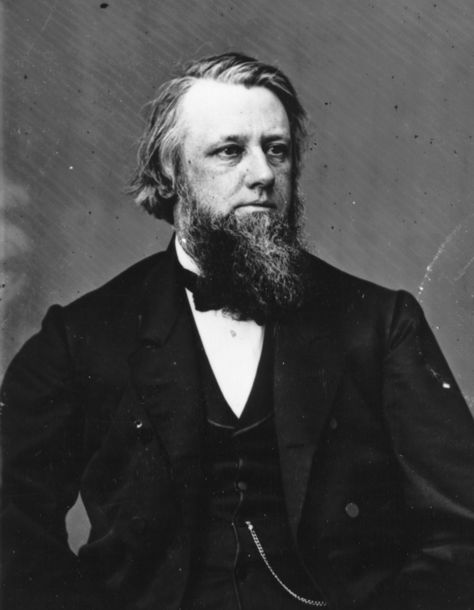
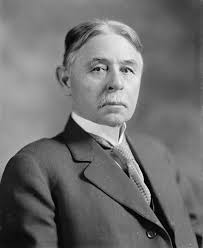
Following the end of Reconstruction, Democrats came to dominate the South, including North Carolina. Although voter intimidation, ballot fraud, and other vote restricting tactics were practiced, there were still a good number of blacks who could vote, and often North Carolina’s 2nd district, based in Scotland Neck, was represented by a black Republican. This was to the degree that it was known as “The Black Second”. However, the political situation was increasingly complicated by the rise of the Populist Party. The Populist Party, an economically left-wing party that also emphasized immigration restriction, formed coalitions with the Democratic Party in the Midwest and West, but in the South they formed an alliance with the Republican Party. In other words, they were consistently fighting against whatever party was dominant in a region. The Panic of 1893 proved disastrous for North Carolina’s Democratic Party, and a multi-racial coalition of black and white workers aligned against North Carolina’s establishment, the consequence being the election of Republicans and Populists to Congress, with Republican Daniel Lindsay Russell being elected governor. This multi-racial and multi-ideological coalition was an uneasy one motivated foremost by opposition to the Democratic Party, and the Democratic Party’s champion to regain power was Furnifold McLendel Simmons (1854-1940).

Democrats like Simmons had been willing to tolerate some black voting as long as Democratic dominance was maintained. However, but with the Democratic Party at stake in North Carolina and elsewhere in the South with the rise of the Republican-Populist fusion, Southern Democrats took harsher measures. Simmons led such official efforts.

The 1898 Election: Democratic Victory By Force and the Wilmington Coup

Simmons had been involved in Democratic politics for some time, including serving a term in the House in the 2nd district from 1887 to 1889, the product of Republican division. During this time he had been seen as a racial moderate, and indeed he pledged to represent both races, stating that he was “not one of the kind that set no value upon the colored man’s vote” (Hand). This approach won him 2,500 black votes, enough for one term. And he indeed seemed to do as he said he would in representing both the interests of blacks and whites in Congress. Yet, he lost reelection in 1888 to black Republican Henry P. Cheatham. In 1892, the Populist Party was proving a great threat to the political power of the Democratic Party, and North Carolina was where they hit the hardest. Simmons was able to successfully lead the Democratic Party’s campaign that year, getting the state into Grover Cleveland’s column. As a reward, he was appointed the Eastern District’s collector of internal revenue. However, the 1894 and 1896 elections proved terrible for the Democrats, and after the 1896 election Democrats were almost completely out of the state’s delegation to Congress, with only William W. Kitchin of the 5th district being their representation. North Carolina’s two senators were Republican Jeter Pritchard and Populist Marion Butler. The Democratic Party appealed to Simmons to lead them back to victory, and he reluctantly agreed to take back the reigns, leaving his post as collector to do so. The 1898 midterms, the Democratic effort which he headed as chairman of the Democratic Executive Committee, were characterized by aggressive racist campaigning over fears of “Negro domination”. Simmons and his campaigners portrayed leading black politicians as corrupt and unqualified for their offices (University of North Carolina).

Election Day, November 8th, was marked by intimidation from Red Shirts that kept away many blacks and white Republicans from the polls, resulting in a blowout victory for Democrats. Two days later, the Wilmington Coup occurred in which the entire government of the city of Wilmington (at the time North Carolina’s largest city) was ousted by force. There were also numerous white voters who had otherwise been previously inclined to support the Republican-Populist alliance shifting to the Democrats. Some did so as a result of the white supremacy campaign, others did so because of the unique persuasion of the Red Shirts. The Democrats won six of nine of the state’s House delegation, but most importantly they won the state legislature. The multi-racial leadership of this at-the-time majority black city was banished by an armed group led by former Congressman Alfred Waddell, who installed himself as mayor. Prominent black political leaders, successful black businessmen, and whites who had courted black support were also banished from the city. This was not a spontaneous event, rather the product of months of planning by Simmons and other leading Democrats, including Waddell and future Secretary of the Navy Josephus Daniels. Waddell had publicly called for the removal of the Republican-Populist coalition in Wilmington and advocated for white citizens to, if necessary, “choke the Cape Fear with carcasses” (NC Department of Natural and Cultural Resources). Further inflaming the situation was an article by Alex Manly in the black-owned newspaper The Daily Record. Manly was writing in response to an aggressively pro-lynching article by Rebecca Latimer Felton, holding that “poor white men are careless in the matter of protecting their women” and that “our experience among poor white people in the country teaches us that women of that race are not any more particular in the matter of clandestine meetings with colored men than the white men with colored women” (NC Department of Natural and Cultural Resources). In the ensuing violence that occurred two days after the election, at minimum 14 blacks were killed, but as many as 60 could have been killed. Many blacks, including Manly, had already fled the city in anticipation of violence, and The Daily Record’s building was burned to the ground. Appeals for help to President William McKinley went unanswered as Governor Russell hadn’t requested assistance.

Long-Term Consequences

The Republican-Populist coalition was toast, and especially so after the adoption of the state’s Jim Crow constitution. Simmons’ words to black voters, it turned out, had an expiration date. In 1901, Simmons would succeed Populist Senator Marion Butler, and in 1903 Simmons’ compatriot, Lee S. Overman, would succeed Republican Senator Jeter Pritchard. The two men, lifelong friends, would serve as North Carolina’s senators together for over 25 years. Simmons would later recall on the 1898 election, “While we dealt with graft and advocated the free coinage of silver, the keynote of the campaign was White Supremacy, and I believe I was chiefly responsible for the choice of the issue” (University of North Carolina)

As a senator, Simmons was considered highly effective and succeeded in securing funds for the Intercoastal Waterway from Boston to Wilmington, which he considered his finest achievement (Faulkner). He was a political boss and had a machine, although his machine lacked the corrupt features that many machines did. Simmons was somewhat supportive of increasing direct democracy; on June 12, 1911, he voted for the Constitutional amendment for direct election of senators but on January 31, 1913, Simmons voted against Senator Robert Owen’s (D-Okla.) proposal to end the Electoral College.

The 1912 Election, Simmons’ Height of Power, and Addressing 1920s Republican Rule

Simmons faced some strong challengers in Governor William W. Kitchin, Chief Justice Walter Clark, and former Governor Charles B. Aycock. However, Aycock died that year and Simmons’ machine easily pulled him through. The height of Simmons’ influence was during the Wilson Administration, chairing the Senate Finance Committee from 1913 to 1919, which had authority over taxation legislation. A traditional Democrat, Simmons was strongly supportive of tariff reduction, and sponsored the Simmons-Underwood Tariff of 1913, which reduced tariffs and imposed a top income tax of 7%, the first income tax adopted after the adoption of the 16th Amendment. He was generally strongly supportive of the Wilson Administration’s Southern-friendly progressivism, but he opposed, as did all of North Carolina’s legislators, the Keating-Owen Act to curb child labor, as North Carolina’s textile mills relied extensively on such labor. Simmons also voted for the Espionage Act of 1917 and the Sedition Act of 1918 to suppress wartime dissent. With the 1918 election, Republicans won Congress and Simmons lost his chairmanship. An internationalist, he supported the Versailles Treaty to the hilt on the Senate floor, but behind the scenes he unsuccessfully urged President Wilson to accept some reservations to increase its chances for passage.

During the 1920s, Simmons was something of a dissenter to Republican tax policy. He opposed the Fordney-Penrose income tax reduction bill, the Fordney-McCumber tariff increase, and in 1924 backed a top income tax rate of 40%, as opposed to Senator Reed Smoot’s (R-Utah) proposed 32%. However, Simmons did support ending the estate tax in 1926.

The 1928 Election and Simmons’ Political Fate

The selection of Al Smith of New York to head the Democratic ticket proved highly controversial in the South due to his opposition to Prohibition, his Catholicism, and the fact that he rose up the political ranks through Tammany Hall. Unlike Senator Tom Heflin of Alabama, Simmons neither objected to Smith’s Catholicism nor endorsed Republican Herbert Hoover, but he publicly stated he could not back Smith on account of his stances on Prohibition and his close relationship with Tammany Hall. In this respect, he differed from his close friend and colleague, Lee S. Overman, who publicly backed Smith. Hoover would win North Carolina in 1928, the first Republican to do so since Reconstruction. Like Heflin, however, there would be consequences for Simmons. Although Simmons had built up a political machine in North Carolina, this didn’t insulate him from the impacts of primaries, and just like Heflin, he lost renomination in 1930 over his refusal to back the Democratic ticket. He never regretted his stance against Smith, even in defeat. Ironically, the man who defeated him on the grounds of party disloyalty, Josiah Bailey, would prove far more of a dissenter to national Democratic Party policy than Simmons ever was as he rebelled against FDR’s New Deal. Yet another blow for Simmons was Overman’s death in December 1930.

Simmons in Retirement

Up until the death of his wife in 1938, Simmons was happiest in his retired years and had accepted his defeat in the primary gracefully. As W.T. Bost noted in a newspaper column on Simmons’ defeat that “He was bigger in it than he ever was in the succession of victories won at the polls and in the Congress” (Hill). Although Simmons is often regarded as a conservative, he approved of much of the liberal policies of Democratic presidents, and FDR was no exception. He approved of much of FDR’s New Deal, most of all his agricultural policy (Hill). Simmons on economic issues during his career was far from a conservative, given his history of supporting inflationary currency, increasing the income tax, and reducing tariffs. I honestly have limited regard for those said to be “conservatives” whose overall record doesn’t reflect it. His DW-Nominate score was a -0.388. Regarding Simmons’ political ethos, historian Richard L. Watson Jr. wrote that he “lacked a consistent worldview” on numerous issues of the day and that he regarded his views on white supremacy and democracy as consistent (Faulkner). Simmons struck me as a highly opportunistic individual on the subject of race; although he was undoubtedly a racist he was willing to cater to black voters when it worked in his interests, and to strip the vote from them when it suited his and his party’s interests. However, Simmons was not a pure creature of opportunism, as his opposition to Democratic nominee Al Smith proved, as it resulted in the end of his career. I cannot say that I admire Simmons, and I cannot excuse the 1898 Wilmington Coup and the extensive violence that accompanied it. Furthermore, on many things I am certainly not in agreement with him. However, I can respect capability in politics, and Simmons had that serving North Carolina in the Senate for three decades. I respect political capability even if it is towards ends to which I disagree.

References

1898 Wilmington Coup. NC Department of Natural and Cultural Resources. NC Department of Natural and Cultural Resources.

Retrieved from

https://www.dncr.nc.gov/1898-wilmington-coup

Faulkner, R.W. Furnifold McLendel Simmons. North Carolina History Project.

Retrieved from

https://northcarolinahistory.org/encyclopedia/furnifold-mclendel-simmons-1854-1940/

Furnifold Simmons: The 1898 Election in North Carolina. University of North Carolina.

Retrieved from

https://exhibits.lib.unc.edu/exhibits/show/1898/bios/simmons

Hand, B. (2023, March 30). History: the political beginnings of Furnifold Simmons. New Bern Live.

Retrieved from

https://newbernlive.org/history-the-political-beginnings-of-furnifold-simmons-p3413-219.htm

Hill, R. (2024). The Strong Man of North Carolina: F.M. Simmons. The Knoxville Focus.

Retrieved from

https://www.knoxfocus.com/archives/this-weeks-focus/the-strong-man-of-north-carolina-f-m-simmons/

Simmons, Furnifold McLendel. NCPedia.

Retrieved from

https://www.ncpedia.org/biography/simmons-furnifold

Simmons, Furnifold McLendel. Voteview.

Retrieved from

https://voteview.com/person/8514/furnifold-mclendel-simmons

RINOs from American History #18: Smith W. Brookhart

I have many peeves with contemporary politics, and one of them is excessive RINO calling. Hence my motivation for this series of historical RINOs to demonstrate that today’s Republican partisans should have some gratitude that the GOP is as conservative as it is now. Today’s entry is Iowa’s Smith Wildman Brookhart (1869-1944).

In 1920, Brookhart, an attorney, veteran, and noted marksman, challenged Senator Albert B. Cummins, a celebrated Iowa Republican, in the GOP primary. His central theme was the senators’ sponsorship and drafting of the Esch-Cummins Railroad Act, which restored railroads to private control and was on net favorable to them. Overall a moderate in his career, Cummins had started out as a progressive insurgent within the GOP but had since moved increasingly towards the conservatives. However, Republican voters renominated Cummins, for 1920 was a good year for Republicans and conservatives. Interestingly, Brookhart afterwards served as the president of a group much celebrated by the political right until 1925 given his hobby: the National Rifle Association. He wouldn’t have to wait long for another shot at the Senate.

On February 24, 1922, Republican Senator William Kenyon, himself among the moderate to liberal wing of the party, resigned so he could serve as a judge on the Eighth Circuit. The dissatisfaction regular Republicans had with Kenyon was not quite like what they would have with Smith Brookhart after his election. He was firmly in the Robert La Follette/George Norris camp, and with six candidates running for the Republican nomination, Brookhart consolidated his support among progressive Republicans and won with 41% of the vote. In the Senate, he stood for increasing income taxes, estate taxes, challenging big business, veterans’ bonuses, and promoting organized labor. Brookhart even went as far as to support government control of the railroads (McDaniel). He was also outspoken for a strong enforcement of Prohibition, a popular stance at the time in Iowa. However, Brookhart occasionally could support something fiscally conservative, such as his vote to cut spending on Rivers and Harbors appropriations in 1923. In 1924, he ran for a full term and much to the consternation of national Republicans, endorsed Progressive Party candidate Robert La Follette of Wisconsin. Senate Republican leadership excluded him, La Follette, and two other senators from the party conference and stripped them of their committee assignments (U.S. Senate). Brookhart wasn’t in the Senate to make nice with the conservative establishment. Indeed, Time Magazine noted in 1936 that his “pugnacious cowhide radicalism nettled patrician Senators”. Although Brookhart had officially won a close election contest that year by under 800 votes, his opponent, Democrat Daniel Steck, who had gotten significant Republican crossover support, challenged the results.

The challenge was reviewed before the Senate, and surprisingly Steck was chosen as the winner on a vote of 45-41 on April 12th, 1926, and Brookhart was unseated. Although most Democrats voted for their man in Steck, 9 voted against and among Republicans 16 defected to vote for Steck. While progressive Republicans unified behind Brookhart, conservative Republicans were divided on whether to oust a boat-rocking ideological foe or take the unprecedented actions of unseating a senator after he has been serving as well as overruling Iowa state election laws, thus the conservative Republican vote was split, causing the loss. This made Steck the first Democrat to represent the state since the 1850s. Brookhart’s ally, Senator George W. Norris (R-Neb.), condemned the result, stating that “this powerful partisan political combination brought about by Republican leaders nullified the voice of the voters of Iowa, threw out a Republican, and put in a Democrat” (U.S. Senate). However, Brookhart was not easily out of the game. In 1926, he challenged Republican incumbent Cummins again, and he won by double digits partly on account of the latter’s age. Indeed, Cummins died one month after losing renomination. Brookhart proceeded to win a full term by over 12 points.

Brookhart continued his rebellious ways in his full term in the Senate, and one might think that this would have helped him for his next reelection with Republican Herbert Hoover deeply unpopular, but this was not to be. He might have survived if not for a revelation of nepotism…that he had placed two brothers, two sons, and one daughter on the Federal payroll, and he lost renomination (Time Magazine). Brookhart ran for reelection nonetheless as a “Progressive” but only scored 4% of the vote. Had he won the Republican primary, it is quite possible he would have been reelected. Brookhart’s DW-Nominate score was a 0.131, low for a Republican, although surprisingly high given how many major issues on which he went against his party.

After his loss, Brookhart accepted a position in the Roosevelt Administration as an advisor on Russian trade, a role he served in until 1935. Even the New Deal’s approach on agriculture had gone too far for him, as he was supportive of a solution that involved the market as opposed to production controls (McDaniel). In 1936, he announced his candidacy for the Republican nomination to the Senate, hoping to oust the anti-New Deal Republican incumbent Lester J. Dickinson in the primary on a platform of a fine-tuned agricultural parity formula. He also charged Dickinson with turning against the New Deal after “voting for most of it” (The New York Times). There was some truth in Brookhart’s charge: Dickinson had voted for both the Agricultural Adjustment Act and the Tennessee Valley Authority in 1933. However, the opposition to Dickinson was split five ways, and Brookhart lost. In 1942, Brookhart suffered a stroke and he declined until his death on November 15, 1944.

References

Again, Brookhart. (1936, April 20). Time Magazine.

Retrieved from

https://web.archive.org/web/20081215074237/http://www.time.com/time/magazine/article/0,9171,848486,00.html

Brookhart Enters Iowa Senate Race. (1936, April 7). The New York Times.

Retrieved from

Brookhart, Smith Wildman. Voteview.

Retrieved from

https://www.voteview.com/person/1070/smith-wildman-brookhart

McDaniel, G.W. (1990, April). The Search for Smith Wildman Brookhart: A Pilgrim’s Progress. Books at Iowa, 52. The University of Iowa.

Retrieved from

https://www.lib.uiowa.edu/scua/bai/mcdaniel.htm

The Election Case of Daniel F. Steck. v. Smith W. Brookhart of Iowa (1926). U.S. Senate.

Retrieved from

https://www.senate.gov/about/origins-foundations/electing-appointing-senators/contested-senate-elections/105Steck_Brookhart.htm

The 1918 Midterms: War, Wheat, and Women

Frederick Gillett (R-Mass.), who was elected Speaker of the House with the new Republican Congress.

I figured my readers could use a bit of a break from Rhode Island history, so I have yet another story about an election! President Woodrow Wilson had a benefit that many presidents envy…having both legislative branches controlled by their party for most of their presidency. Although the 1916 election came very close to Republican control of the House with Republicans having more representatives than Democrats, Democrats were able to maintain a majority with a coalition of Progressive Party members and a Socialist. Wilson and Democrats would not be so fortunate in the 1918 midterms. It is often true that the public gets some fatigue with a president well into his term, and this year was no exception. In the House, Republicans gained 24 seats and, in the Senate, they secured a narrow 49-47 majority. This was also the election that occurred during the “Spanish flu”, thus when people went out to vote, they did so at some risk.

Wilson was particularly hurt in the Midwest for his insistence on price controls on wheat, vetoing a bill that would raise the maximum of $2.20 per bushel to $2.40. The results were quite clear in Indiana, in which Republicans won all of the state’s House seats, in Kansas, in which Republicans won all but one of Kansas’ eight districts, and in Nebraska, in which Republicans won all of its House seats by defeating three Democratic incumbents. In the Senate, Kansas Democrat William Thompson lost reelection by a devastating thirty points to Republican Arthur Capper, who would become a foremost champion of agricultural interests in his 30-year career. Opponents of WWI did badly too. The following representatives who voted against World War I did not return to Congress this year:

Everis Hayes, R-Calif. – Defeated for reelection by conservative Democrat Hugh Hersman, who would only serve a term.

Benjamin Hilliard, D-Colo. – Defeated for renomination, ran for reelection as an Independent but lost badly to Republican William Vaile.

Edward Keating, D-Colo. – Defeated for reelection by Republican Guy Hardy.

Frank Woods, R-Iowa – Defeated for renomination by Lester J. Dickinson. who would win the election.

John Connelly, D-Kan. – Defeated for reelection by Republican Hays White, although its hard to say how much of his defeat was due to wheat price controls as opposed to his vote against entering World War I.

Ernest Lundeen, R-Minn. – Lundeen lost renomination to conservative Walter Newton, who would win the election. Lundeen’s career would be revived as a Farmer-Labor politician during the Great Depression.

James K. Vardaman, D-Miss. – Defeated for renomination by Wilson loyalist Congressman Pat Harrison, with his vote against entering World War I the centerpiece of the campaign. He was the only one of the six senators who voted against declaring war on Germany to face electoral consequences in 1918, with Democrats William J. Stone of Missouri and Harry Lane of Oregon dying before the next election and Republican Asle Gronna of North Dakota losing renomination in 1920, albeit to similarly minded Edwin F. Ladd. Republican George Norris of Nebraska was reelected this year, and Republican Robert La Follette of Wisconsin was reelected in 1920.

Dorsey Shackleford, D-Mo. – Lost renomination to William L. Nelson, who won the election.

Perl Decker, D-Mo. – Lost reelection to Republican Isaac McPherson.

Jeannette Rankin, R-Mont. – Declined to run for reelection, would be again elected to Congress in 1940 where she would vote against declaring war on Japan.

Edwin Roberts, R-Nev. – Retired from the House to run for the Senate, lost to Democrat Charles Henderson, in part due to the third-party candidacy of Independent suffragette Anne Henrietta Martin.

Meyer London, S-N.Y. – Congress’s only member of the Socialist Party lost reelection to Democrat Henry M. Goldfogle.

A. Jeff McLemore, D-Tex. – Lost reelection to Democrat Joe Eagle for his anti-war and anti-Wilson stances.
Clarence Dill, D-Wash. – Lost reelection to Republican J. Stanley Webster. He managed to make a comeback by getting elected to the Senate in 1922, where he served two terms.

Henry A. Cooper, R-Wis. – Lost renomination to conservative Clifford Randall, who won the election. He would regain his seat in the 1920 election and hold it until his death in 1931.

John Nelson, R-Wis. – Lost renomination to conservative James Monahan, who won the election. He would regain his seat in the 1920 election and hold it until he lost renomination in 1932.

William Cary, R-Wis. – Lost renomination to John C. Kleczka, who won the election.

The Loss of the Anti-Suffragists

The following members who voted against women’s suffrage in 1918 did not return to Congress, and no anti-suffragist defeated a member of Congress who had voted for suffrage. The failure of the Democratic Congress to ratify the women’s suffrage amendment damaged them at the polls, and the following anti-suffrage legislators were ousted:

Senate

Delaware – Democrat Willard Saulsbury Jr. lost reelection to Republican L. Heisler Ball, who paired for suffrage in 1919.

Georgia – Democrat Thomas Hardwick was defeated for renomination by William Harris, who voted for suffrage in 1919. However, this likely had more to do with Hardwick’s political independence from President Wilson.

Massachusetts – Republican John W. Weeks lost reelection to Democrat David I. Walsh, who voted for suffrage in 1919. Weeks was the only Republican senator to lose reelection that year.

House

Delaware – Democrat Albert Polk loses reelection to Republican Caleb Layton, who votes for suffrage. Interestingly, Layton would lose reelection in 1922 and his vote against the Dyer Anti-Lynching Bill was likely the decisive factor.

Georgia – Democrat William S. Howard declines to run for reelection in a bid for the Senate, but loses the primary to William Harris, who votes for suffrage.

Maryland – Democrat Jesse Price loses reelection to William Andrews.

Kentucky – Democrat J. Swagar Sherley, chairman of the House Appropriations Committee who had served since 1903 lost reelection to Republican Charles Ogden, who would vote for suffrage in 1919.

New Jersey – Republican Edward Gray doesn’t run for reelection to run for the Senate, but loses the nomination to Walter Edge, who votes for suffrage.

Republican R. Wayne Parker loses reelection to Democrat Daniel F. Minahan, who votes for suffrage. Parker wins his seat back in 1920, only to lose again in 1922 to Minahan.

Ohio – There’s a lot to cover here!

Democrat John S. Snook loses reelection to Republican Charles Thompson, who votes for suffrage.

Democrat John Key loses reelection to Republican R. Clint Cole, who votes for suffrage.

Democrat Horatio Claypool loses reelection to Republican Edwin Ricketts, who votes for suffrage.

Democrat Arthur Overmyer loses reelection to Republican James Begg, who votes for suffrage.

Democrat George White loses reelection to Republican C. Ellis Moore, who votes for suffrage.

Democrat William Gordon loses renomination to Charles A. Mooney, who votes for suffrage.

Wisconsin – Republican William Stafford loses reelection to Socialist Victor Berger, but Congress refused to seat Berger due to his indictment for sedition.

References

1918 House of Representatives Elections. Wikipedia.

Retrieved from

https://en.wikipedia.org/wiki/1918_United_States_House_of_Representatives_elections

1918 Senate Elections. Wikipedia.

Retrieved from

https://en.wikipedia.org/wiki/1918_United_States_Senate_elections

The Wheat Veto. (1918, July 16). The Bridgeport Telegram.

Retrieved from

https://www.newspapers.com/image/24469781/?match=1&terms=%22veto%20wheat%22

To Adopt S.J. Res. 1… Voteview.

Retrieved from

https://voteview.com/rollcall/RH0650010

To Adopt H.J. Res. 200. Voteview.

Retrieved from

https://voteview.com/rollcall/RH0650069

To Pass HJR 1. Voteview.

Retrieved from

https://voteview.com/rollcall/RS0660013

To Pass H.J. Res. 1… Voteview.

Retrieved from

https://voteview.com/rollcall/RH0660002

To Pass H.J. Res. 200. Voteview.

Retrieved from

https://voteview.com/rollcall/RS0650325

To Pass S.J. Res. 1… Voteview.

Retrieved from

https://voteview.com/rollcall/RS0650002

Theodore F. Green: Rhode Island’s Agent of Change


In 1932, change swept the nation with the election of FDR, and it also swept Rhode Island as Theodore Francis Green (1867-1966) was elected its governor. Although Republicans had dominated Rhode Island since the party’s inception, there could be the occasional Democratic governor. However, the governor was quite weak, not even having control over the budget except to veto the whole package, thus the occasional Democratic governor would be at worst an annoyance to the consistently Republican legislature. Green, who had been a figure in state politics since his election to the state legislature in 1907, would not serve as a mere annoyance.

Theodore Green had been something of a perennial candidate beforehand. He had run for governor twice before without success, in 1912 and 1930. He came close both times, but 1912’s closeness was the product of the conservative/Bull Moose split in the GOP and Rhode Island voters had narrowly supported retaining Republican officeholders in 1930. Green had also run for Congress in 1918, but was defeated by 11 points. However, 1928 had already been a warning for Republicans as to what the future held as Democrat Al Smith had won the state. While Smith hadn’t been the first Democrat to win Rhode Island since the Republican Party’s founding, he was the first to win without there being a split in the Republican vote. In 1932, Green won the gubernatorial election by 12 points over Republican incumbent Norman Case, roughly the same margin that FDR won the state.

1935’s “Bloodless Revolution”

The 1934 midterms did not go well for Republicans, and that applied to Rhode Island. Senator Felix Hebert lost reelection to Democrat Peter Gerry, and Democrats won control of the Rhode Island House. Still in question, however, was the state Senate. There were two seats that were so close they were being contested. Although the official results had Republicans winning 22 Senate seats to the Democrats’ 20, Democrats claimed fraud in two elections that Republicans had been certified the winners, and Lieutenant Governor Robert Quinn refused to allow the two Republicans, B. Earle Anthony of Portsmouth and Wallace Campbell of South Kingstown, to take office (Conley). Thus, Governor Green and Quinn engineered the creation of a commission of two Democratic and one moderate Republican senator to recount the ballots behind closed doors. While this was occurring, Republican senators were prevented from leaving the chamber so as to deny this proceeding a quorum, and the three senators after emerging unanimously proclaimed Democrats Joseph P. Dunn of Portsmouth and Charles A. White of South Kingstown the winners of the races (Conley). Now that the Democrats finally had unified government, they proceeded to purge state government of Republican officeholders and vacated the Supreme Court. The five Republican justices were offered large pensions if they left by noon the next day, and they did (Conley). Furthermore, the Democrats granted the governor more power than the post’s previously weak state. The governor could now have control over the state budget rather than the finance commissioner, a post that was appointed by the Senate (Conley).

This event was likened to a Central American coup by The Providence Journal, a newspaper that had been controlled in the past by Henry Anthony and in that time was owned by Republican Senator Jesse Metcalf’s brother (Frias). The Chicago Tribune’s owner, Colonel Robert R. McCormick, had an even more dramatic reaction. He hauled down the American flag in the Tribune’s lobby and cut out one star, representing Rhode Island, but had the star promptly replaced after being informed that this was an illegal act (Conley). Much like with the Dorr Rebellion, however, others regarded this act as consistent with democracy, and the Democrats of the time regarded Thomas Dorr as a hero.

One way in which Governor Green built up popular support was by managing to unify Irish, Italian, and French ethnic workers, the latter two having often voted Republican in the past. The Green Administration, with its Democratic majority, managed to get a bill providing for a forty-eight hour work week into law, a measure long opposed by the state’s Republicans (Conley). Another way was towards the state legislature by offering jobs to its members in exchange for favorable votes. During the time of unified control, one-third of legislators were given state jobs, an example being one Republican state senator who got a state job after voting to confirm Green’s department heads (Frias). It was possible in that time that legislators could hold office and have state jobs at the same time! Green reflected on the change in the wealthy Republicans he knew after his victories, “As long as I got beaten, my conservative friends tolerated my liberal views as an amiable idiosyncrasy, as though I had taken up Buddhism. But when I won and began to get results and make reforms, they were angry. Many cut me on the street, turned their backs on me in the clubs” (MacKay). For Democrats, Green was their Henry B. Anthony in the sense that it was he who truly led them to victory in the state, and he was just as able to play hardball. In 1936, Green defeated Republican Jesse Metcalf for reelection by four points. This, along with the presidential election in which FDR won the state by 13 points, was a referendum on the first New Deal, and Metcalf had proven one of the strongest detractors of the New Deal. For instance, he was one of only eight senators to oppose Social Security!

Senator Green

As a senator, Theodore Green proved a staunch supporter of FDR. He was one of twenty senators to vote to uphold the “court packing plan”, supported the Fair Labor Standards Act, and housing legislation. Unlike his Republican predecessors, he was a supporter of organized labor. Green also was quite a contrast to Rhode Island’s other senator, Peter Gerry. Gerry was a critic of President Roosevelt’s domestic policy. However, like Gerry, Green was wealthy and such wealth helped his campaigns as well as those of Democrats. He was even more supportive on the president on foreign policy, backing all of FDR’s pre-war measures as a member of the Senate Foreign Relations Committee. The voters clearly approved of his work as well as his attentiveness to constituent service, and he was reelected by 15 points in 1942.
A confidential analysis of him by Isaiah Berlin for the British government read, “a former Governor of his State, he is, for all his years, a typical “progressive” pro-New Deal businessman. While he is a man of limited intellect, he is right-minded to a degree and a completely reliable ally of the Administration. He is a free trader with a particular hatred of the “Silver Bloc” in the Senate” (Hachey, 146).

Green was a staunch proponent of the Truman Administration both in its liberal domestic policy as well as its internationalist foreign policy. In 1950, he was among the liberals who opposed the McCarran Internal Security Act, the central feature of the law being the registration of communists with the Justice Department. Green would likewise vote to uphold President Truman’s veto of the McCarran-Walter Immigration Act in 1952, regarding the legislation as too restrictive for upholding the national origins quota system.

When Lyndon B. Johnson became Senate Majority Leader in 1955, Senator Green made himself a strong ally. Although normally a strong supporter of civil rights legislation, Green voted for the two weakening amendments to the Civil Rights Act of 1957: the striking of the implementation of the 14th Amendment and the jury trial amendment. Such votes were possibly cast in the name of supporting what Majority Leader Johnson wanted. By the misfortune that many of his Senate colleagues who had been in office before him also served a long time, Green had throughout his career lacked an important committee chairmanship, but finally in 1957 he ascended to chairman of the Senate Foreign Relations Committee. Although certainly a welcome figure by Senate Democrats for his internationalist views, by this time Green was 90 and his hearing was compromised. By the end of his one term as chairman, it was clear that Green’s age was having too great of an impact, and Johnson managed to get him to vacate his post for fellow internationalist J. William Fulbright of Arkansas. In 1960, Green opted not to run for another term on account of his advanced age, at the time setting a record for oldest senator in history at 93. The liberal Americans for Democratic Action’s average score for him from 1947 to 1960, not counting unopinionated absences, was an 88%, indicating a solid liberalism, while DW-Nominate has him at -0.342. In their 1960 release of ratings, the conservative Americans for Constitutional Action gave him an 11% based on 77 votes from 1955 to 1959.

Historians who have looked into Rhode Island since Green’s rise have had some ambivalence about whether the Democratic rise improved the situation on ethics. Brown University historian William McLoughlin stated on the Democratic rise, “In the long-run it replaced one party rule and patronage by the Republicans for the same kind of single-party system run by the Democrats. None could deny, however, that at least the state was run by its majority” (MacKay).

References

ADA Voting Records. Americans for Democratic Action.

Retrieved from

https://adaction.org/ada-voting-records/

Conley, P.T. Robert E. Quinn and the Political Revolution of 1935. Small State Big History.

Retrieved from

https://smallstatebighistory.com/robert-e-quinn-and-the-political-revolution-of-1935/

Frias, S. (2015, October 7). Going backwards on ethics. The Providence Journal.

Retrieved from

https://www.providencejournal.com/story/opinion/2015/10/07/going-backwards-on-ethics/33324742007/

Green, Theodore Francis. Voteview.

Retrieved from

https://voteview.com/person/3783/theodore-francis-green

Hachey, T.E. (1973-1974). American Profiles on Capitol Hill: A Confidential Study for the British Foreign Office in 1943. The Wisconsin Magazine of History, 57(2), 141-153.

Retrieved from

https://web.archive.org/web/20131021185357/http://berlin.wolf.ox.ac.uk/published_works/singles/bib139a/bib139a.pdf

Hill, R. Theodore Francis Green of Rhode Island. The Knoxville Focus.

Retrieved from

https://www.knoxfocus.com/archives/theodore-francis-green-of-rhode-island/

MacKay, S. (2018, February 19). T.F. Green, The Largely Forgotten Man For Whom The RI Airport Is Named. The Public’s Radio.

Retrieved from

https://thepublicsradio.org/article/tf-green-largely-forgotten-man-whom-ri-airport-named/

The Dorr Rebellion: An Armed Revolt for Suffrage

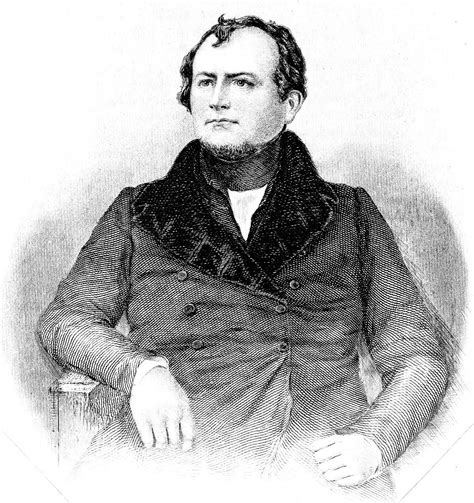
Thomas Dorr

As some who are a bit more well-versed in history of the United States will know, the United States did not start out with universal suffrage…not even for white men. What they may not know is that Rhode Island was the most restrictive of them all on this front. When Rhode Island was admitted as a state, it used for its Constitution the royal charter for the colony from 1663. This charter was quite a forward-thinking document for its day and age, and it included religious freedom (not common in that time) as well as suffrage for men who owned property. Indeed, at the time of statehood, property ownership as a requirement to vote was the norm. The requirement that such men be white, incidentally, was only added in 1822. However, by 1841, the rise of Jacksonian democracy, which established suffrage regardless of property ownership, had spread throughout the nation. That is, except for Rhode Island. Rhode Island’s political establishment were not fans of Andrew Jackson or Jacksonian democracy, and the property-owning men of the state had not once voted for him. By this point, over 60% of the white male population were barred from voting due to their lack of property ownership, and this group of citizens as well as some of the currently eligible voters rallied behind Thomas Dorr, a big fan of Andrew Jackson and an advocate of bringing Jacksonian democracy to Rhode Island. Dorr initially supported including black residents in suffrage, but his base of support insisted on them getting suffrage first, leading him to drop it, at least for the time being. The Dorr faction drew up their own reformist Constitution, but the Rhode Island Assembly formed a counter-proposal that included some concessions to the Dorrites. The Dorrite Constitution prevailed in a public vote overwhelmingly, but Rhode Island’s governor Samuel Ward King was a staunch foe of the Dorrite constitution, and refused to recognize the result of the referendum. In 1842, both the supporters of King and the Dorrites held their own elections, and both proclaimed their candidates the winner, with a strange situation existing in which different citizens of Rhode Island recognized different governors, and both issued executive orders.

This conflict was in truth quite minor; while armies were formed and moved about, ultimately only one civilian was accidentally shot and killed (Shatwell). Reactions to the Dorr Rebellion differed among the prominent names of the time. The distinct lack of combat led Frederick Douglass to describe the rebellion as merely the “Dorr excitement” (Tardiff). Others saw more importance in the event, such as Francis Wayland, a staunch conservative president of Brown University, who decried the event as almost resulting in “the horrors of civil war” and a retired Andrew Jackson, who thought the event a legitimate assertion of the power of the people (Chaput & DeSimone). A temporary party that was formed off the Whig Party was the Law and Order Party (“law and order”, like so many phrases in American politics, have had long usages), which prevailed in the next election.

Among the soldiers who helped put down the Dorr rebellion were 400 black men. Many of Rhode Island’s blacks had supported Dorr initially for his calls for expanding suffrage but changed their minds after he dropped black suffrage. These men were praised in the prominent Providence Journal, headed by future Republican Senator Henry B. Anthony. For their role, the political reward from Rhode Island’s elite was that with the revisions to the state Constitution, blacks could vote. Although the common thinking today is that black voters are largely associated with the political left given that usually about 9 in 10 black voters vote Democrat (although up to 1 in 3 consider themselves conservative), in this time they aligned themselves with the political right of their day and got rewarded.

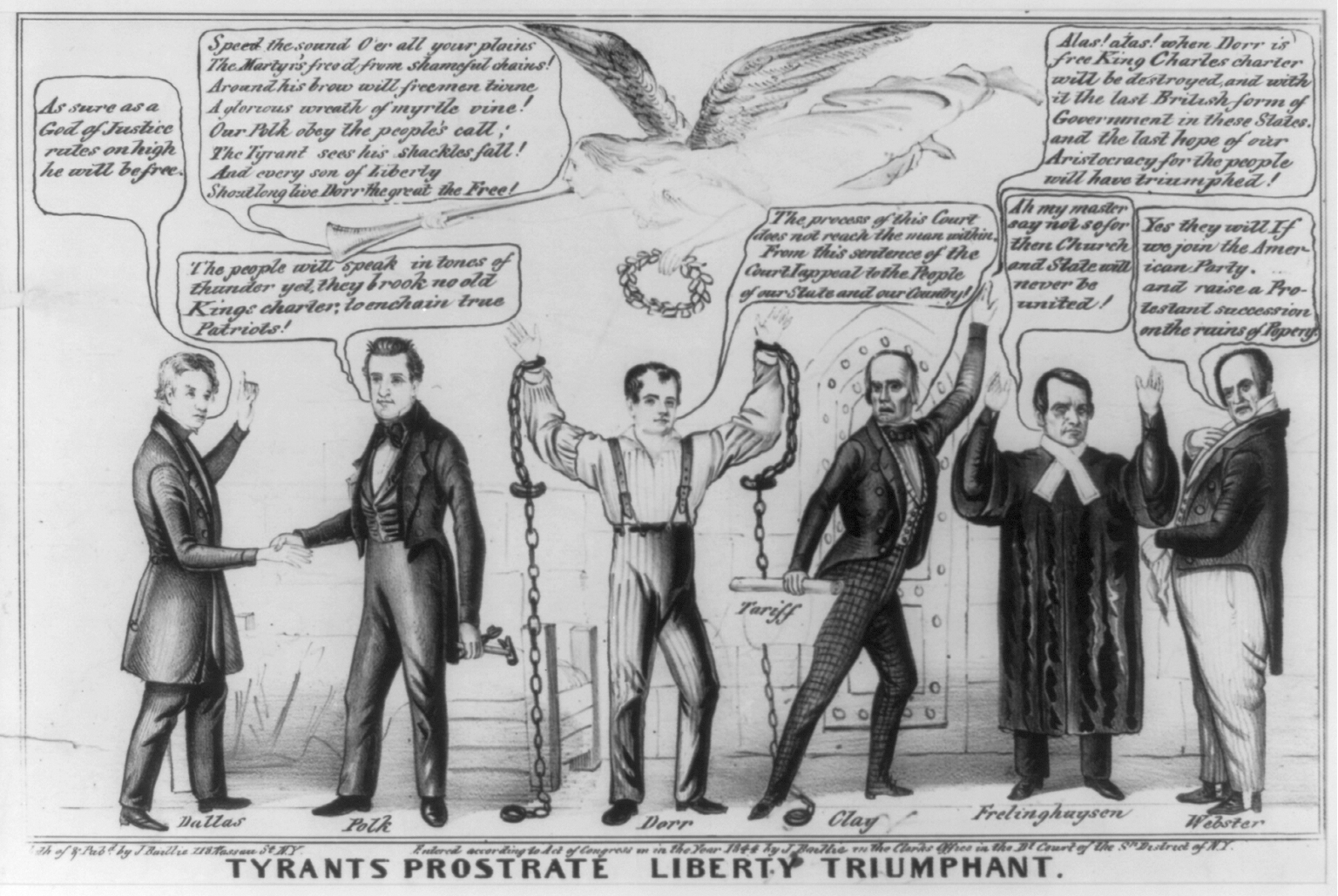
A Pro-Dorr Cartoon

In 1844, Dorr was sentenced to life of solitary confinement and hard labor for treason in a court in Newport, one that the general public considered far too harsh and protested. Only the following year amid public pressure, all participants in the Dorr Rebellion were granted amnesty. Even this one year of solitary confinement and hard labor, however, exacted a terrible toll on Dorr’s health; he would be retired for the rest of his life and died on December 27, 1854 at the age of 49. Although the rebellion was unsuccessful in making Thomas Dorr governor and in ousting the political elite of Rhode Island (the latter would not be achieved until the 1930s), the Dorr Rebellion did manage to push the state legislature to amend the state’s constitution so that Rhode Island no longer had property requirements for suffrage…for native-born men that is, provided they could pay a $1 poll tax. Foreign-born men still had to own property to vote, thus leaving many Irish Catholics out of the electorate, and this requirement persisted until 1888, when it was amended to permit foreign-born men who didn’t own property to vote. Although Southern restrictions on suffrage under Jim Crow administrations were more discriminatory and overtime proved much more dramatic in their impact (Virginia, for instance, had only about 10% of the population voting in the general election by the 20th century thanks to their onerous poll tax), Southerners pointing out hypocrisy on the rules of some Northern states like Rhode Island weren’t without a point. The power of the elites, who had been predominantly Federalist, Whig, and Republican over the history of Rhode Island didn’t start to weaken until the direct election of senators and wasn’t undone until the 1930s with the rise of FDR and the election of Governor Theodore Green. Today, Rhode Island is a staunchly Democratic state, with no Republican being elected statewide since 2006 and their voters since 1928 have only seen fit to elect Republicans to the presidency four times. Dorr himself is looked upon more favorably today, and the state of Rhode Island even recognizes him as governor during the brief time he and his supporters regarded him as governor.

References

Chaput, E.J. & DeSimone, R.J. (2010, January). Strange Bedfellows: The Politics of Antebellum Rhode Island. Common Place, 10(2).

Retrieved from

https://commonplace.online/article/strange-bedfellows/#:~:text=The%20former%20slave%20and%20staunch,was%20to%20induce%20the%20old

Shatwell, J. (2020, March 3). Dorr Rebellion – Rhode Island’s Very Own, Very Small Civil War. New England.

Retrieved from

https://newengland.com/yankee/history/dorr-rebellion/

Tardiff, E. The Dorr Rebellion. Rhode Tour.

Retrieved from

https://rhodetour.org/tours/show/29

Peter Gerry: Democratic Trailblazer in Rhode Island


Fun fact: Rhode Island used to be what we’d call a “red state”. Rhode Island was strongly unionist as well as anti-slavery, so when the Republican Party formed in 1854, they came to dominate the state, and the last post was about the most prominent figure to come out of this rise in Henry B. Anthony. After Anthony, the state’s powerhouse was Nelson W. Aldrich, the “economic manager of the nation”, who was a strong believer in the protective tariff as well as free enterprise at home. His domination came to an end with his retirement in 1911, with him being followed by wealthy Republican banker Henry Lippitt, perhaps an even more conservative figure than Aldrich. However, in 1913 the 17th Amendment was ratified, which provided for the direct election of senators. Under the system of state legislatures electing senators, Democrats had literally no chance of electing a senator given the apportionment of the state legislature that overwhelmingly favored rural areas over cities. However, 1916 was a different story. Lippitt was to face the first popular election for a senator in the state, and his opponent was Peter Goelet Gerry (1879-1957), who had served in Congress from 1913 to 1915. Gerry, the great-grandson of the namesake of gerrymandering, Elbridge Gerry, ironically benefited from the limiting of the influence of gerrymandering and defeated Lippitt by eight points.

Senator Gerry

Gerry was a frequent supporter of President Wilson’s domestic policy but even moreso a supporter of his foreign policy, strongly supporting the Versailles Treaty, which went down to defeat in 1920. In 1922, he was reelected in an election that went poorly for Republicans. It also helped that Gerry was quite rich so he could spend his own money on his campaigns, and he helped the state Democratic Party as well this way, helping them be competitive. He was mostly an opponent of Republican policies during the 1920s, and served as minority whip from 1919 to 1929. In 1928, Gerry suffered an inverse result of the 1916 election. While in 1916, Republican presidential nominee Charles Evans Hughes won Rhode Island and Gerry won the Senate election, that year Democrat Al Smith won the state with Gerry’s help but Gerry himself lost by a point. Republicans got some wedge votes with French-Canadian voters by selecting Felix Hebert, a man born to a family of French extraction in Quebec, becoming the first one to serve in the Senate (Hill). In 1930, Gerry tried to regain his seat by running against incumbent Jesse Metcalf, who happened to own the very same Providence Journal that had helped Henry B. Anthony stay in power, but was narrowly defeated despite getting Al Smith to campaign with him. Metcalf during the campaign complained of the “Gerry money machine”, and he wasn’t wrong (McBurney). However, Republicans became deeply unpopular during the Great Depression, and by 1934 Hebert’s French-Canadian descent mattered far less to voters than his party affiliation and staunch opposition to the New Deal, and Gerry regained his seat by almost 15 points, winning all cities except Cranston and Warwick (McBurney). This was the first and only time in Senate history that a senator who had been defeated in one election beat his opponent in a rematch (McBurney).

Gerry and FDR

President Franklin D. Roosevelt pushed both the Democratic Party and overall American politics in directions that could alienate figures who previously were regular Democrats or considered good progressives, and Gerry was one of them. He would often prove a thorn in FDR’s side by voting against New Deal measures frequently; he voted against a TVA bill in 1935, the bituminous coal bill in 1935, voted to strike the “Death Sentence” clause from the Public Utilities Holding Company Act, and voted against a housing bill in 1936. Gerry did vote for Social Security in 1935 and in 1937 he voted for the minimum wage, but he was certainly among the opposition within the Democratic Party to FDR’s domestic policies. Although in a radio address on the eve of election day in 1936, Gerry urged support for the state Democrats but mentioned neither FDR nor the New Deal (McBurney). In 1937, he was among senators who offered suggestions for the drafting of the Conservative Manifesto, a document principally authored by Senators Josiah Bailey (D-N.C.) and Arthur Vandenberg (R-Mich.), which called for ten conservative policy alternatives to New Deal policy. This contrasted greatly with his colleague, Theodore Green, who had defeated Metcalf in 1936 and was the man who really put Rhode Island in the Democratic column in his term as governor. However, Senator Gerry retained his support for Wilsonian foreign policy, and thus backed Roosevelt’s foreign policy initiatives. He was also a consistent supporter throughout his career of strengthening the navy. As one might expect, Gerry’s power in the Senate in his second go was weaker in the majority in the 1930s and 1940s then it had been in the minority in the 1920s, when he had served as whip given his opposition to the New Deal as well as his absence from 1929 to 1935 preventing him from getting any chairmanships. By 1946, the state’s Democrats were tiring of Gerry’s contrarian record. This plus his declining health resulted in him opting not to run for reelection. His DW-Nominate score was a -0.187, which accounts for both his earlier Wilsonian liberalism in his first two terms as a senator and his anti-New Deal stances in his second two terms. Had he chosen to run for another term, he would have likely had an uphill battle for the Democratic nomination. Gerry is arguably the last person of a conservative bent to get elected to the Senate from Rhode Island, yet he was also the first to make the Democratic Party a genuinely strong force in the state, although the ideological consequences of this were surely not fully of his intent.

References

Gerry, Peter Goelet. Voteview.

Retrieved from

https://voteview.com/person/3544/peter-goelet-gerry

Hill, R. The Senator and Mrs. Vanderbilt: Senator Peter Gerry of Rhode Island. The Knoxville Focus.

Retrieved from

https://www.knoxfocus.com/archives/the-senator-and-mrs-vanderbilt-senator-peter-gerry-of-rhode-island/

McBurney, C. (2016, November 3). Peter Gerry, Former U.S. Senator from Rhode Island, is in the News Today. Small State Big History.

Retrieved from

https://smallstatebighistory.com/peter-gerry-former-u-s-senator-rhode-island-news-today/

Henry B. Anthony: Father of the Senate and Founding Father of the Rhode Island GOP


Rhode Island today is one of the most Democratic states in the nation. Although Republicans do have chances to elect governors, they haven’t had a member of Congress elected since 1992, they haven’t been able to elect a conservative to Congress since 1938, and the last time they were able to elect a conservative Republican to the Senate was in 1930. Indeed, before 1928 the GOP had a solid grip on the politics of Rhode Island. The man who established this solid grip was Henry Bowen Anthony (1815-1884).
A journalist by profession, Anthony’s editorship of the Providence Journal made him a prominent and influential citizen in the state. A Whig, he used the Providence Journal to promote such political positions as retaining property requirements for voting, limiting immigrants’ political power, and the rule of law and order as opposed to rule by mob (Ferraro). Rhode Island’s constitution at the time of Anthony’s political career was based on the old 1663 charter from the English crown. This charter included provisions that limited voting to property owners and had in the Assembly each town having one representative with no city having more than 1/6 of the legislature, and the Senate having one for each town and city (Steffens). The former resulted in a rebellion by Thomas Dorr in 1842, a figure who supported eliminating the property requirement so new immigrants could vote, hence Anthony’s emphasis on “law and order” (Warwick History, Part II). Ultimately, that year despite the failure of the rebellion to put Dorr in power as governor, the state did enact universal suffrage for those men born in the United States (foreign-born would have to own property to vote until 1888, and there would still be limitations on suffrage), the last to do so (Steffens). However, the state had not changed the township provision, thus although Rhode Island may have more immigrants who are inclined towards Democrats in cities such as Providence, the small townships have at least one representative and one senator. Thus, what one must do to secure power is please those small townships. Throughout his political career, Anthony would be sure to do so. He served as Rhode Island’s governor from 1849 to 1851 as a Whig, where he began creating his machine that he would use to dominate Rhode Island politics. He drifted into the American, or, “Know Nothing” Party after the Whig Party’s collapse and then became a Republican. Anthony was married in his younger years, to Sarah Rhodes, but after her death in 1854 he did not remarry. The couple had no children, thus the remainder of his life was free to be committed to politics, and commit himself he did.

In 1859, Anthony was elected to the Senate as an “American Republican”. There, he became known as a talented orator and his abilities as well as his political wisdom and friendliness with senators regardless of party resulted in him gaining a lot of influence. In December 1862, his colleagues elected him chairman of the Senate Republican Conference, a post he would hold for the rest of his life. In his day, the positions of majority and minority leader did not exist, but the functions of party leader were held by the chairman of the conference of their party. Anthony would also 17 times be elected president pro tempore, a position of popularity rather than seniority at the time (U.S. Senate). He was affectionately known as the “Father of the Senate”…rather than having a family, Anthony had made the Senate his family. Per Senator George Frisbie Hoar (R-Mass.) in 1903, “He had come to be the depository of [the Senate’s] traditions, customs and unwritten rules…He seemed somehow the intimate friend of every man in the Senate, on both sides. Every one of his colleagues poured out his heart to him. It seemed that no eulogy or funeral was complete unless Anthony had taken part in it, because he was reckoned [as a protecting] friend of the man who was dead” (Baker, 5-6).

The Journal Ring – The Source of His Power

Anthony’s power was unrivaled in Rhode Island as one of its senators, and he could be quite ruthless. One writer of the time wrote that he did not hesistate to use “political legerdemain and bribery” to achieve his goals (U.S. Senate). The practices Anthony engaged in were more common in his day than now. In Rhode Island a culture of bribery of people to vote was normalized, with many voters refusing to turn out if not bribed (Steffens). The official reasoning was that such payments were compensation for lost time, a defense that strikes me as especially laughable in hindsight.

Anthony’s greatest way of maintaining power, however, was through his dominating influence over the press, particularly the power of his Providence Journal, hence his machine being known as the “Journal Ring”. Given that Anthony was such a powerful figure, opinions differed on him. For his supporters, he was a skilled politician, an intellectual, a scholar, and one who would put disagreeing opinions in his newspaper. For his critics, he behaved as a typical political boss and who employed anti-Irish Catholic bigotry and ignorance to maintain control (Warwick History, Part II). The latter came in the form of supporting Governor William Hoppin, who espoused anti-Catholic conspiracy theories, and allowing anti-Catholic groups to publish material in his paper, one of which fretted that if suffrage were extended to immigrants, “civil and political insitutions and public schools would come under the control of the Pope of Rome through the medium of thousands of naturalized foreign Catholics…” (Warwick History, Part II). The conflicts between the Protestants and Catholics that had characterized Britain in the past transferred over to the United States, making Catholics in that day essentially the “Jews” of the United States. Anthony himself responded to criticisms of the system of government he supported by saying, “a republican government might be representative without being democratic” and regarded immigrants as those who “came among us uninvited and upon whose departure there is no restraint” (Warwick History, Part II). He saw such immigrants as a threat to his political power as well as to that of the GOP, and at least in the long run he wasn’t wrong. By the 1928 election their descendants would be sufficiently mobilized to vote for Democrat Al Smith over Republican Herbert Hoover and by the 1930s they would prove fatal to the GOP’s dominance of the state. Rhode Island voters have since seen fit to vote for the Republican candidate for president only four times (Ike both times, Nixon in ’72, and Reagan in ’84). Political power seems a tremendous motive in his actions on immigration, as he did not support all immigration restrictions equally, opposing the Chinese Exclusion Act of 1882, a law which attracted overwhelming support among laboring white men of the West. Anthony’s position in the Senate was guaranteed by his control of his political machine which elected the very people who elected him in the state legislature, a state legislature proportionately favorable to him and the GOP by Constitutional structure.

Anthony would occasionally have a challenge to his machine, and one such figure who did so was William Sprague, a wealthy man from a family that had already produced politicians who managed to win the governorship of Rhode Island as a member of the Rhode Island Union Party in 1860, helped greatly by spending his own money. However, after the outbreak of the War of the Rebellion, he was quick to send troops to support the Union and became a Republican. Anthony courted the at the time popular Sprague and had his machine elect him to the Senate in 1863. However, William Sprague would end up being more politically independent than Anthony liked, and in 1868 he had to be threatened with political ruin to vote to convict President Andrew Johnson (Warwick History Part III). He became one of the Liberal Republicans during the Grant Administration who backed the candidacy of Horace Greeley in 1872. After publicly lashing out against Anthony and his domination of the political scene in Rhode Island through the Providence Journal, he saw to it that he did not win another term and was able to capitalize in the Providence Journal on both his Liberal Republicanism as well as his worsening alcoholism, calling him a madman (Warwick History, Part III). In 1875, he had the legislature replace him with General Ambrose Burnside.

Anthony and Lincoln and Johnson

As the leader of the Senate Republicans, Anthony was a strong supporter of President Abraham Lincoln and his efforts both at securing the union and in opposition to slavery. After Lincoln’s assassination, he gave his support to President Andrew Johnson, even though the two had considerable disagreements on Reconstruction policy. Anthony would vote, contrary to Johnson’s positions, for the 14th and 15th amendments to the Constitution. However, Johnson decided to give patronage appointments in Rhode Island to Anthony’s foes, and thus when the time came for the vote on convicting Andrew Johnson of impeachment charges, Anthony, the first to vote, announced, “Guilty!” (U.S. Senate) He would support all subsequent presidents in his lifetime, for all of them would be Republicans; he was spared by his own death from witnessing the election of Grover Cleveland. Ideologically, he could be thought of broadly as a conservative given his positions on currency, interest rates, tariffs, and immigration, he was not necessarily uniformly so in how he voted and was far from a guaranteed vote for railroad interests. Anthony also supported the annexation of Santo Domingo (now known as the Dominican Republic). His DW-Nominate score was a 0.286, indicating a moderate conservatism by that standard.

A Successor

In the late 1870s, Anthony came to know one Nelson Aldrich, and was sufficiently impressed that he backed his rise in politics. After serving a single term in the House from 1879 to 1881, Anthony secured his election to the Senate, where he would serve for 30 years and become a titan in that body, leading its “Big Four” of conservatives who called the shots in the Senate from 1897 to 1905, and he would himself essentially lead the Senate until his retirement in 1911. Although reelected in 1883, Anthony’s health was declining, and in January 1884 he declined to be elected again as Senate pro tempore. He would die on September 2nd. Anthony’s death was followed by the single largest public funeral in the state’s history.

References

Anthony, Henry Bowen. Voteview.

Retrieved from

https://voteview.com/person/212/henry-bowen-anthony

Baker, R.A. (2007). Traditions of the United States Senate. U.S. Senate.

Retrieved from

https://www.google.com/books/edition/Traditions_of_the_United_States_Senate/PV-SvOCvC_AC?hl=en&gbpv=1&dq

Ferraro, W.M. (1999). Anthony, Henry Bowen. American National Biography. New York, NY: Oxford University Press.

Retrieved from

https://www.anb.org/display/10.1093/anb/9780198606697.001.0001/anb-9780198606697-e-0400026

Henry Bowen Anthony 1815-1884 – A brilliant editor and politician. Warwick Rhode Island Digital History Project.

Retrieved from

https://www.warwickhistory.com/index.php?option=com_content&view=article&id=270:henry-bowen-anthony-1815-1884-a-brilliant-editor-and-politician&catid=56&Itemid=125

Steffens, L. (1905). Rhode Island: A State for Sale. Small State Big History.

Retrieved from

https://smallstatebighistory.com/rhode-island-state-sale/

The Last Time a President Dropped Out for Another Term


On June 27th, 2024, America saw during the Biden-Trump debate an “emperor has no clothes” scenario. Biden’s terrible state in that debate was something that even his staunchest of supporters in the media could not explain away or spin. The game was up, the truth was before everyone’s eyes. With the money for the Democrats threatening to dry up if Biden stayed on and after publicly denying he was dropping out, he dropped out on Sunday. While dramatic, this event is not unprecedented, and the president who dropped had won his term by a far greater margin than Biden had in 2020.                                     

The 1964 election brought a sweeping victory to President Lyndon B. Johnson, with Goldwater only winning Arizona and the Deep South. This, plus a staunchly liberal Congress that came with it, resulted in the most activist liberal Congress since the days of FDR. This Congress passed Medicare and Medicaid, the Elementary and Secondary Education Act, and the Voting Rights Act of 1965 among other sweeping measures. However, with a profoundly productive Congress came a backlash to the policies of the Johnson Administration, a slowing economy, and adding fuel to the fire were numerous “ghetto riots”. The Great Society backlash of 1966 was a portend of trouble for Johnson. Presidents have come back from bad midterms before (Truman, Clinton, Obama), and since Johnson had not served a full two terms, he was Constitutionally allowed to run again in 1968. The greatest trouble he was having, however, was with his own party’s base over the Vietnam War, and Johnson needed to first be renominated. In 1967, liberal activists Allard Lowenstein and Curtis Gans started the “Dump Johnson” movement over the Vietnam War. Lowenstein visited several prospective Democrats to try and talk them into the race, including Senators Bobby Kennedy of New York and George McGovern of South Dakota. However, the first person he was able to recruit into the race was Senator Eugene McCarthy (D-Minn.) (Britannica). At first, he seemed like a candidate with a snowball’s chance in hell of beating Johnson, but youthful enthusiasm was with him. Many college students volunteered for McCarthy’s campaign and campaigned throughout New Hampshire for him. LBJ was expected to win the New Hampshire primary through write-in votes as he hadn’t filed, and did on March 12th. However, he only did so with 48% as opposed to 42% for McCarthy. This elevated McCarthy from a lesser challenger to a greater challenger. Johnson’s deteriorating political position wasn’t the only thing on his mind. Another factor Johnson considered was his health, as he had believed for some time that his death was not far off. In 1967, Johnson secretly had a study done into his life expectancy based on the males in his bloodline, and predicted that based on his heart issues and the history of the Johnson men that he would die at the age of sixty-four, a prophecy that came true (Janos). My how times have changed!

On March 31, 1968, Johnson announced that he would “neither seek nor accept” the Democratic nomination (Glass). The New Hampshire primary showed both Johnson and the public the sorry state his presidency was now in. Unfortunately for McCarthy, this gave bigger figures in the Democratic Party the permission they needed to enter the race, with Bobby Kennedy and Vice President Hubert Humphrey both entering the primary. Kennedy was largely considered the favorite, but was tragically assassinated after winning the California Democratic primary. Thus, the path was open for Vice President Hubert Humphrey to clinch the nomination in the disastrous and chaotic 1968 Democratic National Convention. He would narrowly lose that year to Richard Nixon, but the race would likely have been worse for Humphrey had George Wallace not been in the race to grab up most of the Deep South states. This event in itself actually seems less dramatic than Biden’s dropping out for a number of reasons. First, the timing. March 31st was early enough for Democratic candidates to fully form campaigns and participate in major primaries. Second, the election is less than four months away with Biden’s departure. Third, the event that took Biden down was so much more revelatory and dramatic than Johnson winning by considerably less than expected in the earliest primary.

References

Allard K. Lowenstein. Encyclopedia Britannica.

Retrieved from

https://www.britannica.com/biography/Allard-K-Lowenstein

Glass, A. (2016, March 12). McCarthy nearly upsets LBJ in New Hampshire primary: March 12, 1968. Politico.

Retrieved from

https://www.politico.com/story/2016/03/mccarthy-nearly-upsets-lbj-in-new-hampshire-primary-march-12-1968-220521

Janos, L. (1973, June). The Last Days of the President. The Atlantic.

Retrieved from

https://www.theatlantic.com/magazine/archive/1973/07/the-last-days-of-the-president/376281/

Great Conservatives from American History #18: Jeremiah Denton

Today, I’d like to talk about an American hero. A man who served his country in Vietnam and bravely endured hell while in the captivity of the North Vietnamese. I’m not talking about John McCain, I’m talking about Jeremiah Denton (1924-2014).

Denton in North Vietnamese captivity, 1966.

Denton had a 31-year career in the navy and one of his achievements was crafting the “Haystack Concept” for nuclear war tactics: the concealing of aircraft carriers from radar by having them travel with commercial shipping and avoiding naval formations (Angevine). He was one of the many unfortunate men serving in Vietnam to fall into North Vietnamese captivity, being shot down while flying in 1965. He and his men were tortured for information, and Denton was among the leading soldiers who resisted, for this he was put into “Alcatraz” for solitary confinement along with other prominent resistors, which included Admiral James Stockdale (who ran as Ross Perot’s VP in 1992) and Sam Johnson, who would later be a longtime representative from Texas. When trotted out for a broadcast to show how allegedly well they were being treated in 1966, while Denton was speaking, he blinked morse code for “torture”. This was observed by a few observant watchers, and this was the first indicator to the American public as to how prisoners of war were being treated. Denton would live for 7 1/2 years in the infamous “Hanoi Hilton”. Denton was released in 1973, and his captors only likely got wise to his morse code when he was awarded the Navy Cross for valor in 1974, as he didn’t face direct consequences for his interview (CBS News). he would write about his horrible experiences in captivity in his book, “When Hell Was in Session”. In 1977, Denton retired from the navy as a rear admiral. In 1979, Denton told the Los Angeles Times that “They beat you with fists and fan belts. They warmed you up and threatened you with death. Then they really got serious and gave you something called the rope trick [cutting off circulation to his limbs with ropes]” (CBS News).


After his naval career, Denton decided to focus on politics, and in 1980 he ran for the Senate as a Republican, his motivation to do so being over what he saw as President Carter’s weak response to the Soviet invasion of Afghanistan (Watson). He was elected to the Senate over Democrat Jim Folsom Jr. by three points, running ahead of Ronald Reagan, who won the state by just over a point. This made him the first Republican to be elected to the Senate from Alabama since Reconstruction and he became only the second Navy admiral to serve in the Senate, the first having been Connecticut’s Thomas Hart. In the Senate, Denton was a staunch conservative. Consistent with his conservative Catholic upbringing, he had a particularly strong focus on social issues (Watson). Denton promoted abstinence as the most reliable form of birth control, supported the Hatch-Eagleton Human Life Amendment, backed a school prayer amendment, and extolled the nuclear family. He was also a strong advocate of national security legislation. Denton’s DW-Nominate score was a 0.467, placing him among the conservatives per that scale. The American Conservative Union thought similarly, giving him an 89%. In 1982, he voted against extending the Voting Rights Act of 1965, as he thought it had unfairly penalized the South (Watson). However, the following year supported the Martin Luther King Jr. holiday. Denton held that although King was personally imperfect, the change he brought to the South warranted the holiday (Congressional Record). While he would have no problem winning reelection in Alabama were he to run today on his conservatism, the Democratic Party was considerably stronger in Alabama in the 1980s, and in 1986 they ran Congressman Richard Shelby, also known as a conservative. Had Denton run for reelection in a different year, he may have won given that 1986 was a pretty bad year for the GOP in the Senate, and he lost by less than a point. Interestingly, Shelby himself would become a Republican in 1995 and served in the Senate until 2023. Denton continued advocating for conservative causes and in 2004, there was a minor controversy surrounding him being prevented from speaking before the California Assembly by the Democratic leadership on July 4th, on account of his conservative politics (Mikkelson). On March 28, 2014, he passed into history from a heart ailment, aged 89. Denton served as a fine example of courage in the face of great adversity, as well as a strong advocate for social stability and public morals and the nuclear family from which he believed these were based.

References

Angevine, R.G. (2011). Hiding in Plain Sight: The US Navy and Dispersed Operations Under EMCON, 1956-1972. Naval War College Review, 64 (2), 80-82.

Retrieved from

https://web.archive.org/web/20111118061108/http://www.usnwc.edu/getattachment/bfd7502d-682c-444d-946c-63245227ae68/Hiding-in-Plain-Sight–The-U-S–Navy-and-Dispersed

Denton, Jeremiah Andrew, Jr. Voteview.

Retrieved from

https://voteview.com/person/14901/jeremiah-andrew-denton-jr

Ex-senator and Vietnam POW who blinked “torture” in Morse code dies. (2014, March 28). CBS News.

Retrieved from

https://www.cbsnews.com/news/jeremiah-denton-ex-senator-and-vietnam-pow-who-blinked-torture-in-morse-code-dies-at-89/

He Survived Captivity, One Minute At A Time. (2014, March 29). NPR.

Retrieved from

https://www.npr.org/2014/03/29/296211985/j-denton-fo

Lowry, R. (2014, March 31). Jeremiah Denton: Grade-A hero. New York Post.

Retrieved from

https://nypost.com/2014/03/31/jeremiah-denton-grade-a-hero/

“Martin Luther King, Jr. Holiday.” Congressional Record 129: 16 (October 19, 1983) p. 28341-28380.

Retrieved from

Click to access GPO-CRECB-1983-pt20-6-2.pdf

Mikkelson, D. (2004, July 15). Jeremiah Denton. Snopes.

Retrieved from

https://www.snopes.com/fact-check/jeremiah-denton/

Sen. Jeremiah Denton. American Conservative Union.

Retrieved from

http://ratings.conservative.org/people/D000259

Watson, E.L. (2010, November 9). Jeremiah Denton Jr. Encyclopedia of Alabama.

Retrieved from

https://encyclopediaofalabama.org/article/jeremiah-denton-jr/