The American Liberty League: A False Start for a Conservative Revival

President Obama’s presidency was haunted by his foil, the Tea Party, which helped gin up enthusiasm for the GOP’s blockbuster results in the House. JFK’s and to a lesser extent LBJ’s presidency was haunted by the John Birch Society, which proved an uncomfortable group for the Republicans to navigate given the support of many base conservatives for it in the early 1960s and the propensity of its leader, Robert W. Welch, to indulge in conspiracy theories. There were a number of groups that formed to oppose FDR and his New Deal, and one of the earliest and best funded was the American Liberty League.


This organization was established in 1934 as unions became bolder with strikes. This was a combination of Democrats and Republicans dissatisfied with the New Deal, with its president being Jouett Shouse, who had served in Congress as a Democrat from Kansas from 1915 to 1919. The organization got a lot of funding from the Du Pont family (30% of its funding) and a number of corporate figures. Perhaps the most compelling fact about the organization was that FDR’s two Democratic predecessor nominees for president were on its National Executive Committee: John W. Davis and Al Smith. Also on the committee were Senator David A. Reed (R-Penn.) and Congressmen Robert Luce (R-Mass.) and James W. Wadsworth (R-N.Y.). They crafted a ten-point philosophy, much of which was directly counter to the New Deal. Some of the figures (such as Shouse) had previous records as progressives but found the New Deal to be going too far. The platform read,


“1. To preserve American institutions which safeguard, to citizens in all walks of life, the right to liberty and the pursuit of happiness. Therefore to uphold American principles which oppose the tendency shown in many countries to restrict freedom of speech, freedom of the press, religious liberty, the right to peaceable assembly and the right to petition the government; and to combat the growth of bureaucracy, the spread of monopoly, the socialization of industry and the regimentation of American life.

  1. To maintain the right of an equal opportunity for all to work, earn, save and acquire property in order that every man may enjoy the fruit of his own ability and labor, and thus have, in his declining years, the peace of mind that comes from a sense of security for himself and for his wife and children who may survive him.
  2. To uphold the principle that the levying of taxes, the appropriation of public funds and the designation of the purposes for which they are to be expended are exclusively the functions of the Congress and should not be exercised by administrative officials.
  3. To advocate economy in government by abolishing useless commissions and offices, consolidating departments and bureaus and eliminating extravagance; to advocate a sound fiscal policy and the maintenance of a sound and stable currency to be preserved at all hazards.
  4. To further the restoration of employment and the rehabilitation of agriculture, business and industry, and to oppose all unnecessary interference and competition by government with legitimate industry.
  5. To oppose all measures that may threaten the security of the invested savings of the millions of savings bank depositors, holders of insurance policies and other investors. Also to support governmental policies that will protect invested funds that go to the maintenance of churches, colleges, hospitals and all institutions that care for the aged, the poor, the orphans and the afflicted.
  6. To support government in the obligation to provide for those who, because of involuntary unemployment or disability, cannot provide for themselves.
  7. To uphold the American principle that laws to be made only by the direct representatives of the people in the Congress, and that the laws be interpreted only by the Courts, and to oppose the delegation of either of these functions to executive departments, commissions or bureau heads.
  8. To provide for the rank and file of the American people, who are unorganized and too often have no voice in legislation that affects their welfare, an opportunity, through united effort and a service of public information, to offset the influence of any and all groups working for selfish purposes.
  9. Finally, to preserve for the succeeding generations the principles of the Declaration of Independence, the safeguards of personal liberty and the opportunity for initiative and enterprise provided under the Constitution. These are the foundation stones upon which America has built the most successful governmental structure thus far devised.” (American Liberty League)

    There are some curious figures who served on the National Advisory Council, perhaps the oddest being Chase G. Woodhouse. The reason is that Woodhouse would be elected to Congress as a Democrat from Connecticut in 1944 and 1948, and both her terms she was a staunch liberal. It appears that her politics changed considerably during the 1930s, as she won her first statewide election as a Democrat in 1940. Part of the National Executive Committee was Pauline Sabin, who had been a key figure in bringing about the end of Prohibition. Indeed, a number of figures who had pushed for the end of Prohibition were in this organization. Yet another was Hal Roach, the Hollywood director-producer of Laurel and Hardy shorts and films and Our Gang (“Little Rascals”) shorts. Even a Roosevelt was on the committee, George E. Roosevelt, a first cousin once-removed of President Theodore Roosevelt. Along with Woodhouse, future members of Congress Rene F. Coudert (R-N.Y.) and Thurmond Chatham (D-N.C.) were members. Past legislators included Senator Elihu Root (R-N.Y.) (who had also served as a Secretary of War and Secretary of State) and Representatives Richmond P. Hobson (D-Ala.) (also a naval hero) and Thomas W. Phillips Jr. (R-Penn.). There were also two former governors in Joseph B. Ely (D-Mass.) and Nathan Miller (R-N.Y.). Yet another figure of interest was William Howard Taft’s Attorney General George W. Wickersham, who was known as a staunch trust buster. One figure on the National Advisory Council was Rep. James M. Beck (R-Penn.), who would fight the New Deal in court until his death in 1936.

    The League’s Positions and Criticisms

    The American Liberty League opposed the Agricultural Adjustment Act, the Tennessee Valley Authority, the Bankhead Cotton Control Act, opposed the National Industrial Recovery Act in the form it was passed, the “death sentence clause” of the Public Utilities Holding Company Act, Social Security, the Townsend Plan, and the Patman Bonus Bill. On the latter two, they were in agreement with the Roosevelt Administration. They also defended the Supreme Court for its rulings against the Administration. Perhaps the most effective activity the group engaged in was publishing 135 educational pamphlets from August 1934 to September 1936, in which their conservative philosophy on numerous topics was effectively described and their cases made (Pietrusza).

    Also of interest was the presence of numerous industrialists on the committee and the council, including J. Howard Pew of Sun Oil, John J. Raskob of Du Pont and General Motors (also chair of the DNC from 1928 to 1932), Alfred P. Sloan of General Motors, and Irenee du Pont of the Du Pont company, who had previously been a Republican but supported Al Smith in 1928 and FDR in 1932. The presence of these industrialists as well as a number of other wealthy figures was effectively capitalized (in a manner of speaking) by FDR and his supporters. Roosevelt and his campaign were highly effective in campaigning against the American Liberty League as representing the interests of the wealthy only, and he asserted that they were founded “to uphold two of the Ten Commandments” on property, that they dismissed “Love they neighbor as thyself”, that they were an “ally of the Republican National Committee”, and that they would “squeeze the worker dry in his old age and cast him like an orange rind into the refuse pail” (PotusGeeks). One of his allies, who would later get a retroactive reputation as a conservative due to some of his domestic stances from 1937 to 1941, Senator Pat Harrison of Mississippi, also had his criticisms. He said of them that they were “a group of griping and disgruntled politicians…masquerading as patriots but who are in reality apostles of greed” (Pietrusza). Such criticisms had their effect on those who during the Great Depression were facing hard times.

    Link to the “Business Plot”

    In 1933, retired General Smedley Butler was approached by Gerald C. MacGuire, a Wall Street bond salesman, who initially offered him a good deal more money than he thought veterans’ organizations could raise to go to Chicago and deliver a speech in support of “sound money” and thus against Roosevelt’s policies on gold. Then MacGuire offered to bankroll him running to be the National Commander of the American Legion, after which Butler was to use the 500,000 veterans of the American Legion to stage a fascist coup. The veterans were to march on Washington in a show of support for Butler with FDR ultimately relegated to the role of the King as he stood in Italy (a figurehead) while Butler would be Mussolini.

    MacGuire’s connection to the American Liberty League is that he told Butler that an organization would be forming to oppose Roosevelt in the coming months that would push liberty, and he could have known about talks of something like that as he worked for Grayson M.P. Murphy’s company. Murphy was a Wall Street banker who had had military service and was made Treasurer of the American Liberty League. The degree of connection between MacGuire, this plot, and those who were in the ALL is unclear as there has been a lack of documented evidence. Indeed, Butler never did meet with anyone from the American Liberty League and was only told about the connection by MacGuire. What does appear to be the case is that MacGuire had some contact with fellow veterans on Wall Street, including businessman Robert Sterling Clark and his employer Liberty Leaguer Murphy. This matter alone in truth is a separate topic, and I plan on covering it in much greater depth in a future post.

    The Results

    The American Liberty League itself proved ineffective at changing the course of the United States, with Roosevelt winning every state except Maine and Vermont. One publicized event that had highlighted their incongruence with the times was in 1936 when the organization had Al Smith deliver an anti-New Deal speech which was broadcast over the radio at the Mayflower Hotel with an audience that consisted mostly of conservative Republicans…at a fancy dinner party. Although the RNC kept a distance from the American Liberty League during the 1936 election, many individual members made sizeable donations to the Landon campaign, and RNC chairman John D.M. Hamilton later admitted, “Without Liberty League money, we wouldn’t have had a national headquarters” (Pietrusza). The American Liberty League both kept the Republican Party alive as a force with money but was also an unpopular partner. The Roosevelt campaign and his allies had ultimately successfully pursued a strategy that was described by George Wolfskill and John A. Hudson in All But the People: Franklin D. Roosevelt and His Critics, 1933-1939 as, “Make the Liberty League synonymous with social and economic privilege, associate it closely with the Republican Party, then attack the Republicans by attacking the League. Once synonymity between the Liberty League and predatory wealth was established, the League could be attacked both directly by name and indirectly by attacking ‘economic royalists'” (Pietrusza).

    Although the American Liberty League was effectively attacked by Roosevelt in the 1936 election and their activities were substantially lessened after until its final demise in September 1940 as it was seen as an anchor for the opposition to the New Deal, it constituted the start of the pushback from the right against FDR and New Deal. In 1937, a bipartisan group of senators led by Josiah Bailey (D-N.C.) and Arthur Vandenberg (R-Mich.) would craft the Conservative Manifesto, which had similar themes to the American Liberty League. What’s more, after the 1938 midterms the goal would be realized for a bipartisan Conservative Coalition to exist on domestic issues. This was in good part thanks to the adept leadership of House Republican leader Joe Martin of Massachusetts and Democrat Gene Cox of Georgia, and they successfully stopped further New Deal measures and limited and even repealed some in place. The Conservative Coalition would last as an informal entity until the 1994 midterms. The American Liberty League, to make a bit of an unflattering comparison, reminds me of the Lincoln Project in this sense: it had a number of figures in the Democratic Party who were has-beens to oppose the agenda of the present Democratic Party, much like the Lincoln Project has a collection of Republican has-beens (although not nearly as impressive as two past party nominees) out to oppose the current Republican Party. The Lincoln Project likely swayed few if any Republicans given its messaging oriented to attracting left-wing donors and the American Liberty League likewise proved a failure at persuasion, especially in a time in which the American public was by and large not particularly interested in hearing what major business interests had to say on the politics of the day.

    References

    American Liberty League. Encyclopedia.com.

    Retrieved from

    https://www.encyclopedia.com/history/dictionaries-thesauruses-pictures-and-press-releases/american-liberty-league

    Pietrusza, D. (1978, January 1). New Deal Nemesis. Reason Magazine.

    Retrieved from

    https://reason.com/1978/01/01/new-deal-nemesis/

    Platform and Organization of the American Liberty League. American Liberty League.

    Retrieved from

    https://digital.hagley.org/islandora/object/islandora%3A2326815/datastream/PDF/download

    Rudolph, F. (1950). The American Liberty League, 1934-1940. The American Historical Review, 56(1), 19-33.

    Retrieved from

    https://cr.middlebury.edu/amlit_civ/allen/field_house/2012%20backup/scholarship/liberty%20league.pdf

    The American Liberty League. PotusGeeks.

    Retrieved from

    https://potus-geeks.livejournal.com/1540873.html
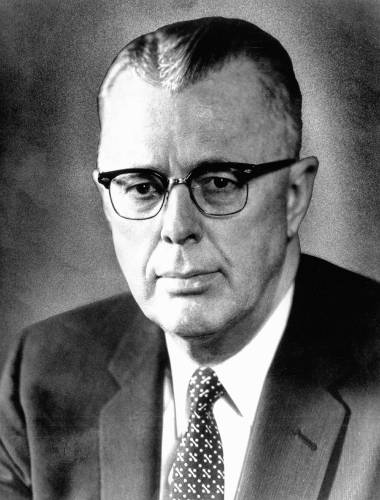
Great Conservatives from American History #10: Norris H. Cotton

Not too long ago, I covered the most significant figure among New Hampshire’s 20th century senators, but now I will cover a man who I regard as having a great deal of conscience. This would be Norris Henry Cotton (1900-1989), who stands as an example of an American success story. He grew up poor on a farm in Warren, New Hampshire, but succeeded in getting an education at Phillips Exeter Academy as well as Wesleyan University. During his time in college, Cotton served as an intern in the New Hampshire House of Representatives and was elected to the body in 1922, serving in 1923, one of the youngest state legislators in American history. He was also a protege of Senator George H. Moses (R-N.H.), serving as his secretary from 1924 to 1928. While one could suggest that he got some of his conservatism from the influence of Moses, he was also considerably more flexible than him during his career. Although his start was early, Cotton spent a good deal of time as an attorney in private practice until being elected again to the New Hampshire House, where he served as speaker from 1945 to 1947.


Cotton in the House

The year 1946 was a blowout for Republicans, with them winning both houses of Congress for the first time since the 1928 election. This was the first term of Congress for two future presidents in John F. Kennedy and Richard Nixon, the latter Cotton would befriend. Cotton, who labeled himself “a rock-ribbed conservative Republican and proud of it”, was a supporter of the 80th Congress’ domestic agenda and supported the Taft-Hartley Act and tax reduction (Weil). However, he also supported the Truman Administration on Greek-Turkish Aid and the Marshall Plan. Indeed, Cotton was something of an internationalist, and this included his vote for Point IV aid in 1950, which provided aid for poor nations as opposed to nations impoverished by war.

Cotton in the Senate

In 1953, Senator Charles Tobey died unexpectedly, and Cotton was elected to succeed him in the special election. Cotton was popular, and he thrice won his elections by double digits. The first issue he tackled in the Senate was none other than the censure of Senator Joseph McCarthy. While Cotton was an ideologically welcome colleague for New Hampshire’s senior senator Styles Bridges, Cotton differed with him on this question, voting for Joseph McCarthy’s censure. He also came to believe that the media was responsible for an erroneous view of government power by the American public, as he saw the public thinking the role of president far more powerful than it was or ought to be. Cotton was indeed an independent-minded man, and his independent-minded instances weren’t always pleasing for liberals.

Cotton and Civil Rights

Norris Cotton’s record on civil rights is complicated and therefore fascinating. He voted for banning the poll tax in 1947 but voted against the 1949 bill. Cotton voted against the Marcantonio anti-discrimination amendment for women’s coast guard legislation in 1949 but in favor of killing a segregated veteran’s hospital in 1951. He also voted in favor of the voluntary Fair Employment Practices Committee in 1950. In 1954, Cotton supported the outcome of ending school segregation as “it rectified a long-standing injustice to the black race”, but believed the Supreme Court shouldn’t have stepped in (Sanborn). Cotton’s record would only grow more complex in the Senate.

In 1957, he, like every other voting Republican, voted for that year’s Civil Rights Act, but he voted for the Anderson-Aiken amendment knocking out 14th Amendment implementation and voted against the O’Mahoney-Kefauver-Church jury trial amendment. His most controversial stance, however, would come in 1964.


Cotton proved an opponent of the Civil Rights Act of 1964, voting to delete both Title II (public accommodations) and Title VII (employment discrimination) from the bill. However, he agreed to vote to end debate on the bill on June 10th in exchange of getting his proposed amendment a vote, which if enacted would have limited Title VII only to businesses with 100 or more employees, as its proponents thought the law couldn’t be enforced with impartiality nationwide on small businesses (Sanborn, 5). The amendment failed the following day on a vote of 35-51, a majority regarding the amendment as gutting much of Title VII. Cotton then was one of six Republicans to vote against the bill, the only senator from New England to do so. He said on the matter, “Mr. President, I cannot vote for this Bill. This has been the most difficult decision I have had to make in all the years I have served in Congress. For 18 years I have supported every measure to end discrimination between the races and guarantee full rights to every citizen and I hope and fully expected to vote for this one” (Sanborn, 6). Cotton would in the next year vote for the Voting Rights Act of 1965 and in 1968 would even support fair housing legislation. However, he also opposed the Immigration and Nationality Act of 1965, which repealed the national origins quota policy. He was supportive of extending the Voting Rights Act and in 1972, he was one of only eight senators to vote against the Equal Rights Amendment.

Cotton, Kennedy, and Johnson

During the Democratic years of the 1960s, Cotton had a conservative albeit pragmatic record. He opposed a strong minimum wage bill, public power in the generation of atomic energy, public housing, and the 1961 proposal for federal aid to education. Cotton also opposed the Economic Opportunity Act of 1964. However, although he voted to kill Medicare multiple times, in 1965 he would vote for the Social Security Act Amendments which contained Medicare and Medicaid. On foreign policy, Cotton voted for restrictions in funding and opposed aid for Iron Curtain nations, but supported the Partial Nuclear Test Ban Treaty after voting for the Tower-Long “understanding” that would permit nuclear weapons in the case of war.

Cotton and Nixon

Richard Nixon’s presidency was welcomed by Cotton, and he proved a strong supporter of his friend, including his efforts on Vietnam, opposing the Cooper-Church Amendment to withdraw funds from military forces in Cambodia as well as the Hatfield-McGovern Amendment to provide a timetable for ending American involvement. However, this didn’t stop him from disagreements. He, for instance, voted to override President Nixon’s veto of an education bill in 1970 and indeed was more willing to occasionally vote for government programs when it came to helping children, such as education and nutrition programs.
Cotton agonized over the Watergate Scandal and was relieved when Nixon resigned as he did not wish to see his friend impeached and be in the position of having to vote to convict him.

Retirement*

In 1974, Cotton opted not to run for reelection, but the election to succeed him proved excessively close. Although Republican Congressman Louis Wyman was ahead by 355 votes on Election Day, a recount was sought by Democrat John A. Durkin. While the matter was being settled, Governor Meldrim Thomson appointed Cotton to temporarily serve again, serving from August 8th to September 18th, 1975. Durkin would ultimately be found the winner by only 10 votes. The next time a former senator would be tapped to temporarily serve was in 2018 when Jon Kyl was selected by Governor Doug Ducey to finish the late Senator John McCain’s (R-Ariz.) term. In 1978, Cotton published his memoirs, In the Senate: Amidst the Conflict and the Turmoil. He died on February 24, 1989. I like Cotton because he’s sufficiently conservative, but he is not one who can be caricatured. His DW-Nominate score was a 0.395, which reflects his strong domestic conservatism as well as his mixed record on foreign policy, especially earlier in his career.


References

Ex-Sen. Norris Cotton, 88; ‘Rock Ribbed Conservative’. (1989, February 27). Los Angeles Times.

Retrieved from

https://www.latimes.com/archives/la-xpm-1989-02-27-mn-286-story.html


Sanborn, R. (2017). The Pragmatism of Politics: Senator Norris Cotton and the Civil Rights Legislation in the 1960s. Inquiry Journal. 6.

Retrieved from

https://core.ac.uk/download/pdf/215520496.pdf

Weil, M. (1989, February 25). Norris Cotton, Ex-Senator of N.H., Dies. The Washington Post.

Retrieved from

https://www.washingtonpost.com/archive/local/1989/02/25/norris-cotton-ex-senator-of-nh-dies/bec87ce8-50e3-491a-9b76-fea0cd227039/

American Radicals #1: Woody Guthrie

I have for some time been meaning to start up a series on the radicals of American history, and what has spurred me to action is the recent death of Harry Belafonte. Although known for his singing and songwriting career and civil rights activism, less is mentioned about his touting of communist regimes abroad (such as East Germany), praising the regime of Hugo Chavez, regarding Cuba a model for the United States, calling for the jailing of opponents of Barack Obama, and declaring George W. Bush “the greatest terrorist in the world” in 2006 (Capshaw). There are a number of people in American history who have played this sort of double game of calling for more freedoms at home but embracing totalitarianism abroad (and in Belafonte’s case, calling for it against political opponents at home).


I want to make clear what I regard as “radical”. For the purposes of this series, it means supporting a severe departure from the founding principles of the United States, to move away from individual rights for “collective” rights, and to embrace a totalitarian philosophy. I originally wanted the first entry to be W.E.B. DuBois, but I think it’s more appropriate given Belafonte’s passing to start with a fellow singer and songwriter, a legend of folk music, Woody Guthrie (1912-1967).


Born Woodrow Wilson Guthrie in Oklahoma to Democratic politician and land speculator Charles Guthrie, a man who may have participated in a 1911 lynching and had, according to Woody, joined the KKK after its 1915 revival, Woody Guthrie (1912-1967) was both a major figure in folk music and a political radical. He was one of the “Okies” who traveled to California for work during the Dust Bowl, and a number of his songs are based on working conditions faced by said workers. He became famous for his musical performances of hillbilly and folk music, and his themes resonated with many who were facing hard times. Some of his hits included “Cumberland Gap”, “Crawdad Song” and “Tear the Fascists Down”. Guthrie had his political awakening while appearing on radio station KFVD. There, he met newscaster Ed Robbin, a staunch left-winger, who mentored Guthrie on politics and introduced him to numerous socialists and communists (John Steinbeck among them).


He was outspoken against fascism and Nazism and he placed on his guitar a label that read, “This Machine Kills Fascists”. One of his most famous songs is “This Land is Your Land”, which although is often regarded as one of those great American songs, it was in fact a retort to Irving Berlin’s “God Bless America”, which he thought was too frequently played on the radio and his song asked how God could bless a nation that had its socioeconomic problems (Leonard). Guthrie’s music and his politics were, in fact, intertwined.


Although Guthrie never publicly labeled himself a communist, he was supportive of the CPUSA and, according to author Aaron J. Leonard, was during 1942 a member of the party before he was booted for discipline issues, namely his failure to show up at a street corner to sell the latest issues of the Communist Party’s newspaper, The Daily Worker, after he had pledged to do so. Guthrie also wrote a song in support of the Molotov-Ribbentrop pact (which convinced many American communists to abandon the party) as well as the Soviet invasion of Poland. Guthrie also opposed FDR granting loans to Finland to counter Soviet aggression as well as American involvement in World War II right up until Operation Barbarossa, a stance that perfectly aligned with that of Stalin and the CPUSA. Indeed, Guthrie was supportive of Stalin and never renounced him.


Over the years, Guthrie’s behavior became increasingly erratic and at times even violent, and in 1952, it was finally figured out that he had Huntington’s disease. His mother, who had become mentally ill in her final years, had died of the same disease and his first two daughters would also die of it. Despite his diagnosis, the FBI, which had been monitoring him for some time for his socialist and communist activities, would continue to do so. Guthrie would be in and out of hospitals until his death on October 3, 1967. He had great influence on a number of others who would arise on the music scene, including Bob Dylan (who he mentored), Joan Baez, and Johnny Cash (McCurdy). However, it should not be forgotten that Guthrie embraced communist politics, including a staunch support for one of history’s greatest mass murderers. After all, had he embraced the racial and nationalistic offshoot of socialism, there likely would be no Woody Guthrie Festival or a postage stamp. The truth, as I see it, is that there is a portion of the public who just won’t believe that communism was all that bad or that all is needed is just the right leader. Maybe this is because the baleful outcomes of communism are downplayed in their education, maybe they’ve had teachers sympathetic with such causes, maybe their antipathy towards private enterprise outweighs anything else, or maybe their parents were just old radicals themselves.


References


Capshaw, R. (2023, April 26). Here’s What Corporate Media Won’t Tell You About Lifelong Communist Harry Belafonte. The Federalist.

Retrieved from

https://thefederalist.com/2023/04/26/heres-what-corporate-media-wont-tell-you-about-lifelong-communist-harry-belafonte/

Leonard, A.J. Woody Guthrie’s Communism and “This Land Is Your Land”. History News Network.

Retrieved from

https://historynewsnetwork.org/article/177412

McCurdy, B. (2022, July 14). Song Stories: Woody Guthrie’s “Dust Bowl Ballads”. Library of Congress Blogs.

Retrieved from

https://blogs.loc.gov/nls-music-notes/2022/07/song-stories-woody-guthries-dust-bowl-ballads/

Styles Bridges: The Granite State’s National Defense Champion

Of the 20th century’s senators from New Hampshire, probably the most impactful one was Henry Styles Bridges (1898-1961). Bridges’ career got off to an early start, his first public office having been sitting on the New Hampshire Public Service Commission, and this gave him a springboard to run for governor in 1934, which he won at the age of 36. Republicans had little in good news in 1934, but Bridges was a bright spot. As governor, he enacted measures that helped needy mothers and children, unemployment insurance legislation was signed into law, and the first woman was appointed to the judiciary (National Governors Association).


In 1936, Bridges was considered as a vice presidential candidate by nominee Alf Landon, another 1934 success, until aides pointed out that the Democrats could use “Landon Bridges falling down” as a campaign slogan (Mieczkowski, 27). Instead of running as VP, Bridges ran for the Senate to succeed the retiring Henry Keyes. He won the nomination over former Senator George Moses and defeated Democratic Congressman William Rogers. Bridges ran ahead of FDR, who won the state by less than two points.
On domestic policy, he was a staunch partisan, opposing the New Deal at practically every turn. However, Bridges proved sympathetic to FDR’s foreign policy, voting for the peacetime draft in 1940 and Lend-Lease in 1941. He did keep his anti-communism in mind while doing so; he also voted to prohibit Lend-Lease aid to the USSR. Bridges’ stance on foreign policy placed him, if briefly, slightly to the left of his colleague Charles Tobey, who was a staunch non-interventionist. In 1940, Bridges initially ran for the Republican nomination for president but he wasn’t a contender by the time of the Republican National Convention, and there he received two votes for the vice presidential nomination, behind Senate Minority Leader Charles McNary of Oregon and Congressman Dewey Short of Missouri.


Rise to Power


In the Senate, Bridges secured a position on the powerful Appropriations Committee, where he became ranking Republican. There he was able to wield power with money. As the ranking member, he was one of the few legislators who was in the know about the development of the atomic bomb and with Appropriations Chairman Kenneth McKellar (D-Tenn.) helped conceal the funding from other members. Not even Harry S. Truman knew about it until he became president. In 1947, former Prime Minister Winston Churchill privately urged Bridges to back a preemptive nuclear strike on Moscow, the idea being to wipe out the Kremlin, and then address Russia from there (Maier).


As might be expected, Bridges voted for Greek-Turkish Aid as well as the Marshall Plan. He also supported more admissions for displaced persons and even voted against Senator Cain’s (R-Wash.) motion to kill public housing in 1948. However, on other subjects he proved staunchly conservative, including backing tax reduction, voting for the Taft-Hartley Act, and opposing the confirmation of David Lilienthal as chairman of the Atomic Energy Commission. His support for foreign aid was also not unlimited; he opposed Point IV aid to poor nations in 1950. He was also mindful of the depth of U.S. commitments abroad, and on April 2, 1951, he voted for Senator John McClellan’s (D-Ark.) amendment, restricting the number of troops the president could send to Europe under NATO at four divisions…more would have to be authorized by Congress.


In 1950, Bridges took the unusual step of endorsing primary challenger Wesley Powell, his administrative assistant, against fellow Republican Senator Charles W. Tobey. Tobey had moved considerably away from conservatism since 1944 and the two were on such poor terms personally they hardly spoke with each other (U.S. Senate). Bridges wanted both a colleague he had better relations with and a more ideologically reliable senator, but Tobey was able to fend off this challenge. He would later get what he wanted after Tobey died in 1953 with the election of Congressman Norris Cotton.


Bridges and Civil Rights


During his career, Bridges was largely supportive of civil rights. In 1946, he served on the special committee to investigate Senator Theodore Bilbo, which investigated violence and intimidation to suppress the black vote in the 1946 election and Bilbo’s role. The committee, however, was split 3-2 with the majority Democrats all being from the South or Border states, and was chaired by segregationist Allen J. Ellender of Louisiana. The committee’s majority report exonerated Bilbo even though he had publicly called for “any means” to prevent blacks voting and said days before the Democratic primary, “You know and I know what’s the best way to keep the niggers from voting. You do it the night before the election. I don’t have to tell you any more than that. Red-blooded men know what I mean” (Kurlander). Bridges and his fellow Republican Bourke B. Hickenlooper of Iowa weren’t buying it, and wrote in their minority report that Bilbo had directly incited election violence and intimidation and had committed multiple crimes. Ultimately Senator Bilbo would not be seated in the 80th Congress and die before another investigation on him concluded.
On civil rights legislation, Bridges voted for the Wagner Amendment prohibiting discrimination in enlistments in 1940, for the Langer Amendment prohibiting racial discrimination in an education bill in 1943, retaining Fair Employment Practices Committee funding in 1945, and for the Civil Rights Act of 1960. However, he voted against ending debate on a permanent Fair Employment Practices Committee in 1946 and 1950.


Bridges and Ike


Senator Bridges was a friend and supporter of President Eisenhower and would often give him backing on foreign aid, but they had some differences over the budget, with Bridges, being chairman of the Senate Appropriations Committee for the first two years of his presidency, being staunch on cutting. One agency he went after frequently was the United States Information Agency, and Eisenhower appointed Bridges’ brother to a leading position in the agency to temper his efforts.


The Lester Hunt Incident


On June 19, 1954, popular Senator Lester C. Hunt (D-Wyo.), who had announced his retirement only ten days prior, shot himself at his Senate desk. Reporting at the time attributed his death to depression over ill health. It was true that Hunt ultimately announced that he would not run for reelection the day after a June 8th visit to the Bethesda Naval Hospital. However, journalist Drew Pearson, who wrote the Washington Merry-Go-Round column, had a different story to tell. Per Pearson, Hunt had taken his own life because of an unrelenting pressure campaign for him to resign the Senate with threats to publicize his son’s arrest (including a specific threat to distribute 25,000 pamphlets across Wyoming about the story) and conviction for soliciting an undercover policeman in Washington D.C. the previous year by Senators Herman Welker (R-Idaho) and Bridges. The allegation was also made that Bridges had pressured Roy Blick of the D.C. police’s morals division to prosecute despite not normally doing so for first-time offenses of this nature and threatened his job if he didn’t (Boston Globe). Hunt had ultimately been convicted and fined $100. Although Bridges and Welker denied that they had threatened Blick’s job and Blick produced an affidavit affirming this, it was left unexplained why he had pursued the morals charge and the nature of three meetings that Bridges had with him in his Senate office. Given that this was in the days before the internet, Wyoming voters relied on their newspapers.


There were two political motives for Hunt to be ousted. The first is that the Republicans had only a one seat cushion for their majority in the Senate, and the second is that Hunt was an outspoken critic of Senator Joseph McCarthy (R-Wis.), a figure who Bridges and especially Welker supported. Also, the day before Hunt’s suicide, McCarthy spoke on the Senate floor of an unnamed senator who had engaged in “just plain wrong doing” (probably referring to Hunt), although Pearson didn’t believe that this statement factored into Hunt’s suicide (Pearson, 323). While every Wyoming paper had declined to publish the story regarding Hunt’s son, The Washington Times-Herald, a conservative publication, reported the story. The Washington Post had reported Hunt Jr.’s conviction, but it didn’t get a lot of publicity. The Hunt suicide was one of the factors that contributed to the sinking of McCarthy’s popularity. Both Bridges and Welker would vote against his censure.


The End

After the Republicans’ defeat in the 1960 election, Bridges, as chair of the Republican Policy Committee, sought to cultivate Rockefeller Republicans as a practical measure…he likely saw it as better for them to have a real shot at winning office in areas that were leaning Democrat than running staunch conservatives and losing. He, however, didn’t have long to implement this strategy. On September 21, 1961, Bridges suffered a heart attack that was described by his physician as “moderately severe” and a second heart attack would kill him on November 26th (The New York Times). He was 63 years old. His protege, Powell, is governor by this time. It is widely expected that he will either pick Bridges’ widow, Doloris, or himself for the role. However, Powell instead picks Maurice J. Murphy Jr., who had been New Hampshire’s Attorney General for only a month. This enrages the chief editor and owner of the Manchester Union Leader, William Loeb, who wanted Doloris to get the nomination and he turns on Powell. Loeb proves a bad figure to cross as not only does his pick of Murphy lose the nomination for the full term in 1962 (moderate Congressman Perkins Bass gets it and loses), but Powell loses renomination that year as well. Both offices go to Democrats, as the powerhouse of Styles Bridges is no more. By contrast, Bridges had won reelection in 1960 by over 20 points.

References

Dexter, D. Review of Styles Bridges, Yankee Senator. New Hampshire Commentary.

Retrieved from

http://nhcommentary.com/styles_bridges.html

Gov. Henry Styles Bridges. National Governors Association.

Retrieved from

https://www.nga.org/governor/henry-styles-bridges/

Kurlander, D. (2021, October 28). ‘A Disgrace to the Senate’: The Fall of Theodore Bilbo and the Long Fight for Voting Equality. CAFE.

Retrieved from

https://cafe.com/article/a-disgrace-to-the-senate-the-fall-of-theodore-bilbo-and-the-long-fight-for-voting-equality/

Maier, T. (2014, October 27). Churchill Urged US to ‘Wipe Out’ Moscow With A-Bomb. International Consortium of Investigative Journalists.

Retrieved from

https://www.icij.org/inside-icij/2014/10/churchill-urged-us-wipe-out-moscow-bomb/

Mieczkowski, Y. (2013). Eisenhower’s Sputnik moment: the race for space and world prestige. Ithaca, NY: Cornell University Press.

N.H. should reassess legacy of Senator Styles Bridges. (2012, December 29). Boston Globe.

Retrieved from

https://www.bostonglobe.com/editorial/2012/12/29/new-hampshire-should-reassess-legacy-senator-styles-bridges/VM5ILWFhTDqsW80owDszPP/story.html

Overwork Makes the Senate Surly. U.S. Senate.

Retrieved from

https://www.senate.gov/artandhistory/history/minute/Overwork_Makes_Senate_Surly.htm

Pearson, D. (1974). Abell, T. (ed.). Diaries, 1949-1959. New York, NY: Holt, Rinehart, and Winston.

Senator Bridges is Ill; His Condition Serious After a Moderately Severe Coronary. (1961, September 22). The New York Times.

Retrieved from

https://www.nytimes.com/1961/09/22/archives/senator-bridges-is-ill-his-condition-serious-after-a-moderately.html

Senator Lester Hunt’s Decision. U.S. Senate.

Retrieved from

https://www.senate.gov/artandhistory/history/minute/Senator_Lester_Hunts_Decision.htm

Styles Bridges: Ten Fun Facts. New England Historical Society.

Retrieved from


https://newenglandhistoricalsociety.com/styles-bridges-ten-fun-facts/

RINOs from American History #6: Charles W. Whalen Jr.

Although the 1966 midterms were a backlash to the Johnson Administration, a lot of the new Republicans were of the moderate to liberal wing, including a number who had won back seats that much more conservative Republicans had lost in 1964. A prime example of this phenomenon was Charles William Whalen Jr. (1920-2011) of Ohio.


Whalen, chairman of the economics department of the University of Dayton and former state legislator who had played a major role in enacting the state’s fair housing law, had won his Dayton-based seat by walking 880 miles around the district meeting and greeting voters. He had won the seat back from Democrat Rodney Love, one of the beneficiaries of the coattails of the LBJ landslide From the start, who had defeated conservative Republican Paul Schenck. From the beginning, Whalen was on the moderate to liberal wing of his party, scoring a 36% from Americans for Constitutional Action in 1967. His record led to people questioning his affiliation as a Republican. Whalen believed that he had chosen the right party, and at least his support for cutting spending by 5% for numerous cabinet departments in 1967 put him in good company with fiscal conservatives. However, he was also strongly supportive of housing and rent supplement programs by the Johnson Administration and backed increasing foreign aid. In 1968, Whalen’s district was won by Hubert Humphrey and he proved one of the most liberal Republicans in the House during Nixon’s time in office. He dissented from the Nixon Administration’s policy on Vietnam and in 1971 he sponsored a troop withdrawal amendment with Rep. Lucien Nedzi (D-Mich.), that set December 31, 1971, as the withdrawal date provided all prisoners of war are returned. Whalen also supported an all-volunteer army, which President Nixon would implement in 1973. Whalen was generally very suspicious of military spending; he repeatedly opposed funding for the B-1 Bomber. In 1973, he authored Your Right to Know: How the Free Flow of News Depends on the Journalist’s Right to Protect His Sources, which contained a foreword by journalist Walter Cronkite.

In 1974, Whalen was estimated to have voted against the majority of his party 72% of the time by Congressional Quarterly. His DW-Nominate score was -0.139, astoundingly low by Republican standards. He was so popular in his district that despite Watergate, he had no opposition for reelection. Although Whalen was on most major issues a liberal and increasingly so, one notable exception on social issues was abortion. This was out of his religious convictions as a Catholic and he repeatedly backed efforts to limit government funds for abortion.

By 1977, Whalen, both out of him growing more liberal and the Republican Party starting a move rightward (within four years prominent Senate Republican liberals Brooke of Massachusetts, Case of New Jersey, and Javits of New York would be out of office), was starting to reevaluate his decision to be a Republican. As he said, “I have indicated an unhappiness with the party in my area, as well as with the national party” (The New York Times). Although Whalen discussed switching parties with Democratic leaders, he opted against as Ohio prohibited such a move and considered running as an Independent in 1978. That year, he scored a 13% from ACA and opted not to run for reelection, being neutral in the election for his successor. Democrat Tony Hall succeeded him, but the Daytona area hasn’t remained staunchly Democrat; in the 2002 midterms Hall was succeeded by Republican Mike Turner, who continues to represent Daytona. Whalen switched party affiliation to Democrat after his departure from Congress and in retirement he wrote with his wife Barbara, The Longest Debate (1985), which chronicles the history of the Civil Rights Act of 1964. He and his wife collaborated again in The Fighting McCooks – America’s Famous Fighting Family (2006). Whalen died on June 27, 2011, just a month short of his 91st birthday.

References

O’Neill Says 3 Republicans Are Weighing Party Shift. (1977, June 14). The New York Times.

Retrieved from

https://www.nytimes.com/1977/06/14/archives/0neill-says-3-republicans-are-weighing-party-shift.html

Wynn, K. (2011, June 28). Former Dayton Congressman dies. Dayton Daily News.

Retrieved from

https://archive.ph/20120525160442/http://www.daytondailynews.com/news/dayton-news/former-dayton-congressman-dies-1195430.html?cxtype=feedbot

The Last Hurrah of the New York City Congressional Republicans

Nathan Perlman, one of two New York City Republicans to win reelection in 1922.

The year 1920 stands as a bit of a last in watermarks for Republicans. For one thing, it was the last time the GOP ever got a supermajority in Congress. For another, it was the last time they held a majority of New York City’s congressional seats. 1920 was quite bad for Democrats on account of President Wilson’s unpopularity among ethnic urban voters who would normally otherwise vote Democrat. Wilson in particular had irked Irish Americans and what happened that year was what happened when Tammany Hall sat on its hands. As a result, Republicans won 14 of the 22 districts, with Democrats only having 7 (Socialist Meyer London held the eighth seat). This crowd of Republicans was a rather unusual set as many were more moderate and a good number were Jewish. All of them were opposed to Prohibition, and despite their opposition, the issue weighed heavily on them in 1922. They were:


John Kissel, 3rd District – The moderately conservative John Kissel succeeded Republican John MacCrate in this normally Democratic district in Brooklyn, being elected by over three points. Although Republican Charles B. Law represented the district from 1905 to 1911, this district overall leaned Democrat and after Kissel’s landslide loss by about 40 points in 1922, the area stuck with Democrats.

Ardolph Kline, 5th District – Interestingly regarding Kline, he had for three months served as New York City’s acting mayor in 1913 after the mayor’s sudden death. Kline won in 1920 by 20 points and was fiscally conservative; he voted against overriding President Harding’s veto of the veterans’ bonus legislation in 1922 as well as the Sheppard-Towner Maternity Act. He did, however, vote for amendments lowering tariffs. Kline, in quite a contrast to his 1920 performance, lost reelection by over 12 points in 1922. The Brooklyn-based district would again elect a Republican in Francis E. Dorn in 1952.

Warren I. Lee, 6th District – The 6th district, which at this time was in Borough Park, Brooklyn, was actually something of a Republican stronghold. Its previous representatives had been Frederick W. Rowe and William M. Calder, both conservative guys. In 1920, it seemed like the district would stay that way as Lee won the election by over 29 points. Lee was a moderate conservative while in Congress, but in 1922 he lost reelection to Democrat Charles Stengle by about five points. The 1924 election saw the election of Democrat Andrew Somers by two points over Lee. Somers would win reelection in 1926 by about 20 points and he held on to the district until his death in 1949. This district hasn’t elected a Republican since.

Michael J. Hogan, 7th District – The 7th district, located again in Brooklyn, had Michael J. Hogan defeated Democratic incumbent James P. Maher in 1920 by 9 points. Maher had held the seat for ten years after defeating Republican Otto G. Foelker in the 1910 midterms. Although Hogan was a moderate Republican, this wouldn’t save him from an electoral drubbing in 1922, losing by 17 points to Democrat John F. Quayle. He was subsequently appointed secretary to the Collector of the Port of New York, and was the most ethically challenged of all the men listed. He was implicated in two scandals: the first was extorting bribes in exchange for the granting of plumbers’ licenses and the second was accepting bribes to falsify the records of three illegal immigrants so they could get citizenship, and for the latter he was sentenced to a year and a day in prison (Political Graveyard). The district would remain in Democratic hands.

Charles G. Bond, 8th District – This traditionally Democratic Brooklyn district in 1920 opted to toss out Democratic incumbent William Cleary to elect Bond, a nephew of Ohio Republican bigwig Charles H. Grosvenor, by over 13 points. Bond was a conservative, and ultimately this win was a fluke as he lost reelection by 24 points to Cleary. The district, when combined with territory from the old 5th, would elect another Republican in Francis E. Dorn in 1952, but after his loss of reelection in 1960, it would remain Democratic.

Andrew Petersen, 9th District – In this yet again Brooklyn district Petersen defeated incumbent David J. O’Connell by 14 points. Petersen was a conservative by orientation, and this district looked like maybe it wasn’t so Democratic given that it had been represented by Republican Oscar Swift from 1915 to 1919, but Petersen got an electoral drubbing in 1922, losing by over 23 points to O’Connell. The area has remained Democratic since.


Lester D. Volk, 10th District – New York’s 10th district in Brooklyn had a long history as a Democratic district, but the Republicans scored a victory with Reuben Haskell in 1914 and were able to hold the district, with Volk being elected in a special election in 1920 and again for a full term with 50% of the vote, coming up ahead of the Democrat by over 22 points. However, it must be considered that the Socialist candidate pulled in over 22% of the vote that year. Volk was a moderate Republican who had backed Theodore Roosevelt in 1912, and his willingness to break with party showed most on his votes on tariffs. He also was outspokenly opposed to Prohibition and voted against the Sheppard-Towner Maternity Act despite being reported as having testified in favor of it. Volk appeared to be concerned about whether doctors would be administering the act. In 1922, Volk was defeated by Democrat Emanuel Celler, who ran on a platform of opposition to Prohibition and support for the League of Nations. Volk would in 1928 back Democrat Franklin D. Roosevelt for governor and Al Smith for President (Stone, 111). Celler would hold the district for fifty years, and this area would later elect Chuck Schumer to Congress. However, this area briefly had a Republican representative in Bob Turner after the resignation of scandal-plagued Anthony Weiner.

Nathan D. Perlman, 14th District – New York’s 14th district (Harlem) had a long history of Democratic representation before Republican Fiorello La Guardia pulled off a remarkable victory in 1916 and benefited from Democratic support in 1918 to stop an anti-war socialist. After La Guardia’s resignation in 1919, Perlman succeeded him in a special election. In 1920, Perlman won reelection by over 35 points; his only opposition was a member of the Socialist Party. He was a moderate Republican and particularly broke with his party on tariffs. Perlman was one of the few Republicans to survive the 1922 midterms in New York City, and the reason was that the Socialist Party had a strong nominee who siphoned votes from the Democratic candidate. He benefited from the three-way race. Perlman would benefit from President Coolidge’s coattails in 1924, barely winning over challenger William I. Sirovich, but in 1926 Sirovich prevailed by almost five points, and the district has remained in Democratic hands since. Perlman interestingly enough after his time in Congress was a judge and grew concerned with the growth of the German American Bund. He had come to the realization that “What those Nazis need is a good ass-whipping”, and got in contact with Jewish mobster Meyer Lansky on the matter (Farley). Lansky was happy to send his men free of charge to disrupt Bund gatherings and beat up Bundists.

Thomas J. Ryan, 15th District – Ryan defeated incumbent Peter J. Dooling by over 10 points. Ryan was a moderate Republican and quite young for Congress, being elected at 32 years old. Despite his relative moderation, he would vote against the Sheppard-Towner Maternity Act and be defeated for reelection by 24 points in 1922. Ryan would in 1926 affiliate himself with the Democratic Party. The district would be incorporated into Sol Bloom’s territory in the 1944 election.

Ogden Mills, 17th District – Located in the “silk stocking” district of New York City, this district was one of the strongest performers for the GOP. Mills, who had defeated incumbent Herbert Pell by over 28 points in 1920, was a more orthodox Republican, particularly on matters of taxes and tariffs, and would later serve as the Secretary of the Treasury under Herbert Hoover. From 1921 to 1969 this district would only be held by two Democrats: William Cohen, who served from 1927 to 1929, and Theodore Peyser, who served from 1933 to his death in 1937. The people who came to serve in this district included advertising executive Bruce Barton and New York City Mayor John Lindsay. Frederic R. Coudert, who represented the district from 1947 to 1959, was perhaps the last figure who could be called conservative to represent this district in Congress.

Walter Chandler, 19th District – Walter Chandler was one of the more conservative Republicans in the New York City delegation, which was curious as he had originally been elected to Congress in 1912 as a Progressive. In 1916, he would be elected to Congress as a Republican, but would lose reelection in the Republican wave year of 1918, an omen for the future of the GOP in the district. Although Chandler won his seat back in 1920 by over 26 points, he lost reelection in 1922 to Democrat Samuel Marx by 6 points. However, Marx died, and Chandler lost the special election by 145 votes to Democrat Sol Bloom. In 1924, he would lose an attempt at a comeback by 12 points. Bloom would hold on to the seat until his death in 1949, and the area would remain in Democratic hands.


Isaac Siegel – 20th District – Elected narrowly in the 1914 midterms, Siegel would face three times for reeelection Morris Hillquit, a major figure in the Socialist Party. Hillquit comes close to defeating Siegel in 1916, but in 1918 the Socialists’ anti-war position is deeply unpopular and Siegel wins by 22 points. He wins again by over 14 points in 1920, with only Hillquit as his opposition. Isaac Siegel is a moderate conservative while in office, but by 1922 New York City Republicans are in deep trouble and he opts not to run again. He is, however, succeeded by maverick Republican Fiorello La Guardia. In 1924, he leaves the Republican Party as he cannot support Coolidge, instead backing Progressive Robert La Follette. Siegel wins the Republican Party nomination while La Guardia wins the Socialist and Progressive Party nominations. Siegel fails to defeat La Guardia and in 1926 the latter again runs as a Republican. Even La Guardia as a liberal Republican loses reelection in the tough year of 1932. The district would be held one more time by a Republican, from 1935 to 1937 when Vito Marcantonio identifies as one. He would later represent the district as a member of the pro-communist American Labor Party. Siegel would later be appointed to the domestic court by Mayor La Guardia, and would serve as a judge until his accidental death from falling out of his ninth story apartment window in 1947 (Stone, 100).

Martin C. Ansorge, 21st District – Elected in 1920 after three unsuccessful runs at Congress, Ansorge was a moderate conservative and an active freshman, and he introduced two anti-lynching bills and legislation to end Prohibition. Ansorge lost reelection by only 345 votes in 1922. He would take an interesting path after his time in Congress, joining Henry Ford’s legal team to negotiate a settlement after he was sued by Aaron Sapiro for libel (Stone, 112). Ansorge would, decades after his term in Congress, continue to believe that Warren G. Harding was one of America’s best presidents. He stated, “I still believe what I then said – that [Harding] was one of our best Presidents” (Stone, 112). Although this district was quite Democratic, it was one of those districts that did elect another Republican…Jacob Javits in 1946. After Javits left the House, it was back to Democrats for keeps.


Albert B. Rossdale, 23rd District – Rossdale defeated incumbent Richard F. McKiniry by 2 points in this normally staunchly Democratic district. He was a moderate who focused most while in office on World War I veterans, and he voted to override President Harding’s veto of the bonus bill in 1922. He proposed a dollar for every day a veteran served over 90 days, but it was rejected in committee (Stone, 93). This was definitely the oddest district out for the Republicans to win, and this would be reaffirmed by the depth of Rossdale’s defeat in 1922; he lost by 28 points. Right after leaving Congress in March 1923, he and fellow former New York City Congressman Andrew Petersen were assigned by Secretary of the Navy Edwin Denby to investigate the lives of sailors stationed in the Panama Canal Zone. What followed was a farce, in which after they dressed as sailors and dined with the crew, they got on shore leave for a cabaret show. They were both arrested in five minutes for being ashore after 11 o’clock, with the headline in the New York Times reading, “Congressmen Seized, Dressed as Sailors” (Stone, 94).


References

Farley, T. (2022, May 7). Jewish gangsters once took on Nazis in the streets of NYC. The New York Post.

Retrieved from

https://nypost.com/2022/05/07/jewish-gangsters-once-took-on-nazis-in-the-streets-of-nyc/

Politicians in Trouble or Disgrace: Bribery. The Political Graveyard.

Retrieved from

https://www.politicalgraveyard.com/trouble/bribery.html

Stone, K.F. (2011). The Jews of Capitol Hill: a compendium of Jewish Congressional members. Scarecrow Press.

The School Prayer Debate, Part II: End of School Prayer and Bible Reading and Legislative Responses

On August 12, 1937, President Franklin D. Roosevelt nominated for the Supreme Court Senator Hugo Black (D-Ala.) to succeed the retiring Willis Van Devanter, who had voted to strike down most New Deal laws. Black was a brain truster and an FDR loyalist, supporting him on his “court packing” plan and spearheading investigations into his political opponents. While Black’s confirmation ended the Supreme Court’s role as an antagonist to Roosevelt, it began the Supreme Court’s role as an antagonist to traditional views on religion in public education. He had also been a member of the KKK in the 1920s and had successfully defended a man who had killed a Catholic priest for performing the wedding ceremony of his daughter and a Puerto Rican man (Goff, 16). Although Black would attribute his membership to wanting to join any group that would help get him ahead in Alabama at the time, he didn’t have nothing in common with them in their thought. Namely, Black shared with the second Klan its thinking on Catholicism. As Black’s son, Hugo Jr., wrote of him, “The Ku Klux Klan and daddy, so far as I could tell, only had one thing in common. He suspected the Catholic Church…He thought the popes and bishops had too much power and property. He resented the fact that rental property owned by the Church was not taxed; he felt they got most of their revenue from the poor and they did not return enough of it” (Goff, 22). He would be, along with fellow Roosevelt pick Wiley B. Rutledge, a leading figure in moving the Court towards ending prayer and Bible reading in school. The first case that began the signaling of the end for prayer was Everson v. Board of Education.

The Impact of Everson v. Board of Education

On February 10, 1947, the Supreme Court decided in favor of the Board of Education but in the process incorporated the Establishment Clause of the First Amendment as binding under the Due Process Clause of the 14th Amendment. Although Black and Rutledge were on opposite ends of the decision, Black’s majority opinion mattered as much as Rutledge’s dissent, as both would be used in future decisions. Although the decision itself came out favorably on the religion side, this critical precedent opened the door to future decisions. Additionally, Black cited, for only the second time in the history of the Supreme Court, an 1802 letter that President Thomas Jefferson wrote to the Danbury Baptist Association in which the famous “wall of separation between church and state” originated. He wrote in his decision that the First Amendment erected “a wall of separation between church and State’….That wall must be kept high and impregnable. We could not approve the slightest breach” (Dreisbach). It should be noted that although Jefferson was a Founding Father and had written the Declaration of Independence, his influence on the Constitution was minimal and he played no role in writing it. As he wrote, “I was in Europe when the Constitution was planned, and never saw it till after it was established” and he in fact did support the use of federal funds to build churches and to fund Christian missionaries who were trying to convert Indians (Goff, 37). Interestingly, in the same year as Everson, the organization Americans United for Separation of Church and State was established. This was partly in reaction to this decision and was fearful that Catholicism presented a threat to democracy (den Dulk).

Separation of Church and State: That of Paul Blanshard?

Justice Black, according to his son, Hugo Jr., was suspicious of the Catholic Church and read the works of a certain former theologian, now an atheist, Paul Blanshard (Goff, 7). This is relevant as Blanshard wrote a number of books, most notably, American Freedom and Catholic Power (1949). In this book, he denounced the Catholic Church as an “undemocratic system of alien control” and claimed that there was a conspiracy in the Catholic Church to take over the United States, calling for opposing Catholic judges and that high-ranking Catholics in the United States should be required to register under the Foreign Agents Registration Law (Goff, 27). The agents they would be, of course, for the Pope. Black had copies of four of Blanshard’s books, including the aforementioned book, Communism, Democracy, and Catholic Power (1951), My Catholic Critics (1952), and The Irish and Catholic Power (1953), and his works were widely regarded as a “liberal, genteel, educated anti-Catholicism” (Bertucio). American Freedom was a curious work as although it was an atheist who was writing it, he was taking an old Protestant view on the matter. Blanshard was additionally curious as a figure as he was an admirer and supporter of John F. Kennedy and Kennedy did consult him for advice. According to Hugo Jr., by the time his father was on the Court, “He wanted to believe but he just could not” (Goff, 31). Thus, you could say that Black was a reluctant atheist. It does seem clear given Jefferson’s non-strict view on “wall of separation” that the wall of separation that informs present-day discourse has more to do with Blanshard than Jefferson.


Strict “Wall of Separation” Begins


For this portion, while going over the Supreme Court decisions and legislative actions that followed, I will also include figures on the population estimates for its largest support groups, those being Protestants, Catholics, and Mormons. All population estimates are from Gallup, and the source will be in References.


In 1962, the Supreme Court begins the push towards strict secularization with the decision Engel v. Vitale, holding that a New York State law permitting non-denominational prayer at the beginning of the day in public schools is unconstitutional per the Establishment Clause of the First Amendment. This is followed up with Abington School District v. Schempp (1963), which found unconstitutional a Pennsylvania law requiring all students to read ten Bible verses and say the Lord’s Prayer at the beginning of the day. The law had an exemption permitted with a parent’s note, but this law was found to have an unconstitutional preference for Christianity. These rulings were yet more outrages from the Warren Court for conservatives. Former Presidents Hoover and Eisenhower condemned Engel, holding that this marked the end of the nation’s public school system (Laats). However, President Kennedy announced his support for Engel. Conservatives then pushed for a constitutional amendment to allow prayer before the term “Christian Nationalist” ever saw the light of our lexicon. At the time, 69% of the American population identified as Protestant and 24% identified as Catholic. The first school prayer amendment is introduced in response to Engel in 1962 by Senator Robert Byrd (D-W.V.), but it doesn’t receive a vote. He would as late as 2006 introduce school prayer amendments. In 1964, Rep. Frank J. Becker (R-N.Y.), who called the 1962 decision “the most tragic in the history of the United States”, pushes another such amendment for allowing “non-denominational prayer” in schools (Laats). However, this proposal doesn’t get a vote after hearings in which there is disagreement among religious leaders as to what would constitute “non-denominational prayer”. This is a dispute that would impact future considerations of the amendment.

Dirksen Responds

Congressional conservatives were finally able to get a vote in 1966, when Minority Leader Everett Dirksen (R-Ill.) proposed an amendment permitting school-led voluntary non-denominational school prayer. He condemned religious organizations and leaders who opposed school prayer, calling for the wrath of God to fall upon them for opposing it and stated “I think of the children, the millions whose souls need the spiritual rehearsal of prayer. Imagine the Chicago Bears football team, made up of green, inexperienced, unpracticed and unrehearsed players, undertaking a game against the Cleveland Browns. It would be unthinkable because they have not been disciplined by practice…Mr. President, the soul needs practice, too. It needs rehearsal” (Kenworthy).The amendment, however, fell nine votes short of adoption on September 21st, with it being rejected 49-37 (D 22-34, R 27-3). A key dissenter, who helps bring other Democrats against the amendment, is Sam Ervin (D-N.C.), who had as a state legislator in North Carolina in the 1920s opposed legislation providing for the teaching of creationism. The American population was 67% Protestant and 25% Catholic at the time.

Conservatives Try Again with Wylie School Prayer Amendment

Conservatives made another push for the school prayer amendment in 1971 despite the opposition of Judiciary Committee Chairman Emanuel Celler (D-N.Y.) and counterpart William McCulloch (R-Ohio). Sponsored by Rep. Chalmers Wylie (R-Ohio), who was motivated by the Prayer Campaign Committee, this amendment stated, “Nothing contained in this Constitution shall abridge the right of persons lawfully assembled, in any public building which is supported in whole or in part through expenditure of public funds, to participate in nondenominational prayer” (Hunter). A debate that plagues this amendment as it did past versions of it regards what the nation’s religions would agree upon as a “nondenominational prayer”. Social conservatives attempt to pass the amendment in the House, but it once again falls short 240-163 (D 102-137, R 138-26) on November 8, 1971. There are also some converts against school prayer, such as Rep. John B. Anderson (R-Ill.), who had previously sponsored a proposed school prayer amendment and would in 1980 run for president as an Independent who would siphon votes from Jimmy Carter. Minority Leader and future President Gerald Ford (R-Mich.), however, votes for. The American population is 63% Protestant and 26% Catholic at this time.

That year, the Supreme Court issued another ruling in an effort to define what constituted a violation of the Establishment Clause in Lemon v. Kurtzman (1971). The Lemon decision struck down laws in Pennsylvania and Rhode Island allowing state aid to financially troubled church-affiliated schools. This decision also established what is known as the “Lemon Test”. This was a three-part test to determine violations of the Establishment Clause that used three prior Supreme Court decisions on the matter. These were,

“The secular purpose doctrine” – Does the law have a secular purpose?

“The principal or primary effects doctrine” – Does the law’s principal or primary effect serve to further religious practice?

“The excessive entanglement test” – Does the state get excessively entangled with religious institutions?

This test continues to exist although there has been questioning of it by some justices and proposals for alternative tests.

Conservatives Try Yet Again with Baker School Prayer Amendment, Gain Republican Foes

1984 seems like a good time for a school prayer amendment. After all, the Senate has a Republican majority, the amendment has the support of President Reagan, and polling at the time puts support for such a proposal at 80% (Tolchin). Although the amendment, sponsored by Majority Leader Howard Baker Jr. (R-Tenn.), has Democratic supporters primarily in the South, this is countered by increasing Republican opposition, and this time around they got a shocking foe in none other than Senator Barry Goldwater (R-Ariz.). His candidacy twenty years before had focused on issues both economic and social and part of this campaign was pushing back against the deemphasis on God. This amendment read, ”Nothing in this Constitution shall be construed to prohibit individual or group prayer in public schools or other public institutions. Neither the United States nor any state shall compose the words of prayers to be said in the public schools” (Tolchin). This was defeated 56-44 on March 20th, and sixteen other Senate Republicans vote against, more than countering any gains in Democratic support. Future presidential candidate Bob Dole (R-Kan.) votes for this amendment. However, the Equal Acess Act was passed instead which protects religious student groups from unequal treatment in public schools and ironically has been used as a core protective law for LGBT student groups. The American population is 57% Protestant, 28% Catholic, and Mormons figure at 2% in 1984.

One More Time: The Istook School Prayer Amendment

As part of the Republican Congress under Speaker Newt Gingrich (R-Ga.), many conservative issues were pushed, and school prayer wasn’t forgotten. In 1998, Rep. Ernest J. Istook (R-Okla.) proposed another school prayer amendment. However, the Democratic Party is far more socially liberal in 1998 than it was in 1971 and 1984, and the amendment fails on June 4, 1998, 224-203 (R 197-28, D 27-174). Future presidential candidates Ron Paul (R-Texas) and Bernie Sanders (I-Vt.) vote against while future candidates John Kasich (R-Ohio) and Lindsey Graham (R-S.C.) vote for. The amendment was also a bit more expansive than previous ones as it would also acknowledge God in the Constitution and permit the government to fund religiously affiliated groups and programs (Eilperin). Although Istook tries again in 2001 and sponsors another such measure with Sanford Bishop (D-Ga.) in 2003, neither get a vote. In 1998, the American population was 58% Protestant, 27% Catholic, and 2% Mormon.

The school prayer amendment has not had a vote in Congress for 25 years, but perhaps if “Christian Nationalism” makes more moves than rhetoric nationally perhaps it will be back for a vote. After all, if liberals are trying to ratify the ERA from where it stood from its 1970s efforts instead of starting over with state ratifications, why shouldn’t the “Christian Nationalist” conservatives push a school prayer amendment? One issue is declining numbers of people of a Christian faith. In 2022, 34% of Americans identified as Protestant, 23% as Catholic, and 2% as Mormon. While this still is a majority of the nation as Christian, there seems to be a major crisis of faith among Protestants, as they are the group that is by far the most in decline. What’s more, Engel has been upheld and reinforced numerous times, notably in Wallace v. Jaffree (1985), Lee v. Weisman (1992), and Santa Fe Independent School District v. Doe (2000) (Hudson). There has been some recent movement towards prayer in the 2022 Kennedy v. Bremerton decision, but if the school prayer amendment could not pass in a nation that was over 90% Christian, the odds, while not impossible, are downright daunting that it will be adopted in a more heterogenous society. Also, given that minority groups, be they racial, religious, or whatnot, are far more activist than they used to be, getting that through will be a headache but it may be one Christians find worthwhile.

References

Bertucio, B. (2020, May 21). The Political Theology of Justice Hugo Black. Journal of Law and Religion, 35(1).

Retrieved from

https://www.cambridge.org/core/journals/journal-of-law-and-religion/article/abs/political-theology-of-justice-hugo-black/88395F8CC1BA7DBD764EB0EBB5056094

Den Dulk, K.R. Americans United for Separation of Church and State. The First Amendment Encyclopedia.

Retrieved from

https://www.mtsu.edu/first-amendment/article/1174/americans-united-for-separation-of-church-and-state

Dirksen Proposes Amendment to Drop School-Prayer Ban. (1966, March 23). The New York Times.

Retrieved from

Dreisbach, D.L. (2006, October). Origins and Dangers of the ‘Wall of Separation’ Between Church and State. Imprimis, 35(10).

Retrieved from

https://imprimis.hillsdale.edu/origins-and-dangers-of-the-wall-of-separation-between-church-and-state

Eilperin, J. (1998, June 5). School Prayer Measure Fails in House Vote. The Washington Post.

Retrieved from

https://www.washingtonpost.com/archive/politics/1998/06/05/school-prayer-measure-fails-in-house-vote/f41ff563-88f4-45f2-b398-caf110bd2f98/

Goff, G. (2012). Hugo Black’s Wall of Separation of Church and State. Liberty University.

Retrieved from

H.J.Res. 78 (105th): Religious Freedom Amendment bill. Govtrack.

Retrieved from

https://www.govtrack.us/congress/votes/105-1998/h201

Hudson, D.L. Engel v. Vitale (1962). The First Amendment Encyclopedia.

Retrieved from

https://www.mtsu.edu/first-amendment/article/665/engel-v-vitale

Hunter, M. (1971, September 22). School Prayer Vote Is Forced in House. The New York Times.

Retrieved from

Kenworthy, E.W. (1969, September 8). Dirksen Dead in Capital at 73. The New York Times.

Retrieved from

https://archive.nytimes.com/www.nytimes.com/learning/general/onthisday/bday/0104.html

Laats, A. (2022, July 15). The Supreme Court Has Ushered In a New Era of Religion at School. The Atlantic.

Retrieved from

https://www.theatlantic.com/ideas/archive/2022/07/supreme-court-religion-schools-prayer-kennedy-carson/661365/

McGovern, G. Lemon v. Kurtzman I (1971). The First Amendment Encyclopedia.

Retrieved from

https://www.mtsu.edu/first-amendment/article/437/lemon-v-kurtzman-i

Murphy, R.P. (1998, July 1). The Origins of the Public School. FEE.

Retrieved from

https://fee.org/articles/the-origins-of-the-public-school/

Religion. Gallup.

Retrieved from

https://news.gallup.com/poll/1690/religion.aspx

Stahl, J. (2015, October 30). 10 important Supreme Court cases about education. Constitution Center.

Retrieved from

https://constitutioncenter.org/blog/10-important-supreme-court-cases-about-education

To Pass H.J. Res. 191. (Two-Thirds Not Having Voted in the Affirmative, the Measure Was Rejected.). Govtrack.

Retrieved from

https://www.govtrack.us/congress/votes/92-1971/h246

To Pass S.J. Res 144, A Resolution Proposing a Constitutional Amendment Permitting School Prayer. Govtrack.

Retrieved from

https://www.govtrack.us/congress/votes/89-1966/s451

To Pass S.J. Res. 73, a Measure Proposing an Amendment to the Constitution of the United States Relating to Voluntary School Prayer. (Motion Failed; 2/3 Required). Govtrack.

Retrieved from

https://www.govtrack.us/congress/votes/98-1984/s405

Tolchin, M. (1984, March 21). Amendment Drive on School Prayer Loses Senate Vote. The New York Times.

Retrieved from

Ward, A. Everson v. Board of Education (1947). The First Amendment Encyclopedia.

Retrieved from

https://mtsu.edu/first-amendment/article/435/everson-v-board-of-education

William E. Mason: The Senate’s “First Insurgent”

A rather odd and yet compelling figure in the history of Illinois politics was in Republican William Ernest Mason (1850-1921), who sporadically from 1887 to 1921 was a presence in Congress and made his biggest splash in the Senate.


Elected to Congress in the 1886 midterms, Mason was at this time a conservative Republican. He did deliver in 1890 a speech in favor of the Sherman Anti-Trust Act, holding that, “trusts have made products cheaper, have reduced prices; but if the price of oil, for instance, were reduced to one cent a barrel, it would not right the wrong done to people of this country by the trusts which have destroyed legitimate competition and driven honest men from legitimate business enterprise” (Congressional Record). Funny enough, due to his mustache and rotund build, he was on occasion mistaken for two presidents. Mason was mistaken for President Cleveland on one occasion by a crowd who cheered him, and people would also mistake him for William Howard Taft during his presidency (The Lyceum News).

Senator Mason: A Surprise

With the election of William McKinley president, Illinois had voted Republican, and the Senate Republicans voted to elect one of their own in Mason; he had delivered some impressive speeches in the 1896 campaign against Democratic and Populist candidate William Jennings Bryan, and he stood independent of the Chicago Lorimer machine. However, it was in the Senate that he would become known as “the first insurgent”.

Mason’s voting record in his first two years in the Senate proved a substantial drop-off in conservatism from his four years in the House, and this was especially apparent on foreign policy. He supported the Cuban revolt against Spain and pushed for US intervention despite the McKinley Administration’s efforts to prevent war. Although Mason under public pressure voted for the Treaty of Paris in 1898 in which the US annexed the Philippines, he supported the people being able to choose their own government, thus US control would be, per Mason’s preference, quite light. This was reflected in his proposing a resolution in 1899 stating, “that the Government of the United States of America will not attempt to govern the people of any other country in the world without the consent of the people themselves, or subject them by force to our dominion against their will” (Prabook). That year, Mason delivered a speech before Congress advocating self-governance for the Philippines. He held, “You cannot govern the Philippine Islands without taxing them. You have not yet their consent to tax them. You propose again to tax them without representation. Look out for tea parties. Those semisocial functions are liable to occur, for Yankee Doodle and the Star-Spangled Banner have been heard in the Archipelago” (Mason). He also voted against the proposed Olney-Pauncefote Treaty on arbitration, negotiated by the Cleveland Administration and supported by President McKinley, which was opposed by many Irish Americans over Britain’s treatment of Ireland, and Mason was sympathetic. After all, Chicago was home to many Irish immigrants. His record on foreign policy would be consistently in opposition to the British; another time in which he clashed with them was in his support on May 29, 1900, of a resolution calling for diplomatic intervention by the US over the Second Boer War. Although Mason favored party doctrine with certain questions such as currency and tariffs, he voted on June 11, 1902, to advance a constitutional amendment for direct election of senators and voted to consider legislation strengthening anti-trust laws on February 28, 1903.


Mason’s butting heads with the McKinley and Roosevelt Administrations on foreign policy came at a tremendous cost. By 1901, his odds for reelection were long as he was highly unpopular in the Republican Party given his “insurgent” views on US foreign policy, and he chose not to run for reelection in 1903. In the meantime, Mason practiced law in Chicago and in 1910 published John, the Unafraid, a religious novel expressing his personal convictions (Prabook).


Mason’s Return

Although President Woodrow Wilson won reelection in 1916, one state he lost was Illinois, and did so by almost ten points. Republicans won four seats in the House from the state, including the election of Mason as one of its at-large representatives. He was a critic of Wilson and once again out of his opposition to Britain was one of the fifty representatives to vote against American entry into World War I. Mason’s opposition to American entry plus his opposition to the draft prompted Senator Tom Heflin (D-Ala.), a staunch Wilson supporter and bigoted blowhard, to propose an investigation into him (Prabook). Mason also cast some conservative votes, namely against an income tax bill regarding Washington D.C., in support of bonuses for navy workers for performance, against increasing funds for seed distribution, and raising the tariff on tungsten. Although the Versailles Treaty didn’t get a vote in the House, Mason was outspoken against it. However, he was also against the use of stopwatches for performance and opposed the Esch-Cummins Act, returning the railroads to private control, as he and other critics saw the legislation as overly favorable to business as opposed to labor. He also, consistent with his critical approach to the British, made an appeal for Irish independence. Mason didn’t live long through the Harding Administration, dying on June 16, 1921. His daughter, Winnifred Huck, was elected to serve the remainder of his term as the first woman to ever represent Illinois in the House.

References

Congressional Record, 51st Congress, 1st session, House, June 20, 1890, p. 4100.

Mason, W.E. (1899, January 10). Speech of Hon. Wm. E. Mason, of Illinois, in the Senate of the United States. Hathi Trust Digital Library.

Retrieved from

https://babel.hathitrust.org/cgi/pt?id=loc.ark:/13960/t1wd4qs4q&view=1up&seq=8

Resembles Taft – Senator Wm. E. Mason Often Mistaken for President. (1911, November). The Lyceum News, 1(10), p. 3.

Retrieved from

https://books.google.com/books?id=uGzwTpUHupAC&newbks=1&newbks_redir=0&printsec=frontcover&pg=PA3


William Ernest Mason. Prabook.

Retrieved from

https://prabook.com/web/william.mason/3763223

Great Conservatives from American History #9: W. Chapman Revercomb

From 1895 to 1933, Republicans were the dominant party in West Virginia politics. The shift had come about from the economic depression during the Cleveland Administration. It would take another depression to swing things back to the Democrats, and in 1932 H. Guy Kump was elected governor while Matthew Neely had been elected once again to the Senate in 1930. Both men created their own machines to dominate West Virginia politics, with Kump’s state machine being more conservative while Neely’s federal patronage machine was populist and liberal. This resulted in a conflict in the Democratic Party of the time and there was a figure who could come in and capitalize on party divisions: William Chapman Revercomb (1895-1979).


Revercomb had unsuccessfully run for governor in 1936, but 1942 provided a unique opportunity for him. Neely had resigned his Senate seat after being elected governor of West Virginia. He had sought the post with the intention of destroying Kump’s machine and was successful. However, Neely liked being a senator and given his stature thought that returning would be an easy matter. Revercomb’s strong candidacy, plus an unfavorable midterm environment for Democrats given that World War II wasn’t going well for the United States at that point, resulted in him defeating Neely by over ten points.


First Term

Chapman Revercomb contrasted vastly from Neely in his first term. He was solidly conservative on domestic issues and extreme on foreign policy. On November 4, 1943, Revercomb proposed an amendment to the resolution calling for the establishment of a United Nations that any participation by the United States in an international organization should be by treaty only, which was rejected. In 1945, he was one of seven senators to vote against the UN Participation Act. He would reflect on this vote thirty years later and regard himself as justified as the UN could commit troops without consulting nations at the time, a provision that was changed (Gwin).

During the Republican 80th Congress he was a poster child for the American left about what was terrible about the Congress. Revercomb antagonized organized labor by voting for the Taft-Hartley Act and he voted against both Greek-Turkish Aid and the Marshall Plan, hallmark legislation of Truman’s postwar anti-communist approach. He was one of only three senators, with Hugh Butler (R-Neb.) and Pappy O’Daniel (D-Tex.) being the others, who ADA scored zero in both 1947 and 1948. What Revercomb probably caught the most flak for was his approach to displaced persons.

Revercomb and the Displaced Persons Controversy

World War II produced many refugees who were without a home or wouldn’t or couldn’t go back, and the United States was one of numerous nations looking to take said refugees in. During the 80th Congress three expansive plans were proposed, including by the Truman Administration, the Stratton (R-Ill.) bill, and the Fellows (R-Me.) bill. All were more than what Revercomb had in mind. He clashed not only with President Truman on this matter, but also Republican presidential nominee Thomas E. Dewey, who requested a more liberalized bill. His bill called for the admissions of 100,000 (a halving of the original number) displaced persons, and restricting access to those who had registered in camps by December 22, 1945 (Friman, 9). This served to considerably impact downwards the number of Jews who be admitted, and Revercomb suspected that a lot of the new refugees would subscribe to subversive left-wing doctrines. He wrote in his report that he submitted to the Republican Steering Committee in December 1946, “Many of those who seek entrance into this country have little concept of our form of government. Many of them come from lands where Communism had its first growth and dominates the political thought and philosophy of the people. Certainly it would be a tragic blunder to bring into our midst those imbued with a communistic line of thought when one of the most important tasks of this government today is to combat and eradicate Communism from this country” (Yad Vashem, 1-2). This approach was condemned as an insult to the people who had suffered the worst of World War II. The final legislation in 1948 was the Revercomb bill with an alteration to expand it back to 200,000 but the additional numbers counted against future national origins quotas. However, President Truman’s commissioners for displaced persons were so loose in their interpretation of the law it was as if the Revercomb legislation didn’t exist (Yad Vashem, 3). Although Senator Pat McCarran (D-Nev.) cracked down on this loose interpretation, legislation passed in June 1950 to liberalize the displaced persons legislation, ending the controversy.

Dewey Proves No Help

As the Republican nominee, Thomas E. Dewey was distinctly a representative of the moderate wing of the party and didn’t care for Revercomb or people like him in the GOP. When Dewey campaigned in West Virginia, he pointedly did not endorse Revercomb, who faced Neely again for reelection, and snubbed him, thinking that he had the commanding lead to do such things. Both Dewey and Revercomb lost that year. Although both men lost reelection by double digits, Revercomb ironically ran slightly ahead of Dewey.


Attempted Comeback: 1952

West Virginia was a tough cookie for Republicans in the 1950s…its entire delegation was Democratic after the 1948 midterms as was the state’s governor. Revercomb embraced an anti-Communist campaign to take on incumbent Senator Harley Kilgore, a staunch liberal. He condemned his support for sharing nuclear information with the USSR right after the dropping of the atomic bomb and accused him of opposing the Internal Security Act of 1950 (communist registration) (Smith). On the latter, Kilgore had voted for the initial legislation only to vote against the conference report and then vote against overriding President Truman’s veto. Kilgore struck back that unlike Revercomb, he had voted for Greek-Turkish Aid and the Marshall Plan to combat communism internationally. Kilgore’s argument swayed the voters of West Virginia, and this was a state that even Dwight Eisenhower lost. Ironically, Revercomb’s campaigning appears to have backfired (Smith). However, this was not the end for him.

Revercomb’s Comeback


In 1956, Senator Kilgore, who had been in decline for some time, died of a cerebral hemorrhage. The Democrats messed up in their primary and picked the unpopular outgoing Governor William Marland. Unlike Dewey had in 1948, President Eisenhower endorsed Revercomb for a comeback. That year was excellent for the Republican Party in the state, and not only did Eisenhower win the state, but Republican Cecil Underwood was elected governor, Republicans Arch Moore and Will E. Neal were elected to House, and Revercomb was elected to the Senate.

In his second term, he proved considerably less conservative than in his first. Although Revercomb remained an opponent of public housing, supportive of anti-subversive legislation, and an opponent of foreign aid, he supported increasing benefits for the elderly and disabled under the Social Security Act, federal aid to education, and the Area Redevelopment Act. He also had an interesting record on civil rights. Although he opposed the Anderson-Aiken Amendment which eliminated 14th Amendment implementation in the Civil Rights Act of 1957, he supported the O’Mahoney-Kefauver-Church Amendment, which was an expansive jury trial amendment for contempt cases to the act that served to weaken the bill. Revercomb’s justification for backing this provision was that organized labor contempt cases would also be subjected to jury trial. His ADA scores in 1957 and 1958 respectively were 25 and 45, a substantive departure from his arch-conservative reputation in his first term. He was joined in 1958 by John D. Hoblitzell, an appointment of Governor Underwood after Matthew Neely died of cancer.


Despite Revercomb’s recent moderation, an economic recession hit the United States in 1958 and West Virginia got it particularly hard. To compound matters, Democrats picked two top tier candidates to run for the Senate: Congressman Robert Byrd and former Congressman Jennings Randolph, who campaigned as a team. Byrd was Revercomb’s opponent, and he was a former KKK organizer who was considerably less favorable to civil rights. Although Revercomb capitalized on Byrd’s past in the KKK, he ignored the issue and the economy proved the overriding factor, with both Revercomb and Hoblitzell being trounced. This began an over fifty-year drought of Republican representation for the state in the Senate. Although Arch Moore, a Republican success story who had by this time served as governor, came within striking distance of defeating Jennings Randolph in 1978, the state’s Democratic voting habits kept up. The Democrats being the dominant party in the state would not start to decline until the 2000 election, when George W. Bush won the state and Moore’s daughter, Shelley Moore Capito, was elected to Congress.

Revercomb tried one more time for public office, running for the gubernatorial nomination in 1960 on a platform of eliminating the sales tax, but Governor Underwood’s endorsement of Harold Neely, a younger man who had served in a minor role in his administration, was decisive. Neely lost and Underwood, who had been 34 when first elected governor, would not get elected to the post again until 1996. Revercomb continued the practice of law but a stroke that compromised his sight and hearing forced his retirement in 1968. Despite no longer practicing law, Revercomb continued to go down to his office to keep up correspondence, a practice he would maintain until his death.


In 1975, the Charleston Daily Mail asked him about the issues of the day, and he called for people to clamp down on personal spending to combat inflation. He also commented on the Kanawha County textbook controversy which involved introducing the concepts of multiculturalism and egalitarianism as well as including material that some parents found blasphemous. The KKK also decided to insert itself into the controversy, and Revercomb stated, “Now on this business of the Kanawha County books, and the KKK coming into the area – there are things in some of those books that I wouldn’t have put in them, but I think they’ve gone about it in the wrong way. I don’t think a thing of the KKK, never had anything to do with it in any way, shape or form. And it is not a step in the right direction” (Gwin). The following year, he suffered another stroke, further compromising his health. Revercomb died of pneumonia on October 6, 1979.

Revercomb makes the list because of his commitment to preserving American sovereignty, his anti-communism, and his generally conservative domestic record.

References

American Immigration Policy 1945-1950. Yad Vashem.

Retrieved from

https://www.yadvashem.org/odot_pdf/Microsoft%20Word%20-%203541.pdf

Friman, H.R. (2019, October). An “Untrammeled Right”? The McCarran Immigration Subcommittee and the Origins of Presidential Authority to Suspend and Restrict Alien Entry Under §1182(f). Political Science Faculty Research and Publications, 76.

Retrieved from

https://epublications.marquette.edu/cgi/viewcontent.cgi?article=1076&context=polisci_fac

Gwin, A. (1975, February 5). Ex-Senator Chapman Revercomb: We’re Living Too High. Charleston Daily Mail.

Retrieved from

http://archive.wvculture.org/hiStory/government/revercombchapman01.html

Hill, R. Chapman Revercomb of West Virginia. The Knoxville Focus.

Retrieved from

https://www.knoxfocus.com/archives/chapman-revercomb-of-west-virginia/

Little, H. (1979, October 7). Ex-Senator Revercomb Dead at 84. The Associated Press.

Retrieved from

https://archive.wvculture.org/history/government/revercombchapman04.html

Smith, J.H. (2007). Red-Baiting Senator Harley Kilgore in the Election of 1952: The Limits of McCarthyism during the Second Red Scare. West Virginia History: A Journal of Regional Studies New Series, 1(1).

Retrieved from

https://muse.jhu.edu/article/236021

The Congress: Surprising Defeat. (1957, August 12). Time Magazine.

Retrieved from

https://content.time.com/time/subscriber/article/0,33009,825240-2,00.html

Boss Crump: “The Man” in Memphis…and Tennessee

When the voters of Memphis elected Police and Fire Commissioner Edward Hull Crump (1874-1954) mayor in 1909, they probably didn’t realize that they were in for him being the dominant force in the city for the rest of his life and a dominant force in Tennessee for much of that time. Crump had been highly effective in his previous role, especially in making the city’s fire department efficient. As a Memphis work song went, “The cotton’s up and the river’s down, and Mr. Ed Crump – he runs this town” (Crandlemere, 11).

Crump as mayor, circa 1915.


Crump’s interests in Memphis politics had apparently begun from when he could vote, and in 1905 he ran for his first elective office for a post on the Lower Legislative Council of the Board of Public Works. He was at the start of his career a reformer, and after his election to the Upper Legislative Council as Police and Fire Commissioner, he used his post to lead a raid on illegal gambling. This was an act that Crump wouldn’t repeat, as he did it for publicity and he would come to make arrangements with criminal establishments in his next role: mayor. In 1909, Crump was elected mayor and had illicit establishments pay his machine protection money. His enforcement of Prohibition, which was adopted in the state in 1909, was non-existent. The following year, his friend and partner in politics, Kenneth McKellar, was elected to the House. In 1911, Crump initially sought to consolidate power by integrating the mayor’s and sheriff’s offices, but this was not legal, so he got his friend, John Reichman, to run. However, Reichman had declared his candidacy past the time he was eligible for inclusion on the ballot, thus he had to be written in. The Crump machine proceeded to initiate an intensive voter education campaign, getting the black vote to turn out for Reichman. However, many blacks in Memphis at the time were illiterate due to the poor state of education that existed for them. Thus, Crump had numerous agents deployed to teach masses of black voters to write in Reichman. Reichman won the election by 8,996 votes, and in 1953 it was said that “even today in Memphis there are Negroes who can spell only one word – Reichman – even though they cannot spell their own names” (Crandlemere, 13).

Refusal to Enforce Prohibition Leads to Temporary Setback

By 1915, Republican Governor Ben Hooper had had enough of Crump’s refusal to enforce Prohibition, and managed to get an ouster law passed by a sympathetic Democratic legislature, which was majority Prohibitionist, to permit the removal by judicial procedure of public officials who refuse to comply with the law. Crump resigned in 1916 to avoid court action, and alleged that he was forced out because of the malign influence of private power companies as they didn’t want a supporter of public power in office. Although no evidence was provided to back his narrative, the voters of Memphis bought it and ultimately the city would buy out all private power providers in 1939. In 1916, Crump had a double victory as he got Memphis Congressman and political junior partner Kenneth McKellar a victory over incumbent Senator Luke Lea in the Democratic primary and got him elected to the Senate. In the process, he bested Ben Hooper by nearly ten points. Crump was then elected treasurer of Shelby County, serving from 1917 to 1923. During this time, he also pursued private ventures, including owning a Coca-Cola plant in New York that made him a millionaire and in 1920 he established E.H. Crump and Company, an insurance agency that grew to be the largest underwriter in the South. From this company, he exacted a great deal of influence over Memphis and Tennessee as a whole. Indeed, Crump pretty much picked his successors as mayor.

From 1890 to 1953, Tennessee had a poll tax in place, and this tax was imposed with the purpose of keeping the black vote down. However, Boss Crump worked around this and it ultimately meant that the poll tax bolstered his regime; his Shelby County machine would pay the poll taxes of voters who otherwise couldn’t (or wouldn’t, the poll tax was not cumulative) and thus the voter-dense county would determine statewide elections. You can talk about poll taxes from a history of racism perspective, but the policy also enabled machine control as political machines can marshal the funds to pay poll taxes for their voters. Crump made ample use of two groups that lacked statewide power: blacks and Republicans. The former he allowed and encouraged to vote as his machine paid their poll taxes; most of them voted for Crump and Crump-backed candidates. It was in truth the best deal blacks could get politically outside of East Tennessee, which also allowed blacks to vote both in theory and practice. The Crump machine even trucked in blacks from Northern Mississippi and Arkansas to vote, provided them with poll tax receipts, and were instructed on how to vote. In exchange, they’d get after casting their ballots a “silver dollar, a barbecue sandwich, a coke, a watermelon, and a bottle of local whiskey” (Crandlemere, 12). Racism in Tennessee, it can be said, bolstered Crump’s power as he used black voters while other areas (outside of Republican-controlled East Tennessee) didn’t want them to vote.

Although blacks were a critical part of Crump’s machine, his views on them were a paternalistic racism. Author Alfred Steinberg reported that “To Crump, Negroes were childish, useful for hard, physical labor under strict guidance, and easily given to tragedy and murder” (Crandlemere, 12). Memphis itself was as segregated as anywhere in the South, but he did grant blacks certain benefits that they would have had trouble enjoying in other places. For instance, Memphis was the first Southern city to hire a black police officer, they did have access to the ballot (most voted for Crump and his chosen candidates) and the Ku Klux Klan was kept out as a threat to Crump’s power (Crandlemere, 12). They also enjoyed the same level of police protection as whites. However, any blacks who dared exhibit leadership independent of the Crump machine were cracked down on or chased out. For Republicans, who only had power in East Tennessee at the time, they had to work with Crump to get anything they wanted done statewide.

In 1930, Crump was elected to Congress. While there, he voted as a liberal and was the strongest supporter in the Tennessee delegation of FDR’s New Deal. This got Roosevelt on his side and a lot of money was funneled into Memphis for public works projects. It was said when someone from Tennessee met him he would ask, “Do you know my friend Mr. Crump?” (Candlemere, 13) Crump, however, didn’t care much for being in Congress. He was far from in charge there and he enjoyed being in charge. He didn’t make much of an impact while in Congress aside from his staunch Roosevelt support and chose not to run again in 1934. However, Crump had something better than a Congressional seat, he had the state of Tennessee, and with the election of his picked candidate Henry Horton as governor in 1932, he was without doubt the foremost politician in the state. Crump’s success as a boss, in Memphis and statewide, was tremendous; from 1928 to 1948 his machine didn’t lose a single election. In 1939, Crump ran again for mayor and won, but did so in truth to have his man in Congress, Clift Chandler, be mayor. He wanted Chandler to do his job in Congress rather than campaign.

Honest Graft

When it came to corruption, Crump’s corruption was not in the form of theft…he was wealthy on his own and didn’t steal a cent. However, his machine did steal elections, took opportunities based on access, and was paid protection money from illegal establishments. Businesses in Memphis had to play by the machine’s rules…new businesses had to purchase their insurance policies from E.H. Crump and Company to get licenses. Public employees were also compelled to buy at least one of their insurance policies from Crump. Crump’s power in Memphis was unrivaled. He controlled every government position, and he could lean on city workers and their families to vote for his candidates (Candlemere, 13).

The Benefits of Crumpism

Although Crump was a political boss, it is likely that even if he didn’t steal elections he’d probably win as he was a popular figure, and in his terms as mayor as well as that of his successors, taxes were kept low and city government was kept efficient. Indeed, Crump saw to it that no cent was taken from the treasury, by him or anyone else. City vehicles were painted a bright yellow so it would be clear if they were being used for non-work purposes. Memphis was a relatively safe, clean, and quiet at night city under Crump’s reign and the fire department became known for its efficacy.

A Censorious Regime


Although Memphis residents benefited from a good deal of what the Crump machine did, the residents paid a price in individual freedom. Crump’s rule was a dictatorship (although for many a benevolent one) and free speech and expression were limited. Memphis’ mayor, Watkins Overton, a Crump man, picked for chairman of the Memphis Board of Censors in 1927 Lloyd T. Binford. Binford would lead the board for 28 years and had little hesitation in imposing film bans; he would ban movies from being shown in Memphis over any scenes in which whites and blacks appeared together and if he disapproved of the morality of the actors or actresses in their private lives. For instance, he banned films with Charlie Chaplin given his communist leanings. Binford also banned all films with Ingrid Bergman given her affair with Roberto Rossellini and banned all films that depicted train robberies as he had witnessed one as a child (Nickas). Starting during World War II, Binford banned any films that depicted what he thought of as “unrealistic” portrayals of blacks, such as them having any sense of social equality with whites. This resulted in places in Tennessee outside of Memphis advertising the showing of numerous films as “Banned in Memphis!” Censorship, however, went beyond film with Crump’s reign… a journalist was beaten for investigating vote fraud, a chemist was fired for complaining in the newspaper, and J.B. Martin, a black druggist and baseball executive who attempted to serve as a black leader independent of Crump, was driven out of town (Tucker).

1948: The Year of Change


No man and no machine can continue forever, and Crump and his machine were no exceptions. In 1948, Crump opted to back Strom Thurmond for president rather than Harry S. Truman over his civil rights platform. He also thought he could pick another senator than the incumbent Tom Stewart. Stewart was never particularly secure in his Senate seat, and Crump picked Judge John A. Mitchell as his candidate for the next senator. Chattanooga Congressman Estes Kefauver, however, decided to throw his hat in the ring for the Senate, and he was even worse in Crump’s eyes than Stewart. Kefauver was a crusading liberal populist and distinctly not a Crump man. Crump and his associates campaigned against him, with them claiming that he was sympathetic to communism and that he was pursuing such ends “with the stealth of a raccoon”, which prompted Kefauver to deliver a winning response, in which he donned a coonskin cap and said, “I may be a pet coon, but I’m not Boss Crump’s pet coon!” (Summers) Kefauver’s growing popularity, it turns out, was too much for even the Crump machine to beat, and Kefauver won the Democratic nomination, which was tantamount to election in Tennessee at the time. Worse yet, Crump’s candidate for reelection as governor, Jim McCord, was defeated for renomination by Crump machine foe Gordon Browning.

After Kefauver and Browning defeated the Crump machine, his power became restricted to Memphis. From that time forward, his health declined as he developed heart disease and diabetes. Worse yet for him, in 1952, his close ally in the Senate, McKellar, lost renomination to another populistic liberal in Al Gore Sr. However, this was tempered by his man, Frank Clement, winning the gubernatorial primary over Browning. Crump died two weeks after his 80th birthday on October 16, 1954.

Legacy

There are some legacies of Crump’s rule that persist to this day. One is a strong noise ordinance, another is a robust fire department, and yet another is Memphis as a Democratic stronghold. The city had but a brief flirtation with Republicans when it voted in Dan Kuykendall to Congress in 1966, but after he lost reelection to Harold Ford in 1974 (a son of N.F. Ford, one of Crump’s black political operators), the district has been the most solidly Democratic one in Tennessee.

References

Crandlemere, C. (1987). Edward Hull Crump: A Political History. Bridgewater Review, 5(2)

Retrieved from

https://vc.bridgew.edu/cgi/viewcontent.cgi?article=1688&context=br_rev

Hill, R. (2012, March 26). Edward Hull Crump. The Knoxville Focus.

Retrieved from

https://www.knoxfocus.com/archives/second-ray-hill-archive/

Neill, K. (1979). Mr. Crump: The Making of a Boss. Memphis: The City Magazine.

Retrieved from

https://memphismagazine.com/features/mr-crump/

Nickas, L. (2017, October 8). Lloyd T. Binford and the Memphis Board of Censors. Tennessee Encyclopedia.

Retrieved from

https://tennesseeencyclopedia.net/entries/lloyd-t-binford-and-the-memphis-board-of-censors/

Summers, J. (2015, June 21). Summers: Chattanooga’s Kefauver had maverick reputation. Chattanooga Times Free Press.

Retrieved from

https://www.timesfreepress.com/news/2015/jun/21/chattanoogas-carey-estes-kefauver/

Tucker, D. (2017, October 8). Edward Hull “Boss” Crump. Tennessee Encyclopedia.

Retrieved from

Crump, Edward Hull "Boss"