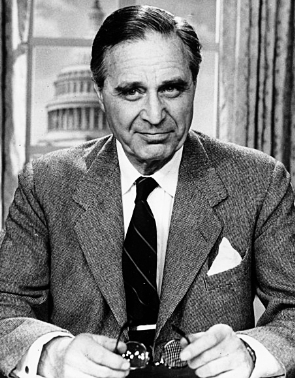
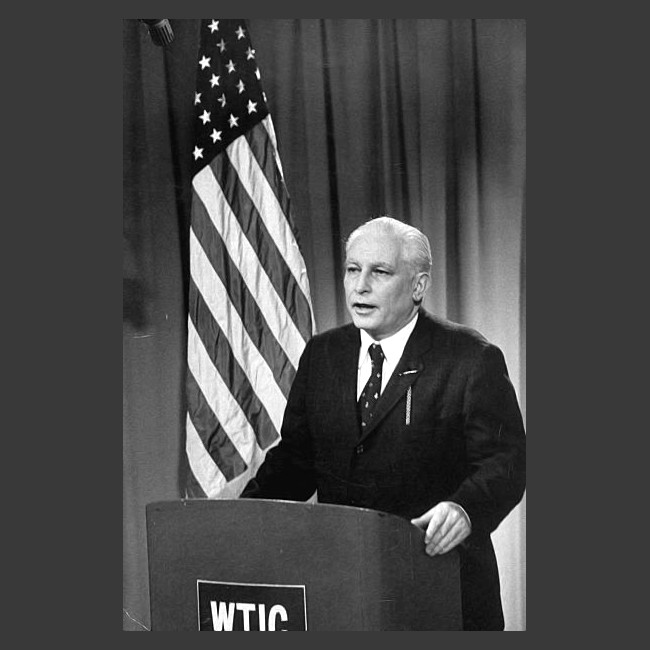
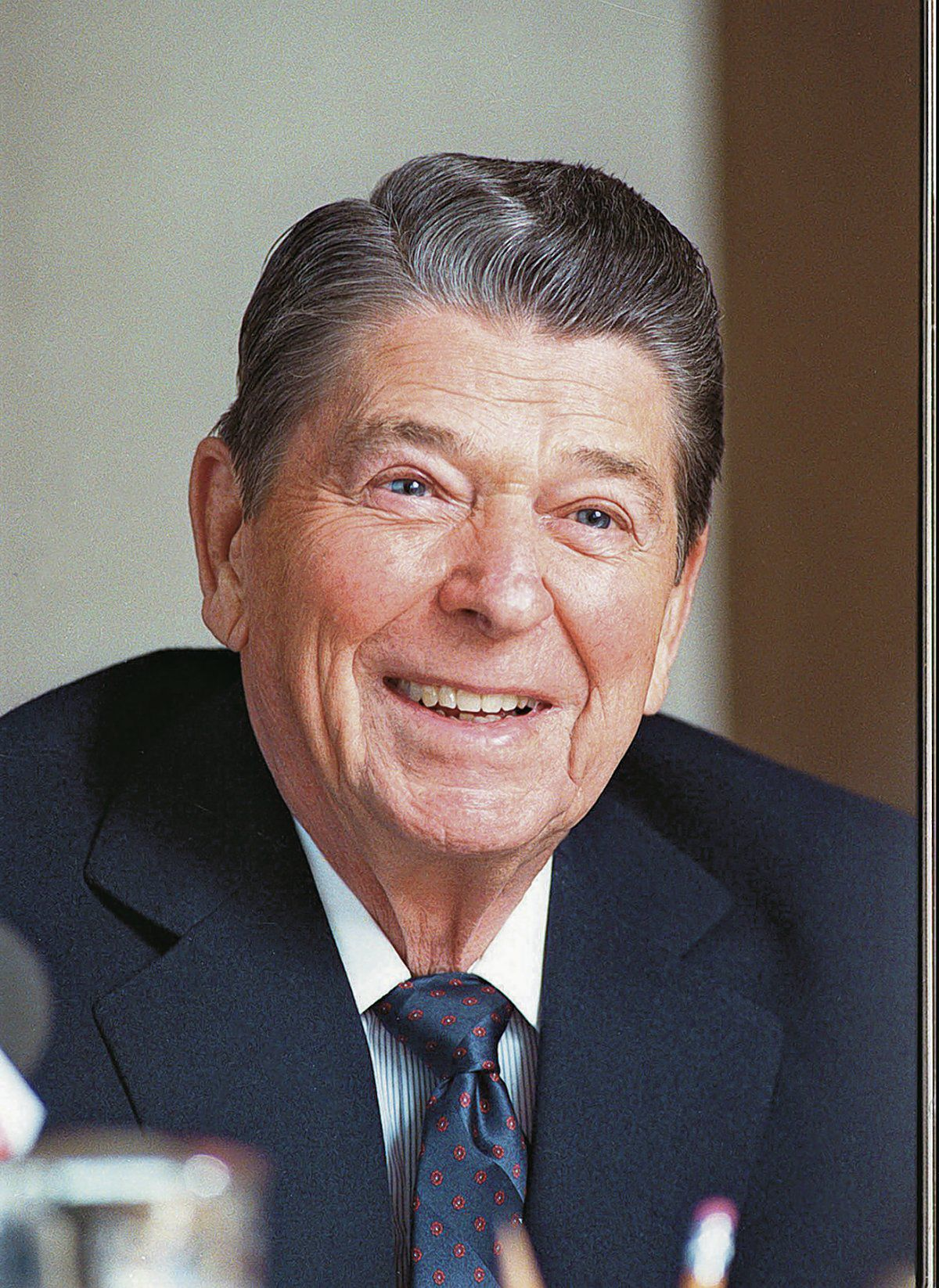
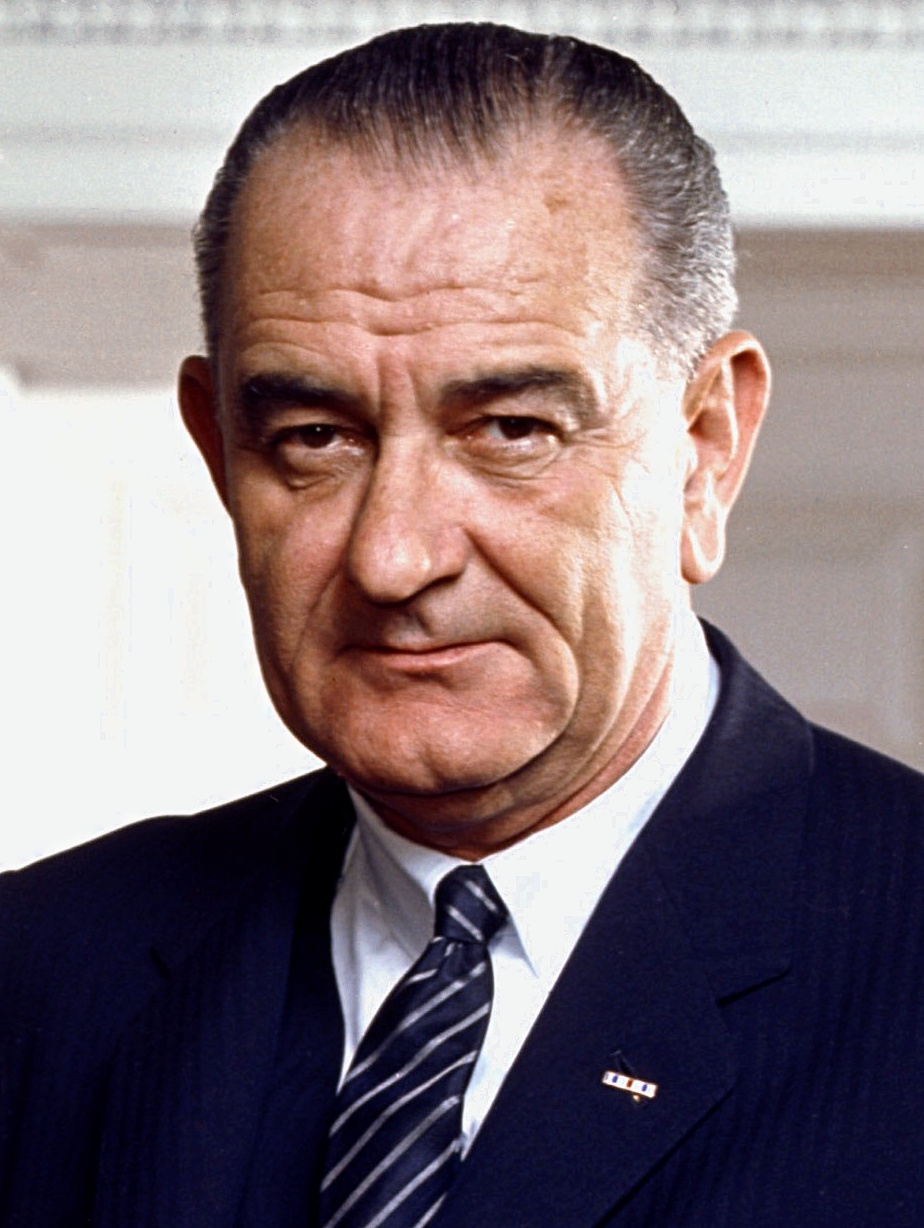
The 1964 Election: A Game Changer, GOP Gets Temporary Licking


I’m going to get something out of the way about this election: the GOP stood zero chance of winning the presidency. The American public was highly sympathetic to Lyndon B. Johnson as he was seen as carrying on the legacy of the murdered JFK. Thus, for the Republicans, the real race was who was going to win party control, and this is where Barry Goldwater comes in. Goldwater was the most conservative senator in this time and regarded as a national spokesman for conservatism. The moderate to liberal Republicans by contrast put forth Governor William Scranton of Pennsylvania and Governor Nelson Rockefeller of New York. The mood for these candidates is low among GOP primary voters, and Goldwater is nominated.

Goldwater doesn’t do himself a whole lot of favors on the campaign trail as he is brash and uncompromising. Some admire him for this, but his vote against the Civil Rights Act of 1964 devastates black support for the GOP, his advocacy for selling the Tennessee Valley Authority harms him in the peripheral South, and his cavalier talk on nuclear weapons scares off numerous voters. LBJ notoriously capitalized on the latter through the airing of the “Daisy” ad, implying that nuclear war would be the result of a Goldwater presidency. The Goldwater campaign’s grand strategy was to try to tick off LBJ, thus his pick of Congressman William Miller (R-N.Y.) for vice president, who was selected for his ability to get under Johnson’s skin. It didn’t work, and Miller added nothing to the ticket for the voters. Although the Goldwater run inspired generations of conservatives, his run depressed support for other Republicans as well, giving LBJ the Congress he needed to pass Great Society legislation in the next Congress.

The 1964 election brought about some permanent changes in American politics. For one, the black vote became near uniformly Democratic. Republicans from this point forward would not win more than 15% of the black vote in presidential elections. By contrast, from 1936 to 1960, although Republicans didn’t win a majority, they commanded a significant minority. Richard Nixon had won one in three of their votes in 1960. This election would be the first time in which the GOP was considered an option in the Deep South; Goldwater only won his home state of Arizona and five Southern states. This election’s biggest impact legislatively was in the House, where incumbents were dragged down by Barry Goldwater being at the top of the ticket. Republicans on the Eastern seaboard in particular took a drubbing, although it was the case in many states that those who usually voted Republican found themselves voting for Democrat LBJ, seeing Goldwater as too extreme and brash. This would be the last time Alaska, Idaho, Kansas, Nebraska, North Dakota, Oklahoma, South Dakota, Utah, and Wyoming voted for the Democratic candidate for president. This would be the first time Georgia ever voted for the Republican candidate, a jarring result given that Kennedy had his second strongest performance (his best was Rhode Island). Others were turned off by his stances on civil rights.

I’m going to list each of the states in which Democrats gained in the House or Senate, and their presidential votes in 1960 and 1964.


California
1960: Nixon +0.55
1964: Johnson +18.32
Colorado
1960: Nixon +9.72
1964: Johnson +23.07
Connecticut
1960: Kennedy +7.46
1964: Johnson +35.72
Illinois
1960: Kennedy +0.18
1964: Johnson +18.94
Indiana
1960: Nixon +10.43
1964: Johnson +12.42
Iowa
1960: Nixon +13.49
1964: Johnson +23.97
Kentucky
1960: Nixon +7.18
1964: Johnson +28.36
Maine
1960: Nixon +14.10
1964: Johnson +37.68
Maryland
1960: Kennedy +7.22
1964: Johnson +30.94
Michigan
1960: Kennedy +2.01
1964: Johnson +33.61
Nebraska
1960: Nixon +24.14
1964: Johnson +5.22
New Hampshire
1960: Nixon +6.84
1964: Johnson +27.78
New Jersey
1960: Kennedy +0.8
1964: Johnson +31.75
New Mexico
1960: Kennedy +0.64
1964: Johnson +31.75
New York
1960: Kennedy +5.26
1964: Johnson +37.25
North Dakota
1960: Nixon +9.9
1964: Johnson +16.09
Ohio
1960: Nixon + 6.56
1964: Johnson +25.89
Pennsylvania
1960: Kennedy +2.32
1964: Johnson +30.22
Texas
1960: Kennedy +2
1964: Johnson +26.82
Utah:
1960: Nixon +9.64
1964: Johnson +9.73
Washington
1960: Nixon +2.41
1964: Johnson +24.59
Wisconsin
1960: Nixon +3.72
1964: Johnson +24.35
Wyoming
1960: Nixon +10.02
1964: Johnson +13.12

States in which Republicans gained in their presidential votes in 1960 and 1964:

Alabama
1960: Kennedy +14.23
1964: Goldwater +38.90
Georgia
1960: Kennedy +25.11
1964: Goldwater +8.25
Idaho
1960: Nixon +7.56
1964: Johnson +1.83
Mississippi
1960: Byrd (unofficial Independent candidate) +2.65
1964: Goldwater +74.28
South Carolina:
1960: Kennedy +2.48
1964: Goldwater +17.79

The Democratic Wins

California
First-term Republican Representative Patrick Martin was defeated by Democrat John Tunney, future senator and son of boxer Gene Tunney. Martin had voted against the Civil Rights Act of 1964.

Colorado

Republicans Donald Brotzman and J. Edgar Chenoweth lose reelection to Democrats Roy McVicker and Frank Evans respectively. Brotzman would win back his seat in 1966.

Connecticut

Republican Abner Sibal loses reelection to former Democratic Congressman Donald Irwin.

Illinois

Republican Robert McLoskey, who voted for the Civil Rights Act of 1964, went down to defeat to Democrat Gale Schisler.

Indiana

Republican Earl Wilson went down to defeat to Democrat Lee Hamilton, who would have a long career in Congress. He had voted for the House version of the Civil Rights Act of 1964 only to turn around and vote against the final version. Republican Donald Bruce would make an unsuccessful run for the Senate and his district would be won by Democrat Andy Jacobs Jr.

Iowa

Congressmen Fred Schwengel, James Bromwell, John Kyl, and Ben Jensen lost reelection. Republican Charles Hoeven retired and his seat was won by a Democrat. With the exception of Jensen, all had voted for the Civil Rights Act of 1964. H.R. Gross was the only survivor among the Republicans. Representatives Fred Schwengel and John Kyl would win back their seats in the 1966 midterms, and Iowa’s 6th and 7th districts would be won back by Republicans in that election as well.

Kentucky

Down went hardcore conservative Gene Snyder of Louisville to Democrat Charles Farnsley. Snyder had voted against the Civil Rights Act of 1964, but he would return in the more Republican 4th district in the 1966 midterms and Louisville would elect the more moderate Republican William Cowger that year.

Maine

Republican Clifford McIntire of Maine retired to run for the Senate against Ed Muskie, and the seat was won in a landslide by future Democratic Senator William Hathaway.

Maryland

Republican Senator J. Glenn Beall lost reelection to Democrat Joseph Tydings by a whopping 25 points. Beall had won a tough reelection in 1958, another bad year for Republicans.

Michigan

George Meader, August Johansen, and Victor Knox lost reelection to Democrats Weston Vivian, Paul Todd, and Raymond Clevenger respectively. All three had voted against the Civil Rights Act of 1964. All of their seats would be won back by more moderate Republicans who supported civil rights legislation in the 1966 midterms.

Nebraska

Ralph Beermann of the 1st district, the state’s most conservative elected official who voted against the Civil Rights Act of 1964 and did no wrong by Americans for Constitutional Action and no right by Americans for Democratic Action, went down to defeat to Democrat Clair Callan. Incidentally, this would be the last time a Democrat won the state’s 1st district.

New Hampshire

Democrat J. Oliva Huot defeated Republican Louis Wyman for reelection. Wyman had voted against the Civil Rights Act of 1964, but he would be returned to office in the 1966 midterms.

New Jersey

The 1964 election was frankly quite bad for Republicans in New Jersey, as LBJ won all the state’s counties and almost 2/3’s of the vote. By contrast, JFK had won the state by less than a point in 1960.
Republicans Milton Glenn and Frank Osmers went down to defeat to Democrat Thomas McGrath and Henry Helstoski respectively while retiring James Auchincloss and George Wallhauser were replaced by Democrats James Howard and Paul Krebs. All of them had voted for the Civil Rights Act of 1964. Glenn’s seat would be won back in the 1966 midterms and Wallhauser’s seat would be integrated into another Republican’s district.

New Mexico

Senator Ed Mechem, who had appointed himself after losing reelection as governor in 1962 to replace the late Dennis Chavez, was defeated for reelection by nearly ten points by Democratic Congressman Joseph Montoya.

New York

This election was exceptionally bad for Republicans in New York, with Republican Senator Kenneth Keating losing reelection to Democrat Robert F. Kennedy by 10 points. Representatives Steven Derounian, Robert Barry, J. Ernest Wharton, Katharine St. George, R. Walter Riehlman, and John Pillion were defeated by Democrats Lester Wolff, Richard Ottinger, John Dow, Joseph Resnick, James Hanley, and Richard McCarthy respectively. Retiring Republican Frank Becker was succeeded by Democrat Herbert Tenzer. Republicans would win back none of these seats in the 1966 midterms.

North Dakota

The state’s staunch conservative Don Short was defeated by Democrat Rolland Redlin. Short had voted against the Civil Rights Act of 1964. His seat would be won back in the 1966 midterms.

Ohio

Republican Representatives Carl Rich, Paul Schenck, and Pete Abele went down to defeat to Democrats John Gilligan (future governor), Rodney Love, and Walter Moeller. Oliver Bolton of the 11th district also went down to defeat when he ran for reelection in the state’s At-Large district to Democrat Robert Sweeney. All had voted for the Civil Rights Act of 1964 and all seats would be won back by Republicans in 1966 save the At-Large, which was eliminated.

Pennsylvania

Republicans George Goodling and James Weaver lost reelection to Democrats Nathaniel Craley and Joseph Vigorito. Both had voted for the Civil Rights Act of 1964. Goodling would win back his seat in the 1966 midterms.

South Carolina (Sort of)

After winning reelection, Democrat Albert W. Watson switches to the Republican Party, and Democratic Senator Strom Thurmond switched to Republican before the 1964 election.

Texas

Down went both of state’s House Republicans, Bruce Alger and Ed Foreman, to Democrats Earle Cabell and Richard White. Both both had voted against the Civil Rights Act of 1964. Although Foreman’s district was normally Democratic, Alger’s was quite the gain as he represented Dallas and had been notoriously anti-Kennedy, as the city had been. This was a bad look post-assassination, even though Lee Harvey Oswald’s politics were the opposite of Alger’s, and he lost by 15 points. He had won reelection by over 12 points in 1962.

Utah

Republican Sherman Lloyd vacated his seat in the 2nd district to run for the Senate, with Democrat David King winning the seat.

Washington

The Democrats did quite well in Washington, and this election was quite arguably the point the state became long-term favorable to them. Of the six Republican representatives, Jack Westland, Walt Horan, Thor Tollefson, and K. William Stinson lost reelection to Democrats Lloyd Meeds, Tom Foley (future speaker), Floyd Hicks, and Brock Adams respectively in a state that had voted for Nixon in 1960. All had voted for the Civil Rights Act of 1964. Republicans would win back none of these seats in the 1966 midterms and the state would go on to vote for Humphrey over Nixon in 1968. On a personal note, the 1964 election ousted the last Republican to represent the county of my current residence (Jefferson), Jack Westland.

Wisconsin

In Wisconsin, Democrats Lynn Stalbaum and Abner Race defeated Republicans Henry Schadeberg and William Van Pelt respectively. The former had voted for the Civil Rights Act of 1964 while the latter had voted against. Schadeberg would win back his seat in 1966 and the more moderate William Steiger would win back Van Pelt’s seat that year.

Wyoming

In Wyoming, Republican William Henry Harrison, who voted against the Civil Rights Act of 1964, lost reelection to Democrat Teno Roncalio, but he would win his seat back in the 1966 midterms.

Republican Gains

Alabama

The most impressive showing Republicans had was in Alabama. The state’s delegation went from 8-0 Democrat to 5-3 Republican; the last time the state had elected a Republican to Congress was in 1898. Republican Jack Edwards gained a newly created district based in Mobile, Democrat George Grant was defeated by Republican Bill Dickinson, Democrat Kenneth Roberts fell to Republican Glenn Andrews, George Huddleston Jr. of Birmingham was defeated by Republican John H. Buchanan Jr., and Republican James Martin won the district held by Democrat Carl Elliott. Republicans Edwards, Dickinson, and Buchanan would be reelected in 1966, while Andrews would be defeated for reelection and Martin would run for governor.

California

Democratic Senator Pierre Salinger, who was appointed after the death of Clair Engle, would lose a bid for a full term to Republican actor, singer, and dancer George Murphy.

Republican Edwin Reinecke won the vacant 27th district, a typically Republican district. Its retiring incumbent, Democrat Everett G. Burkhalter, had defeated John Bircher incumbent Edgar Hiestand in 1962.

Georgia

Republican Bo Callaway won in the 3rd district, which had been held by retiring Democrat Tic Forrester.

Idaho

Republican George Hansen defeated Democrat Ralph Harding for reelection in the 2nd district. The district, based in the south of the state, had voted for Goldwater.

Mississippi

Republican Prentiss Walker defeated Democrat W. Arthur Winstead for reelection. Walker seems to have ridden the coattails of Barry Goldwater, who got the state’s overwhelming vote for his stance on the Civil Rights Act of 1964 as opposed to President Johnson. No issue mattered more for Mississippi voters that year, and other Democrats in the state delegation may have only been spared by the fact that no Republican had bothered to challenge them. Walker’s election would be a bit of a false start for the Republicans in the state, as he would run for the Senate in 1966 and lose, and the seat would go back to the Democrats.

Overall

Although 1964 was a landslide for LBJ it was in truth a considerably less devastating election for Republicans than the 1958 midterms, as the Senate swing was only slightly to the Democrats and Republicans more than won back their losses in the House in the 1966 midterms.

The Great Contender: Estes Kefauver


When Carey Estes Kefauver (1903-1963) was elected to Congress from Tennessee’s 3rd district to succeed the late Sam McReynolds in 1939, the state was firmly in the grip of Boss Crump of Memphis. Kefauver was a populist and a foe of bossism. Although some Tennessee Democrats, even those with prior progressive records like Crump’s partner Senator Kenneth McKellar, were pushing back against some elements of the New Deal, Kefauver was sticking with it. He distinguished himself early by voting to ban the poll tax in 1942 and 1943, being among the first Tennessee Democrats to ever vote for civil rights legislation. Kefauver was also an opponent of a number of anti-communist domestic measures, including funding for the House Committee on Un-American Activities in 1943, the permanent establishment of the House Committee on Un-American Activities in 1945, and a measure requiring loyalty investigations for all federal employees in 1947.

In 1948, the young representative felt he was ready to move up to the Senate but he was against a powerhouse in Boss Edward Hull Crump, who detested him and backed a challenger to incumbent Senator Tom Stewart over his handling over TVA matters in a little known judge named John A. Mitchell. However, Congressman Kefauver decided to tour the state and would often wear a coonskin cap on the campaign trail. Although not a good public speaker, he was second to none talking to individual voters and had a fanbase who would show up to his events. During this campaign, Crump made a fatal error for his candidate that would contribute to the iconic image of Kefauver. He posted an ad with the headline “Estes Kefauver Assumes the Role Of a Pet Coon”, and it charged Kefauver with being easy on communism and possibly even a fellow-traveler, with a comparison between his votes in the House and those of pro-communist Vito Marcantonio of New York. Kefauver responded that he may be a “coon, but not Boss Crump’s pet coon” (Hill). This approach was a winner! Kefauver’s victory in 1948 marked the beginning of the end of Crump’s statewide control, with his influence becoming completely limited to Memphis after his ally Kenneth McKellar’s defeat for renomination in 1952. Kefauver faced off against former Congressman B. Carroll Reece in the general election, and although the Republicans ran a serious campaign, Tennessee was statewide still a solidly Democratic state and he won commandingly.

Kefauver’s Senate Career: Starting with a Bang

Kefauver quickly made a splash in the Senate, and in 1950 he sponsored the Celler-Kefauver Anti-Trust Amendments, which strengthened the Clayton Anti-Trust Act of 1914 by prohibiting a company from purchasing assets from a competing firm. He also was one of the few senators, and one of only two from the South, to vote to sustain President Truman’s veto of the Internal Security Act. That year, Kefauver moved to create the Kefauver Organized Crime Committee.

Kefauver vs. Organized Crime and Runs for President


These hearings were televised throughout 1950 and 1951 and made the public aware of organized crime, with 20-30 million viewers for the first time seeing prominent mobsters testify. Kefauver took a no holds barred approach to this investigation, uncovering whatever could be uncovered regardless of political consequence. This had the effect of making numerous politicians uncomfortable, including ones from his own party. Former New York City Mayor William O’Dwyer was revealed to have connections with organized crime, Florida’s Democratic Governor Fuller Warren was revealed to have extensive ties with illicit gambling syndicates which ended his political career, and former Republican Governor Harold G. Hoffman of New Jersey made an appearance before the committee. Hoffman would admit in a written confession in an envelope opened after his death four years later to having embezzled over $300,000 as governor (Blackwell). Kefauver also publicized before 1950 Election Day a Chicago police corruption scandal, which along with the generally conservative and anti-communist mood of the electorate contributed to Senate Majority Leader Scott Lucas’s (D-Ill.) narrow reelection loss to former Republican Congressman Everett Dirksen. Although popular among the public, such moves, combined with his sanctimonious tone, made him unpopular with other politicians.

These hearings elevated Kefauver on the public scene and there was talk of him running for president. In 1952, he made a solid bid for the nomination, winning most of the primaries. However, the Democratic party bosses managed to use their influence to prevent him from getting the majority of delegates at the Democratic National Convention, and the nomination went to Illinois Governor Adlai Stevenson II. Kefauver tried again in 1956 and even had a televised debate with Stevenson in Miami, but this time Stevenson won more primary votes, although he would get the nomination for vice president. While the Southern Democrats were getting more conservative, he was staying staunchly liberal, giving him appeal among Democrats across the country.


Personal Life

Although Kefauver was a strong advocate for ethics in politics, he personally had his issues. A married man, he was both a heavy drinker and a womanizer, and an FBI source reported that he “made love in plain view” with his date at a party at the Mayflower Hotel, and then swapped dates with JFK (Cox). Kefauver didn’t sleep around in Tennessee, but in Washington and abroad, he was libertine, once escorting a famous call girl to a society ball while touring Europe. On one occasion, New York Times columnist Russell Baker overheard him say to an aide, “I gotta fuck!” (Russo, 120) His ravenous appetite was well known among the Washington insiders. William “Fishbait” Miller, the House’s longtime doorkeeper, once called him the “worst womanizer in the Senate” and this assessment was shared by Chicago Sun-Times newspaper columnist Irv Kupcinet, who added, “Whenever he came to town…he let the word out: ‘Get me a woman!’ He would have put Gary Hart to shame” (Russo, 120). Bear in mind, Kefauver served for years with stiff competition in LBJ and JFK in the Senate.

Kefauver and Civil Rights

Although without question Kefauver was one of the most pro-civil rights Southerners in the Senate, he had difficulty with the idea of racial integration and was in favor of cross-examination of black complainants in voting rights cases. Kefauver also voted against ending debate on the Fair Employment Practices Committee in 1950 as well as in favor of weakening army desegregation. He displeased his Southern colleagues by being one of three Southern senators to not sign the segregationist Southern Manifesto (the other two were LBJ and Al Gore Sr.). Although Kefauver voted for both key weakening amendments (strike 14th Amendment implementation and jury trial amendment) to the Civil Rights Act of 1957, he voted for the final bill. He also voted for the Civil Rights Act of 1960.

The Comic Book and Switchblade Crusade

Kefauver’s campaign for public morals extended beyond organized crime and he aimed to tackle juvenile delinquency as well. In 1954, he was on the special Senate committee holding hearings on the allegedly corrupting influence of comic books, especially “horror comics” which could have gruesome covers and images. Its chairman, Senator Robert Hendrickson (R-N.J.), called them “the fifth horseman of doom” (Gonzalez). Among the people who testified was William Gaines, who would found MAD Magazine. Although the committee ruled out government censorship, they called upon the comic book industry to self-regulate, which they did with the Comics Code, which remained a substantial force in the industry into the 2000s.

In 1957, Kefauver, based on sensationalized newspaper reporting of threatening young hoodlums in leather jackets with switchblade knives, pushed for a federal ban on interstate sales and possession of them. He would categorize all sorts of knives under the umbrella term of “switchblade knives”, a bit of a precursor to the employment of the term “assault weapons” for numerous types of guns by gun control proponents. His legislation, however, was roundly rejected by his colleagues.

Final Term

In 1960, Kefauver decided instead of running for president again that he would run for a third term and won by a 2-1 margin – despite Richard Nixon’s 7-point victory over JFK in Tennessee, the Republican Party was still years away from its rise on a state level. Kefauver, like his colleague Al Gore Sr., proved a strong supporter of JFK’s New Frontier programs. He also had one last legislative accomplishment to achieve.

In the wake of the thalidomide catastrophe that mostly occurred abroad, Sen. Kefauver pushed for a new drug law, which became the Kefauver-Harris Amendment to the Food, Drug, and Cosmetic Act in 1962. This required drug manufacturers to prove efficacy and safety of their products before they could be approved by the FDA.

On August 8, 1963, Kefauver suffered what was diagnosed as a “mild” heart attack on the Senate floor and was taken to Bethesda Naval Hospital. However, there was something far more serious underlying and he needed surgery. However, dramatically underestimating the essence of time for this procedure, Kefauver put it off so he could see his wife and daughters before the operation – he suffered a ruptured aortic aneurysm and died before they could arrive, two days after his heart attack. Given his playboy lifestyle combined with heavy drinking, his demise at 60 certainly adds up. His adjusted average Americans for Democratic Action score, which tracks his career from 1947 and also counts his votes for part of 1963, is an 89%. His DW-Nominate score is a -0.429, which by that standard makes him more liberal than JFK, LBJ, Hubert Humphrey, Barack Obama, and Joe Biden.

References

Blackwell, J. 1954: The governor was a thief. The Trentonian.

Retrieved from

https://www.capitalcentury.com/1954.html

Brown, T. (2017, October 8). Carey Estes Kefauver. Tennessee Encyclopedia.

Retrieved from

https://tennesseeencyclopedia.net/entries/carey-estes-kefauver/

Cox, A.M. (2010, May 23). Doing It for the People: The 25 Greatest Philanderers in American Political History. GQ.

Retrieved from

https://www.gq.com/gallery/the-twenty-five-greatest-philanderers-in-american-political-history

Gonzalez, J. (2022, October 26). The Senate Comic Book Hearings of 1954. Library of Congress.

Retrieved from

https://blogs.loc.gov/law/2022/10/the-senate-comic-book-hearings-of-1954/

Hill, R. The Greatest Campaigner Of Them All. The Knoxville Focus.

Retrieved from

https://www.knoxfocus.com/archives/the-greatest-campaigner-of-them-all-senator-estes-kefauver-part-five/

Russo, G. (2008). Supermob: how Sidney Korshak and his criminal associates became America’s hidden power brokers. London, UK: Bloomsbury Publishing.

Retrieved from

https://www.google.com/books/edition/Supermob/YalWxsoWEIkC?hl=en&gbpv=1&dq=Estes+Kefauver+womanizer&pg=PA120&printsec=frontcover

Sherrill, R. (1971, November 7). A decent man, but not a big one. The New York Times.

Retrieved from

https://www.nytimes.com/1971/11/07/archives/kefauver-a-political-biography-by-joseph-bruce-gorman-illustrated.html

Special Committee on Organized Crime in Interstate Commerce. U.S. Senate.

Retrieved from

https://www.senate.gov/about/powers-procedures/investigations/kefauver.htm

Great Conservatives from American History #14: Phil Crane

In a recent post, I covered an Illinois Republican who dramatically departed from conservative orthodoxy. Today’s post is about a figure who could be said to have been a trailblazer for Reagan conservatism: Philip Miller Crane (1930-2014) of Illinois.


The son of newspaper columnist Dr. George W. Crane, who wrote the advice column “The Worry Clinic”, Crane carried his father’s conservative beliefs with him and was a Republican not only by ideology but by family legacy. Crane recounted, “My dad made sure that we shook hands with him [his great-grandfather], because he shook hands with Abraham Lincoln. In 1858, he went over to Danville in a covered wagon and sat in Lincoln’s lap. And Lincoln patted him on the head and shook his hand and said, ‘You know, you’re a fine young Republican, boy, and you stick with it.’ So we were knee-jerk Republicans because of that inheritance” (Loerzel). Dr. Crane would bring Phil to campaign for Republicans from a young age, including Alf Landon in 1936. Dr. Crane “felt Roosevelt had destroyed the republic”, and Phil himself condemned FDR for bringing “people to the nonsense belief that somehow you can get something for nothing out of Washington” (Loerzel). Crane served in the army from 1954 to 1956 and in 1961, he earned a PhD in history and subsequently became a professor at Bradley University, where he set up University Professors for Barry Goldwater. In 1964, he worked on the Goldwater campaign conducting research and published “The Democrat’s Dilemma” alleging heavy socialist influence on the Democratic Party. Crane was from that point forward active in the conservative movement, and recounted attacks against Goldwater supporters from other professors, “They charged that anyone supporting Goldwater was an incipient fascist, racist, anti-Semite. I didn’t mind the slings and arrows…I just redoubled my efforts” (Loerzel).


Crane to Congress

In 1969, Congressman Donald Rumsfeld resigned from his seat in the Chicago suburbs to head the Office of Economic Opportunity. Crane ran for the seat on a platform of never voting to raise taxes, and although he was not favored by the party establishment, he won. State Representative Bernie Pedersen said of him in 1992, “He’s a brilliant guy. He had a lot of appeal personally. He’s very articulate. In the beginning, if you asked him a question, he’d give you a 15-minute answer, like he was still a professor” (Loerzel). In Congress, he quickly established himself as an energetic advocate of conservative causes on numerous fronts. Crane was one of the founders of and served as chairman of the Republican Study Committee from 1973 to 1989, which was created to push the GOP leadership in a more conservative direction. He also helped found the Heritage Foundation in 1973 and hosted the show Conservative Viewpoint. From 1977 to 1979, he chaired the American Conservative Union, and he was quite ideologically fit to do so; In most of his years in Congress Crane received 100% scores from the organization. Indeed, his lifetime score would be a 99%. On May 26, 1972, he was one of only seven representatives to vote against authorizing the President to approve of the interim SALT Treaty with the USSR. Crane only once voted for a foreign aid bill: in 1974 the International Development Association bill included his amendment legalizing private ownership of gold, which took effect on December 31, 1974. That year, he successfully pushed for the only public and filmed audit of the U.S. Bullion Depository at Fort Knox, in which 12 members of Congress and 100 journalists participated on September 19th (Ganz). He was also involved in the successful effort to re-legalize gold clauses in contracts in 1977. Although his constituents repeatedly reelected him, Crane had critics in his district. His Democratic opponent in 1992, Sheila Smith, held that “Phil lives in an ivory tower. He entered it when he was teaching in the 1950s, and he never came out. (But) the real world doesn’t work that way” (Loerzel).


Although Crane had voted for the Equal Rights Amendment in 1971, he turned against it after Roe v. Wade and with the rise of the Stop ERA movement. Indeed, he was a staunch opponent of abortion throughout his career. During the Carter Administration, Crane was one of the leading figures against the Panama Canal treaties and the proposed SALT II Treaty. In 1978, his brother, Daniel, joined him in Congress. Dan Crane would vote almost identically to Phil, however he would lose reelection in 1984 due to him having an affair with a 17-year-old female page.

Running for President

In 1976, Crane endorsed Ronald Reagan’s challenge to Gerald Ford and chaired Illinois Citizens for Reagan. However, this didn’t stop this rising Republican star from announcing a presidential run in 1979. Unfortunately for Crane, he had made a powerful enemy who was supporting Ronald Reagan: William Loeb. Loeb’s newspaper, the Manchester Union-Leader, began publishing numerous anonymous accusations about Crane’s personal life and these dogged his already underdog campaign (Loerzel). Crane would endorse Reagan after dropping out. Rep. Mike Pence (R-Ind.) would tell in a tribute to Crane in 2004 why he ran, “I will never forget the evening sitting on the House floor when Congressman Crane told me the story of that night. He said, “We all just figured that one day Governor Reagan would look at Nancy and say, ‘I think, Mommy, we should just go and retire to the ranch.’ Ronald Reagan and history had different intentions, but as he has always been throughout his career, Phil Crane was ready to stand in the gap,” Pence said. “And when Ronald Reagan made his candidacy a reality, Phil Crane stayed in the race to honor his delegates from Illinois who had supported their favorite son, but he was one of the strongest supporters of President Reagan in 1980, enabling and assisting in his election and also being one of the great champions of the Reagan revolution from the minority here on Capitol Hill” (Sweet).


Subsequent Time in Congress

After the 1980 election, Crane, although as rigidly conservative as ever and his views becoming more in vogue, he was becoming eclipsed by other conservative advocates, such as Newt Gingrich. This was noted in the 1992 edition of “The Almanac of American Politics”, “There is an anomaly to his career. At the same time as his beliefs — in free-market economics, in a strong national defense, in traditional American ideals have been sweeping the country and the world, his own influence has been woefully meager and he continues to languish mostly unnoticed, despite 20-plus years of seniority, on back benches” (Loerzel). He remained a fighter for conservatism and if there was conservative opposition to be had to legislation, even if only a small group was opposing, he could usually be found among that minority. Although Crane had voted for the Balanced Budget Amendment in 1982 as well as repeated budget reduction proposals, he voted against the Gramm-Hollings-Rudman Balanced Budget Act in 1985. In some instances, he proved relevant, such as winning a repeal on the ban on chewing gum with the U.S.-Singapore Free Trade Agreement in 2003.


Personal Issues

In 1982, Crane was arrested for drunk driving in California but was found not guilty in June 1983. By the 1990s, his drinking had been on an upswing, which he attributed to the death of his 17-year-old daughter from cancer and his quitting of smoking cold turkey after 50 years (Sweet). In 2000, he admitted to being an alcoholic, drinking up to ten beers in a night, and successfully sought treatment. Although being senior to California’s Bill Thomas, he was passed over for the chairmanship of the House Ways and Means Committee, instead getting the vice chairmanship.


The End of the Road


In 2002, Crane faced a surprisingly strong challenge from Democrat Melissa Bean, who ran on him being out of touch with his constituents. Indeed, he had no public email address and numerous Republican voters said that they hadn’t seen him in decades. Although Crane won reelection, Bean had gotten 43% of the vote. In 2004, she tried again, and although President Bush carried the district by 12 points that year, Bean defeated him by about four points. The district, which has since been redistricted to favor Democrats considerably, has remained represented by Democrats for all except Joe Walsh’s term from 2011 to 2013. Crane died of lung cancer on November 8, 2014.

Overall


Crane was one of those conservatives who was instrumental in building up the conservative organizations that helped bring about the rise of conservatism in the United States. This, plus his stalwart record, his restoring the legality of gold ownership, and length of service, have earned him a place among the great conservatives of American history. Crane incidentally also scores a 99% on the MC-Index.


P.S.: My father has told me that my grandmother, who lived for some time in Crane’s district, had quite an argument with him. The subject of the argument is unknown to me.


References


Ganz, D.L. (2014, November 20). Right to own gold due to Phil Crane. Numismatic News.


Retrieved from


https://www.numismaticnews.net/archive/right-to-own-gold-due-to-phil-crane


Loerzel, R. (1992, September 17). A profile of conservative Congressman Philip Crane. Pioneer Press.


Retrieved from


https://www.robertloerzel.com/1992/09/17/a-profile-of-conservative-congressman-philip-crane/


Skiba, K. (2014, November 9). Longtime congressman Philip Crane dies at 84. Chicago Tribune.


Retrieved from


https://www.chicagotribune.com/news/obituaries/ct-philip-crane-obit-met-20141109-story.html

Sweet, L. (2014, November 9). Rep. Phil Crane was a pioneer in spreading conservative gospel. Chicago Sun Times.

Retrieved from

https://chicago.suntimes.com/2014/11/9/18473113/rep-phil-crane-was-a-pioneer-in-spreading-conservative-gospel


Tarm, M. (2014, November 9). Former Illinois congressman Phil Crane dies at 84. Associated Press.


Retrieved from


https://apnews.com/article/3a329df5e47d4b45b1c03fac18c7b96c

Americans for Constitutional Action on the 88th Congress, House

The 88th Congress was the product of a midterm that was about as good as President Kennedy could have had. The Democrats lost only a single seat in the House and the Republicans lost three in the Senate. During this Congress, the tragedy that was the JFK assassination occurred. However, perhaps motivated to cooperate with the new administration, they passed a lot of significant measures, including mass transportation legislation, food stamp legislation, the Civil Rights Act of 1964, and the Economic Opportunity Act of 1964. However, liberals did face some setbacks, with a vote on extending the Area Redevelopment Act failing, the foreign aid bill being recommitted for further cuts, and an additional appropriation for the International Development Association being recommitted before a second version successfully passed. Notably, this was also the Congress that passed the Gulf of Tonkin Resolution.

1963 100%

Clausen, R-Calif.

Talcott, R-Calif.

Smith, R-Calif.

Clawson, R-Calif.

Haley, D-Fla.

Gurney, R-Fla.

Collier, R-Ill.

McClory, R-Ill.

Rumsfeld, R-Ill.

Hoffman, R-Ill.

Reid, R-Ill.

Anderson, R-Ill.

Michel, R-Ill.

McLoskey, R-Ill.

Findley, R-Ill.

Bruce, R-Ind.

Gross, R-Iowa

Hoeven, R-Iowa

Jensen, R-Iowa

Dole, R-Kan.

Snyder, R-Ky.

Johansen, R-Mich.

Hutchinson, R-Mich.

Curtis, R-Mo.

Hall, R-Mo.

Beermann, R-Neb.

Cunningham, R-Neb.

Martin, R-Neb.

St. George, R-N.Y.

Andrews, R-N.D.

Short, R-N.D.

Clancy, R-Ohio

Betts, R-Ohio

Abele, R-Ohio

Devine, R-Ohio

Ashbrook, R-Ohio

Minshall, R-Ohio

Belcher, R-Okla.

Dague, R-Penn.

Goodling, R-Penn.

Johnson, R-Penn.

Berry, R-S.D.

Alger, R-Tex.

Foreman, R-Tex.

Stinson, R-Wash.

Schadeberg, R-Wis.

1964 100%:

Utt, R-Calif.

Martin, R-Calif.

Gurney, R-Fla.

Reid, R-Ill.

Wilson, R-Ind.

Gross, R-Iowa

Jensen, R-Iowa

Johansen, R-Mich.

Hall, R-Mo.

Beermann, R-Neb.

Baring, D-Nev.

Short, R-N.D.

Ashbrook, R-Ohio

Berry, R-S.D.

Quillen, R-Tenn.

Alger, R-Tex.

Foreman, R-Tex.

Poff, R-Va.

1963 Americans for Constitutional Action Index, House:

1964 Americans for Constitutional Action Index, House:

The Prairie State Maverick: John B. Anderson

I get the sense from reporting on the subject that 2023’s new party, No Labels, is for people who both want a break from Trump and the social justice obsessives and are roughly center to center right in orientation. Liberals and that parade of has-been Biden sycophants known as The Lincoln Project are alarmed by this development and they should be. Third parties tend to be detrimental to the party holding the White House, although the 1948 election was arguably an exception, as the perception of Truman’s distance from the nationally unpopular pro-Soviet Progressive Party and the segregationist State’s Rights (Dixiecrat) Party may have won him votes that would have otherwise gone to Dewey. This exception certainly did not apply to the 1980 election, and a contributing factor to Carter’s loss was a “tell it as it is” style independent candidate in Congressman John B. Anderson (1922-2017) of Illinois.

Anderson in 1965.


When Anderson was first elected to Congress in 1960 from a staunchly conservative rural Illinois district, succeeding longtime conservative Leo Allen, there was little thought that his record would be any different. And indeed, for a time, it wasn’t and if anything, more conservative. From 1961 to 1964, Americans for Democratic Action counted only one selected vote of his favorably: the Civil Rights Act of 1964. In the 87th Congress (1961-1962) Anderson only disagreed with John Birchers John Rousselot and Edgar Hiestand of California on one issue on Americans for Constitutional Action’s 23 selected votes. Indeed, they wrote on him, “He stands firm against the liberal pressures of Washington, the wild spending schemes, and the permissive society offered by the proponents of the Great Society” (Mason, 14). Anderson stood as an intellectual and articulate voice for conservatism in the 1960s, and if we were to look only at his record during the Kennedy and Johnson years, he stands as an easy candidate for a great conservative from American history. Indeed, his record was so impressive to the Republican leadership at the time that they made him number #3 in party leadership in the House as chairman of the House Republican Conference in 1969, the post that Elise Stefanik now occupies and figures such as Gerald Ford, Mike Pence, and Dick Cheney occupied in the past. However, by this point Anderson was already starting to turn away from conservatism.


A Turn to the Left


The classic story is that people who run for Congress pledging to change Washington become more changed by Washington than they change it. This was certainly the case for Anderson. In 1968, he flipped on a highly controversial issue: open housing. As former Congressman Don Manzullo recalls, “He was on the Rules Committee and under a lot of pressure to vote against bringing open housing to the House floor. But he was very touched by the plight of black Americans facing discrimination. At one point, he read a letter from a black husband and wife in Rockford who were teachers and had answered more than 100 advertisements for an apartment. They were turned away from all. That really moved him” (Gizzi). In 1966, Anderson had voted against that year’s civil rights bill over the open housing provisions, regarding it as a homeowner’s right to sell to who they want to sell to, whether their criterion was racially discriminatory or not. However, on April 9, 1968, only five days after MLK’s assassination, he cast the deciding vote for the bill to leave the Rules Committee and move to the floor and from that point forward his record would be consistently in support of civil rights measures. Anderson would repeatedly vote for busing and in 1978 he voted against curbing racial quotas. He also in 1968 voted for the Housing and Urban Development Act, providing extensive housing aid to low-income families along with other provisions. His turn to the left on social issues was also pronounced, as in 1971 he voted against the Wylie School Prayer Amendment; Anderson had previously sponsored multiple amendments for school prayer. Anderson proved supportive of environmental legislation as well, supporting environmental protection of Alaska lands and opposing compliance deadline for vehicle emission standards to 1977 in 1973, voting for a comprehensive land use bill in 1974, and voting to override President Ford’s veto of a strip-mining control bill in 1975. He did, however, regard the Reuss (D-Wis.) proposal in 1972 to require firms to have the latest water pollution control technology by 1980 to be excessive. By contrast, in 1961 Anderson had voted for the Cramer (R-Fla.) proposal to cut grants for water pollution facilities and in 1963 he had voted against the Clean Air Act.


Anderson also went liberal on foreign policy, opposing importing Rhodesian chrome, easing up on opposition to Export-Import Bank loans for communist nations in 1971 (he had voted multiple times against Ex-Im Bank funding for grain purchases for communist nations in 1963), and voted supportively of the Panama Canal treaties in 1976. As opposed to his early-mid 1960s record, he also voted for foreign aid measures. What’s more, he proved supportive of the creation of the Legal Services Corporation and supported a version of a proposed Consumer Protection Agency. To add to the laundry list of key issues Anderson backed that elicited hearty conservative complaints was his votes for New York City bailouts in 1975 and 1978. He bears a good deal of similarity to his Illinois colleague also elected in 1960, Paul Findley, but Anderson’s change was more dramatic.

His 1978 primary opponent, Rev. Don Lyon, came to believe that Anderson’s change was “Like a lot of ambitious Republicans, he wanted The Washington Post and The New York Times to like him. And, he wanted the money of the Rockefellers behind him. So he moved liberal” (Gizzi).

Where Anderson Kept Conservatism

Anderson hadn’t gone full to the left, of course, he voted to sustain many of President Nixon’s spending vetoes and remained a bit wary of anti-poverty and food stamp expenditures; in 1974 he proposed an amendment prohibiting food stamps for college students who were claimed as dependents by their parents. However, Anderson did vote for Nixon’s Family Assistance Plan in 1970. He supported Nixon on the subject of impoundments, a practice his critics regarded as being abused for political reasons and after Watergate Congress passed a severe curb on impoundments. Anderson also backed his 1973 veto a bill increasing the minimum wage and proved an opponent of price controls on oil, voting against the Emergency Energy Act in 1974 and voting for deregulation proposals in 1975 and 1977.

Increasing Dissatisfaction with the GOP

One source of constant support for Anderson despite his turns was the affable Gerald Ford, both as minority leader and as president, but Ford’s loss in 1976 to Carter took him out of the picture. By this point, conservatives were moving forward on primarying moderates and liberals, and they would prove successful in ousting Senators Clifford Case of New Jersey and Jacob Javits of New York in 1978 and 1980 respectively. Although Anderson bested his conservative primary challenger in 1978 by almost 10,000 votes, he was feeling done with Congress.

Anderson for President

Anderson in 1980

Anderson was getting a rather tired of the House and he had in 1979 been moved out of leadership in favor of arch-conservative Samuel Devine of Ohio. He resolved to either win the Republican nomination for president or be out of political office after 1980.


Anderson was often the odd man out in the Republican primary, bucking numerous conservative shibboleths in the primary debates. He supported raising the gas tax and supported the licensing of firearms (Neuman). Anderson also opposed lowering income taxes and supported the ratification of the Equal Rights Amendment, which at this point had become associated with abortion. And yes, Anderson did support government funding of abortions. However, Anderson, like other Republicans, focused against inflation. He hit both Carter and Reagan, for the former calling him a “mean and evasive” campaigner who was using recession to fight inflation, and he regarded Reagan as a dispenser of “slick and simplistic” campaign one-liners (Neuman). Anderson presented an alternative for the Republican Party’s weakening liberal wing. As the Washington Post noted at the time, “Anderson has built his success so far around what he calls “the Anderson Difference” — a willingness to take firm, sharp stands on such controversial questions as gasoline taxes and gun control (which he favors) and the MX missile system (which he opposes). Paradoxically, his position on the economy is not as distinct, because it consists of a complex mixture of orthodox Republican conservatism and liberal activism” (The Washington Post). After losing the primary, Anderson couldn’t back Reagan, but he wasn’t giving up yet.

Instead of backing Reagan, he runs as an Independent, focusing on his liberal positions to bleed support from Carter. However, he is no match in a debate with him. Anderson also selects a rather odd choice for running mate in Wisconsin’s former Democratic Governor Patrick Lucey. Ultimately, the Anderson-Lucey ticket only nets 6.6% of the popular vote in the general election. His ticket, does, however, have an interesting impact. It puts Reagan over the top in some states that he may not otherwise have won. In the following states Reagan’s margin of victory was less than the Anderson vote:

Arkansas

Connecticut

Delaware

Maine

Massachusetts (Reagan barely won the state while Anderson got 15% of the vote)

Michigan

Mississippi

New York

North Carolina

South Carolina

Tennessee

Vermont (Reagan won by six but Anderson got 15% of the vote)


Anderson would later sue the state of Ohio for their early filing deadline for independent candidates, and the statute was struck down by the Supreme Court in Anderson v. Celebrezze (1983) as unconstitutional. His foremost regret in Congress was his vote for the Gulf of Tonkin Resolution in 1964.

By 1984, Anderson had left the Republican Party and endorsed Democratic nominee Walter Mondale. He remained a political independent albeit a left-leaning one: in 2000, he endorsed Ralph Nader and in 2008 he supported Barack Obama for president. In 2012, Anderson played a minor role in the creation of the left-wing Justice Party, which ran former Salt Lake City Mayor Rocky Anderson for president. In 1992, he had founded Citizens for Proportional Representation, which has since changed its name to FairVote. This organization calls for instant run-off voting and proportional representation as well as universal voter registration. Anderson also voiced opposition to the Tea Party movement in 2010, stating, “I break out in a cold sweat at the thought that any of those people might prevail” (Clymer). Anderson died on December 3, 2017.


Just as a note of curiosity. The 1979 and 1980 ACA scores I have not mapped out, although information available on Voteview’s legacy website indicates Anderson’s 1979 and 1980 official ACA-Index scores.

ACA (Modified)ADA (Modified)
Kennedy-Johnson Era
19611000
1962910
19631000
1964798
19659112
1966880
19678113
19686817
Average876
Nixon-Carter Era
19693836
19706829
19716336
19724354
19734238
19743338
19755861
19763353
19773847
19784465
197937 (Official)80
19800 (Official)100
Average4253

References

For my citations of votes, check my posted ACA-Indexes of the years I mention.

Voting Record Supplement (1964). ADA World 19(1).

Retrieved from

Clymer, A. (2017, December 4). John Anderson, Who Ran Against Reagan and Carter in 1980, Is Dead at 95. The New York Times.

Retrieved from

https://www.nytimes.com/2017/12/04/us/politics/john-anderson-who-ran-against-reagan-and-carter-in-1980-is-dead-at-95.html

Gehrke, R. (2011, November 30). Rocky Anderson returns – this time shooting for president. The Salt Lake Tribune.

Retrieved from

Gizzi, J. (2017, December 24). Remembering Ex-Rep. John B. Anderson: Why Did He Move From Hard Right to Strong Left? NewsMax.

Retrieved from

https://www.newsmax.com/johngizzi/john-b-anderson-independent-republicans-democrats/2017/12/24/id/833591/

Greenfield, J. (2017, December 28). John B. Anderson: The Great Independent Hope. Politico.

Retrieved from

https://www.politico.com/magazine/story/2017/12/28/john-b-anderson-illinois-republican-party-obituary-216176/

Mason, J. (2011). No holding back: the 1980 John B. Anderson presidential campaign. Lanham, MD: University Press of America.

Neuman, S. (2017, December 5). John Anderson, Independent For President In 1980, Dies At 95. NPR.

Retrieved from

https://www.npr.org/sections/thetwo-way/2017/12/05/568489924/john-anderson-independent-for-president-in-1980-dies-at-95

Americans for Constitutional Action on the LBJ Backlash Congress (the 90th)

The 90th Congress took place in the years 1967 and 1968, a time of tremendous tumult in the United States. The 1966 midterms were a backlash to the policies of President Lyndon B. Johnson, with the Democrats losing a net of three seats in the Senate and 47 seats in the House.

The National Context

In January 1967, the Marxist Black Panther Party, established only months before, formed its first headquarters. You also had the rise of the hippie movement which made itself most known in the Summer of Love that year. The Vietnam War dragged on, and 159 urban race riots occurred starting in April. It was at this time that crime was being seen to rise in the nation as well. The following year, you had the PR disaster for the United States Army in the Tet Offensive and contributed to the “credibility gap” being perceived with the Johnson Administration and Vietnam. There were also the assassinations of MLK and RFK which rocked the nation, with urban riots occurring after the former and the shape of the race for the Democratic nomination changing. The Democratic National Convention in Chicago was marked by civil disturbances. By this time, on the economic front, inflation was clearly rising due to a combination of Vietnam War expenditures, Great Society spending, and the tax reductions that had come into law in 1964. All of this overheated the economy, and to make matters worse, President Johnson intervened against clamping down on inflation by the Fed as 1968 was an election year.


The 90th Congress saw a rising conservatism in its members. In 1968, for instance, Senators Abraham Ribicoff (D-Conn., Frank Church (D-Idaho), Birch Bayh (D-Ind.), and George McGovern (D-S.D.) scored a 36%, 68%, 39%, and a 39% respectively. These were normally quite liberal legislators. Senate Majority Leader Mike Mansfield scored an 11% in 1967 and a 38% in 1968. However, House Majority Leader Carl Albert (D-Okla.) stayed quite loyal to liberalism by ACA’s standards, scoring a 3% and a 4% in 1967 and 1968 respectively. Proposals for spending cuts were frequently counted by Americans for Constitutional Action especially given inflation. Also counted was the Consular Treaty in 1967 and most curiously the 1967 railroad strike agreement in the House, which saw a lot of crossover from liberals into ACA’s position of opposition, while many tried and true conservatives, such as H.R. Gross (R-Iowa) and Durward G. Hall (R-Mo.), had their votes for counted against them. Although I previously mentioned rising conservatism, an interesting phenomenon occurs. In numerous districts in which Republicans retook seats won by liberal Democrats in 1964, the Republicans are considerably more liberal than their predecessors.

Examples include, with modified ACA scores:

Illinois’ 19th District: Tom Railsback (1967: 79%, 1968: 55%) as opposed to Robert McLoskey (1963: 100%, 1964: 84%).

Iowa’s 6th District: Wiley Mayne (1967: 75%, 1968: 70%) as opposed to Charles B. Hoeven (1963: 100%, 1964: 94%).

Kentucky’s 3rd District: William Cowger (1967: 73%, 1968: 75%) as opposed to Gene Snyder (1963: 100%, 1964: 95%) (who won in the more conservative 4th in 1966).

Michigan’s 2nd District: Marvin Esch (1967: 62%, 1968: 32%) as opposed to George Meader (1963: 82%, 1964: 81%).

Michigan’s 3rd District: Garry Brown (1967: 81%, 1968: 64%) as opposed to August Johansen (1963: 100%, 1964: 100%).

Michigan’s 11th District: Philip Ruppe (1967: 48%, 1968: 45%) as opposed to Victor Knox (1963: 88%, 1964: 84%).

Nebraska’s 1st District: Robert Denney (1967: 93%, 1968: 91%) as opposed to Ralph Beermann (1963: 100%, 1964: 100%).

North Dakota’s 2nd District: Thomas Kleppe (1967: 86%, 1968: 91%) as opposed to Don Short (1963: 100%, 1964: 100%).

Ohio’s 1st District: Robert Taft Jr. (1967: 72%, 1968: 57%) as opposed to Carl Rich (1963: 94%, 1964: 84%)

Ohio’s 3rd District: Charles Whalen (1967: 36%, 1968: 32%) as opposed to Paul Schenck (1963: 82%, 1964: 84%).

Wisconsin’s 6th District: William Steiger (1967: 79%, 1968: 70%) as opposed to William Van Pelt (1963: 94%, 1964: 88%).

President Johnson does not, as you might imagine, fare well under ACA’s grading. His House scores are 4% and 6% respectively. His Senate scores are 13% and 11% respectively. Curiously, no votes surrounding law enforcement are counted in the House in either session save for providing that grants for law enforcement will be block as opposed to categorical grants in 1967. The Senate, on the other hand, had numerous votes on crime, including in 1968. Gun control is only listed in the Senate as an issue in 1968, while no gun control vote is listed for the House in 1968.

100% for 1967, House:

J. Arthur Younger, R-Calif.
Edward Gurney, R-Fla.
J. Herbert Burke, R-Fla.
James McClure, R-Idaho
Richard Roudebush, R-Ind.
William J. Scherle, R-Iowa
Thomas B. Curtis, R-Mo.
John Ashbrook, R-Ohio

100% for 1967, Senate:

John J. Williams, R-Del.
Carl Curtis, R-Neb.
Roman Hruska, R-Neb.
Strom Thurmond, R-S.C.

100% for 1968, House:

Jack Edwards, R-Ala.
James Haley, D-Fla.
J. Herbert Burke, R-Fla.
George Hansen, R-Idaho
Edward Derwinski, R-Ill.
Charlotte Reid, R-Il.
William G. Bray, R-Ind.
H.R. Gross, R-Iowa
John Rarick, D-La.
Durward G. Hall, R-Mo.
Carleton J. King, R-N.Y.
Donald Clancy, R-Ohio
Samuel Devine, R-Ohio
Frank Bow, R-Ohio
John Ashbrook, R-Ohio
George Watkins, R-Penn.
George Goodling, R-Penn.
James Quillen, R-Tenn.
Dave Satterfield, D-Va.
William Tuck, D-Va.
Henry Schadeberg, R-Wis.

No one scored a 100% in the Senate, at least from modified ratings. Three senators, however, scored a 96%:

John J. Williams, R-Del.
Bourke B. Hickenlooper, R-Iowa
Carl Curtis, R-Neb.

KEY:

+ – Voted for the ACA position.

– – Voted against the ACA position.

+ – Paired or announced for the ACA position.

 – Paired or announced against the ACA position.

? – No opinion on the vote.

Republicans are in bold italics.

Democrats are in plain text.

ACA Vote Descriptions:

1967 ACA-Index, House:

1968 ACA-Index, House:

1967 ACA-Index, Senate:

1968 ACA-Index, Senate:

John R. Rarick: Fever-Swamp Fringe Congressman

The year 1966 was one of backlash to the Johnson Administration, and the midterms showed it, both in Republican gains and in Democratic primaries in the South. One of these places was Louisiana’s 6th district. Its representative, James Morrison, was a racial moderate who had staunchly backed the Great Society and even voted for the Voting Rights Act of 1965. Out to challenge him was Judge John R. Rarick (1924-2009). Rarick as a judge had a history of racism, including telling one black lawyer who entered his courtroom, “I didn’t know they let you coons practice law” (Time). However, Louisiana’s 6th District had had enough of Morrison, and he was defeated in the primary. Rarick overwhelmingly won the election against Republican Crayton “Sparky” Hall and proceeded to become quite extreme even by Southern Democratic standards.


For him, Justice Thurgood Marshall was a “scamp”, a “cheat”, and a “user of false evidence” (referring to the admittedly questionable “doll test” presented in Brown v. Board of Education) although he clarified that “There are also Negro lawyers who are morally and professionally honest” (Spiegel). He wasn’t any kinder to MLK. For him, he was “an errand boy” for “international communism” who engaged in a “lifetime of subversions and immorality and exploitation” (Spiegel). Rarick found no civil rights measure that met his approval, and was one of the few legislators to vote against prohibiting age discrimination in 1967 and voted against prohibiting racial discrimination in juries in 1968. Rarick was a favorite legislator of Willis Carto and Liberty Lobby, speaking on multiple occasions at their events. In 1969, journalists Drew Pearson and Jack Anderson reported that Carto through his United Congressional Appeal had contributed $3000 to his reelection, only two other (Republican E. Ross Adair of Indiana, possibly for his leadership in opposition to foreign aid, and Republican Jimmy Quillen of Tennessee) representatives commanding such a high contribution. Rarick would also speak before the John Birch Society on multiple occasions. He was frequently accused of racism as well as anti-Semitism. This was due to his rhetoric, his voting record on race, and his insertions into the Congressional Record. He was also a member of the Ku Klux Klan at the time he was elected to Congress (Perlstein). Rarick not only associated himself with Carto, but also Richard Cotten, a radio broadcaster with his virulently anti-Semitic publication and radio program Conservative Viewpoint, who had urged him to run for Congress. He was popular enough among the extreme right for a pamphlet to be published in 1968 titled “Stand Up! You Are An American”, a collection of his quotes and speeches with a foreword by American Independent Party politician Tom Anderson.


Assassination Attempt and Other Controversies

In 1967, after less than a year of service in Congress, Rarick challenged Governor John McKeithen for renomination, but only won 17.3% of the vote in the primary. During this campaign, he was for reasons unknown nearly the victim of a drive-by shooting, with a car speeding past him and 3-4 men firing shots at him, with him recounting, “The whole thing happened about like the flip of a finger. At first it sounded like someone threw a cherry bomb. Then I turned around and looked at this car. This fellow was pointing a gun right at me. The shots kept coming. I jumped between cars … I couldn’t even tell you how many shots were fired” (The Washington Post). That year, he introduced H. Res. 208, asking Congress to renounce the 14th Amendment and presented evidence gathered by Plaquemines parish boss Leander Perez purporting to show that the amendment was illegally adopted. In 1968, Rarick endorsed the independent candidacy of George Wallace, for which he was penalized by having his only two years of seniority stripped.

On October 26, 1969, Rarick inserted into the Congressional Record remarks from retired Lieutenant General Pedro del Valle, an associate of Willis Carto, who warned against a “one-world government dreamed up in the Protocols by the Elders of Zion” (Spiegel). In 1971, he defended Captain Jerry B. Finley, who was facing dismissal for refusing to shake a black officer’s hand, by stating that in Louisiana “it is not considered in good taste for a white person to shake hands with a black stranger” (The New London Day). On December 6, 7, and 15, he inserted into the Congressional Record quotations from a 1953 anti-Semitic diatribe, “Zion’s Fifth Column”, by Jack B. Tenney. By this time deceased, Tenney had been a California state legislator known for investigating communism in the state and in his later years out of office aligned himself with the notoriously bigoted Minister Gerald L.K. Smith. That year, he was condemned by Rep. Charles C. Diggs (D-Mich.), the chairman of the Congressional Black Caucus, as “the leading racist in this [92nd] Congress” for his opposition to home rule for Washington D.C. based on political activites of Black Muslims; blacks made up 77% of the city (The Baltimore Afro-American).


Yet More Controversies

In 1971, Rarick introduced an amendment to the draft extension to prohibit the prosecution of soldiers for killing during wartime in response to the conviction of 2nd Lieutenant William Calley for the My Lai Massacre, holding that “We must tell every mother we shall not let another soldier be disgraced in this manner”, adding, “Isn’t premeditated murder what war is all about?” (The Tuscaloosa News) His amendment was defeated by voice vote. He would also regularly put in the Congressional Record material about Viet Cong terror tactics and was a staunch supporter of the Vietnam War effort. That year, he was one of 19 representatives to vote against the 26th Amendment, granting 18-year-olds the vote. Rarick also later that year was one of 24 representatives to vote against the Equal Rights Amendment. However, he wasn’t against all amendments to the Constitution; he voted for the school prayer amendment that year.


Rarick on Military and Foreign Policy

Rarick was a truculent opponent of foreign aid, stating, “In my three terms in the House I have never seen a foreign aid bill that deserved passage. I have always felt that we should have Americans helping Americans first, not after they got through helping everyone else” (The New York Daily News). Curiously, Rarick sponsored with liberal Reps. Robert Leggett (D-Calif.) and Parren J. Mitchell (D-Md.) a Constitutional amendment requiring a public referendum for the U.S. to go to war, which had originally been sponsored by Rep. Louis Ludlow (D-Ind.) in 1938.

Defeat and Descent Into Obscurity

Although Rarick won reelection in 1972, 1974 was in general a bad year for conservative candidates, and the Democratic Party in the state was growing more liberal. This permitted radio broadcaster Jeff LaCaze, a liberal, to defeat him for renomination. The seat would be won by Republican W. Henson Moore in one of the few Republican pickups of that year. Rarick’s DW-Nominate score was a 0.333, making him one of the most conservative Democrats in American history. His adjusted ACA-Index average score is a 93%. The American Conservative Union only found error with his record in 1973, when he twice voted against their position, once on agriculture and the other regarding food stamps for strikers.

In 1976, he ran for the nomination for president under the American Independent Party ticket, which was won by former Georgia Governor Lester Maddox. After his loss of nomination, he attempted to return to Congress by running in Louisiana’s 1st district, which almost certainly cost Republican Bob Livingston the race. However, the winner, Richard Tonry, was so scandal-plagued that Livingston would win a special election in 1977. In 1980, Rarick won the American Independent Party’s nominee for president, but he was only on the ballot in eight states. He won 40,906 votes, thus coming in seventh place. Rarick’s total was so low that he wasn’t even counted in most publicized tallies. He continued to associate with fringe movements and in 1991 he supported David Duke for governor, speaking at several of his rallies. Rarick died of cancer on September 14, 2009.


References

Fighting Wars on Credit. (1971, September 20). The New York Daily News.

Four Shots Fired at Rep. Rarick. (1967, November 3). The Washington Post.

House Approves Draft Extension. (1971, April 2). The Tuscaloosa News.

Retrieved from

https://news.google.com/newspapers?id=TBYfAAAAIBAJ&pg=3088,170692

Pearson, D. & Anderson, J. (1969, April 20). Hitler Fan Aids Congressmen. The Washington Merry-Go-Round.

Retrieved from

http://jfk.hood.edu/Collection/Weisberg%20Subject%20Index%20Files/Y%20Disk/Yockey%20Francis%20Parker%20Movement/Item%2006.pdf

Spiegel, I. (1971, November 24). Jews Call Rarick a Costly Racist. The New York Times.

Retrieved from

https://www.nytimes.com/1971/11/24/archives/jews-call-rarick-a-costly-racist-bnai-brith-unit-says-public-pays.html

Lawyers: Harassment in the South. (1968, August 16). TIME Magazine.

Retrieved from

https://content.time.com/time/subscriber/article/0,33009,838559,00.html

Perlstein, R. (2008, May 7). Louisiana Represents. The American Prospect.

Retrieved from

https://prospect.org/article/louisiana-represents./

Rarick called worst racist in Congress. (1972, February 12). The Baltimore Afro-American.

Rarick Continues Inserting Anti-jewish Diatribes in Congressional Record. (1972, January 20). Jewish Telegraphic Agency.

Retrieved from

Rarick Continues Inserting Anti-jewish Diatribes in Congressional Record


White Officer Faces Dismissal Over Handshake. (1971, February 12). The New London (Connecticut) Day.

Americans for Constitutional Action on the 95th Congress and President Carter

From this Saturday to next I am on vacation, so I’ll be posting new material up until this Saturday, so I won’t have to think about writing or posting. Today’s entry is yet another episode of revealing Americans for Constitutional Action scores and their criterion.

When he was elected president in 1976, Jimmy Carter presented an opportunity for the Democratic Party to move away from the politics of McGovern and to have an appeal broad enough to keep the South. Indeed, Carter had been Georgia’s governor for four years and the voters of all states in the former Confederacy except Virginia cast a majority of votes for him. However, on balance Carter proved a liberal.

As you might expect, Americans for Constitutional Action (ACA) wasn’t a fan of President Carter. They are almost constantly against him on domestic issues…they oppose public funding of Congressional campaigns, support deregulation of oil prices, oppose raising the minimum wage, and oppose bailing out New York City. They were also against pay increases for government officials while the public struggled with high inflation. ACA was a bit less opposed to him on matters regarding foreign and military policy. They counted three votes regarding the Panama Canal: the Panama Canal Neutrality Treaty and the Implementation Treaty as well as a property protection amendment. Although the House had no direct vote on the Panama Canal as a treaty, they counted Rep. George Hansen’s (R-Idaho) amendment to block any foreign aid to Panama. ACA also stood against any foreign aid, direct or indirect, to Vietnam, Cambodia, Laos, and Uganda as well as against rescinding funding for B-1 Bombers. They sided with President Carter on supporting sales of jet fighters to Egypt, Israel, and Saudi Arabia, the development of the neutron bomb, and lifting an arms embargo on Turkey over the conflict between Greece and Turkey regarding Cyprus. On domestic policy, they sided with Carter on the Emergency Farm Bill and the 1977 version of the Consumer Co-op Bank. ACA opposed any funds to Uganda, Cambodia, Vietnam, and Laos, including indirect funds.

On social issues, ACA counted votes on busing, racial quotas, and the scope of obscenity laws. Curiously, they only counted a House vote for consideration regarding the extension of the deadline of the Equal Rights Amendment. They also, as per their usual practice, included no votes on the subject of abortion.

The greatest point of interest was, for me, the counting of a vote for the Emergency Farm Bill, sponsored by Bob Dole (R-Kan.), as against the ACA position. Many conservatives voted for this, and many liberals voted against. It was the single vote in 1978 in which by ACA standards staunchly liberal Clifford Case (R-N.J.) and Jacob Javits (R-N.Y.) voted the conservative position and arch-conservative Jesse Helms (R-N.C.) voted liberal. The GOP at this time was still a profoundly ideologically diverse party as were the Democrats. Save for Reps. Bob Stump (D-Ariz.) and Larry McDonald (D-Ga.), no legislator got a 100% for the whole 95th Congress. Famous politicians with reputations as conservative such as Bob Dole (R-Kan.) (70% in 1977 and 58% in 1978) and Henry Hyde (R-Ill.) (59% in 1977 and 70% in 1978) are rather weak sauce by ACA standards, reinforcing ACA as being tough graders. Senate Majority Leader Robert Byrd (D-W.V.) scores a 37% and a 29% in 1977 and 1978 respectively, while House Majority Leader Jim Wright (D-Tex.) scores a 4% in 1977 and a 28% in 1978. The Democratic Party was a bit of a different animal in the time of the release of Star Wars. President Carter himself scores a 25% and an 11% for 1977 and 1978 in the House respectively and a 0% in the Senate 1977 ratings, while he gets a 27% in the Senate 1978 ratings. Carter is, for the most part, playing ball with liberals.

100%: 1977

House:

Bob Stump, D-Ariz.
Eldon Rudd, R-Ariz.
Bill Armstrong, R-Colo.
Larry McDonald, D-Ga.
Steve Symms, R-Idaho
George Hansen, R-Idaho
Jim Collins, R-Tex.


Senate:

Barry Goldwater, R-Ariz.
Jesse Helms, R-N.C.
Jake Garn, R-Utah

100%: 1978


House:

Bob Stump, D-Ariz.
William Ketchum, R-Calif.
Barry Goldwater Jr., R-Calif.
John Rousselot, R-Calif.
Delwin Clawson, R-Calif.
Robert Badham, R-Calif.
Richard Kelly, R-Fla.
Skip Bafalis, R-Fla.
Larry McDonald, D-Ga.
Phil Crane, R-Ill.
John Ashbrook, R-Ohio
Bill Archer, R-Tex.
Dave Satterfield Jr., D-Va.

Senate:

Harry Byrd Jr., I-Va.
William Scott, R-Va.

Below are a list of votes ACA used for their ratings as well as scoresheets.

KEY:

+ – Voted for the ACA position.

– – Voted against the ACA position.

+ – Paired or announced for the ACA position.

– Paired or announced against the ACA position.

? – No opinion on the vote.

American Radicals #2: J. Robert Oppenheimer

Given the release of what just might be film director Christopher Nolan’s magnum opus, Oppenheimer, it is now a good time to take a look at him politically. J. Robert Oppenheimer (1904-1967) is foremost known in the public consciousness, and rightly so, for being the “father of the Atomic Bomb”. Also perhaps known is that in 1954, he was stripped of his security clearance after a contentious security hearing before the Atomic Energy Commission. Oppenheimer is often portrayed sympathetically on this, and indeed the U.S. government last year posthumously restored his security clearance. Journalist Kai Bird and historian Martin Sherwin concluded that he was not a communist in their 2005 biography of him, American Prometheus, for which the film is based on, holding that he “was branded a security risk at the height of anticommunist hysteria in 1954” and that he merely had “hazy and vague connections to the Communist Party in the 1930s – loose interactions consistent with the activities of contemporary progressives” (Radosh, 2012). This fits completely with what Oppenheimer said about himself, and indeed many biographers choose to take him at his word. However, the real story on him is a bit different.


There is no doubt that Oppenheimer was a man of the left, and those he closely associated with were communists, including his wife, his brother Frank (who admitted it in 1949), and his friends, one of whom was French literature professor Haakon Chevalier. He himself admitted to being a “fellow traveler” although he denied having been a member of the Communist Party at his security clearance hearing in 1954. However, was he a communist or, worse, a spy?


Affiliation with the CPUSA: Late 1930s-1942

Historians John Earl Haynes and Harvey Klehr (2012) concluded based on available evidence that it “convincingly indicates that Robert Oppenheimer joined the CPUSA in the late 1930s. Exactly when he joined is not clear. Certainly by 1939 he was active in the secret Communist faculty unit at the University of California, Berkeley, remained so in 1940 and into 1941, and actively participated in public Party-related activity through the end of 1941. A corollary of this evidence is that Oppenheimer repeatedly perjured himself on government security forms he signed, in statements to security officials and his colleagues, and under oath in testimony to the AEC.” These activities included writing pamphlets. One of these, according to physicist Philip Morrison, a student of Oppenheimer’s and a young communist, was defending the USSR’s invasion of Finland and another one was attacking FDR as a “war monger” and a “reactionary” for modest measures to mobilize for war (Haynes and Klehr, 2012). Around the time of his recruitment to the Manhattan Project in 1942, he had dropped out of the CPUSA. However, there is a more disturbing charge about him…that he passed on intelligence to the Soviets.


Soviet Spy?

The Case For

In 1994, Pavel Sudoplatov, who oversaw Soviet espionage for the atomic bomb, claimed in his book Special Tasks that Oppenheimer had provided the Soviets with intelligence reports on the development of the atomic bomb (Romerstein & Breindel, 274). This was not the first time Sudoplatov had mentioned Oppenheimer in connection with espionage. In 1982, he appealed to Soviet leader Yuri Andropov for his rehabilitation (he was on the outs due to his connections with Lavrenty Beria), claiming that he had “rendered considerable help to our scientists by giving them the latest materials on atom bomb research, obtained from such sources as the famous nuclear physicists R. Oppenheimer, E. Fermi, K. Fuchs, and others” (Romerstein & Breindel, 275). There is also a letter from Boris Merkulov to Lavrenty Beria published in Sacred Secrets by Jerrold and Leona Schechter that indicates that Oppenheimer informed the USSR about the start of the Manhattan Project and that Communist Party members should distance themselves from atomic scientists so as to lessen the risk of attention being drawn to their extensive intelligence network in the United States.

The Case Against

In 1995, the FBI reviewed its files and, in the process, cleared Oppenheimer of espionage. At the time of his book’s publishing, Sudoplatov was 87 years old, so it is possible that he mixed up some details or even lied about his record in his appeal to Andropov. Another issue is that the GRU (Soviet military intelligence) and the NKVD were trying to recruit Oppenheimer in 1944, which begs the question, why were they trying to recruit him if he was already engaging in espionage for them? Additionally, there were already Soviet agents at Los Alamos who were confirmed to have given atomic bomb secrets to the Soviets in Klaus Fuchs and Ted Hall (Schechter et. al.). Additionally, it is not confirmed that the Merkulov letter to Beria is genuine. There is also no documentation as to how the Schechters (who worked with Sudoplatov in his book) came across this document. If authentic, it proves that Oppenheimer provided intelligence to the USSR, but as it is not confirmed, we must take it with a grain of salt.

Overall

The weight of evidence reflects the conclusions of Haynes and Klehr, including their view that Oppenheimer was evasive due to a sense of pride, although it is an interesting detail that Sudoplatov had in 1982 claimed all these scientists, including Oppenheimer, were passing on information to the Soviets. At least one of the people he mentioned, Fuchs, was proven to have been an agent. Was Sudoplatov embellishing in 1982 to Andropov in his efforts to be rehabilitated and was his memory off by the time of Special Tasks given his advanced age? But what is clear is that Oppenheimer was a communist in the 1930s and up until his recruitment to the Manhattan Project. Notably, after World War II, Oppenheimer appeared to have a bit of a change in philosophy, as Haynes and Klehr (2012) write, “Whatever the initial reason for Oppenheimer’s dropping out of the CPUSA in 1942, it seems clear that by 1946 he was a firm supporter of the developing Cold War liberalism that would dominate the Truman administration and the Democratic Party in the late 1940s, ’50s, and into the mid ’60s.”

References

Haynes, J.E. & Klehr, H. (2012, February 11). J. Robert Oppenheimer: A Spy? No. But a Communist Once? Yes. Washington Decoded.

Retrieved from

https://www.washingtondecoded.com/site/2012/02/jro.html


Letter from Boris Merkulov (USSR People’s Commissar for State Security) to Lavrenty Beria (USSR People’s Commissar for Internal Affairs), 2 October 1944.


Retrieved from

https://digitalarchive.wilsoncenter.org/document/letter-boris-merkulov-ussr-peoples-commissar-state-security-lavrenty-beria-ussr-peoples

Radosh, R. (2012, February 15). Was the Father of the A-Bomb a Communist and Soviet Spy? Hudson Institute.

Retrieved from

https://www.hudson.org/domestic-policy/was-the-father-of-the-a-bomb-a-communist-and-soviet-spy-

Radosh, R. (2021, May 6). Secrets and Lies. Law & Liberty.

Retrieved from

https://lawliberty.org/book-review/secrets-and-lies/

Risen, J. (1995, May 2). FBI Clears Top Physicists of Passing Weapons: Allegations in ex-KGB officer’s book that Oppenheimer, Bohr, Fermi and Szilard had given postwar aid to Soviets provoked outrage. Los Angeles Times.

Retrieved from

https://www.latimes.com/archives/la-xpm-1995-05-02-mn-61373-story.html

Romerstein, H. & Breindel, E. (2001). The Venona secrets: exposing Soviet espionage and America’s traitors. Washington, D.C.: Regnery Publishing.

Schechter, J., Schechter L., Herken, G., & Peake, H. Was Oppenheimer a Soviet Spy? A Roundtable Discussion. Wilson Center.

Retrieved from

https://www.wilsoncenter.org/publication/was-oppenheimer-soviet-spy-roundtable-discussion

Great Conservatives From American History #12: Malcolm Wallop

When he runs for the Senate in 1976, no one initially gives State Senator Malcolm Wallop (1933-2011) a chance against three term incumbent Gale W. McGee. McGee had been a war hawk on Vietnam but was largely a domestic liberal (oil was an exception) who had opposed efforts to ease OSHA regulations on small businesses and supported environmental legislation seen as intrusive to many Wyoming voters. Wallop had previously run for the Republican nomination for governor in 1974 and took a bit of a pro-environmental stance and lost. A number of Republicans were frustrated at him for his perceived lukewarm support of the primary winner, who lost the general election. Polling in the months before the election showed McGee at 72% with Wallop at only 18% and his seat was commonly thought of as safe, but Wallop runs a campaign condemning his votes in support of legislation regulating small business (namely, OSHA) and an EPA many people in Wyoming regard as overbearing. His master class ad spots (see the link in References) contribute to his victory by nine points, a 63-point swing, on Election Day. Gale McGee to this day is the last Democrat to represent Wyoming in the Senate.


Senator Wallop

Wallop is initially staunchly conservative on economics with a couple liberal votes on social issues. For instance, there were multiple occasions in which he voted to maintain Medicaid funding for abortion and he wasn’t gung-ho about the death penalty. But Wallop’s promotion of deregulation, pushing back against overly intrusive government, and his push for lower taxes by far outdid any liberal spots he had early in his Senate career.

Height of Power: The Reagan Years

During the Reagan Administration, Wyoming, with Wallop as well as Senator Alan Simpson and Representative Dick Cheney were a powerhouse in Washington D.C., carrying a great deal more influence with Reagan than would be expected of the least populated state in the U.S. As fellow Wyoming Senator Alan Simpson stated, “It was said that was the most powerful delegation pound for pound in Washington, and I’m sure we didn’t let it go to our heads” (Moen). Wallop was active in pushing for the Strategic Defense Initiative as well as fighting communism in Central America, and his bill to cut inheritance and gift taxes was incorporated into the Kemp-Roth tax reduction in 1981. He also helped bring an end to the windfall profits tax imposed during the Carter Administration. Wallop was effective and packed a legislative punch, so to speak. As colleague Alan Simpson recalled of him, “He had rare legislative skills, and his friendship meant a great deal to me…He did his homework and he had a powerful command of English. As a legislator, he was a devastating debater because of his command of language” (Pelzer). In 1981, as chairman of the Senate Ethics Committee, he presided over the Senate response regarding Senator Harrison Williams’ (D-N.J.) part in the Abscam Scandal.


In 1984, Wallop, whose grandfather Oliver Henry Wallop, was the Earl of Portsmouth, hosts Queen Elizabeth II and Prince Phillip for four days at his ranch in Big Horn, Wyoming as part of their American visit. That year, he sponsors legislation with Sen. John Breaux (D-La.) to form the Wallop-Breaux Trust Fund, which funds state fishery and boating programs (Pelzer).

Wallop moves to the right throughout his time in the Senate and is not afraid to stand in the overwhelming minority; in 1988 he is one of only five senators to vote against the INF Treaty and in 1990 he votes against the Americans with Disabilities Act. In 1994, Wallop calls it quits, this possibly having to do with him coming close to losing reelection in 1988 (he had in 1976 promised to run for two terms), even as George H.W. Bush won the state by 22 points. A report in The Economist noted about his controversial nature, “Although his detractors have steadily grown in number, even Democrats grudgingly admitted to liking his candor and his willingness to be stupendously politically incorrect” (Fox).

After the Senate and Death

After leaving the Senate in 1995, Wallop founds Frontiers of Freedom, a conservative advocacy group. The following year, he chairs Steve Forbes’ candidacy for the Republican nomination for president, and although he wins the Arizona and Delaware primaries, Bob Dole wins the nomination. Sadly, his final years were marked by advanced Parkinson’s Disease and coronary disease, and he died on September 14, 2011 (Pelzer). Wallop’s lifetime MC-Index score is a 95%, while DW-Nominate scored him a 0.575. For his contributions to tax reduction, national defense, and expanding trade as well as his conservative voting record and his general political incorrectness, he earns his place.

References

Fox, M. (2011, September 16). Malcolm Wallop, Senator From Wyoming, Dies at 78. The New York Times.

Retrieved from

https://www.nytimes.com/2011/09/16/us/malcolm-wallop-ex-senator-of-wyoming-dies-at-78.html?_r=1

Malcolm Wallop for U.S. Senate Wyoming 1976 TV Ad. YouTube.

Retrieved from


Moen, B. (2011, September 14). Former Wyo. US Sen. Malcolm Wallop dies at age 78. The San Diego Union Tribune.

Retrieved from

https://www.sandiegouniontribune.com/sdut-former-wyo-us-sen-malcolm-wallop-dies-at-age-78-2011sep14-story.html

Pelzer, J. (2011, September 15). Former three-term Wyoming U.S. Sen. Wallop dies. Casper Star Tribune.

Retrieved from

https://trib.com/news/state-and-regional/former-three-term-wyoming-u-s-sen-wallop-dies/article_c6439289-3b33-5c43-b582-dfb65ad143e9.html