1978: A Midterm of Minor Gains for the GOP

Bill Armstrong of Colorado, perhaps the GOP’s (and for conservatives) greatest success in a candidate who defeated a Democrat. He will be a future entry in my Great Conservatives series.

The 2022 midterm was one in which although the GOP gained the House, it was one of substantial disappointment as they had a net loss of one seat in the Senate and had a net loss of governor races. The results were especially bad in Michigan and Pennsylvania, in the former case Democrats got unified government on the state level for the first time in over 40 years. There were two fundamental factors that resulted in this dreadful outcome. The first being Trump using the legitimacy of the 2020 election outcome as a litmus test for his endorsement in primaries, which resulted in numerous underperforming candidates like Tudor Dixon and Doug Mastriano, who impacted the party downticket. The second factor was the overturning of Roe v. Wade, which heightened Democratic turnout. I have no regrets about the latter even if it cost the GOP some, but the former was beyond belief. It was so avoidable! This election was a bit better for the GOP in numeric gains, although they started at a worse position and won neither chamber of Congress, but did manage to have the numbers to sustain a filibuster should the GOP of the time unify. Then again, the parties were not as “ideologically responsible” then as now. The elements were there for a bad midterm for Jimmy Carter and the Democrats, but they managed in some places to mitigate the damage. Much like in 2022, Michigan proved a bright spot for Democrats in this midterm.


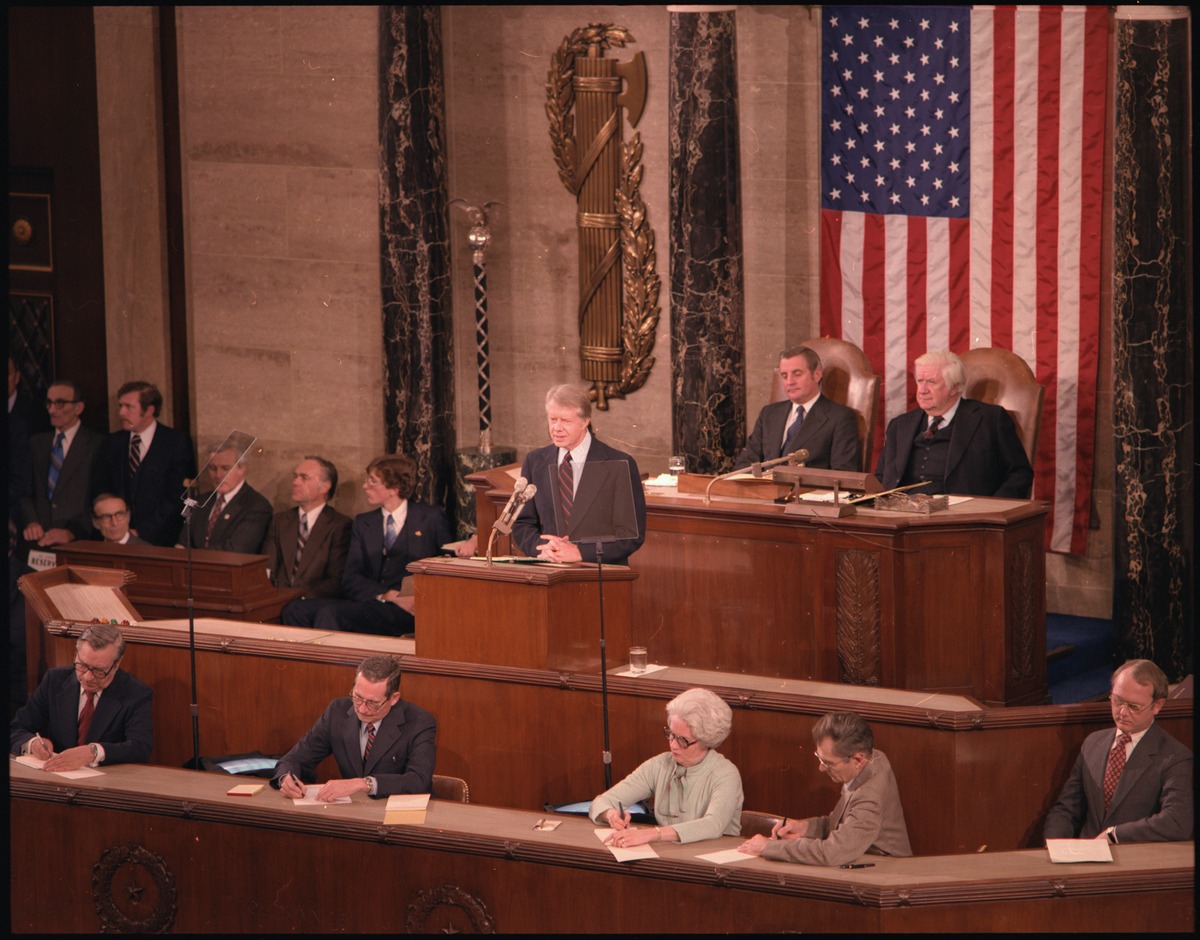
A midterm that could have been quite bad for President Jimmy Carter given the not-so-great state of the economy was mitigated by gains in some states, particularly Florida and Michigan. Some states such as Nebraska and Oklahoma replaced their arch-conservative Republican senators with considerably more moderate Democrats.

The states in which Republicans gained were:

Arkansas – Democratic Congressman Jim Guy Tucker retires to run for the Senate and is succeeded by Republican Ed Bethune.

California – Democratic Congressmen John J. McFall, John Krebs, and Mark Hannaford lose reelection to Republicans Norman Shumway, Chip Pashayan, and Dan Lungren respectively.

Colorado – Republican Congressman Bill Armstrong defeats Democratic Senator Floyd Haskell for reelection.

Georgia – Republican Newt Gingrich succeeds retiring Democratic Congressman John J. Flynt.

Illinois – Retiring Democratic Congressman George Shipley is succeeded by Republican Dan Crane.

Indiana – Democratic Congressman David Cornwell loses reelection to Republican H. Joel Deckard.

Iowa – In the Senate, Democrat Dick Clark loses reelection to Republican Roger Jepsen. In the House, Democrat Mike Blouin loses reelection to Republican Tom Tauke.

Kansas – Democratic Congresswoman Martha Keys loses reelection to Republican Jim Jeffries.

Kentucky – Democratic Congressman John Breckinridge loses renomination, and he is succeeded by Republican Larry Hopkins.

Maine – Republican Congressman William Cohen defeats Democratic Senator William Hathaway for reelection.

Minnesota – Senate seats held by Muriel Humphrey (widow of Hubert Humphrey) and Wendell Anderson are won by Republicans Dave Durenberger and Rudy Boschwitz, with Durenberger defeating nominee Bob Short and Boschwitz defeating Anderson for a full term. I wrote in more depth about this part of the 1978 midterms in my post of September 25, 2021, “The Minnesota Massacre”.

Mississippi – Congressman Thad Cochran succeeded the retiring Democrat James Eastland to the Senate. This is the first time since Reconstruction Mississippi elected a Republican to the Seante.

New Hampshire – Republican Gordon Humphrey defeats Democrat Thomas McIntyre for reelection to the Senate.

New York – Democratic Congressman Otis G. Pike retires and is succeeded by Republican/Conservative William Carney, and Democrat Edward Pattison loses reelection to Republican Gerald Solomon. However, Democrat Peter Peyser gains Republican Bruce Caputo’s seat as he retired to run for Lieutenant Governor of New York.

Pennsylvania – Democrats Josh Eilberg, Fred Rooney, and Joseph Ammerman lose reelection to Republicans Charles Dougherty, Donald Ritter, and William Clinger respectively. Democrat Eugene Atkinson succeeds retiring Republican Gary Myers.

South Carolina – Republican Carroll Campbell succeeds retiring Democratic Congressman James Mann.

Texas – Republican Tom Loeffler succeeds Democrat Bob Krueger, who ran for the Senate, while Republican Ron Paul defeats Democrat Bob Gammage for reelection.

Wisconsin – Republican Toby Roth defeats Democrat Robert Cornell for reelection.

Wyoming – Republican Dick Cheney succeeds retiring Democratic Congressman Teno Roncalio. Roncalio to this day is the last Democrat to represent Wyoming in Congress.

Mixed:

New Jersey – Democrat Bill Bradley wins the Senate seat held by Republican Clifford Case, who was defeated for renomination by conservative activist Jeffrey Bell. To this day Case is the last Republican to be elected to the Senate by the people of New Jersey. Republican Jim Courter defeats Democratic Congresswoman Helen Meyner for reelection in the House.

Ohio – Democrats gain a seat when Tony Hall succeeds retiring Republican Charles Whalen, while Republicans gain a seat with Lyle Williams defeating Charles Carney for reelection in a typically Democratic district.

South Dakota – Republican Representative Larry Pressler succeeds retiring Democrat James Abourezk to the Senate, but Democrat Tom Daschle succeeds him to the House.

The states in which Democrats gained were:

Connecticut – Republican Congressman Ronald Sarasin retires to run for Governor of Connecticut and is succeeded by Democrat William Ratchford.

Florida – Republican Louis Frey retires to run for Governor of Florida, and he is succeeded by Democrat Bill Nelson, while Republican J. Herbert Burke, beset by scandal, loses reelection to Democrat Edward Stack.

Maryland – Republican Congressman Newton Steers of Bethesda loses reelection to Democrat Michael Barnes. Both men are liberals.

Massachusetts – Republican Senator Ed Brooke loses reelection to Democratic Representative Paul Tsongas. Both men are liberals. Brooke was harmed by negative publicity surrounding his divorce.

Michigan – Republican Senator Bob Griffin, despite being a fairly prominent Senate Republican, loses reelection to Democrat Carl Levin, and Republican Congressmen Garry Brown and Al Cederberg lose reelection. Griffin’s reelection bid was harmed by his initial announcement that he would not run for another term.

Nebraska – Republican Senator Carl Curtis retires at 73, and in his place Democrat J. James Exon is elected. While normally Nebraska votes Republican, Exon was a popular governor who emphasized low spending and taxes.

Oklahoma – Republican Senator Dewey Bartlett retires due to his lung cancer diagnosis (he dies two months after leaving office), and he is succeeded by Democrat David Boren, a popular governor.

Washington – Representative John Cunningham of Seattle loses reelection to Democrat Mike Lowry. Cunningham’s election in 1977 was a bit of a fluke.

This election is in itself a last, as in it is the last time that a midterm for a Democratic president resulted in their party holding both houses of Congress. 1978 was a time in which the Democratic Party was structurally stronger, but the price was that it was a bigger tent party, thus being able to secure Senate victories in places such as Nebraska and Oklahoma with candidates who would not pass muster today in the party. What’s more, in this election, Democrats Richard Shelby of Alabama and Phil Gramm of Texas would be elected to their first terms; both men would have futures as Republican senators. Given this midterm, it seems a bit difficult to believe that the 1980 election would work out so well. Whether history repeats itself here we have yet to see…after all Biden was a big supporter of Carter and was the first politician outside of Georgia to endorse him in 1976 (Hurt).

References

1978 House of Representatives elections. Wikipedia.

Retrieved from

https://en.wikipedia.org/wiki/1978_United_States_House_of_Representatives_elections

1978 Senate elections. Wikipedia.

Retrieved from

https://en.wikipedia.org/wiki/1978_United_States_Senate_elections

Hurt, M. (2023 March 1). How Jimmy Carter and Joe Biden built an enduring friendship. Axios.

Retrieved from

https://www.axios.com/2023/03/01/jimmy-carter-joe-biden-friendship
Americans for Constitutional Action on the 96th Congress (1979-1980)

President Carter’s final two years were marked, per Americans for Constitutional Action, by many Democrats playing ball a bit more with the administration. Some strong conservatives did get elected to the Senate in 1978, most notably Bill Armstrong of Colorado and Gordon Humphrey of New Hampshire, but that election year seemed in some ways a bit of a wash, as in some cases staunch conservatives were replaced by less conservative people, such as Democrat Dave Boren succeeding Republican Dewey Bartlett in Oklahoma. Minnesota was a strange case with Republicans taking both Senate seats, replacing liberal Democrats with moderate conservative Rudy Boschwitz and centrist Dave Durenberger. President Carter himself scores 0 in both chambers in 1979 and a 12 in the House in 1980 and a 33 in the Senate in 1980. ACA and Carter agreed on the reinstatement of the selective service, against Warren Magnuson’s (D-Wash.) restricting amendment on trucking deregulation, for Jake Garn’s (R-Utah) amendment deleting middle income housing subsidies, against Daniel Patrick Moynihan’s (D-N.Y.) amendment making eligible private school students for federal education grants, and against Paul Simon’s (D-Ill.) amendment denying funds for an MX missile basing system.

A key point of difference among the House and Senate’s strongest conservatives was the matter of selective service. In a rather unusual instance for ACA, they sided with President Carter over figures such as Phil Crane (R-Ill.) and John Rousselot (R-Calif.). Another interesting point for the ACA was that on three occasions in 1980, what they counted as the correct position was also what Americans for Democratic Action counted as the correct position in their scorecard. In the House, Representative Devine’s (R-Ohio) motion to delete the Energy Mobilization Board was supported by both ACA and ADA. In the Senate, Senator Garn’s (R-Utah) proposal to eliminate subsidies for middle-income housing was supported by both ACA and ADA, and both opposed Senator Moynihan’s (D-N.Y.) proposal to make private school students eligible for Basic Educational Opportunity Grants.

One notable case in the Senate of increased cooperation with Carter was that of Harry Byrd Jr. (Ind.-Va.), who while he was a political independent, he caucused with the Democrats. While in 1977 and 1978 he scored a 96 and a 100 respectively, making him the most conservative of the Senate’s non-Republicans, his scores tumbled to a 74 and a 69 respectively in 1979 and 1980. Part of this is that he assisted the Carter Administration in a few critical votes, such as securing the 3/5’s vote necessary to end Senator Orrin Hatch’s (R-Utah) filibuster on the important nomination of AFL-CIO-backed William A. Lubbers as counsel of the National Labor Relations Board, despite voting against the nomination shortly after. Despite voting against the windfall profits tax in 1980, Byrd also voted against Senator Bob Dole’s (R-Kan.) motion to recommit the bill for hearings. Incidentally, Byrd is still the strongest conservative among the Senate Democratic caucus.

Issues counted in this Congress included the establishment of the Department of Education, the establishment of a windfall profits tax on oil, releasing sanctions on Zimbabwe-Rhodesia, food stamp funding, a Constitutional amendment to prohibit busing, prohibiting foreign aid to Nicaragua, implementing the Panama Canal treaties, the bailout of the Chrysler Corporation, and the tax-exempt status of private schools. As always with ACA, abortion was excluded as an issue.

The Senate’s all-star for the 96th Congress was Jesse Helms of North Carolina, who is the only one to score 100 in both years. In the House, Dan Lungren and Bill Dannemeyer of California, Larry McDonald of Georgia, and Robert Daniel of Virginia did no wrong by ACA standards for the entirety of the session. Some notable freshmen this session include future Speaker of the House Newt Gingrich of Georgia and future Vice President Dick Cheney of Wyoming. In 1980, only Representative Charles Diggs (D-Mich.) scored a 0 in the House, once again demonstrating that ACA frequently made their scores hard to completely succeed or fail on.

KEY

+ – A vote for the conservative position.
+ – A pair or announcement for the conservative position.
– – A vote against the conservative position.
– A pair or announcement against the conservative position.
? – No vote or opinion.
Democrats are in plain text, Republicans are in bold italics.

Vote Descriptions:

ACA-Index Scoresheets:

Claiborne Pell: An Influential Oddball

At one time, Rhode Island was a staunchly Republican state, but things began to change with the 1928 election in which although Herbert Hoover scored a resounding national victory, the Democrats succeeded in mobilizing their voters in Rhode Island and won the state for Smith. Not too long after, Democrats in the state began making major gains, with the leading figure being Theodore Green as governor. His time as governor led to the Senate for him, being elected in 1936. However, by 1960, Green was 93 years old and hard-of-hearing. He had not too long before been eased out of his chairmanship of the Senate Foreign Relations Committee by LBJ in favor of Arkansas’ J. William Fulbright. A new figure needed to step up, and that was Claiborne Pell (1918-2009).


Politics were deeply ingrained in Pell’s family, with an ancestor serving as the state’s lieutenant governor as well as his father Herbert serving as a diplomat and a term in Congress from Manhattan from 1919 to 1921. Pell and his wife were friends of the Kennedys, and John joked of him that he was “the least electable man in America” because he had some strange habits and beliefs. Among his oddities were his beliefs in UFOs, psychic mediums, and ESP, buying used cars and using public transportation despite his wealth, and wore his father’s belt despite his father having been an overweight man while Pell was rail-thin. Pell thought of himself as “about as improbable, impossible and implausible a candidate as could have turned up in many a moon” (Roberts). Ironically given Kennedy’s joking, Pell not only in his first time ever running for elected office defeated the choice of the state Democratic establishment in the Senate primary, he also won the election. Although his lifestyle was generally upper-class despite his practices on used cars and public transportation, he was quite popular with working class voters in Rhode Island. Part of his popularity was his ability to campaign in the native languages of numerous of the state’s immigrant populations as he spoke French, Italian, and Portuguese. Pell was considered by some to be too nice…he didn’t once in his political career run a negative campaign, although he seldom had a need to do so. In office, he proved a liberal who supported civil rights and the New Frontier and Great Society programs. His best friend in the Senate was liberal Republican Jacob Javits of New York, with who he would frequently collaborate to advance liberal legislation. The conservative lobbying group Americans for Constitutional Action would judge him as a staunch liberal, with his career average score, taking pairs and certain position announcements into account between 1961 and 1984, being an 8%. The occasional exceptions he made tended to involve agricultural issues and occasional military procurement and development, such as for a nuclear attack aircraft carrier in 1972 and the SAM-D missile in 1973. He would, however, oppose the B-1 Bomber and MX Missile. Pell also opposed bailing out businesses, casting votes against the Lockheed Martin bailout in 1971 and the Chrysler bailout in 1979. Pell’s most notable achievement, and its the achievement that makes his last name familiar to many, is the Pell Grant to fund college educations, which was included in the 1972 Basic Educational Opportunity Act. This was also the achievement he was most proud of. That year, he faced his most formidable challenger in Republican John Chafee, former governor and President Nixon’s Secretary of the Navy. Initially, polls put Chafee up on Pell by 25 points, and indeed 1972 was an election that for once could work in favor for the Republicans for national office in Rhode Island; the last time they won a Congressional election in the state was in 1938 and the last time they had won a Senate seat was in 1930. Pell would prevail, but by single digits, and it was the only time he did not win all the state’s counties. Four years later, Chafee would win Rhode Island’s other Senate seat with the retirement of John Pastore. The two would serve together for twenty years.


Pell was effective at pushing his priorities while forming bipartisan compromises given his nonconfrontational demeanor that emphasized discussion, artfully characterizing his skill as “letting the other fellow have my way” (Roberts). Among his other accomplishments included sponsoring the bill establishing the National Endowment of the Arts and the National Endowment of the Humanities and sponsoring legislation for Amtrak. He also served on the powerful Foreign Relations Committee and was its chairman from 1987 to 1995, often sparring with North Carolina’s ultra-conservative Jesse Helms. Pell was an internationalist, backing foreign aid. Although a strong supporter of President Carter and generally of his foreign policy, he dissented on Carter’s sale of fighter jets to Egypt, Israel, and Saudi Arabia, seeing this policy as on net disadvantaging Israel. Pell was an opponent of the Reagan Administration, both domestically and on its increased military spending as well as support for El Salvador and the Contras.


In 1990, Pell faced another significant challenger in Republican Congresswoman Claudine Schneider. Despite Schneider being liberal and voters generally liking her, many didn’t want to risk control of the Senate going to Republicans, and Pell was victorious with 61% of the vote. Shortly after, he cast his vote against the US authorizing military force against Iraq for its invasion of Kuwait. Pell was an opponent of the Contract with America agenda of Congressional Republicans and in 1996 he was one of 14 senators to vote against the Defense of Marriage Act. In December 1994, he was diagnosed with Parkinson’s disease, and although he mulled for a time whether to run again, he ultimately opted to retire. Pell died on January 1, 2009 at the age of 90. It is so rich with irony that the man JFK once jokingly called the “least electable man in America” turned out to be the most electable man Rhode Island ever sent to the Senate.


References

Claiborne Pell dies at 90; former Rhode Island senator, creator of Pell Grants. (2009, January 2). Los Angeles Times.

Retrieved from

https://www.latimes.com/local/obituaries/la-me-pell2-2009jan02-story.html

Lesniewski, N. (2011, November 29). Claiborne Pell: Story of an Uncommon Senator. Roll Call.

Retrieved from

https://rollcall.com/2011/11/29/claiborne-pell-story-of-an-uncommon-senator/

Ludes, J. (2018, November 20). Sen. Pell: Life and legacy. The Newport Daily News.

Retrieved from

https://www.newportri.com/story/news/local/2018/11/21/senator-claiborne-pell-life-and-legacy/8325235007/

Pell, Claiborne de Borda. Voteview.

Retrieved from

https://voteview.com/person/10818/claiborne-de-borda-pell

Roberts, T. (2021, Fall). Senator Claiborne Pell Helped Bring the Arts and Humanities to Every State. Humanities, 42(4).

Retrieved from

https://www.neh.gov/article/senator-claiborne-pell-helped-bring-arts-and-humanities-every-state

Lar “America First” Daly: The Don Quixote of American Politics

There are numerous perennial candidates in American history, with the king of them easily being Harold Stassen. But at least Stassen was at one time Minnesota’s incredibly popular governor and even seriously considered for the Republican nomination for president. Lawrence Joseph Sarsfield Daly (1912-1978) of Chicago could not claim the same successes.

Daly was not exactly the guy you’d think of entering politics. He was a high school dropout who for a living manufactured barstools in his garage. Daly was also married and would have five children. Yet, there was some force in this man that motivated him to consistently seek political office, despite having no connections with the major parties.

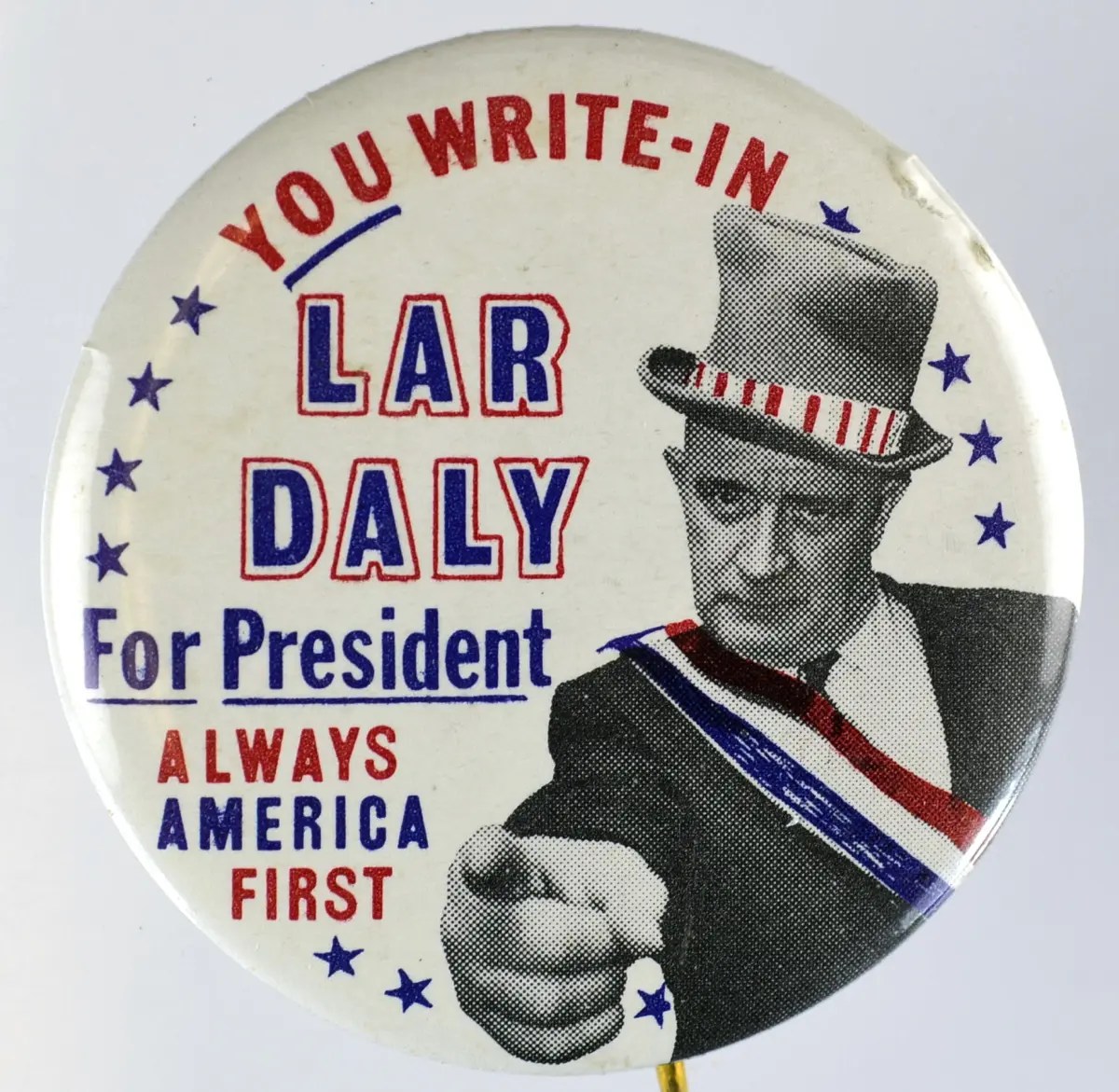
Daly’s pursuit of public office interestingly started with a minor victory. In 1932, he ran for and won a post as ward committeeman, only to be booted from the post as it was discovered he was only 20 years old, and thus underage. Daly also became a big fan of General Douglas MacArthur, and would submit his name in the Illinois primaries every presidential election year starting in 1936, and MacArthur would routinely withdraw his name. In 1938, he ran for Cook County School Superintendent and it was in this race that he started going by “Lar” as he thought it would appeal to Swedish voters (Rudnick). His name, however, appeared as Lawrence J. Daly on the ballot, and he surprisingly got 300,000 votes as numerous Irish voters liked his name. Daly also adopted “America First” in his name to appeal to American voters. But really, it was because he consistently was opposed to American involvement in foreign affairs. Daly would frequently wear an Uncle Sam suit to enhance his image as a super patriotic candidate. Along with non-intervention, Daly stood for numerous positions throughout his perennial career, including lower taxes, shooting drug peddlers on sight (after a seven-day warning to get out of town), 100% support for Joseph McCarthy’s anti-communist investigations, imprisoning any witness who invokes the 5th Amendment (protection from self-incrimination) in their testimony, and “Christian” education in public schools, with clergymen of Catholic, Protestant, and Eastern Orthodox factions as teachers (Boese).

Daly ran in Democratic and Republican primaries for political office, but more often the latter. He ran in the following elections:

GOP primary for Illinois Governor – 1956 and 1964.

GOP and Democratic primary for Chicago Mayor, as well as candidate in general election – 1959.

GOP primary for Chicago Mayor – 1963 and 1967.

Democratic nomination for president, and in the general election for president on the “Tax Cut” and “America First” slates – 1960.

Democratic primary for Senate – 1962.

Republican primary for Senate – 1966, 1970, 1974, and 1978.

In 1950, Daly, ever the resolute anti-Communist, wrote a letter to President Harry S. Truman offering to fly to the Kremlin to drop an atomic or hydrogen bomb (The La Crosse Tribune). History tells us that Truman did not take him up on this offer. In 1952, although there was a great deal of speculation and interest in General MacArthur running for president among the political right, he had once again declined. Perhaps, Daly thought, MacArthur just needed a nudge to motivate him. He first added his name to the Illinois primary, but MacArthur had it removed. Daly tried a different tactic for the Wisconsin primary by scanning the Chicago phone book and he found a man literally named “General MacArthur”. General MacArthur was a 42-year old tank inspector who was black and had eight children. With his consent and signature, Daly submitted his name on the Indiana Republican primary ballot.

Equal Time Menace

One way Daly sought to enhance his profile was in his efforts to force broadcasters to allocate him equal time to major candidates. Perhaps the thought was with publicity will come votes, and he certainly needed those if he wanted to become Chicago’s mayor.

In 1959, Daly ran for mayor of Chicago after having run for both the Republican and Democratic nominations and lost. In the process, he demanded to be given equal time to incumbent Democrat Richard J. Daley and his Republican challenger, Timothy Sheehan, and filed a complaint to the FCC about Chicago broadcasters not doing so. On a 4-3 vote, the FCC in February ruled that networks had been in error not granting Daly equal time in broadcast coverage. He ultimately only got two votes in the general election. Daly thus became the proximate cause of a change in the Equal Time Act signed into law by President Eisenhower in September 1959, which exempted routine news coverage from having to cover candidates equally. However, if candidates were invited to appear for a broadcast, equal time still applied.

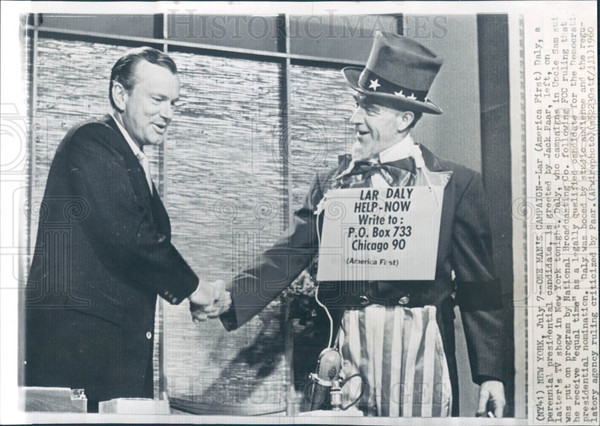
In 1960, Daly ran in the Democratic primary for president, having filed just before the deadline in the New Hampshire primary. In the general election, he would again agitate for equal time to the FCC so that he too could be interviewed on the Jack Paar Tonight Show as John F. Kennedy and Richard Nixon had. Paar was livid that he was forced to accommodate this crank, and Daly showed up in his Uncle Sam costume, as you can see below:

During the show he did himself no favors by calling President Eisenhower a “poor excuse” for a president and directly solicited the public for campaign contributions, provoking boos and heckling from the audience (Lindberg, 194). One audience member challenged him, “Mr. Daly, I would like to know where your supporters are located. I teach special studies in Illinois, and we’ve never heard of you” to which he responded, “Well, sir, you apparently don’t read newspapers, watch television, listen to the radio, or attend meetings, because in every Illinois campaign in which I engage, I am known as the tireless candidate” (Zurski). Daly was known for delivering his speeches in a shouting and even threatening manner. As author Hal Higdon noted, “Lar Daly is a likeable person, but one of his major flaws in his character is that when he gets in front of a microphone, he begins to shout and threaten in an attempt to intimidate the audience. With Lar Daly as his own best friend, he doesn’t need enemies!” (Lindberg, 194). He did not fail to demonstrate this in his Jack Paar appearance. Daly’s conclusion to his speech before the audience was, “Your only choice is America first – or death” (Zurski). At the end of the program, Paar apologized to the audience to which they cheered.

The Jack Paar appearance netted Daly $151.17 in donations, a fraudulent check, and three death threats (Lindberg, 194). After this appearance, Congress suspended equal time regulations for the 1960 election so Nixon and Kennedy could debate without the possibility of Daly wanting to appear too (imagine that!). Daly would receive few votes outside of his own.

In his next Senate campaign, his “six point program” was

“ – An immediate invasion of Cuba to restore its “Christian social order”.

  • No aid to communist countries except food and clothing to be distributed by Catholic and Orthodox churches.
  • A cut in aid to Africa and Asia, and a boost in aid to America’s own underprivileged, including Negroes and Latin-born.
  • A high tariff barrier to protect American working men.

Equal federal aid to parochial schools.

  • And legalized gambling” (Ebert, 1962).

In the 1973 special election for Illinois’ 7th district, Daly won a major party’s primary. However, he only won the Republican primary because no one else bothered to challenge Democrat Cardiss Collins in this heavily Democratic district. He only got 1,329 votes.

These campaigns, although a passion for him, came at a cost, and in his later years had to sell his Uncle Sam outfit. Daly’s health also was declining as he was in and out of hospitals and lost the ability to grasp objects with his hands (Anderson). In 1978, Daly again challenged incumbent Senator Chuck Percy in the Republican primary, but only got about 15% of the vote in the March 21st election. This was his last race, and although he surely would have been up for more, his health gave out and he died of a lung ailment on April 17th, less than a month after the primary.

Conclusion

Although one of the most ridiculous perennial figures in American politics, Daly is a testament to an indomitable spirit characteristic of America. Indeed, there are few people who would go as far as he did and meet with so little success. Daly’s approach was unabashed and shameless, and while on occasion he scored certain victories, they never translated into success in an election. Indeed, Father Mark Dennehy remembered him as “…the embodiment of Don Quixote” (Anderson).  He was also well-liked in his community as despite his tenacity and his poorly received Jack Paar appearance, he was known to be friendly and as a devout Catholic contributed to the church every Sunday even though he was sometimes strapped for cash. However, his story also gives backing to the famous W.C. Fields quote, “If at first you don’t succeed, try, try again. Then quit. There’s no point being a damn fool about it.”

References

Anderson, J. (1978, April 22). Lar Daly remembered for what really counted. Chicago Tribune.

Retrieved from

Boese, A. (2008, October 22). Strange Candidate #6: Lar “America First” Daly. Weird Universe.

Retrieved from

http://www.weirduniverse.net/blog/comments/strange_candidate_6_lar_america_first_daly

Ebert, R. (1962, November 1). US Senate Candidate Lar Daly Presents Program Here Friday. The Daily Illini, p. 9.

Retrieved from

Lar Daly, 66, Dead. (1978, April 19). The New York Times.

Retrieved from

Lar Daly, a candidate for everything, is dead. (1978, April 19). La Crosse Tribune (La Crosse, Wisconsin), 18.

Retrieved from

Lindberg, R.C. (2020, July 28). Tales of forgotten Chicago. Carbondale, IL: Southern Illinois University Press.

Rudnick, N. (2021, June 17). The Biggest Loser: Elections Edition. The Hot Seat.

Retrieved from

https://medium.com/@rudnicknoah/the-biggest-loser-elections-edition-8dc372f6e401

Vos, T.P. & Ashley, S. (2014, December 1). Amending Equal Time: Explaining Institutional Change in American Communication Policy. Boise State University ScholarWorks.

Retrieved from

Zurski, K. (2020, November 5). Lar Daly and the Art of Losing Elections. Unremembered.

Retrieved from

Television: Equal Sequel. (1964, August 28). Time Magazine.

Retrieved from

https://content.time.com/time/subscriber/article/0,33009,876112,00.html

The Press: Free, Equal & Ridiculous. (1959, March 30). Time Magazine.

Retrieved from

https://content.time.com/time/subscriber/article/0,33009,892443,00.html

The 1972 Election: Great for Nixon, Middling for GOP

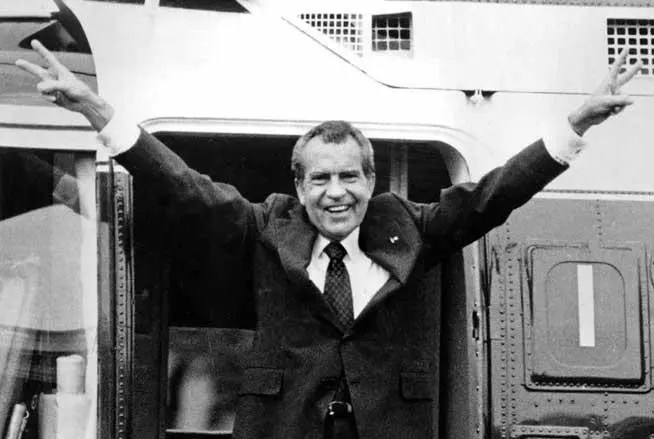
The 1972 election was for Richard Nixon an unparalleled triumph. Although he was expected to win and win big, he won a whopping 49 states, a feat repeated only once more since. Senator George McGovern of South Dakota had a disastrous if principled run for president, and even that was challenged given his quick dropping of Senator Thomas Eagleton of Missouri as his running mate upon revelation that he had seen a psychiatrist even though he had initially denied it would happen. However, for his party, things didn’t quite go that way. Part of it was that the GOP at this time was really picking and choosing their battles when it came to the South, and many voters were still clinging onto their traditional Democratic Party affiliation even if their vote for president was going to Nixon. In races in which there were open seats in the South, the GOP did well, but in other places in the nation, they could have used some coattails.

The House: Moderately Positive

The Democrats had a formidable House majority, so it was unlikely that an election would flip control to the Republicans, but they won a net of 12 seats. They had net gains in the following states:

Arizona – The 1970 census had produced an extra House seat, and this was won by John B. Conlan.

Colorado – Republicans lost a seat in the Denver-based 1st but won a newly created district as well as the 4th district.

Connecticut – Ronald Sarasin defeats Democrat John Monagan for reelection.

Illinois – Staunchly liberal Democrat Abner Mikva lost reelection to Republican Samuel Young, and Republicans gained two seats from redistricting. Mikva would be back after the 1974 midterms though.

Indiana – Democrat Andy Jacobs Jr. loses reelection to Republican Bill Hudnut. Like Mikva, he would be back after the 1974 midterms.

Louisiana – Republican Dave Treen wins in the 3rd district, the first one to win a Congressional seat in Louisiana since 1888.

Maine – Although Democrat Bill Hathaway moves up to the Senate, his successor is Republican William Cohen, who will later trounce Hathaway in the 1978 Senate race.

Maryland – Marjorie Holt wins a newly created district in the D.C. suburbs.

Michigan – Robert Huber is elected in a newly created district, but he only lasts a term.

Mississippi – Republicans had a bit of a false start in this state with the election of Prentiss Walker to Congress in 1964. However, the elections of Thad Cochran and Trent Lott, two major figures in the rise of Republicans in Mississippi, is their real start.

Nevada – Republican Dave Towell succeeds Democrat Walter Baring, who endorsed him after losing renomination to a liberal.

New Jersey – Joseph Maraziti wins a newly created district. However, he is swept away in the 1974 midterms.

New York –Angelo Roncallo wins a newly-created district (he doesn’t last), while Republican Ben Gilman defeats Democrat John G. Dow for reelection. Democrats keep one seat when Republican Seymour Halpern’s district is merged with Democrat Lester Wolff’s.

North Dakota – Republicans essentially gain by a seat being held by a Democrat being dropped from the census. Mark Andrews continues representing the state.

South Carolina – Republican Edward Young succeeds Democrat John McMillan. He doesn’t last.

South Dakota – Republicans had a bit of a rough time in the state lately, but Jim Abdnor winning the 2nd district helps things.

Tennessee – Republican Robin Beard wins the newly created 6th district, which merged Democrat William Anderson’s and Ray Blanton’s.

Texas – Republican Alan Steelman defeats Democrat Earle Cabell for reelection in Dallas, and Republican Bob Price’s district is merged with Democrat Graham Purcell’s, with Price coming out on top. Price loses reelection next time around.

Virginia – Republican Bob Daniel succeeds Democrat Watkins Abbitt. It’s not much of a change, as Abbitt was already quite conservative.

Net Losses:

Georgia – Atlanta’s Fletcher Thompson retired to run for the Senate, and the seat was won by Democrat and civil rights activist Andrew Young, the first black representative elected in Georgia since Reconstruction.

Iowa – Fred Schwengel loses reelection in the 1st district, and Rep. John Kyl loses reelection in his district merging with Democratic Rep. Neal Smith. Republicans are similarly disappointed in the Senate, as I will cover later.

Massachusetts – Hastings Keith opts to retire, and is succeeded by liberal Democrat Gerry Studds, who narrowly prevails over his Republican opponent. In the 5th district, future senator and presidential candidate John Kerry runs for the seat, but is defeated.

Oklahoma – In 1970, Republican Page Belcher faced a tough challenge from Democrat James Jones. Instead of facing him again, he opts to retire, and Jones wins the seat.

Utah – Republican Sherman Lloyd loses reelection to Democrat Douglas Owens. A candidate of the American Independent Party notably takes over 11% of the vote.

Wisconsin – Redistricting places Democrat Dave Obey and Republican Alvin O’Konski in the same district; the latter loses. Obey will serve until 2011.

The Senate

The Senate is a much grimmer picture for the Republicans, and some significant incumbents lose. However, there are offsets in gains in other states.

Wins:

New Mexico – Republican Pete Domenici succeeds retiring Democrat Clinton Anderson. He will serve until 2009.

North Carolina – Jesse Helms succeeds Democrat B. Everett Jordan, who had lost renomination. He will serve until 2003.

Oklahoma – Governor Dewey Bartlett wins the election, succeeding the very liberal Democrat Fred Harris. He lasts only a term, as he develops lung cancer and dies shortly after his term ends.

Virginia – Democrat William B. Spong loses reelection to Republican Congressman William Scott. Scott only lasts a term as his time as senator is marked by numerous verbal blunders. His successor, Republican John Warner, will be in office until 2009.

Losses:

Colorado – Republican Gordon Allott, running for his fourth term, loses reelection by a point to Democrat Floyd Haskell. Haskell would only serve a term before being defeated by Republican Congressman Bill Armstrong.

Delaware – Republican Cale Boggs, who was reluctant to run again but pushed into doing so by President Nixon, is defeated by none other than the current president. That’s how long he’s been on the scene, folks!

Iowa – Although Nixon handily wins reelection in Iowa as he does just about everywhere, Republican Jack Miller loses reelection by over ten points to Democrat Dick Clark. Like Haskell, he lasts only a term, being defeated by Roger Jepsen in 1978.

Kentucky – Republican John Sherman Cooper retires, and former Governor Louie B. Nunn just doesn’t make it against Democrat Dee Huddleston.

Maine – Perhaps the most stunning Senate loss was that of Margaret Chase Smith. Smith was a trailblazer for women in the Senate and a known centrist, but by 1972 the state of Maine had changed from when she first got into politics. Congressman Bill Hathaway defeats her, and I have already written what happens in 1978.

South Dakota – Republican Karl Mundt retires on account of him being in bad health after suffering a major stroke, and staunchly liberal Democratic Congressman James Abourezk wins the election to succeed him.

The 1972 election was amazing for Nixon, but the Congressional GOP could have used a better election, especially given what was coming after Watergate.

References

1972 United States House of Representatives elections. Wikipedia.

Retrieved from

https://en.wikipedia.org/wiki/1972_United_States_House_of_Representatives_elections

1972 United States Senate elections. Wikipedia.

Retrieved from

https://en.wikipedia.org/wiki/1972_United_States_Senate_elections

The Truman Committee  – A Springboard to the Presidency

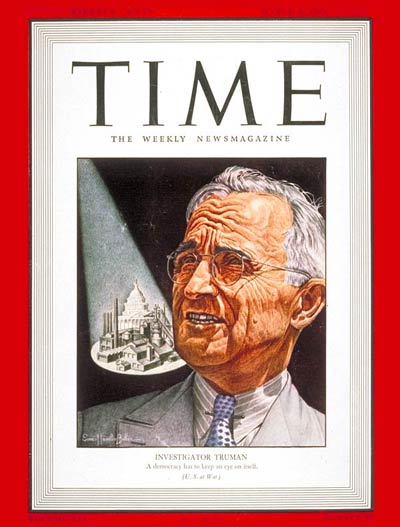
Senator Harry S. Truman (D-Mo.) was not a particularly known figure nationally at the start of 1941 save for being an FDR loyalist, although in Missouri he was controversial. He had won his renomination in 1940 by the skin of his teeth and had a close election given that his career was boosted extensively by the corrupt Pendergast machine, which was now crippled given Tom Pendergast’s imprisonment for voter fraud. Indeed, when first elected in 1934, Truman was known as the “Senator from Pendergast”. However, what he would do after the election would be a reputation changer for the ages.

A Good Government Committee

Truman went on a trip in early 1941, touring the country to see how $10.5 billion was being spent on national defense, and he saw a lot of waste and war profiteering, which disgusted him, recalling, “…there were men, hundreds of them, just standing around collecting their pay, doing nothing” (Levin Center).

On February 10, 1941, he delivered a speech calling for the creation of a committee, officially called the Special Committee to Investigate the National Defense Program, as a watchdog committee to make sure that funds were being spent properly and to uncover waste and malfeasance. President Roosevelt was not enthusiastic about this committee to say the least, but decided that it was better for a Democrat to take the lead on this than Republicans who were itching to lead investigations (Inskeep). On March 1, 1941, the Senate voted without objection to create this committee and give it a little money. This would be popularly dubbed the “Truman Committee”, as he was selected to chair it.

The Truman Committee Gets to Work

 Although Senator Truman was pressured by the Roosevelt Administration to fill the committee with loyalists, he filled the committee with men he had found to possess integrity and practicality, whatever their party or wherever they stood on the New Deal (Levin Center). Interestingly, one of these men was Maine Republican Owen Brewster, who would have a major conflict with Howard Hughes and be portrayed as a villain in Martin Scorcese’s The Aviator, but Brewster’s story, and my take on him as a politician, is for another time. This committee discovered a good deal of waste and malfeasance. Examples included:

“The Carnegie-Illinois Steel Corporation sold faulty slabs of steel to be sued in shipbuilding and falsified quality control reports;

Defective engines made by the Curtiss-Wright Company and used in airplanes led to the death of student pilots;

Standard Oil Company and Alcoa, which had exclusive patents or monopolies on critical war materials, had intentionally slowed the development of substitutes or created artificial shortages; and

The Remington Company, according to Senator Truman, got “$600,000 for acting as advisors to the Government” but in his words: “[n]o one knows what this advice is or what it is worth.” (Levin Center)

Although Truman did publicize the committee, he also was not taking every opportunity he could to do so. If he found mismanagement in certain places, he’d give the department heads a chance to fix it by giving them a call and telling them of the problem (Inskeep & Drummond). If they were not receptive, then Truman’s temper would flare up and he would go after them, including holding a public hearing. In their first report, the Truman Committee found $100 million in waste on upgrading army camps, and that these camps were not being modernized in the process (Inskeep & Drummond). The committee also issued recommendations based on their findings, and such recommendations would save the government money, which became all the more valuable when the United States entered World War II.

Although only $1 million was spent on the committee, the committee throughout World War II is estimated to have saved between $10-15 billion in costs, saved thousands of lives through exposing defective military equipment and materials, and easing federal contracting processes (Levin Center). This was a remarkable turnaround from past perceptions of him, and made him a popular figure. Truman’s highly capable chairmanship of this committee, his good relations with Southern Democrats, being from a border state, and Majority Leader Alben Barkley’s (D-Ky.) defiance of FDR on tax legislation set him up for the vice presidential nomination in 1944. Although he didn’t want the nomination, it was foisted upon him as a service to his party, as many Democrats on the inside knew that FDR’s running mate would likely be president. And indeed, it only took three months into Roosevelt’s fourth term for that to happen. The Truman Committee to this day is a model for legislative investigative committees.

References

Portraits in Oversight: Harry Truman and the Investigation of Waste, Fraud, & Abuse in World War II. Levin Center.

Retrieved from

Special Committee to Investigate the National Defense Program. U.S. Senate.

Retrieved from

https://www.senate.gov/about/powers-procedures/investigations/truman.htm

Inskeep, S. & Drummond, S. (2023, May 11). Truman Committee became the model for scrutinizing giant public expenditures. NPR.

Retrieved from

https://www.npr.org/2023/05/11/1175403633/truman-committee-became-the-model-for-scrutinizing-giant-public-expenditures

An Ideologically Interesting Vote: Funding the Selective Service

Note: I will be posting this and two others early as I will have unreliable internet connection over about the next week.

In 1973, President Nixon ended the draft, and by 1975 men no longer were obligated to sign up with Selective Service, leaving the program in limbo. However, on December 24, 1979, the USSR began their invasion of Afghanistan, and on January 24, 1980, President Carter restored the Selective Service in case the US should need to quickly mobilize. While national security advocates praised the move, civil liberties and student groups were strongly opposed (UPI). However, what makes this matter interesting is that in the 1980 campaign, it placed Ronald Reagan to the left of Carter. Reagan condemned the resumption of the Selective Service and promised to eliminate it as president. He was quite critical of military conscription as a concept, asserting that it “rests on the assumption that your kids belong to the state…That assumption isn’t a new one. The Nazis thought it was a great idea” (Gregory). What’s more, it produced some interesting divisions within the Republican and Democratic parties when funding came for a vote. The critical vote for funding in the House was on April 22nd, passing 218-188, with Democrats voting for 135-122 and Republicans voting for 83-66. The Senate followed up on June 12th, passing the bill 58-34, with Democrats breaking for 33-18 and Republicans at 25-16.

Divides Among Republicans

The frightening idea that your children belong to the state brought up by Reagan was on the minds of numerous conservatives on the Republican side who voted against, fearing a restoration of the draft. These included Senator Orrin Hatch of Utah as well as Representatives John Rousselot of California, formerly a spokesman for the John Birch Society, Phil Crane of Illinois, who was conservative on almost everything, and Ron Paul of Texas, consistent with his libertarian brand. However, there were plenty of prominent conservatives who voted for. Senators Barry Goldwater of Arizona and Jesse Helms of North Carolina voted for, as did future Vice President Dick Cheney and future Speaker of the House Newt Gingrich. This vote also split, interestingly enough, moderate to liberal Republicans. Resuming the Selective Service won the vote of the ultimate liberal Republican of the Senate, Jacob Javits of New York, as well as those of John Chafee of Rhode Island and Robert Stafford of Vermont. However, Mac Mathias of Maryland and Mark Hatfield of Oregon voted against.

Future Presidents and Hopefuls

Joe Biden did not cast a vote on the Selective Service measure, while future Presidential candidate Bob Dole voted against as did 1984 contender for the Democratic nomination Gary Hart of Colorado. Ted Kennedy of Massachusetts, actively campaigning for president, saw this vote as important enough to show up to vote against. The service-minded John Glenn of Ohio, who would run for the Democratic nomination in 1984, voted for, as did South Carolinian Fritz Hollings. John B. Anderson of Illinois, seeking the Republican nomination and then running as an Independent, voted against.

The “Solid South” Comes Out in Full Force

The politicians of the states of the former Confederacy were strongly for this measure. Senators from these states voted 19-0 for, and representatives on the key amendment to appropriate funds voted 87-9 for. The nine dissenters were Edward Stack (D-Fla.), W. Henson Moore (R-La.), Mendel Davis (D-S.C.), Harold Ford (D-Tenn.), Jim Collins (R-Tex.), Mickey Leland (D-Tex.), Ron Paul (R-Tex.), Herb Harris (D-Va.), and Joe Fisher (D-Va.). Of the Democrats, only one was in the moderate camp, while the others were staunch liberals. Of the three Republicans, Collins was known as arch-conservative and Paul, well, we know where he is. Moore was the only Deep South Republican opposed.

Divides Among Democrats

Among Democrats, the figures were of interest as well. Conservative Democrats in the Senate to a man voted for, while there were some splits among liberals. Birch Bayh of Indiana, who was generally known as quite a liberal, voted for, as did Abe Ribicoff of Connecticut, the latter who had become a bit more conservative on defense issues in his later career. Pete Williams of New Jersey, known as a staunch liberal, voted for as well. As might be expected, certain outspoken foes of the Vietnam War were opposed, such as George McGovern of South Dakota and Bill Proxmire of Wisconsin. My home state of Washington split on this one, with the anti-détente Henry “Scoop” Jackson voting for and Warren “Maggie” Magnuson voting against. Although the men agreed on most things, they did split on the Vietnam War. Speaking of Washington, its House delegation was overwhelmingly against, with only Democrat Norm Dicks voting in favor.

The Curious Cases of Oklahoma and Utah and South Dakota Meeting Expectations

Of the states, two had divisions that would seldom be expected: Senator Henry Bellmon and Representative Mickey Edwards, Oklahoma’s Republicans, voted against while all the state’s Democrats voted for. Utah’s Democratic Representative K. Gunn McKay voted for while the state’s Republican senators and its representative voted against. South Dakota, on the other hand, is the only state that would likely fit common perceptions of the parties among today’s young, with voting Democrats against and Republican Senator Larry Pressler for.

Conclusion

I see this vote in several ways. For one, it does function on a conservative/liberal scale (although not strongly on the conservative side), as Americans for Constitutional Action counted a vote for as favorable and Americans for Democratic Action counted a vote against as favorable. However, it also functions to determine who the more libertarian individuals in the parties are as well as establishment vs. anti-establishment. Ideologically, on the opposition side, there is a horseshoe effect going on with many of the Vietnam War’s prominent opponents against but also those who shared Reagan’s opposition, fearing it would lead to the resumption of the draft. Incidentally, Reagan as president walked back on that one, supporting an extension of the Selective Service in 1982 after being advised by the Presidential Military Manpower Task Force to continue it, and we have had it since (Reagan).

References

Carter revives selective service. (1980, January 24). UPI.

Retrieved from

https://www.upi.com/Archives/1980/01/24/Carter-revives-selective-service/1941579661751

Gregory, A. (2004, June 15). Honor Reagan’s Promise and Abolish the Selective Service. Independent Institute.

Retrieved from

https://www.independent.org/news/article.asp?id=1317

Reagan, R. (1982, January 7). Statement on Continuation of the Registration Program Under the Military Selective Service Act. Ronald Reagan Presidential Library & Museum.

Retrieved from

https://www.reaganlibrary.gov/archives/speech/statement-continuation-registration-program-under-military-selective-service-act

To agree to Appropriations Committee Amendment to H.J. Res. 521, Draft Registration, that increases the transfer authority to Selective Service from $4.7 million to $13.295 million. Voteview.

Retrieved from

https://www.voteview.com/rollcall/RH0960842

To pass H.J. Res. 521. (Motion Passed) See Note(s) 29. Voteview.

Retrieved from

https://www.voteview.com/rollcall/RS0960708

Leverett Saltonstall: Collegiality and Compromise

For all the disagreements out there, I think we can all agree that we live in highly disagreeable times. The “culture war” is at fever pitch, partisanship is the highest its been since the era of the War of the Rebellion, and we have numerous political figures I will charitably call publicity hounds (I have worse words for them, but I will not express them here). This is a consequence of the long-standing effort across the board to have ideologically responsible parties. Although I am inclined to also point the finger at primaries, I am not as certain about it as a factor. Primaries have produced outcomes in the GOP that I have both agreed and disagreed with on grounds of “electability”. And the truth is that there are times in which primary voters have had some great hits over the party establishment choices (Marco Rubio, Ted Cruz) and horrific misses (Christine O’Donnell, Roy Moore). One figure whose politics deeply contrast with today in tone and in ideological purity is Leverett Saltonstall (1892-1979), a Massachusetts Republican.

Saltonstall came from one of the oldest families in Massachusetts and one that had a history of political involvement; his great-grandfather Leverett Saltonstall I (1783-1845) had been a prominent Whig politician in his day. Leverett began his political career as an alderman of Newton, which led to his election to the Massachusetts House of Representatives in 1922, where from 1929 to 1937 he served as its speaker. In 1938, Saltonstall ran for governor. Jim Curley, who had been governor from 1935 to 1937, was a highly corrupt figure who had run for the office to avoid going to prison, but he had a fan base particularly among Boston’s ethnic Irish population, who held a grudge against the Boston Brahmins (wealthy WASPs). Although Saltonstall was a Brahmin, he was also of Irish descent, so he was in both worlds and could appeal to both camps. Curley blundered when he revived an old description of him by referring to him as “a man with a Harvard accent and a South Boston face”, which Saltonstall repeatedly used to his advantage, adding, “I’ll have the same face after election that I have before election” (Weeks, xiii). 1938 was a good year for Republicans and Saltonstall was the right sort of Republican, winning the election.

Saltonstall’s tenure as governor was ethically squeaky clean, a pleasant contrast to the grafting ways of Curley. He also managed to eliminate most of the state’s deficit, successfully mediated a major Teamster’s Union strike, and established an interfaith committee to curb discrimination (Blair). Saltonstall also had the benefit of having a craggy but trustworthy face. He would sometimes quote a limerick to describe his appearance,

“For beauty I am not a star.

There are others more handsome by far,

But my face, I don’t mind it,

For I am behind it,

It’s the people in front that I jar” (Blair).

In 1944, Saltonstall ran for the Senate to complete the term of Henry Cabot Lodge Jr., who had resigned to fight in World War II. By this time, he was popular with Republicans and Democrats alike and won the election with 64% of the vote, even winning the Democratic stronghold of Boston.  

In the Republican 80th Congress, he supported much of the party’s conservative economic agenda, but voted internationalist and in favor of more refugees being admitted to the US. Saltonstall also supported the Taft-Ellender-Wagner housing bill, which included public housing. Although he didn’t sponsor much legislation, his contributions came in the form of adding amendments to legislation, thus he was a bit of a behind-the-scenes player (Blair). In hearings on controversial issues, Saltonstall wouldn’t ask questions meant to solicit a specific answer or to grandstand, he would do so to find out information so he could better make decisions. Despite his nickname being “Salty”, he couldn’t have been further from it. Saltonstall was known for his unfailing courtesy and manners and this made him one of the most agreeable legislators on Capitol Hill. This set him up for being part of the Republican leadership, but he had to win reelection first.

In 1948, he pulled off another win for a full term, even though President Truman won by over ten points in Massachusetts that year. In 1949, Saltonstall was elected party whip, serving until 1957. As whip, he was able to effectively appeal to both the conservative and moderate to liberal wings of the party. From 1957 to 1967, he served as the chairman of the Republican Conference.

Although an internationalist, Saltonstall voted against Point IV aid in 1950, granting foreign aid to nations on the basis of being poor rather than recovering from post-war damage. He was strongly for Eisenhower, and indeed he was one of the figures Saltonstall respected most. In 1954, he voted to censure Senator Joseph McCarthy (R-Wis.). That year, Saltonstall had a close shave against Treasurer and Receiver-General Foster Furcolo, prevailing by 1.5% in an election that lost the GOP the Senate.

While he could be conservative on numerous issues regarding budgets and organized labor, he also was supportive of increasing the minimum wage, internationalism, and opposed certain domestic anti-communist policies such as maintaining a student loyalty oath on college campuses and giving states a broad authority to crack down on subversive organizations. Americans for Constitutional Action gave him a 69% for their first ratings, which covered his record from 1955 to 1959. Saltonstall’s DW-Nominate score was a 0.175, suggesting moderation.

While in 1960 John F. Kennedy had his third best performance in Massachusetts, Saltonstall won reelection by around 13 points. Interestingly, although he remained having clean hands, his campaign manager was Chuck Colson. Colson, who would gain infamy in the Watergate Scandal as Nixon’s “hatchet man”, was ruthless and behind his boss’s back, concocted a “grassroots” movement of voters who wished to split their tickets to vote for Kennedy and Saltonstall, which surely assisted in at least the margin of his victory (Massachusetts Historical Society).

On civil rights, Saltonstall was supportive, backing both the Civil Rights Act of 1964 and the Voting Rights Act of 1965. However, he also was a supporter of state’s rights, and voted for the Anderson-Aiken Amendment to the Civil Rights Act of 1957, which struck out the section that granted the attorney general authority to initiate lawsuits in civil rights cases, which numerous senators outside the South thought went too far beyond protection of voting rights (Douglas).

Saltonstall had a mixed record on the Great Society. While he voted against the Economic Opportunity Act of 1964 and had voted against Medicare proposals in 1960, 1962, and 1964, he did vote for Medicare in 1965 and supported the Elementary and Secondary Education Act, providing federal aid to schools. In 1966, Saltonstall voted for both of Minority Leader Everett Dirksen’s (R-Ill.) proposals to amend the Constitution. First, to allow legislative districts in states to not solely be based in population, and second, to permit teacher led prayer in public schools.

Although Saltonstall was still in good health in 1966 and probably could have capably served another term, at 74 he wished to retire before he declined. As he explained, “I wanted to quit when I was still doing the job rather than just fade away in the Senate…Too many of my Senate colleagues overdid it. They stayed on too long – napping through committee hearings when they should have packed up and gone home” (Blair). Saltonstall lived 12 years after his final day in the Senate, and in 1971 published his autobiography written with Edward Weeks of Atlantic Monthly, titled Autobiography of Leverett Saltonstall; Massachusetts Governor, U.S. Senator, and Yankee Icon. He died on June 17, 1979 of congestive heart failure.

Saltonstall was the right sort of Republican that the GOP could run in Massachusetts statewide at the time, and although he certainly fits the characterization of a “Country Club Republican”, his record was golden by conservative standards compared to his Republican successor, Ed Brooke. Among the characters I have covered, I admit a great admiration for Saltonstall, even though his politics fall a bit short of mine on the conservative scale. He played the game of politics honorably and won. We should hope for the same for all our office seekers.

References

Blair, T. Saltonstall, Leverett. Harvard Square Library.

Retrieved from

Douglas, P.H. (1957, December). The Right to Vote. The Atlantic.

Retrieved from

https://www.theatlantic.com/magazine/archive/1957/12/the-right-to-vote/642205

Object of the Month: The Next Four Years. (2020, September). Massachusetts Historical Society.

Retrieved from

https://www.masshist.org/object-of-the-month/objects/september-2020

Saltonstall, Leverett. Voteview.

Retrieved from

https://www.voteview.com/person/8185/leverett-saltonstall

Weeks, E. (2015). Preface to The autobiography of Leverett Saltonstall: Massachusetts governor, U.S. senator, and Yankee icon. Lanham, MD: Rowman & Littlefield.

Retrieved from

RINOs from American History #16: Claudine Schneider


Congressman Eddie Beard (D-R.I.) was a bit of an unusual fellow. In his first campaign for Congress in 1974, he was a 34-year-old house painter and he often campaigned in painter’s clothes to appeal to working class voters, against the wishes of the Democratic establishment who thought him a “grandstander” and a “loudmouth” (Szkotak). Despite opposition from the Democratic establishment, he defeated incumbent Robert O. Tiernan in the primary in the Providence-based 2nd district. However, the 1978 election saw a compelling alternative come in the form of Claudine Schneider (1947- ). Interestingly, she had been a Democrat until then, but the GOP offered her more for a political career. Although Schneider lost that year, she lost by only 5 points. Beard had won reelection in 1976 with 76.5% of the vote. The 1980 election was different, as Beard was increasingly harmed by his propensity to be “quarrelsome and ill-informed” and Schneider had gained publicity by hosting a public affairs TV program and enhanced her appeal with ethnic Italians by taking Italian lessons (Wasniewski, 611). Although Jimmy Carter won Rhode Island, Carter’s victory in the state was not enough to save Beard, and Schneider won the election by over 10 points, making her the first Republican elected to the House from Rhode Island since 1938.

Congresswoman Schneider

Schneider supported a number of Reagan’s budget and tax policies in 1981 but she also voted favorably on many policies typically opposed by conservatives, such as arts funding, the Legal Services Corporation, food stamps, and the use of busing as a means of desegregation. Schneider also opposed the Reagan Administration on funding of military priorities such as the B-1 Bomber and the MX-Missile. In 1983, Schneider was the only Republican in the House that Americans for Democratic Action scored as a liberal, meaning she voted liberal on at least 14 of 20 of their selected votes (Associated Press). She was foremost an advocate for environmental issues and was an early proponent of climate change legislation. One of her major victories in Congress was defeating the Clinch River Breeder Reactor in 1983, which was strongly supported by the Reagan Administration and the GOP leadership and opposed by environmentalists. Schneider said of the reactor that it was “a confederacy of corporate issues” (Wasniewski, 612). Her DW-Nominate score was an unusually low -0.026 and she had an average of 21% by Americans for Constitutional Action for her first four years in Congress. Schneider opposed President Reagan’s position 75% of the time and became extremely popular in her district, whose voters were largely against Reagan and in 1988 she won reelection with 72.1% of the vote, the highest for any Republican since 1878 (Wasniewski, 612). However, this came at the cost of being passed over for committee assignments best suited to her specialty.

Schneider in 1989 originated a joke about Dan Quayle which was mistaken by a number of publications as one of his gaffes, “I was recently on a tour of Latin America, and the only regret I have was that I didn’t study Latin harder in school so I could converse with those people” (O’Connell). Given her popularity in her district, Republicans saw her as a top contender to take on Democratic Senator Claiborne Pell. Pell had been in office since 1961, and perhaps it was time for a change in Rhode Island. However, he had high favorables in Rhode Island overall, and many Democratic voters, although they liked Schneider, didn’t want to risk the Senate being majority Republican, and Pell won reelection with ease (Wasniewski, 614).


Post-Career

After her career in Congress, Schneider was further involved in the environmental movement. She also accepted a teaching position at the John F. Kennedy School of Government at Harvard University and served on the Competitiveness Policy Council during the Clinton Administration (Wasniewski, 614). Although her Congressional career has long passed, she isn’t quite history. Schneider has lately been critical of GOP environmental policy and in a 2019 interview she asserted that they had been “bought off by the fossil fuel industry” (Bologna & Borchers). She endorsed Democrat Seth Magaziner in his campaign for Congress in 2022 and as a resident of Colorado was one the plaintiffs in the case to remove Donald Trump from the ballot.

References

Bologna, J. & Borchers, C. (2019, April 28). How The GOP Became The Party To Oppose Climate Change Legislation. WBUR.

Retrieved from

https://www.wbur.org/radioboston/2019/04/25/gop-climate-change

Liberal Vote Gains in House. (1983, December 28). Associated Press.

Retrieved from

O’Carroll, E. (2011, June 3). Political misquotes: The 10 most famous things never actually said. The Christian Science Monitor.

Retrieved from

https://www.csmonitor.com/USA/Politics/2011/0603/Political-misquotes-The-10-most-famous-things-never-actually-said/I-was-recently-on-a-tour-of-Latin-America-and-the-only-regret-I-have-was-that-I-didn-t-study-Latin-harder-in-school-so-I-could-converse-with-those-people.-Dan-Quayle

Schneider, Claudine. Voteview.

Retrieved from

https://voteview.com/person/14857/claudine-schneider

Szkotak, S. (1981, December 20). Eddie Beard — Ex-congressman, now a saloon keeper. Champion of the working class plans ‘one more shot’ at political office. UPI.

Retrieved from

https://www.upi.com/Archives/1981/12/20/Eddie-Beard-Ex-congressman-now-a-saloon-keeperChampion-of-the-working-class-plansone-more-shot-at-political-office/2648377672400/

Wasniewski, M.A. (ed.). (2006). Women in Congress, 1917-2006, 611-614. Washington D.C.: U.S. Government Printing Office.

Civil Rights in 1950

Majority Leader Scott Lucas (D-Ill.), who led the pushes on both army desegregation and the FEPC.

In 1950, the Senate took on two issues on civil rights that had been pushed by President Truman. The first was army desegregation and the second was on a proposal for a permanent Fair Employment Practices Committee (FEPC), the purpose of which was to curb employment discrimination based on race.

Analyzing the Votes

Senator Richard Russell (D-Ga.), the leader of the Southern Democratic faction, managed to include an amendment to the draft bill allowing “voluntary” segregation in units. This had the potential to seriously undermine President Truman’s desegregation of the army, and Majority Leader Scott Lucas’s (D-Ill.) motion to delete the amendment carried 42-29 on June 12th. Democrats voted 25-16 against Lucas’s motion and Republicans voted 26-4 for. One might trot out the old “party switch” talking point, but the votes for defeating the Russell Amendment included most of the GOP conservatives too. There were also a few votes outside of the South from Democrats in Carl Hayden of Arizona as well as Lester Hunt and Joseph O’Mahoney of Wyoming. The Republicans who favored keeping Russell’s amendment included Chan Gurney of South Dakota, the ranking Republican on the Armed Services Committee, as well as westerners Zales Ecton of Montana, Guy Cordon of Oregon, and Arthur Watkins of Utah. I am curious, what was with some westerners and supporting this amendment anyway? You also had many high-profile conservatives voting for, such as William Jenner of Indiana, Kenneth Wherry of Nebraska, and John Bricker and Robert Taft of Ohio.

The Fair Employment Practices Committee bill had a bit of a different thing going on as it involved in the invoking of cloture, or ending debate. The vote to end debate failed 55-39, with the vote going against ending debate 27-22 by Democrats and for ending debate 33-6 from Republicans. Interestingly, the number of Senate Republicans who would vote against the Civil Rights Act of 1964 would also be six. Of the GOP senators who voted against this year, Milton Young of North Dakota and Karl Mundt of South Dakota would later vote for the Civil Rights Act of 1964, vote to retain Title II (public accommodations), but support striking Title VII (employment discrimination). In Arizona and Nevada, senators had a long history of not voting to end debate in case legislation targeting their state was on the table and they wished to filibuster. Indeed, all senators from Arizona and Nevada voted against. This does not necessarily indicate opposition to civil rights. Hayden, for instance, voted against ending debate on the Civil Rights Act of 1964 but voted for the bill and voted to keep in Titles II and VII, the most debated parts of the measure. Nevada’s Pat McCarran and George Malone both voted to kill the Russell Amendment to hinder army desegregation, but Malone would also be one of the Republicans who voted to strike Title III from the Civil Rights Act of 1957 and for a jury trial amendment. Had Malone won reelection in 1958 and survived until 1964, I find it quite possible that he would have voted against the Civil Rights Act of 1964.

Interestingly, only two Senate Republicans took the side of the South on both votes: Zales Ecton of Montana and Chan Gurney of South Dakota. People who would later be thought of as civil rights liberals in the South such as Estes Kefauver of Tennessee and Lyndon B. Johnson of Texas vote against both. You also see a curious left/right intersection on civil rights here, as some of the most left-wing senators vote alongside some of the most right-wing senators (of the North, anyway) in favor.

Interestingly, for the FEPC vote, Senator Kenneth Wherry (R-Neb.) says of it, “…I do not believe in the FEPC legislation in the form which it is now before the Senate. I am sincere about that. But I will state that I believe the time has come when we should terminate debate and agree to a motion to take up. I think, however, that the Members of the Senate should write an FEPC bill which will be acceptable in the four corners of the United States. On that basis, I am perfectly willing to vote for cloture, in order to bring the measure before the Senate, and enable it to perfect such a bill” (Congressional Record, 9979). Since Wherry was one of the Senate’s strongest conservatives and a good representative of the strongly conservative, there may have been quite a few more conservative Republicans who didn’t like the bill as presented, but wanted to give the measure a chance to be considered so it could be crafted more to their liking. Wherry’s support for cloture may have been of importance in winning as many conservative Republican votes as it did. The Democratic Party of 1950 in the Senate is fundamentally more split on civil rights and on the negative side, although a significant part of this is that Republicans had seats in states that would later elect staunchly pro-civil rights Democrats. The states of Indiana, Michigan, Missouri, Ohio, and Wisconsin all had two Republican senators in 1950, but by 1964 all the senators were Democrats. In none of those states were there “nays” for on striking the Russell Amendment nor on the FEPC. That’s right, folks, Joseph McCarthy voted for the FEPC! It may sound strange to some, but the whole conflating of civil rights and communism was primarily a John Birch Society and a Southern thing. McCarthy was also a bit less conservative than people might think he was given his rhetoric. Interestingly, Scott Lucas would lose reelection that year, and his successor, Everett Dirksen, would be minority leader in the 1960s, being a leading figure in the Senate push for the Civil Rights Act of 1964.

Oh, yes, and the votes I have analyzed with DW-Nominate Scores:

References

Federal Fair Employment Practice Act – Cloture Motion. (1950, July 12). Congressional Record. Washington, D.C.: Government Printing Office.

Retrieved from

Hayden, Carl Trumbull. Voteview.

Retrieved from

https://www.voteview.com/person/4227/carl-trumbull-hayden

Malone, George Wilson. Voteview.

Retrieved from

https://www.voteview.com/person/5944/george-wilson-malone

Mundt, Karl Earl. Voteview.

Retrieved from

https://www.voteview.com/person/6796/karl-earl-mundt

Young, Milton Ruben. Voteview.

Retrieved from

https://www.voteview.com/person/10450/milton-ruben-young