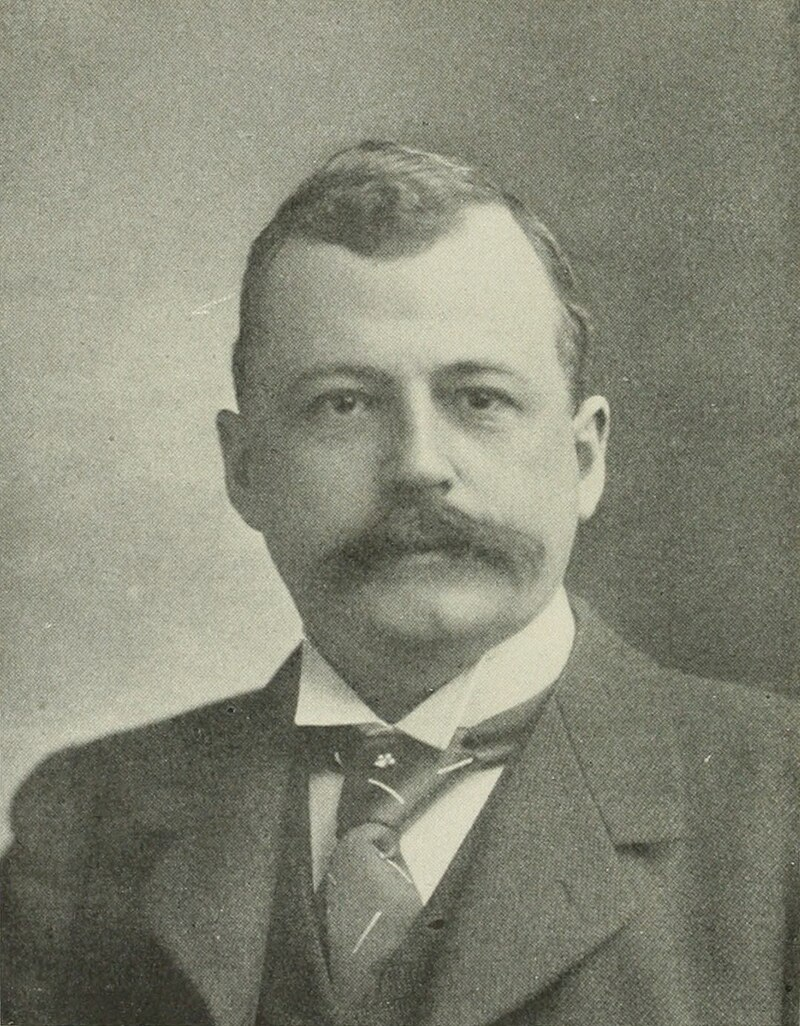
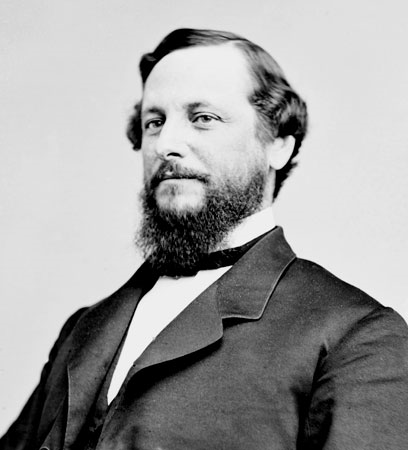
John A. Logan: War Hero, Dynamic Politician, and Father of Memorial Day


The foremost general to politician known of the postwar period was of course President Ulysses S. Grant. However, there were others who had worthy performances in battle and were in politics. One of these men was John Alexander Logan (1826-1886) of Illinois.

Early Years

Politics was in Logan’s blood and had been on his mind from the time he was quite young. When he was a teenager, he wanted to be the “Congressman of the United States”! (Logan Museum). What’s more, his father had served in the Illinois General Assembly as a staunch Jacksonian Democrat. Before Logan entered politics, he served in the Mexican-American War, but did not see battle. He won his first political office at the age of 23 when he was elected clerk of Jackson County in 1849. Logan also attended the University of Louisville and graduated in 1851, serving as prosecutor for Illinois’ Third Judicial District. But a year later, he was elected to the Illinois General Assembly, and proved a tremendously talented public speaker. Much of Logan’s politics in the 1850s didn’t suggest his future, particularly his politics on race. Logan was against any free black settlement in Illinois, and sponsored a law that prohibited all free blacks from settling in the state, capping their time there at 10 days, with a $50 fine for any who stayed longer and indentured servitude for those who couldn’t pay (Morris Library). He also supported testimony laws, or laws that barred non-whites from testifying in court. In opposition to a proposal that permitted blacks to testify in court, he stated, “It was never intended that whites and blacks should stand in equal relation” (Logan Museum). He was also staunchly anti-abolitionist, as he regarded abolitionists as a force in American politics that were endangering national stability. In 1858, he was elected to Congress from a southern Illinois district (known as “Little Egypt” because of several towns named after Egyptian cities) which had sympathies with the South and, like him, were staunchly anti-abolitionist. However, Logan was also first and foremost unionist, just like the man he supported for president in 1860, Senator Stephen A. Douglas. He warned that “The election of Mr. Lincoln, deplorable as it may be, affords no justification or excuse for overthrowing the republic. [We] cannot stand silently by while the joint action of extremists are dragging us to ruin” (Joyner, 17). In August 1861, two months after the death of Douglas, Logan announced that he was resigning Congress to serve in the Union Army and encouraged his voters to do the same. Although Little Egypt was once a region that was in doubt as to its allegiance, they moved behind Logan and the Union. None other than Ulysses S. Grant credited Logan with keeping the region loyal to the United States, writing, “Logan went to his part of the State and gave his attention to raising troops. The very men who at first made it necessary to guard the roads in southern Illinois became the defenders of the Union. Logan entered the service himself as colonel of a regiment and rapidly rose to the rank of major-general. His district, which had promised at first to give much trouble to the government, filled every call made upon it for troops, without resorting to the draft. There was no call made when there were not more volunteers than were asked for. That congressional district stands credited at the War Department to-day with furnishing more men for the army than it was called on to supply” (Mr. Lincoln’s White House). After all, not all Midwestern Democrats proved unionists like Logan – Senator Jesse Bright of Indiana was expelled for recommending an arms dealer to Confederate President Jefferson Davis in a letter dated March 1, 1861 (U.S. Senate).

Military Service

Most generals who had been politicians beforehand were pretty bad at it. Benjamin Butler, Ambrose Burnside, and Nathaniel Banks were among the worst generals of the War of the Rebellion, with the latter being known by Confederate troops as “Commissary Banks” for his bad habit of leaving behind supplies while retreating. Logan, however, proved a natural commander and there’s a strong argument that he was the best of the politicians turned generals, leading the successful effort to capture Vicksburg and performing valiantly at Fort Donelson and Corinth. He became known as “Black Jack” Logan for his dark hair and eyes. Logan could have gone further in the military but for General William T. Sherman’s well-founded skepticism of generals who came from politics. It was, however, in the case of Logan unjustified, and he resented military careerists for the rest of his life over this perceived slight (Army Historical Foundation). Although he was approached to run for Congress in 1862, he was committed to ensuring the preservation of the Union before resuming his career.

A Political Transformation

The War of the Rebellion changed Logan. While he had once been a staunch Jacksonian who was opposed to abolitionism and President Lincoln, he was by 1864 a strong supporter of President Lincoln and came to support abolishing slavery. Was the change opportunistic or out of principle? The latter certainly seems true on the question of black rights. In 1860, Logan attended the Democratic National Convention in Charleston, South Carolina, and according to his biographer Byron Andrews, writing in 1884, he “had for the first time in his life had the opportunity to see the horrors of slavery. He witnessed the brutal scenes of the auction block, where men were sold for a price like cattle” and “the revolting inhumanities of the slave pen” (Dunphy). This does not appear to be the only factor. Logan himself told a group of Union veterans that witnessing the bravery of blacks during the War of the Rebellion had ended his prejudices (Morris Library). Instead of blaming the most devastating war in American history on abolitionists, he now squarely blamed it on the institution of slavery. In 1866, Logan was again elected to Congress, this time as a Republican. In Congress, he supported the 14th and 15th Amendments and argued that “I don’t care whether a man is black, red, blue, or white” on the question of whether they should have suffrage (Morris Library). Like his fellow Union general and former Democrat Benjamin Butler, he was one of the House managers for the impeachment of President Andrew Johnson, whose Reconstruction policies were highly lenient on the South and didn’t take into account the rights of freedmen.

Father of Memorial Day

As one of the most prominent and celebrated Union veterans, Logan served as the third Commander-in-Chief of the Grand Army of the Republic, a powerful Union veterans organization that consistently pushed for more benefits for Union soldiers. On May 5, 1868, he proclaimed with General Order No. 11 a national day of remembrance for late and missing soldiers of the conflict in which their graves would be decorated to be held on May 30th, known as “Decoration Day”. This would come to be known as Memorial Day and adopted as a federal holiday in 1971.

Other Political Issues

Logan was a partisan Republican, although not necessarily the most strongly ideological. In the conflict within the GOP on civil service, Logan was decidedly a Stalwart. Although Stalwartism can perhaps be considered the more “conservative” position in that time, it was in keeping with Logan’s old Jacksonian philosophy, as it had been President Jackson who had instituted the spoils system in the first place. Logan was also not a consistent vote for higher tariffs, voting to reduce in some categories. In 1874, he came out in support of the Inflation Act in an effort to stimulate the economy in the midst of the Panic of 1873, as did many Republicans in the Midwest. President Grant vetoed the bill, being convinced by Secretary of the Treasury Hamilton Fish and Senator Roscoe Conkling (R-N.Y.) to do so. In the cartoon below, Logan along with Senators Simon Cameron (R-Penn.), Oliver Morton (R-Ind.) and Matthew Carpenter (R-Wis.) are caricatured:

Republican Senators Logan, Oliver Morton (Ind.), Simon Cameron (Pa.), and Matthew Carpenter (Wis.) looking disapprovingly on Thomas Nast, portrayed as asking pardon for condemning their support for greenbacks.

Logan was also one of the foremost advocates in the Senate of expanding veterans’ pensions and also supported the Blair Education Bill in the 1880s aimed at increasing literacy, especially among Southern blacks. He was named in the Credit Mobilier Scandal but was cleared of wrongdoing by the investigating Poland Committee.

The 1880 Presidential Election

In 1880, Logan along with other Stalwarts supported the candidacy of former President Ulysses S. Grant for a third term, but they were undone when the supporters of Senators Blaine of Maine, Sherman of Ohio, and Edmunds of Vermont unified to nominate dark horse candidate Congressman James A. Garfield. Logan himself had interest in the presidency, but this would have to wait.

The 1884 Presidential Election and Future Prospects


In 1884, James G. Blaine, now regarding himself as a “Half-Breed”, provided balance to the GOP ticket by picking Midwestern Stalwart Logan. Logan was a solid choice as he had a strong personal following among Union veterans and black voters, due to his exemplary war record and strong support for civil rights respectively. The latter were facing increasing difficulties in having their vote counted in the South post-Reconstruction due to a combination of voter fraud, laws aimed at restricting the black vote, intimidation, and violence. The Blaine-Logan ticket lost in one of the narrowest presidential contests in American history, and Logan was bitter over the loss.

Logan continued his work in the Senate after this loss, and it was a real possibility that he would be running for president in 1888. He worked very hard on his duties in the Senate in the meantime, to the point that it compromised his immune system. By December of 1886 he developed acute rheumatism, and although it appeared he was recovering, his condition deteriorated over a period of close to two weeks, with an illness that caused fever, delirium, and lethargy, and died on December 26th (Beaverton Historical Society). Logan had worked himself to death, and he was far from the last senator to do so. His death reminds me of Stephen Douglas’s in 1861 in its untimeliness, and that his demise cut short a career that otherwise had the potential to lead to greater things. His DW-Nominate score was a 0.215 and had he been elected president, he would likely as had Benjamin Harrison made great efforts on behalf of Union veterans and black voters. One figure who mourned the loss of Logan was Frederick Douglass, who lauded him as “the dread of traitors, the defender of loyal soldiers, and the true friend of newly made citizens of the Republic. Much was predicated for our cause on this man’s future. But he, too, in the order of Providence, has laid off his armor” (Dunphy).

References

Dunphy, J.J. (2023, February 3). Logan repudiated his early racism, deserves stamp. The Telegraph.

Retrieved from

https://www.thetelegraph.com/opinion/article/john-logan-repudiated-early-racism-deserves-stamp-17761578.php

Expulsion Case of Jesse D. Bright of Indiana. U.S. Senate.

Retrieved from

https://www.senate.gov/about/powers-procedures/expulsion/040JesseBright_expulsion.htm

General John A. Logan, Memorial Day Founder. Army Historical Foundation.

Retrieved from

https://armyhistory.org/general-john-a-logan-memorial-day-founder/

John A. Logan – Death of the Illustrious Soldier and Statesman, Which Event Occurred At His Home In Washington December 26. Beaverton Historical Society.

Retrieved from

http://www.gladwinhistory.org/obits/Logan_John_A.html

John Alexander Logan, 1826-1886. SCRC Virtual Museum at Southern Illinois University’s Morris Library.

Retrieved from

https://scrcexhibits.omeka.net/exhibits/show/sihistory/poststatehood/logan#:~:text=During%20his%20first%20session%20in,Illinois%20longer%20than%20ten%20days.

Joyner, B. (2012). Dirty Work: The Political Life of John A. Logan. Eastern Illinois University.

Retrieved from

https://www.eiu.edu/historia/2012Joyner.pdf?itid=lk_inline_enhanced-template

Logan, John Alexander. Voteview.

Retrieved from

https://voteview.com/person/5746/john-alexander-logan

Political Life. Logan Museum.

Retrieved from

https://loganmuseum.org/political-life/

The Generals and Admirals: John A. Logan (1826-1886). Mr. Lincoln’s White House.

Retrieved from

https://www.mrlincolnswhitehouse.org/residents-visitors/the-generals-and-admirals/generals-admirals-john-logan-1826-1886/

Henry Teller: Champion of the West

When it comes to the first senators of states, not all have had impressive starts with who they sent. However, one of Colorado’s was unquestionably a man of tremendous influence and staying power in Henry Moore Teller (1830-1914).

Although a New Yorker by birth, Teller as a young man made his way west to seek his fortune as an attorney for miners. He was from the beginning of his time in politics opposed to slavery and joined the Republican Party in the 1850s. Settling in the Colorado Territory, Teller aimed to grow the region. Like many prominent Republicans of his day, he was a businessman, establishing with Edward L. Berthoud and William A.H. Loveland the Colorado Central Railroad, with him serving as president for five years. Although Teller is noted for his opposition to the Dawes Act, many of his actions were in opposition to Indian tribes as independent of society. From 1863 to 1865, he led the Colorado militia in campaigns against the Cheyenne and Arapaho tribes.


In 1876, the state of Colorado, after multiple attempts from Republicans to admit the state to the Union, is finally admitted. Sworn in as its first senators are Teller and Jerome B. Chaffee on November 15th. Chaffee didn’t remain in the Senate too long, but Teller became a mainstay in American politics for over thirty years. His record in the Senate was as a moderate Republican, and consistently supportive of bimetallism as a policy, as opposed to the favored stance of the Republican Eastern establishment of the gold standard. Silver currency stimulated the mining of silver in the West and was inflationary, thus serving to help indebted farmers reduce their debt. Thus, Teller voted to override President Hayes’ veto of the Bland-Allison Silver Purchase Act, establishing bimetallism as a policy. In 1882, President Chester Arthur nominated Teller to the post of interior secretary.

Interior Secretary

As Interior Secretary, Teller supported measures aimed at forcibly assimilating Indians into American society, including legal penalties for continuing to engage in certain tribal practices. He saw them continuing their practices as holding them back from advancement in white society and wished them to convert to Christianity. Teller also backed opening numerous Indian lands to white settlement and was strongly favorable to developing the west. After the election of Grover Cleveland, Teller was out of the Interior Department but back in the Senate.

Teller Returns to the Senate: Opposition to the Dawes Act and to Edmunds-Tucker Act

The Dawes Act of 1887 probably deserves more coverage than I’m giving it here, but it was in short an attempt at social engineering American Indian tribes to adopt individual property ownership instead of the concept of communal property, thus furthering assimilation policy. The law proved catastrophic for Indian tribes in its land allotment scheme; during the life of the Dawes Act they lost 90 million acres of land (or 2/3’s of the holdings they had in 1887), with at least some of it obtained through fraud. Teller strongly opposed allotment, warning that it would serve “to despoil the Indians of their lands and to make them vagabonds on the face of the earth” and held that “the real aim [of allotment] was to get at the Indian lands and open them up to settlement. The provisions for the apparent benefit of the Indians are but the pretext to get at his lands and occupy them. … If this were done in the name of greed, it would be bad enough; but to do it in the name of humanity … is infinitely worse” (Otis, 18-19).

Interestingly, although Teller did not vote on the Edmunds-Tucker Act in 1887 which disincorporated the Church of Latter-Day Saints for polygamy, it was clear he opposed it as excessively harsh, a pretty lonely stance within the GOP, which had in its 1856 platform regarded polygamy and slavery as twin evils.
Teller was ultimately a deeply respected senator in Colorado not only for his politics transcending his party affiliation but also for his advocacy for the West. He was known as the “defender of the West” and as “Colorado’s Grand Old Man” (Straayer). However, the state’s “Grand Old Man” would not remain with the “Grand Old Party”.

Estrangement from the GOP


The Panic of 1893 plunged the United States into the worst depression it had faced thus far, with rural areas especially suffering. After the repeal of the Sherman Silver Purchase Act of 1890, the repeal being backed by Bourbon Democrats and conservative Republicans, Colorado’s economy suffered horribly with numerous residents looking to leave. Although Teller opposed the Gorman-Wilson Tariff in 1894 like the other Republicans, he also supported keeping the provision imposing an income tax on the wealthy.
In 1896, Teller led the walkout of the Republican National Convention when a bimetallism plank was overwhelmingly defeated (Larson, 189). Thus, he and other Republican politicians from the West refused to support William McKinley and formed the “Silver Republican Party” in protest, which backed Democrat William Jennings Bryan.

Final Years in Office: McKinley and Roosevelt

Although Teller historically supported Republican tariff policy, he opposed the Dingley Tariff in 1897, not wanting to support the GOP on this one if they would no longer accommodate bimetallism. In 1898, he sponsored the Teller Amendment, which put the Senate on record in opposition to the U.S. annexing Cuba in the aftermath of the Spanish-American War. The US would only remain in Cuba until 1902. The Silver Republican Party as a faction came to an end after the 1900 election given the passage of the Gold Standard Act and the economy had recovered by that point, but Teller did not return to the GOP as many Silver Republicans did. He switched to the Democratic Party and helped build up its support in Colorado. Teller was an interesting addition to the Democratic Party as he did not necessarily change all his core values when he entered their party, for instance retaining his old party’s Lincolnian legacy on blacks, which was beginning to make minor strides in the Democratic Party of the early 1900s. Teller did also support increasing spending on the US navy, consistent with the view of influential author Admiral Alfred Thayer Mahan that the great powers of history had strong navies. By 1909, he was 78 years old and opted not to have another term. His DW-Nominate score was a 0.161, reflecting an overall moderate record. Teller departed public life in 1912 and died on February 23, 1914. The state of Colorado has numerous places named in his honor, most notably Teller County.

References

Buys, C.J. Henry Teller. Colorado Encyclopedia.

Retrieved from

https://coloradoencyclopedia.org/article/henry-teller


Holsinger, M.P. Henry M. Teller and the Edmunds-Tucker Act. Colorado Magazine, 48(1), 1-14.


Retrieved from


https://www.historycolorado.org/sites/default/files/media/document/2018/ColoradoMagazine_v48n1_Winter1971.pdf


Larson, R.W. (2013). New Mexico’s quest for statehood, 1846-1912. Albuquerque, NM: University of New Mexico Press.

Retrieved from

https://www.google.com/books/edition/New_Mexico_s_Quest_for_Statehood_1846_19/6OlME56WpfAC?hl=en&gbpv=1&pg=PA189&printsec=frontcover

Otis, D.S. (1973). The Dawes Act and the allotment of Indian lands. Norman, OK: University of Oklahoma Press.

Straayer, J.A. Teller, Henry (1830-1914). Encyclopedia of the Great Plains.

Retrieved from

http://plainshumanities.unl.edu/encyclopedia/doc/egp.pg.080

Teller, Henry Moore. Voteview.

Retrieved from

https://voteview.com/person/9246/henry-moore-teller

George F. Edmunds: The Staunchest of the Half-Breeds


For some reason I’ve lately been on a bit of a kick for the politics of the late 19th century. There’s something tremendously fascinating about the Gilded Age as well as interpretations of the time period. From the celebrity status of numerous of its politicians to how to examine the era ideologically, it is a subject of great attention. The Gilded Age has often been characterized as a time of high partisanship but with low ideological substance, and there seems to be some truth to that. The issue of civil rights in this time was overwhelmingly partisan, with some regionality coming out on the matter of racial discrimination in interstate commerce. Both parties had inflationary wings on currency questions, although the inflationary wing was stronger among Democrats than Republicans. Republicans in this time were the party of more centralized power while the Democrats were the party of state’s rights. However, Republicans thought of this in the Hamiltonian sense, that the purpose of the government was to assist private enterprise through the imposition of protective tariffs and using such funds to build up national infrastructure, such as canals, bridges, and roads. The business ethos of the old Federalists and their emphasis on property rights is strongly alive in the modern GOP. The greatest issue that divided the parties was one that frequently served as a subject of partisan division throughout America’s history: the protective tariff.

A reformer figure in the GOP at the time was Senator George Franklin Edmunds (1828-1919) of Vermont. Edmunds was not quite as recognized in his time as his fellow Vermonter Justin Morrill, who sponsored some critical legislation in his day that still benefits many Americans, such as the Morrill Land Grant Acts that resulted in the establishment of many of the US’s universities. Elected to the Senate in 1866 following the death of Senator Solomon Foot, Edmunds proved an independent thinker. Although in some key fundamentals he could be thought of as conservative, such as his staunch support for anti-inflationary monetary policy as well as his frequent backing of tariffs, he was also often in opposition to the interests of the railroads and shipping industry and was during the 1870s and 1880s perhaps the foremost supporter of civil service reform in the Republican Party. Edmunds also served as chairman of the powerful Judiciary Committee from 1872 to 1879 and again from 1882 to 1891. He played a considerable role in the effort to convict President Andrew Johnson in 1868, falling short by a single vote. The Stalwarts called Edmunds and his band of reformers the “Half-Breeds” in that they were “half-hearted” Republicans. The term “RINO” springs to mind today. Edmunds made friends across the political aisle in his time, with his closest friendship being with Democrat Allen G. Thurman of Ohio, who he sometimes worked with on efforts to curb railroad power.

Electoral Commission

The 1876 election was one of the most contentious elections in American history, with threats of another War of the Rebellion in the air. One of the elected officials appointed to the Electoral Commission to decide the election was Edmunds. The commission’s vote ended up being 8-7 that Hayes won the election, the vote corresponding with the political affiliations of the members. Although this and the arrangement that put Hayes in office prevented a resumption of armed national division, it came at a price. Civil rights advancement for Southern blacks was hindered with the end of Reconstruction and they gradually would be rendered completely politically neutralized by Jim Crow voting laws.

Edmunds and Civil Rights

If Edmunds was thought of as a “Half Breed” for his support of civil service reform, he unwaveringly stood for black voting rights in the South and he enjoyed baiting Southern senators into making ill-considered outbursts that embarrassed the Democrats. In 1880, a Southern journalist expressed the sort of enmity that many white Southerners in politics shared for him, “When I look at that man sitting almost alone in the Senate, isolated in his gloom of hate and bitterness, stern, silent, watchful, suspicious and pitiless, I am reminded of the worst types of Puritan character…You see the impress of the pure persecuting spirit that burned witches, drove out Roger Williams, hounded Jonathan Edwards for doing his sacred duty, maligned Jefferson, and like a toad squatted at the ear of the Constitution it had failed to pervert” (Adler, 202).

Presidential Aspirant

Edmunds was a contender for the Republican nomination for president in 1880 and 1884, but he was not a major contender, and his latter bid was undercut when it was found out that on the side, he was accepting retainers for legal services for railroads and corporations. Although this was legal at the time and certainly not as damaging as Blaine’s scandal was, it was controversial. Although such payments do not appear to have impacted his judgment surrounding corporate interests and railroad legislation given that he far from always voted for proposals that benefited them.

In 1882, Edmunds was nominated to the Supreme Court by President Chester Arthur after the Stalwart of Stalwarts Roscoe Conkling refused to accept a seat, but twice refused, the post ultimately going to Samuel Blatchford. It is a commentary on the power of a senator in this time that refusing a Supreme Court nomination could be considered an optimal move. Indeed, the presidents of the Gilded Age were known as “custodial presidents” as the role was perhaps more limited in this time than any other. Starting with the dismal presidency of Andrew Johnson, a man who even his defenders acknowledged was a weak leader, the role of president was in practice subordinated to that of Congress.

In 1884, he was a minor contender for the presidency, but some prominent future politicians backed his campaign, including future President Theodore Roosevelt and future Senator Henry Cabot Lodge. After Blaine won the nomination, Edmunds refused to support his campaign, regarding him as a phony Half-Breed. He wrote of him, “It is my deliberate opinion that Senator Blaine acts as the attorney of Jay Gould. Whenever Mr. Thurman and I have settled upon legislation to bring the Pacific Railroad to terms of equity with the government, up has jumped Mr. James G. Blaine musket in hand, from behind the breastworks of Jay Gould’s lobby to fire in our faces” (Ward, 130). Although Edmunds himself didn’t endorse Cleveland, many of his supporters were “Mugwumps”, or Republicans who, inspired by Cleveland’s good government ethics, voted for him. Edmunds hardly did worse for Blaine than Roscoe Conkling, who when asked if he would campaign for Blaine stated, “Gentlemen, you have been misinformed. I have given up criminal law” (Cooper). Although Blaine often gets seen as a Half-Breed historically including formerly by me, Edmunds had a point about him and he was really somewhere in between the Stalwarts and the Half-Breeds as he had opposed President Hayes’ pushes for civil service reform. Despite Edmunds’ refusal to endorse Blaine, possibly tipping the scales to Cleveland given how incredibly close the election was, he pulled off a resounding victory in his reelection bid in 1886.

Anti-Polygamy Legislation

Edmunds was the point man in the Senate in cracking down on polygamy, sponsoring two laws in opposition. First was the Edmunds Act in 1882, which provided for enforcement of the Morrill Anti-Bigamy Act, making the practice of polygamy a criminal offense punishable by up to 5 years in prison and stripped numerous civil rights from polygamists, including suffrage, holding public office, and serving on juries (Cornell University). President Lincoln had suspended enforcement during the War of the Rebellion as an incentive for Brigham Young to keep out of the conflict. This law was followed up with the Edmunds-Tucker Act in 1887, which disincorporated the Church of Latter-Day Saints and the Perpetual Emigration Fund for promoting polygamy. These stances were entirely consistent with the Republican Party’s foundation, as in its first convention in 1856 their platform had condemned polygamy and slavery as the “twin relics of barbarism”. The law passed by such a margin that it would be overridden if President Cleveland vetoed it, but he didn’t like the law either, so he simply let the act become law without his signature. The Edmunds-Tucker Act would be repealed in 1978.

Anti-Trust Legislation

In 1890, Senator Edmunds turned his sights on the growing power and influence of trusts. Despite the name of the Sherman Anti-Trust Act, Senator John Sherman of Ohio was only the senator who introduced the measure, and it was quite vague in concept, something that Edmunds feared had potential to curb honest private enterprise (Welch, 70). He worked with George Frisbie Hoar (R-Mass.) to finalize the measure. Edmunds also insisted on unions being subject to anti-trust laws (Encyclopedia Britannica). The approach of Edmunds and Hoar was in keeping with the philosophy of the Half-Breeds on business. As historian Richard E. Welch (1968) writes, “The Half-Breeds distrusted the growing economic and political power of industrial combinations, but distrusted even more those who would endanger economic expansion by indiscriminate attacks on Big Business” (70). The Republicans of old were quite far from New Dealers in philosophy, including the Half-Breeds. Both Edmunds and Hoar saw the legislation as preserving free enterprise while providing the legal framework to curb bad actors.

Post-Senate Legal Career

In 1891, Edmunds resigned the Senate to practice law in Philadelphia. Edmunds’ DW-Nominate score seems to reflect his independence well, with him getting a 0.274. As an attorney, he tackled numerous major cases, his foremost one was arguing for the unconstitutionality of the income tax before the Supreme Court in Pollock v. Farmers’ Loan & Trust Co. (1895), which he won on a 5-4 vote. Despite his high minded stances, Edmunds was condemned as a “senatorial bribe-taker” in 1921 by Richard Pettigrew, a former South Dakota Republican senator who by that time had become a pro-Bolshevik radical (Pettigrew, 215-16). He was referring to Edmunds getting paid retainers for legal counsel by railroads and corporations while in office that impacted support for him in 1884. After his legal career, Edmunds retired to Pasadena, California. In 1910, he publicly came out against the proposed 16th Amendment (income tax) and explained his reasons in an open letter to Vermont Senator William Dillingham. He outlived most of his Gilded Age colleagues and even lived to see the death of Theodore Roosevelt, dying on February 27, 1919 at the age of 91. Although he has a public school named after him in Burlington, Vermont, ironically the foremost places named after him are on the other side of the nation: the city of Edmonds, Washington, is actually a clerical error, a misspelling of Edmunds (Edmonds Historical Museum, 47). The Edmunds Glacier of Mount Rainier, Washington, is also named after him.

George Edmunds reminds me in some ways of Nikki Haley. Note that I wrote in some ways, as she has been willing to support the front-runner. I doubt the same could be said for Edmunds if he were serving today. His concerns about Blaine seem a bit quaint compared to what has been alleged about the current front-runner. Perhaps Edmunds knew his career could survive a repudiation of Blaine’s candidacy while many other Republicans know that many of their primary voters seem to trust in whoever Trump endorses. And they’d better be on his endorsement list come primary time.

References

Adler, S. (1934). (Ph. D. diss.) The Senatorial Career of George Franklin Edmunds, 1866-1891. University of Illinois.

Retrieved from

https://www.proquest.com/openview/5a1ec9695f4ff3222b436aeb730f4760/1?pq-origsite=gscholar&cbl=18750&diss=y

Cooper, J. (2000, March 3). Rum, Romanism, and Rebellion: The Election of 1884. Hope Charter School.

Retrieved from

https://www.hopecharter.org/~johncooper@prodigy.net/john-cooper/rum-romanism-and-rebellion-the-election-of-1884

Edmunds Anti-Polygamy Act of 1882. Cornell Law School.

Retrieved from

https://www.law.cornell.edu/wex/edmunds_anti-polygamy_act_of_1882#:~:text=The%20Edmunds%20Act%20suppressed%20different,on%20juries%20in%20federal%20territories.

Edmunds, George Franklin. Voteview.

Retrieved from

https://voteview.com/person/2855/george-franklin-edmunds

Federal Income Tax; Ex-Senator Edmunds States His Reasons Against Proposed Amendment. (1910, February 15). The New York Times.

Retrieved from

https://www.nytimes.com/1910/02/15/archives/federal-income-tax-exsenator-edmunds-states-his-rea-sons-against.html

George F. Edmunds Dead at 91 Years. (1919, February 27). The New York Times.

Retrieved from

https://timesmachine.nytimes.com/timesmachine/1919/02/28/118144241.pdf

George Franklin Edmunds. Encyclopedia Britannica.

Retrieved from

https://www.britannica.com/biography/George-Franklin-Edmunds

Pettigrew, R.F. (1921). Triumphant plutocracy: the story of American public life from 1870 to 1920, 215-16.
The Founding and Beginning of Edmonds, Washington, 1876-1906. Edmonds Historical Museum.

Retrieved from

https://web.archive.org/web/20120601144837/http://www.historicedmonds.org/TTManual.pdf

Ward, B. (2019). The Downfall of Senator George F. Edmunds: The Election of 1884. Vermont History, 87(2).

Retrieved from

https://vermonthistory.org/journal/87/VH8702DownfallOfEdmunds.pdf

Welch, R.E. (1968). George Edmunds of Vermont: Republican Half-Breed. Vermont History, 36(2).

Retrieved from

https://vermonthistory.org/journal/misc/GeorgeEdmunds.pdf

The Strutting Senator: Roscoe Conkling

Most people do not know of senators from history, especially those who did not run for president. One senator who is very much worth remembering, however, is Roscoe Conkling of New York (1829-1888). His iron political grip on New York, a vital swing state in his time, produced divisions within the Republican Party itself.


In 1858, the Republican Party was a young organization, and elected to Congress from New York that year was Roscoe Conkling. Formerly the mayor of Utica, Conkling was such a striking figure in Washington that if he were serving today, one might call him “Congressman Chad”. By profession a successful lawyer, he was a strapping young buck who was always committed to self-improvement. This meant strength of body and mind, making him exercise a great deal including through horseback riding and boxing. Conkling was also tremendously well-read, and his memory was such that he could read books and documents and be able to recite much of them afterwards. He could deliver speeches for hours without stumbling on a single word or losing anyone’s attention. Conkling also did not smoke and seldom drank. All this, including his height of 6’3″ and his reputation as “Lord Roscoe” made him a hit with the ladies of Washington. When Republican representatives were concerned for the safety of the aging Thaddeus Stevens (R-Penn.) as his words for Southern Democrats were often harsh, considering the brutal beating inflicted on Senator Charles Sumner in 1856, Conkling served as his bodyguard. He condemned President Buchanan during the secession crisis as being “petrified by fear, or vacillating between determination and doubt, while the rebels snatched him from his nerveless grasp the ensign of the Republic, and waved before his eyes the banner of secession…” (National Park Service, Part 1). However, there were negative aspects to Conkling. He wasn’t particularly popular among his fellow legislators, as he had a well-deserved reputation for arrogance. Conkling was humorless, often disagreeable, easily offended, and was known to strut about as opposed to walk. This, combined with him having a distinctive blonde curl on his forehead as well as his loudly colored vests and bowties, made him a gold mine for political cartoonists of the era.

Conkling was on much better terms with Buchanan’s successor, Abraham Lincoln. Although his first choice had been Senator William Seward of New York, Conkling stood by Lincoln. While he often backed typical Republican positions such as high tariffs with the Morrill Tariff, he didn’t always agree with the president. For instance, he voted against the Legal Tender Act of 1862, refusing to accept fiat paper currency even as an emergency measure. That year, Conkling lost reelection to War Democrat Francis Kernan, his former law professor. Conkling in turn defeated Kernan for reelection in 1864, but both men remained good friends throughout. After the War of the Rebellion, Conkling stood as a Radical Republican. To be clear, the term “Radical Republican” means believing in a punitive approach to the South as well as strongly standing for the rights of freedmen and has no greater issue implications for the politics of the time. He clashed not only with Democrats but also with his fellow Republicans, including prominent ones in James G. Blaine and James A. Garfield. It was particularly bitter with the former, and their bad relations began in 1866, when after several exchanges on the House floor Blaine said, “The contempt of that large-minded gentleman is so wilting; his haughty disdain, his grandiloquent swell, his majestic, super-eminent, overpowering turkey-gobbler strut has been so crushing to myself and all the members of this House that I know it was an act of the greatest temerity of me to venture upon a controversy with him” (National Park Service, Part I). Conkling never forgave Blaine and would continually battle him for power and influence in the Republican Party. In 1867, Congressman Conkling became Senator Conkling.


The Senate


In the Senate, Conkling staunchly supported the impeachment of President Andrew Johnson, and the effort to convict him fell only one vote short. When it came to presidents, he would easily have his best relationship with Johnson’s successor, Ulysses S. Grant. Conkling undoubtedly found his greatest ally in his good friend Grant. He at the time was competing with Reuben Fenton, New York’s other senator, for patronage in the state, and he was quite the success on that front. Fenton thought it was a good idea to suck up to Grant, which he despised, and by contrast respected Conkling sticking to his guns respectfully (National Park Service, Part II). Grant thus heeded Conkling on many matters, including who to appoint to positions in New York, especially the customs collector of the Port of New York, the port that took in the most tariff revenue. Conkling selected Thomas Murphy for the position, but Murphy proved so antagonistic to other Republicans that he was replaced with Chester Arthur in 1871, a highly competent administrator loyal to Conkling. Chauncey Depew, a railroad executive and a senator himself, attested to his rise to power, “Conkling was a born leader, very autocratic and dictatorial…He immediately began to remove [Reuben] Fenton officials and to replace them with members of his own organization. As there was no civil service at that time and public officers were necessarily active politicians, Senator Conkling in a few years destroyed the organization which Fenton had built up as governor, and became master of the Republican party in the State” (The Lehrman Institute). Conkling’s power got to the point that anyone who wanted to have a state job had to get his seal of approval. Elihu Root, a GOP statesman, further attested to Conkling’s power, “I do not remember how many years, Mr. Conkling was the supreme ruler in this state; the Governor did not count, the legislatures did not count; comptrollers and Secretaries and what-not, did not count. It was what Mr. Conkling said” (Lamphier, 135).


In 1873, Grant nominated Conkling to succeed the late Salmon P. Chase as chief justice of the Supreme Court, a position he declined…he preferred to run his New York machine and saw himself as Grant’s successor. He also assisted Grant in numerous ways, such as when he led the push to oust Charles Sumner from his chairmanship of the Senate Foreign Relations Committee after his opposition proved key to the defeat of the annexation of Santo Domingo (now known as the Dominican Republic). The president often heeded his advice on legislation as well; for instance, both he and Secretary of the Treasury Hamilton Fish, economic conservatives, advised him to veto the popular Inflation Act of 1874, which he did. The following year, to the gratitude of black Americans, Conkling walked black Senator Blanche K. Bruce of Mississippi down the Senate aisle. This was a task usually reserved for the senator’s colleague in the state, but Mississippi Senator James Alcorn, a rival who would later support the disenfranchisement of black voters in Mississippi, wanted nothing to do with Bruce. Conkling and Bruce developed a close friendship, and numerous black parents would name their boys “Roscoe Conkling” in the following years in his honor, Bruce himself being among them.


In 1876, Conkling ran for the Republican nomination, but after his bid failed to attract much support, he managed to score a victory by pledging New York to Rutherford B. Hayes, thereby blocking former Speaker James G. Blaine’s path to the White House. After Hayes came out for civil service reform during the presidential campaign, Conkling’s efforts for Hayes slowed down, and Hayes lost New York in the presidential election. Had he won New York, there would have been no Constitutional crisis from this election. Incidentally, Conkling ended up believing that Hayes had actually lost the election and gave a propagandistic assist to Democrats by referring to him by the names they did, such as “Rutherfraud B. Hayes” and “his fraudulency”. Conkling derided civil service reform as “snivel service reform”, believing that state politicians should have free reign in their state’s affairs, a most convenient principle for him. He was not personally corrupt…no evidence has arisen that he profited from his office and although he was a target of investigation for the Credit Mobilier Scandal, documentary evidence cleared him of wrongdoing. Conkling had made his fortune legitimately; he hungered for power rather than money. However, numerous underlings were corrupt and profited off their offices.


As president, Hayes tried to appoint people to prominent positions in New York independent of Conkling’s approval. This resulted in several failed nominations, including one Theodore Roosevelt Sr. for customs collector for the Port of New York, the post formerly held by Conkling man Chester Arthur, who Hayes had fired. Ultimately Hayes managed to replace Conkling men Arthur and Alonzo Cornell with Edwin Merritt and Silas Burt in 1879. He did, however, consistent with his position favoring hard money, back Hayes’ veto of the bimetallist Bland-Allison Act in 1878.


Indiscretions in Washington


I mentioned earlier that Conkling was a hit with the ladies, but he was married. While he denied accusations that he was a womanizer, it was an open secret in Washington was that he was carrying on an affair with Kate Chase Sprague, the wife of former Senator William Sprague of Rhode Island, an insecure narcissist and abusive alcoholic. His only great virtue for the marriage seemed to be his wealth, much of the latter he had lost in the Panic of 1873. There was a rather famous incident surrounding this in 1879 in which Sprague chased Conkling out of his home with a shotgun.


Conkling Goes to Bat for Grant: 1880


Senator Roscoe Conkling, keen to have a Stalwart in office as opposed to Rutherford B. Hayes, who had through his single term crossed him in multiple ways, pushed for Grant get the nod again. There was indeed a real chance this could happen, but Grant had competition in former Senator John Sherman of Ohio as well as Conkling’s old rival Blaine. Although Grant won the first ballot, the threshold for winning the nomination wasn’t reached until the 35th ballot, by which point Sherman and Blaine had thrown their support to the dark horse candidate, Congressman James A. Garfield of Ohio. To please the Stalwarts, Conkling’s old right-hand man, Chester Arthur, was selected as the nominee for vice president.


Conkling vs. Garfield


President Garfield, like his fellow Ohioan Hayes, challenged Conkling’s authority in his nominations. He nominated a candidate for customs collector of the Port of New York in William Robertson, a former Fenton man, and in response Conkling “raged and roared like a bull for three mortal hours” and decried a violation of “senatorial courtesy” to which Garfield responded that he was the president rather than “the registering clerk of the United States Senate” (U.S. Senate). After Garfield was able to secure his nominee for customs collector of the Port of New York, Conkling and his protege, Senator Thomas C. Platt, resigned the Senate in protest on May 16, 1881, so they could be reelected by the state legislature in a show of power and support in New York. However, the men had miscalculated in trying to make loyalty to Garfield or loyalty to Conkling an issue for the state legislature, and in the meantime Garfield had been shot by Charles Guiteau, a deranged office-seeker who when he did it proclaimed, “I am a Stalwart” (Mitchell). The state legislature instead elected Republicans Elbridge Lapham and Warner Miller to the Senate. With this failed gambit, Conkling’s political career was over, and he returned to practicing law. Conkling’s DW-Nominate score stands at a 0.306, on the right side of Republican senators of his time. Platt would become a political boss in his own right but would not return to the Senate until 1897.


Although President Arthur nominated Conkling to the Supreme Court and the Senate voted to confirm him, he refused to serve. There were two reasons for Conkling to do so. First, he wanted a more active lifestyle than the Supreme Court would give him, and second, he was bitter over Chester Arthur’s embrace of a civil service, viewing it as a betrayal. Conkling to this day is one of only two men to refuse a Supreme Court nomination twice.


Conkling and the 14th Amendment as a Vehicle for Corporate Rights


In 1882, Conkling argued before the Supreme Court in San Mateo County v. Southern Pacific Railroad Company that as a member of the Joint Committee on Reconstruction, which drafted the 14th Amendment, that there was a debate about the distinction between “persons” and “citizens” and that this debate revealed that corporations were intended for coverage. Although enhanced legal protections for corporations certainly fit the ideology of the former Whigs, of which central framer John A. Bingham of Ohio and Conkling were formerly of, 14th Amendment scholar Howard Jay Graham found in the 1960s that Conkling had almost certainly deliberately misrepresented and misquoted the Globe regarding Congress’s proceedings to help his client. While the idea of corporations as persons as a legal fiction predates the adoption of the 14th Amendment, it is understandable that this episode would give people the idea that the concept was born in illegitimacy.


Conkling vs. The Great Blizzard of 1888


On March 12, 1888, New York City faced the Great Blizzard of 1888, and although Conkling could have taken a carriage to get from his office to his home, but the carriage driver was charging an exorbitant (although affordable for Conkling) rate, which he refused to pay and opted to walk the three miles home. Conkling made it to Union Square, about halfway to his destination, before collapsing from exposure. Although this episode was of some embarrassment to him, it was much worse than that; it had weakened his immune system and he contracted pneumonia. This pneumonia progressed into meningitis, which killed him on April 18th at the age of 58. Both Conkling’s end in politics and of life was brought about by his own arrogance. As Chauncey Depew said of him, “Roscoe Conkling was created by nature for a great career” and that his lost potential “was entirely his own fault. Physically he was the handsomest man of his time. His mental equipment nearly approached genius…His oratorical gifts were of the highest order, and he was a debater of rare power and resources. But his intolerable egotism deprived him of the vision necessary for supreme leadership….[H]is wonderful gifts were wholly devoted to partisan discussions and local issues” (National Park Service, Part II).


References


Both New York Senators Resign. United States Senate.


Retrieved from


https://www.senate.gov/about/origins-foundations/parties-leadership/new-york-republican-senators-resign.htm


Conkling, Roscoe. Voteview.


Retrieved from


https://voteview.com/person/1984/roscoe-conkling


Graham, H.J. (1968). Everyman’s Constitution. Madison, WI: State Historical Society of Wisconsin.


Retrieved from


https://celdf.org/wp-content/uploads/2015/08/everyman_s-constitution-graham-Conspiracy-Theory-web.pdf


Lamphier, P.A. (2003). Kate Chase and William Sprague: politics and gender in a Civil War marriage. Omaha, NE: University of Nebraska.


Mr. Lincoln and New York: Roscoe Conkling. The Lehrman Institute.


Retrieved from


https://www.mrlincolnandnewyork.org/new-yorkers/roscoe-conkling-1829-1888/


Mitchell, R. (2022, February 27). The senator who said no to a seat on the Supreme Court – twice. The Washington Post.


Retrieved from


https://www.washingtonpost.com/history/2022/02/27/roscoe-conkling-supreme-court/


O’Grady, J. (2015, January 27). Bad Idea: The Most Powerful Man in America Walks Home Through the Blizzard of 1888. WNYC News.


Retrieved from

https://www.wnyc.org/story/bad-idea-most-powerful-man-america-walks-home-through-blizzard-1888/

The Remarkable Roscoe: Friend and Nemesis of Presidents (Part I). National Park Service.

Retrieved from

https://www.nps.gov/articles/000/the-remarkable-roscoe-friend-and-nemesis-of-presidents-part-i.htm

The Remarkable Roscoe, Part II. National Park Service.

Retrieved from

https://www.nps.gov/articles/000/the-remarkable-roscoe-part-ii.htm

The Confederate Sympathizers of Oregon

In 1859, the state of Oregon was admitted to the union. By the time of the election of Abraham Lincoln, the state’s two senators were Republican Edward Baker and Democrat Joseph Lane. Baker, formerly an Illinois politician and a close friend of Abraham Lincoln’s, would serve as a colonel in the War of the Rebellion and would be the only senator killed in the conflict, and indeed he has the distinction of being the only senator killed in any military conflict. Joseph Lane was a different story.

Joseph Lane


Joseph Lane (1801-1881) was described by his friend, Robert Dale Owen, an Indiana Democrat (and socialist) thusly, “In politics Gen. Lane is a Democrat of the Jefferson and Jackson school…His native powers of debate and his intimate acquaintance with facts and records have enabled him at all times, in political and Presidential conflicts on the “stump,” to overwhelm the opponents of Democracy” (Southern Oregon History, Revised). He had served as the first governor of the Oregon Territory under President Polk after several military successes in the Mexican-American War, and in this position, he combatted Indian tribes as well as negotiated and signed two treaties with them.

A North Carolinian by birth and upbringing, he served as both a defender of slavery (not a popular position there, despite the state’s NIMBY provision regarding black people in its original constitution). Most unacceptably for the people of Oregon, however, he also defended secession, and as such a prominent Northerner to do so he was nominated for vice president by the Southern Democrats. Lane had presidential ambitions, and if a fusionist scheme in the Electoral College had succeeded, Lane would have been president (John, 2014). One of his sons, John, would enlist with the Confederate Army and Joseph Lane’s Confederate sympathizing ended his career for good. His DW-Nominate score was a -0.654. One of his sons, LaFayette Lane, would serve a term in the House, and his grandson, Harry, would serve as a senator during the Wilson Administration. Lane to this day has Lane County named after him, a matter of recent controversy.

Benjamin Stark


Most senators of history are forgotten by the public, but Benjamin Stark (1820-1892) is so obscure that if one performs a Google search for his name, the first result is “Benjen Stark” from Game of Thrones. Stark was Baker’s successor in the Senate who served just under a year and was considerably different from his predecessor. A Louisianan by birth, although he started as a Whig, he was a “cotton Whig” as opposed to a “conscience Whig”, staunchly favoring the institution of slavery. Thus, when the Whig Party fell apart, he joined the Democrats. While in office, many Republicans accused him of having Confederate sympathies. Indeed, The Oregon Statesman condemned him as a “secessionist of the rankest dye and the craziest professions…as far as words spoken can constitute treason; he is a traitor as infamous as any that disgraces northern soil” (Abbott). A proposal to expel him ultimately failed by only five votes. Stark was not long in office as he did not opt to run for a full term, being succeeded by fellow Democrat Benjamin Harding, who would vote for the 13th Amendment. Stark’s DW-Nominate score was a -0.336. He would later serve in the Connecticut House. In 2018, Southwest Stark Street in Portland was renamed to Southwest Harvey Milk Street. While there would be no more Confederate-sympathizing senators, there was a governor…later on.

Sylvester Pennoyer


The Oregon of the late 19th century was quite a Republican place, but its voters from time to time made exceptions. One of them was Democrat Sylvester Pennoyer (1831-1902). Although Pennoyer during the War of the Rebellion was strongly supportive of slavery and as an outgrowth of his Jacksonian state’s rights views sympathized with the Confederacy, by the 1880s the issues had shifted, and many of Oregon’s working-class voters were focusing on Chinese labor. They elected Pennoyer governor in 1886 on an anti-Chinese labor and pro-white labor platform. Opposition to Chinese laborers was popular in the West in general, with opponents often claiming they couldn’t be assimilated, and most importantly, they were a source of competition to white labor. Pennoyer, like numerous labor advocates of the late 19th century, was only standing for the white men among the laborers.

Dealing with Republican majorities in the state legislature, Pennoyer didn’t accomplish much in his time as governor aside from establishing a commission to regulate railroads. As governor, he refused to call out the militia in 1888 to stop a strike against the Corvallis and Eastern Railroad until workers were paid what they were owed and was the first governor to establish Labor Day. In 1894, Pennoyer refused to intervene when members of Coxey’s Army stole a train to travel to Washington to present a petition for employment (Oregon History Project). Pennoyer was also the first major Oregon politician to call for an income tax.

Pennoyer vs. Presidents

Sylvester Pennoyer, consistent with his populism as well as his state’s rights views, conflicted with both Presidents Harrison and Cleveland. When President Harrison in 1891 proposed to meet Pennoyer at the Oregon border, he insisted that as governor he was an equal to President Harrison and that he meet him at his office in Salem. They ultimately agreed to meet at the Salem train depot, but Pennoyer made a point of arriving 10 minutes late, making Harrison and a crowd wait in the rain (John, 2010). In 1893, President Cleveland, having previously paid an indemnity to the Chinese government over the Rock Springs massacre of 1885 in Wyoming in which 28 Chinese miners were killed by rioting white miners, was interested in avoiding more anti-Chinese violence. He sent Pennoyer a telegram asking him to do whatever he legally could to prevent expected anti-Chinese violence, to which Pennoyer telegraphed Cleveland’s Secretary of State, “I will attend to my business, let the President attend to his” (Rosman). That same year, Pennoyer bolted the Democratic Party for the Populists and endorsed their left-wing platform, including free coinage of silver and the adoption of an income tax. An opponent of President Cleveland and his “Bourbon” Democratic faction, he tried to prevent state’s ceremonial cannon from firing to celebrate President Grover Cleveland’s inauguration in 1893. He stated his justification, “No permission will be given to use state cannon for firing a salute over the inauguration of a Wall Street plutocrat as president of the United States” (John, 2010). However, the state Democratic Party managed to, under the fraudulent pretense of an unpaid bill, have Marion County’s sheriff confiscate the cannon and it was fired on time. Pennoyer’s eccentric, abrasive, and stubborn political nature resulted in his political foes referring to him as “Sylpester Annoyer” and “Pennoyer the Annoyer”.

Two Thanksgivings and Political Success

Pennoyer’s governorship also resulted in two years in which Oregonians celebrated two Thanksgivings. Pennoyer opted to announce Thanksgiving as the fourth Thursday of November in 1893, thus Oregon technically had two Thanksgivings, one on the fourth and one on the fifth week of November (Rosman). He did it again the next year. Pennoyer didn’t explain his motivations for this…perhaps he wanted to beat Cleveland to the punch on Thanksgiving, or perhaps he had made a mistake in 1893 and refused to change course. The Oregonian wrote of the matter, “The accident that November has five Thursdays this year gave Pennoyer the opportunity to again claim his independence” (Rosman). A national Thanksgiving controversy would arise during FDR’s presidency, and a compromise in 1942 set Thanksgiving nationally to the day Pennoyer did. So, one might say that in the long run, Pennoyer won, and in a far greater way than he ever expected to do.

Pennoyer also was the first ever Oregon governor to serve two terms, and the only Democrat to do so until John Kitzhaber, who served from 1995 to 2003. Although Pennoyer left the governor’s mansion in 1895, he had run instead for Portland’s mayor and won. As Portland’s mayor he fired the entire police force to replace the police chief (Marsh). Pennoyer’s influence carried on, as he mentored George Chamberlain, who would serve as the state’s attorney general, governor, and senator.

References

Abbott, C. Benjamin Stark. Oregon Encyclopedia.

Retrieved from

https://www.oregonencyclopedia.org/articles/stark-benjamin/

Biographies of Jo Lane. Southern Oregon History Revised.

Retrieved from

https://truwe.sohs.org/files/Jolanebio.html

Blue, F. Joseph Lane. Oregon Encyclopedia.

Retrieved from

https://www.oregonencyclopedia.org/articles/lane_joseph_1801_1881_/

John, F.J.D. (2010, August 1). Oregon governor to United States president: Drop dead. Offbeat Oregon History.

Retrieved from

https://www.offbeatoregon.com/H1008a_governor-pennoyer-tells-president-to-drop-dead.html

John, F.J.D. (2014, December 21). Oregonian nearly became President; lucky he didn’t. Offbeat Oregon History.

Retrieved from

https://offbeatoregon.com/1412c.318.president-joseph-lane.html

Lane, Joseph. Voteview.

Retrieved from

https://voteview.com/person/5444/joseph-lane

Marsh. T. Sylvester Pennoyer. Oregon Encyclopedia.

Retrieved from

https://www.oregonencyclopedia.org/articles/pennoyer_sylvester_1831_1902_/

Rosman, J. (2017, November 20). The 2 years Oregon had 2 Thanksgivings. OPB.

Retrieved from

https://www.opb.org/artsandlife/series/history/thanksgiving-oregon-history-sylvester-pennoyer/

Stark, Benjamin. Voteview.

Retrieved from

https://voteview.com/person/8849/benjamin-stark

Sylvester Pennoyer. (2002). Oregon History Project.

Retrieved from

https://oregonhist-ohp-dev.azurewebsites.net/articles/historical-records/sylvester-pennoyer-1831-1902/

Third Party Strength: A Measure for Determining Presidential Victory

I figure it was appropriate to feature a picture of Theodore Roosevelt, given that his third party outpolled one of the two major parties.

A substantial factor in this election, despite the conviction of Donald Trump of 34 felony counts of falsifying business records (which could be overturned on appeal), I think will remain the candidacy of Robert F. Kennedy Jr., a man who frankly would not be getting any consideration for president if it were not for his last name. I think it is worthwhile looking at elections in which a third-party candidate took 5% or more of the vote from the election to see how it impacted the race. Perhaps this will be a controversial move on my part, but I have excluded the 1948 election despite there being two other candidates. The reason is both the State’s Rights Party (Dixiecrats) and the Progressive Party of Henry Wallace combined didn’t get 5%, even though Thurmond won four states.

Elections in Which the President’s Party Won with a Third-Party Candidate Who Got At Least 5% of the Vote:

1832

In 1828, Andrew Jackson had achieved a populist victory in his defeat of President John Quincy Adams. Opponents to Jackson’s reelection in 1832 included Henry Clay of the newly formed Whig Party, the Anti-Masonic Party with William Wirt, and John Floyd of the Nullifier Party. Jackson in this election scored a clear majority for reelection given his power in the western states, with Wirt winning Vermont and Floyd, more extreme than the Democrats of the day on questions of state’s rights, winning South Carolina. The Whig Party just wasn’t ready quite yet to win an election, particularly not against Jackson, seen by many as representative of the “common man” of his day.

1856

Although the Democrats had an incredibly troubled presidency with Franklin Pierce, Pierce did not get renominated, with the Democrats picking a man who had been out of the country for most of Pierce’s presidency in James Buchanan. This was the first presidential election of the newly formed Republican Party with John C. Fremont, and the American Party (“Know Nothing”) with former President Millard Fillmore. Fremont only had appeal in the anti-slavery North, and Buchanan was able to pull off some significant wins in the North, including his home state of Pennsylvania.

1924

Although the Republicans had a fracture from Robert La Follette’s split from the party that won the state of Wisconsin and commanded 16% of the vote, the Democratic Party’s fracture was even more substantial, producing a weakened compromise candidate in John W. Davis. Coolidge getting the majority of the vote demonstrated that conservatism was the preferred ideology of the election.

1996

Ross Perot’s second run as an Independent didn’t work nearly as well for him as his first, as the economy was good and rising in 1996, with him scoring 8% of the vote.

Elections in Which the President’s Party Lost:

1824

1824 may be a bit of a strained example and one of interpretation, as this was the election in which the dominant party, Jefferson’s “Democratic-Republicans”, collapsed into factions, and this requires me counting the factions as parties. John Quincy Adams winning this controversial election of four candidates I suppose was a departure from the Democratic-Republican’s Jeffersonian origins, with the losses of Jackson and William H. Crawford of the Old Republicans constituting the loss of the truest Jeffersonians.

1848

The 1848 election saw the loss of Democratic nominee Lewis Cass, aiming to succeed Democrat James K. Polk, with war hero Zachary Taylor of the Whig Party. The third-party candidate was former President Martin Van Buren of the Free Soil Party. Although he won no states, he got 10% of the vote. The Free Soil Party stands as the first distinctly anti-slavery party to run a presidential candidate.

1860

The tensions leading up to the War of the Rebellion have boiled over by this point and the Democratic Party as a unified force has collapsed, with there being four candidates for president: Republican Abraham Lincoln, Southern Democrat John C. Breckinridge (who would side with the Confederacy), Constitutional Union candidate John Bell (who would also side with the Confederacy), and Northern Democrat Stephen Douglas (who would remain loyal to the Union). This election was interesting because the candidate who scored the most electoral votes aside from Lincoln was Breckinridge, but he came in third in popular votes, while Stephen Douglas came second in popular votes but came in dead last in the electoral vote, only winning Missouri. Lincoln only won the election with 39.8% of the vote, as if the highly fractured nature of the United States needed to be highlighted more.

1892

The 1890 midterm elections were a pretty good indicator that the presidency of Republican Benjamin Harrison was in trouble, and this would only get worse with the entry into the election of the Populist Party’s candidate, James B. Weaver, who netted 8.5% of the vote from agricultural regions of the countrie. Weaver would only serve to cost Harrison states he would have probably won otherwise, including the newly admitted Idaho and North Dakota.

1912

The 1912 election stands out in a number of ways. It constitutes a horrible election for conservatism with the leading contenders being Democrat Woodrow Wilson and Progressive (Bull Moose) Theodore Roosevelt. The Republican ticket actually came in third, both on popular and electoral votes, with Taft only prevailing in Utah and Vermont. The Socialist Party’s candidate, who I wrote about previously, got 6% of the vote. In its time, it served as a complete repudiation of the Taft Administration and as a ringing endorsement of progressive politics. Had Theodore Roosevelt lived to 1920, he would have run for president once more.

1968

The 1968 election stood as a referendum of the Johnson Administration as well as the Vietnam War, and although Republican Richard Nixon’s win was narrow, there was a substantial third-party presence in George Wallace of the American Independent Party. Wallace, a segregationist, won 13.5% of the vote and five Southern states. The combined vote of the Republicans and the American Independent Party indicated a deep dissatisfaction with the Johnson Administration.

1980

The 1980 election constituted a referendum of the Carter Administration and was largely a repudiation of liberalism. Complicating matters was the entry of Congressman John B. Anderson (R-Ill.) as an Independent. Although once a staunch conservative, Anderson had moderated considerably in his career, and felt he could not support Reagan. His presence on the ticket probably cost Carter a few states, such as Massachusetts, which Reagan barely won. Although some of Anderson’s vote may have gone to Carter, some of it would have gone to Reagan as well. In other words, Anderson simply highlighted Carter’s lack of popularity rather than serving to spoil his efforts or guarantee Reagan’s win.

1992

Let’s face facts: George H.W. Bush was not a particularly inspiring president or candidate. However, I think he was a good man and honestly a decent president, he just lacked the touch that men like Ronald Reagan and Bill Clinton had with the American public. To make matters worse, Bush had a recession on his hands, and he seemed out of touch. Although in retrospect, this recession was not particularly bad, it nonetheless opened the door for others. One of these people was Independent Ross Perot, CEO of Electronic Data Systems and Perot Systems, who was in some ways a precursor as a candidate of Donald Trump, namely in his critiques of “free trade” and his emphasis on illegal immigration. Although Republican partisans have argued that Bush would have won the election had Perot not entered, this is unknowable (Trende).

Overall, I say watch RFK Jr.’s polling when it comes to whether Biden gets another term or Trump pulls through. RFK Jr. is a bit of a wildcat choice, as I can see him eating into Biden’s base as well as Trump’s with his anti-establishment message. Just to be clear, RFK Jr. has zero chance of winning this election, but I think he has a good shot at being a spoiler. If he gets 5% or more, the history I have presented tells us Biden has a 1 in 3 chance of winning.

References

Trende, S. (2019, July 10). We Don’t Know Whether Perot Cost Bush in 1992. RealClearPolitics.

Retrieved from

https://www.realclearpolitics.com/articles/2019/07/10/we_dont_know_whether_perot_cost_bush_in_1992_140743.html

Yes, a Man Has Run for President as a Convicted Felon Before!


On May 30, 2024, former President Donald Trump was convicted of felony business record fraud over his hush money payments to Stormy Daniels that has produced the predictable divides and is destined for appeals. Believe it or not, a candidate running for president while a convicted felon, or even in jail, is not unprecedented. This was the case with the Socialist Party candidate Eugene V. Debs (1855-1926).

Debs was originally a Democratic politician who was twice elected City Clerk for Terre Haute, Indiana, and served a term in the Indiana House from 1885 to 1887. He then became a union activist, but was frustrated with unions being hindered by not standing together, leading him the found and head the American Railway Union (Constantine, 30). During the Pullman Strike of 1894, Debs’s union despite his counsel not to held a sympathy strike and did so by boycotting the use of Pullman cars on all railroads with his union. He proceeded to defy a court injunction to halt the boycott, and was imprisoned for six months (Constantine, 30-31). While in prison, Debs was radicalized and in 1897 he announced that he was a socialist, and a socialist he would remain. He was the Socialist Party’s candidate in 1900, 1904, 1908, 1912, and finally, 1920. In 1912, Debs had his best performance as he received 6% of the vote and even won four counties, a record high performance for the Socialist Party. It was noted in 1912 that Wilson and Roosevelt had “stolen Debs’ thunder” by embracing some planks of his platform (Constantine, 31). Debs called for policies in the 1912 platform that were later embraced in the United States including the establishment of a minimum wage, old age insurance, and adoption of the income tax. The latter was embraced by both the Democratic and Progressive platforms. Indeed, some of his planks we take for granted today. Part of Debs’ socialism was opposition to the US entering World War I, and on June 16, 1918, he made a speech in which he encouraged draft resistance. This was enough for President Wilson’s Justice Department to indict him for sedition under the 1918 Sedition Act, a law that constitutes one of the most severe infringements on civil liberties in US history. Debs was sentenced to ten years’ imprisonment on September 18, 1918, and after his appeal to the Supreme Court was unanimously rejected in Debs v. United States, he started serving his sentence in 1919.

Despite his felony conviction and imprisonment, Debs decided to run for president, and received 3.4% of the vote, his second-best performance. However, 1920 wasn’t a total loss for the Socialist Party: Socialist Meyer London was elected to Congress that year, regaining the New York City seat he had lost in the 1918 election. By 1921, his health, declining even before he went to prison, was considerably worsening. Although Attorney General A. Mitchell Palmer, known for the “First Red Scare”, advocated he be released on health grounds, President Wilson refused to commute his sentence. His successor Warren Harding did so on December 23rd, with his release to occur on Christmas Day. Despite how some may view it now and that Harding had voted against the Sedition Act as a senator, this was not a repudiation of his conviction, rather a compassionate release. Harding said to Debs upon him visiting the White House on the 26th, “Well, I’ve heard so damned much about you, Mr. Debs, that I am now glad to meet you personally” (Robenhalt). Debs’ poor health persisted, and despite the urgings of his supporters he opted not to run again in 1924, endorsing Progressive candidate Robert La Follette. He also rejected calls for him join the Communist Party and condemned the USSR for its suppression of freedom of speech (Constantine, 33). Debs died of heart failure on October 20, 1926. If he had been made to serve his full sentence, he would indeed have died in prison. Debs is regarded as a hero by Bernie Sanders and other socialists today, not only as a compelling leader, but also as a man willing to face the penitentiary for his convictions.

References

Constantine, J.R. (1991, August). Eugene V. Debs: an American paradox. Monthly Labor Review.

Retrieved from

https://www.bls.gov/opub/mlr/1991/08/art4full.pdf

Robenhalt, J.D. (2022, January 6). 100 Years Ago, a president forgave his opponent’s alleged subversion. The Washington Post.

Retrieved from

https://www.washingtonpost.com/history/2022/01/06/warren-harding-eugene-debs/

The Socialist Party Platform of 1912. Teaching American History.

Retrieved from

https://teachingamericanhistory.org/document/the-socialist-party-platform-socialist-party-national-convention-indianapolis-indiana/

Charles Randall: A Prohibitionist in Congress

Although the two-party system is pretty well cemented in, there have been lawmakers elected from third parties. We currently have three senators who identify as “Independents” even though they caucus with the Democrats. In 2020, Libertarians got a win of sorts when they got their first representative in Justin Amash, who switched from Republican to Independent to Libertarian. However, this was short-lived as he did not run for reelection in 2020. A party that did better was the Prohibition Party, who got Charles Randall (1865-1951) of Los Angeles into Congress for six years.

The 1914 Midterms

Randall had first been elected to public office in 1910 when he won a seat in the state Assembly for a term, and normally he wouldn’t have secured election to Congress, but the Taft-Roosevelt split was still going on in the GOP, and in Los Angeles this produced a four-way race: Charles W. Bell, the Bull Moose incumbent, Randall the Prohibitionist, the regular Republican candidate, and the Socialist candidate. Randall won the election by less than a point. I suppose such elections are the dream for those who wish for political systems closer to that of most of Europe’s legislatures.


Randall’s record in Congress was, on major issues, overall liberal as was its party platform. He opposed Republican efforts at building up the army to prepare for war, supported the Adamson Act, opposed the use of stopwatches to measure efficiency in work, and supported an excess profits tax. In addition to standing for Prohibition he also stood for women’s suffrage, the latter a popular stance in California, its Republican Party having endorsed women’s suffrage in 1894 and its voters having extended suffrage to women in 1911. Randall did prove sufficiently popular to win reelection in 1916, a race in which all candidates were third party! Bell was now running for his seat back as an Independent and there was a Socialist in the running too. However, the coalition he had was strong. As the San Luis Obispo Daily Telegram (1916) reported, “he has the unanimous endorsement of progressives and democrats”. To some people, perhaps except the Prohibitionist part, this is, again, the dream. In 1918 and 1920, he was listed on the ballot as “Prohibition/Democratic”.

Although the Prohibition Party ultimately did attain the goal of Prohibition nationally from 1920 to 1933, the enactment of Prohibition didn’t help Randall, as the 1920 election saw a Republican wave that swept him away. Randall’s DW-Nominate score was a 0.026, which seems a bit higher than his stances on major ideological issues would indicate. He almost immediately got a chance to win back his seat as the winner of the election, Charles F. Van de Water, was killed in an auto accident only 18 days after the election. However, the political climate hadn’t changed by February 1921, and he lost by 20 points. Randall attempted to win back his seat in 1922, 1924, and 1926 as well, in the 1924 contest outright running as a Democrat. In 1924, Randall was briefly the vice-presidential candidate for the American Party, a Ku Klux Klan sponsored party, but he dropped out to focus on his Congressional race (Los Angeles Times, 1924).
Randall had a bit of a second life in California politics when he won a seat on the Los Angeles City Council in 1925. Although he faced a recall election the next year, he survived it and in 1931 he was elected president of the Los Angeles City Council, holding the post for two years. During this time, Randall initially favored an appeal on a court ruling against segregated swimming pools but switched to opposing after a black politician successfully argued against it to him (Los Angeles Times, 1931). In 1934, Randall tried one more time to get back into Congress, this time as a member of the second Progressive Party. Believe it or not, the Prohibition Party still exists today. You don’t really hear from them, but they are the oldest standing third party in the United States.


References


Angeleno Quits Race for Vice-President. (1924, August 22). Los Angeles Times, 13.


Retrieved from


https://www.proquest.com/docview/161696255?sourcetype=Historical%20Newspapers


Fanning, H. (1916, November 20). Chas. H. Randall, Prohibition Member of Congress Will Have Company, is Prediction. San Luis Obispo Daily Telegram, 3.


Retrieved from


https://cdnc.ucr.edu/?a=d&d=SLODT19161102.2.31&e=——-en–20–1–txt-txIN——–


Randall, Charles Hiram. Voteview.


Retrieved from


https://voteview.com/person/7712/charles-hiram-randall


Vote Drops City’s Pool Racial Case. (1931, July 4). Los Angeles Times, A1.


Retrieved from


https://www.proquest.com/docview/162456473?sourcetype=Historical%20Newspapers

Worker’s Compensation: A Conservative Issue?

John A. Sterling (R-Ill.), Republican advocate of worker’s compensation.

Although worker’s compensation is often considered a progressive advancement as it is a benefit to workers, the debate surrounding a worker’s compensation measure in 1913 as well as the debate surrounding it paint a different picture. The bill in question, S. 5382, if enacted would grant an exclusive remedy and compensation for accidental injuries resulting in disability or death to employees of railroad companies engaged in interstate or foreign commerce and for the District of Columbia. On its face, it looks like a progressive measure and that it provides evidence for Republicans being the progressive party of the time. The House vote was 218-81, with 100 Democrats, 116 Republicans, 1 Progressive Republican, and 1 Socialist voting for, while 79 Democrats and 2 Republicans voted against. However, when we look into the debate surrounding the legislation, the political contours appear different.
A champion of the legislation, John A. Sterling (R-Ill.), praised it thusly, “This bill is in harmony with the spirit of the age and enlightened civilization. It lifts the burden of industrial accidents from the shoulders of those least able to carry it and places it where it belongs. Why should the injured man or his family bear all the loss incident to accidents in the operation of these great quasi public enterprises. Railroads are operated for the benefit of society, and society should bear the burden imposed by them…Not only are the railroad men of the country demanding it but humanity requires it…It is intended to give prompt and adequate relief to the injured man in the hour of his need and to his widow and children in case of his death. It is in harmony with Christian civilization, and its adoption is imperative if our Government is to keep step with the onward march of progress. These new industrial conditions which have sprung up in the last half century have necessitated this revolution in legislation pertaining to this subject. The old laws should be abrogated, because our civilization has outgrown them. The time has come when we must strip ourselves of laws which, although good in their day, are now holly inadequate to meet the new conditions” (Congressional Record, 4481).

However, John Floyd (D-Ark.) was not having it, “The distinguished gentleman from Illinois who has just closed his remarks says that it is the most generous compensation act ever proposed in a legislative body. Yes; for the railroads, but it is the most outrageous, unjust, and damnable law that was ever brought forward in the name of virtue. It is the favorite method of those who seek to procure the enactment of bad legislation to seize upon and champion some popular idea or sentiment and then accomplish their ulterior purpose by indirection. That is what is sought by this legislation. This legislation originated with the claim agents of the great railroad systems of this country as disclosed in the hearings before the Committee on the Judiciary of the House” (Congressional Record, 4481).


Robert Henry (D-Tex.) also opposed this bill as limiting worker’s rights, “For 10 years we endeavored to pass the employers’ liability bill, abolishing the barbaric doctrine of assumed risk, contributory negligence, and the doctrine of fellow servant. And no sooner had we abolished them and established that law than the railroads began the crusade to repeal it; and to-night they come into this Congress, in the closing hours, and endeavor to repeal that act and shut the courthouse doors of every State in this Union against these litigants. If you give the litigant the right to elect his remedy and go into court and assert his remedy, if he sees proper, I will vote for the bill. Let the courthouse doors be open so that the litigant may assert his right in the courts” (Congressional Record, 4502).

There were those, however, who thought this was a step in the right direction despite its accused benefits to railroads and limitation to possible remedies. Rep. David J. Lewis (D-Md.), a former member of the Socialist Party who would later in life be a staunch New Dealer and prime crafter of the Social Security Act, embraced the bill, stating, “Mr. Speaker, in the coming year 90,000 men are to be injured on our railroads and 10,000 killed. That is as much to be expected as the orderly operation of the planets themselves. Under existing law less than one-third of these victims will receive some $15,000,000, certainly not more than $20,000,000 with their lawyers to pay. Under the bill that is presented to the House to-night all the victims will be compensated and that sum will be lifted to from $48,000,000 to $60,000,000 as compensation to the victims of industry” (Congressional Record, 4502).

However, Adolph J. Sabath (D-Ill.), who would serve as a staunch liberal until his death in 1952 and would be a strong New Deal supporter, had this to say about the legislation, “Mr. Speaker, in the short space of time allotted to me all I can hurriedly say is this: I am heart and soul in favor of a workmen’s compensation bill which will provide for compensation to employees that are injured or killed; in fact, the first workmen’s compensation bill considered by this House was introduced by me during the first session of the Sixtieth Congress, nearly six years ago. Since that time I have devoted a great deal of time and have expended large sums of money in an effort to acquaint the people with the principle underlying workmen’s compensation and in endeavoring to convince them of the merits of this legislation. Therefore I regret exceedingly that after struggling for six years to secure workmen’s compensation I can not cast my vote for the bill which is now before the House, for it is a compensation bill in name only; it should rightfully be called the “Railroad relief measure.” Nearly every section is so drafted as to be in the interest of the railroads. It provides that this shall be the exclusive remedy that employees shall have and takes away from them their present statutory and common-law rights. Since the very beginning of my fight for workmen’s compensation I have contended that such legislation should not deprive the injured employees of any rights which they now enjoy, but should give them additional protection…” (Congressional Record, 4503).

For another matter of interest, let’s look at some figures who served in Congress during the Roosevelt Administration and voted on this proposal:

Carl Hayden (D-Ariz.) – Nay – New Deal supporter in the Senate.
William B. Cravens (D-Ark.) – Nay – New Deal supporter.
John A. Martin (D-Colo.) – Yea – New Deal supporter in the House.
Adolph J. Sabath (D-Ill.) – Nay
Henry Rainey (D-Ill.) – Nay – Speaker of the House who shepherded FDR’s First 100 Days legislation.
Finly Gray (D-Ind.) – Yea – Largely supportive of the New Deal.
David J. Lewis (D-Md.) – Yea
James Curley (D-Mass.) – Yea – Overall moderately liberal.
Pat Harrison (D-Miss.) – Nay – A staunch supporter of the New Deal during FDR’s first term, but in his second term he started calling for tax and budget reductions.
Hubert Stephens (D-Miss.) – Nay – Although a progressive, his reception to the New Deal was considered lukewarm and he lost renomination to the Senate in 1934.
Clement Dickinson (D-Mo.) – Nay – New Deal supporter.
George Norris (R-Neb.) – Yea – New Deal supporter, left the GOP in 1936.
Edward Pou (D-N.C.) – Nay – New Deal supporter for his last year in office.
Robert Doughton (D-N.C.) – Nay – House sponsor of Social Security, but he became considerably more right-wing in the 1940s.
William Ashbrook (D-Ohio) – Yea – Never the most liberal of Democrats, Ashbrook would turn sharply against the New Deal during FDR’s second term. He was also the father of ultra-conservative Republican Congressman John Ashbrook.
Robert Bulkley (D-Ohio) – Yea – Independent in voting, a sometimes supporter of the New Deal as a senator.
Benjamin Focht (R-Penn.) – Yea – A moderately conservative to conservative legislator who backed a few New Deal measures.
James F. Byrnes (D-S.C.) – Nay – One of the Senate’s foremost champions of the first New Deal and essentially assistant president on domestic issues during World War II. He would after his time in the Roosevelt Administration shift to the right and backed Republican candidates for president from 1952 onwards.
Kenneth McKellar (D-Tenn.) – Yea – A progressive who shifted a bit to the right during the 1940s, and although he was a consistent supporter of the Tennessee Valley Authority, he feuded with its head, David Lilienthal.
Carter Glass (D-Va.) – Paired for. – A senator by the time of the New Deal, Glass was, along with Thomas P. Gore (D-Okla.), among the most hostile of Senate Democrats to FDR’s New Deal.

Ultimately, the problems the detractors of this legislation, who were of the left in Congress at the time, involved not worker’s compensation as a concept, rather that there was an “exclusive remedy”, this being viewed as favorable to railroads. It was, but streamlining the process for workers and setting up an automatic system was seen as a benefit for them as well. This is why this measure got the support of some who would champion the New Deal later, like Lewis. While there were divisions among the left in Congress over this, there were no significant ones among the Republicans. Figures that no historian disputes were conservative were voting for this, such as former Speaker of the House Joe Cannon (R-Ill.). John A. Sterling himself scores a 0.469 by DW-Nominate.

References

Sterling, John Allen. Voteview.

Retrieved from

https://voteview.com/person/8900/john-allen-sterling

To Suspend Rules and Pass S.5382… Govtrack.

Retrieved from

https://www.govtrack.us/congress/votes/62-3/h257

Workmen’s Compensation Bill. (1913, March 1). Congressional Record, 4476-4548. Washington, D.C.: Government Printing Office.

Retrieved from

The 1912 Progressive Party: Who Was in It and What Did They Stand For?

Theodore Roosevelt is a figure who can be cited for what I call the “party switch narrative”. After all, he is strongly associated with the Progressive movement that swept the Unted States in the early 20th century, and many Democrats as of late have preferred to use the label “progressive” as opposed to “liberal” and many of their opponents have gone along with this, myself admittedly included. However, this may give people the idea that the Democrats of now are the natural successors of Theodore Roosevelt. Oh, how we play with language! To be fair, the 1912 Progressive Party did have numerous figures associated with it who would later translate their support into support for New Deal liberalism. Perhaps the most prominent example is Harold Ickes, a Progressive who would later serve as FDR’s Interior Secretary and director of the Public Works Administration. I write this to point out that this narrative isn’t conjured out of thin air, but I find the notion that being part of the Progressive Party translates into New Dealism and modern-day liberalism to be deeply flawed.


The 1912 election was one of those that defied the typical two-party formulation we know of in American politics, and this was only possible because the leader of the third party himself had been a popular president: Theodore Roosevelt. His handpicked successor, William Howard Taft, had turned out to be more conservative than he expected. Tariff reform of the record-high Dingley Tariff under him had only produced a net 5% reduction on tariffs, as he had given in to conservative Republican leaders in getting a weak reduction bill through in the Aldrich-Payne Tariff. There was also the controversy Taft had gotten into when he had sided with his Interior Secretary Richard Ballinger over U.S. Forest Service chief Gifford Pinchot, an ardent conservationist. Pinchot had accused Ballinger of acting illegally to aid a former client of his, and although Ballinger was eventually exonerated of illegality, it was established that Ballinger was anti-conservation, and this contributed to the conservative-progressive split in the GOP in which the conservatives in the GOP sided with Taft and the progressives sided with Pinchot.

To know what to make of it, let’s use first a primary source, namely the Progressive Party platform! This platform was largely written by Progressive reformer Charles McCarthy. From here on out any quotes regarding the Democratic, Progressive, and Republican party platforms will be, unless otherwise specified, sourced from the respective platforms themselves, the links for which will be in References.

On Business:

The Progressive Party supported a “strong National regulation of inter-State corporations”. For the latter, the Progressive Party platform clarifies, “The concentration of modern business, in some degree, is both inevitable and necessary for national and international business efficiency. But the existing concentration of vast wealth under a corporate system, unguarded and uncontrolled by the Nation, has placed in the hands of a few men enormous, secret, irresponsible power over the daily life of the citizen — a power insufferable in a free Government and certain of abuse”.

. The Progressive Party stood for strong regulation of interstate corporations through a federal commission, namely creating a sort of Interstate Commerce Commission for them. This was, interestingly, a conservative substitute from Theodore Roosevelt, who had removed a strong provision for “trust busting”, which critics attributed to the influence of key financial backer George Walbridge Perkins, a director of U.S. Steel.

. Such “constructive regulation”, as the Progressive Party platform called it, “legitimate business” was intended to thrive as it would not be subject to “fruitless litigation”. The Progressive Party was seeking to, in its own way, to make doing business in the United States easier through curbing monopolies.

. Stood for strengthening the Sherman Anti-Trust Act of 1890.

. Stood for the federal government cooperating with business to help them expand their global reach, citing Germany as an example of the success of this approach. The GOP during the Harding and Coolidge Administrations sought to do this by giving favorable tax treatment to American businesses in China.

On Tariffs:


“We believe in a protective tariff which shall equalize conditions of competition between the United States and foreign countries, both for the farmer and the manufacturer, and which shall maintain for labor an adequate standard of living”.

“We condemn the Aldrich-Payne bill as unjust to the people.”


The Progressive Party on Labor

. Occupational safety laws, including “minimum safety and health standards”.
. Prohibiting child labor (a popular position with the regular GOP as well, a regional rather than a left-right one as evidenced by the vote on the Keating-Owen Act in 1916).
. Requiring one day off a week for wage workers.
. An eight-hour day in continuous 24-hour industries and for women and young people.
. A minimum wage for women.
. A “livable wage” in all industrial occupations.
. The abolition of the convict contract labor system (directed at the South).
. Worker’s compensation.

Interestingly, worker’s compensation was also a concept supported by GOP conservatives…it is a way to streamline injury claims that would otherwise be separate lawsuits. Thus, there were some Democrats who opposed this as they believed that a worker ought to be able to file their own suit for injury, with potentially greater damages for companies.


These explicit endorsements of labor laws were not present in the Republican or Democratic Party platforms. Both Democrats and Progressives, however, opposed how the courts were treating unions.


The Progressive Party on Healthcare


. The Progressive Party stood for consolidating all existing agencies addressing public health into a single national health service. This could be seen as an efficiency measure.

On Conservation


“The natural resources of the Nation must be promptly developed and generously used to supply the people’s needs, but we cannot safely allow them to be wasted, exploited, monopolized, or controlled against the general good. We heartily favor the policy of conservation, and we pledge our party to protect the National forests without hindering their legitimate use for the benefit of all the people.
Agricultural lands in the National forests are, and should remain, open to the genuine settler. Conservation will not regard legitimate development. The honest settler must receive his patent promptly, without hindrance, rules or delays.

We believe that the remaining forests, coal and oil lands, water powers and other natural resources still in State or National control (except agricultural lands) are more likely to be wisely conserved and utilized for the general welfare if held in the public hands”.

Their conservation stance seems rather moderate and nuanced compared to the environmentalism that ideologically developed in the 1960s and 1970s. The Progressive Party’s concerns revolve around lands being of use to people, or we might now say, they are anthropocentric. Old conservationism didn’t consist of rigid restrictions on development, rather emphasizing a wise use of resources. Whether this would translate to support for the Republican position of today of allowing oil drilling in the Arctic National Wildlife Refuge is unknowable, as the Progressive Party never contended with the modern environmentalism. If their anthropocentric perspective were to prove unmovable, then I suspect they would back the modern GOP position.

Currency


. Opposed the Aldrich currency bill on the grounds that “its provisions would place our currency and credit system in private hands, not subject to effective public control”.

On Taxation

The Progressive Party favored the adoption of a graduated inheritance tax as well as ratifying the income tax. The former stance is undoubtedly against modern GOP orthodoxy (which labels it the “death tax”) and the latter, although its adoption is bemoaned by hardliners, I think the reality is realized by most that the income tax is here to stay in some form.

On Immigration

“We denounce the fatal policy of indifference and neglect which has left our enormous immigrant population to become the prey of chance and cupidity.

We favor Governmental action to encourage the distribution of immigrants away from the congested cities, to rigidly supervise all private agencies dealing with them and to promote their assimilation, education and advancement”.

Although one cannot be precisely sure of where the Progressive Party would stand today on immigration, it is worth pointing out that their focus on assimilation is certainly against the identitarian mindsets that exist in the modern-day American left. What’s more, Progressive Party members of Congress were in favor of immigration restriction legislation, undoubtedly against the modern liberal position. However, it must be noted that immigration restriction was an issue that was backed by numerous labor unions at the time, including Samuel Gompers’ American Federation of Labor.


On Government Efficiency:

“We pledge our party to readjustment of the business methods of the National Government and a proper co-ordination of the Federal bureaus, which will increase the economy and efficiency of the Government service, prevent duplications, and secure better results to the taxpayer for every dollar expended”.
Interestingly, both the Republican and Democratic platforms also pledge to make the government more efficient. So, this platform is rather difficult to judge as “liberal” or “conservative”.

Direct Democracy:


The Progressive Party platform called for the adoption of Initiative, Referendum, and Recall. Some states adopted some of these direct democracy measures. 20 of 50 states have a form of recall. Neither the Democratic nor Republican platforms mention these direct democracy measures.


Some other notes:

. All parties state their opposition, at least in theory, to monopolies, thus this can’t really be considered a left-right issue, rather how to go about addressing monopolies is a left-right issue. The GOP platform asserts, to the disagreements of the Democratic and Progressive platforms, that it has “consistently and successfully enforced” the Interstate Commerce Act of 1887 (regulating railroads) and the Sherman Anti-Trust Act of 1890. The Democrats criticized the Republicans for embracing a “judicial construction” of anti-trust law, relying on courts to make rulings rather than setting hard and fast rules by the Federal government. Federal courts at the time, with many Republican appointees, had reputations of being favorable to business. Thus, management of trusts by courts is the “right” position. Ironically, Taft busted more trusts than Theodore Roosevelt through the judicial approach condemned by progressives.

. The Democratic and Progressive Party platforms endorse the income tax amendment while the GOP platform is silent on the matter.

. The Democratic and Progressive Party platforms condemn the Aldrich currency bill, which would in a modified form (namely partially private and partially public as opposed to entirely private) become the Federal Reserve under Wilson. while the GOP platform is again silent on the matter. The GOP platform’s framers may be aware of the unpopularity of specifics on Taft policy, and thus their platform language is vague.

. The clearest marker of polarization in this period is the tariff. The GOP enthusiastically embraces the protective tariff, the Democratic Party is opposed to the protective tariff, while the Progressive Party is, although supportive of the protective tariff, wanting to revise tariffs lower than the GOP. The GOP clearly regards the protective tariff as good for business, holding, “We condemn the Democratic tariff bills passed by the House of Representatives of the Sixty-second Congress as sectional, as injurious to the public credit, and as destructive to business enterprise”. However, the GOP platform doesn’t outright state support for the Payne-Aldrich bill, a measure that Taft himself had strongly defended. This was yet another example of vague platform language. The Democratic Party on the other hand asserts regarding the protective tariff that “the high Republican tariff is the principal cause of the unequal distribution of wealth; it is a system of taxation which makes the rich richer and the poor poorer [that aphorism in American politics actually goes back to Andrew Jackson]; under its operations the American farmer and laboring man are the chief sufferers; it raises the cost of the necessaries of life to them, but does not protect their product or wages.”

. The Progressive Party seems to be considerably more imaginative and innovative in policy proposals than the Republican and Democratic parties of the day, and some of its proposals will become part of FDR’s New Deal. Although not as to the left as the Democrats, the Progressive Party was more forward-thinking while the Democratic platform comes off as more focused on the issues of the present.


The Progressive Party won six states in the 1912 election: California, Michigan, Minnesota, Pennsylvania, South Dakota, and Washington. Roosevelt won more states and more votes than the Republican nominee, William Howard Taft, who only won Utah and Vermont. The Progressive split gives Taft the dreadful distinction for the flimsiest election performance of an incumbent president in American history. The Progressive Party also wasn’t just a Roosevelt vehicle, as it elected people to Congress too! In the 63rd and 64th Congresses, the following members were of the Progressive Party, and I have included their DW-Nominate scores:


. Charles Bell, Calif. – 0.32
. William Stephens, Calif. – 0.349
. James W. Bryan, Wash. – 0.189
. Jacob Falconer, Wash. – 0.213
. Ira Copley, Ill. – 0.329 – Ran for reelection in 1914 as a Progressive, but in 1916 was reelected as a Republican.
. William Hinebaugh, Ill. – 0.328
. Charles Thomson, Ill. – 0.285
. Whitmell Martin, La. – -0.132 – Served as a Progressive from 1915 to 1919, and as a Democrat from 1919 until his death in 1929. Martin was more favorable to tariffs than the usual Democrat, and part of this is him representing a Louisiana district, and Louisiana was one of the most favorable Democratic states to tariffs, as the sugar industry was powerful and favored high sugar tariffs. Martin is the only Progressive representative to switch to the Democratic Party.
. William J. MacDonald, Mich. – 0.212
. Roy Woodruff, Mich. – 0.348 – Woodruff served one term as a Progressive from 1913 to 1915, and then as a Republican from 1921 to 1953. In the latter period, he started as a moderate and backed numerous measures of the first New Deal. However, by FDR’s second term, he had firmly shifted to ultra-conservatism. This included opposing the Fair Labor Standards Act and scoring quite badly by Americans for Democratic Action standards from 1947 to 1952.
. Thomas Schall, Minn. – 0.321 – Schall would be one of the legislators in the 65th Congress responsible for allowing Democrats to retain a House majority. He would in the 1918 election switch back to the GOP. Later on, as a senator, he would be harsh critic of FDR until he was accidentally run over in 1935. Another thing of note about Schall was that he was blind.
. Walter M. Chandler, N.Y. – 0.305 – Chandler would serve from 1913 to 1919 and from 1921 to 1923. He would run for reelection as a Republican in 1916 given that the Progressive Party shuttered. Chandler would support much of conservative President Warren Harding’s agenda in his final term.
. Willis Hulings, Penn. – 0.29
. Henry M. Temple, Penn. – 0.427 – Temple would only be a Progressive in his first term in Congress, subsequently serving as a Republican, and a conservative one at that.
. Miles Poindexter, Wash. – 0.199 – Poindexter was the only Progressive Party senator. Interestingly, he would move sharply to the right later in his Senate career.
. James W. Bryan, Wash. – 0.189

The remaining Progressive Party members by the 65th Congress were notably critical for the Democrats maintaining control of the House, as three Progressives and one Socialist opted to caucus with the Democrats rather than allow Republicans, who had a plurality, to gain control. The figures on the Progressive Party legislators suggest that although the Progressive Party was of course to the left of the GOP, it was politically a bit of a mixed bag. The 1912 cartoon below illustrates a common perception of Theodore Roosevelt’s approach:


The political paths of men such as Miles Poindexter, Walter Chandler, Henry Temple, and most notably of all Roy Woodruff as he served during the Roosevelt and Truman Administrations, hardly speak of a radical philosophy, despite what regular Republicans tried to portray in the 1912 election. Its exterior as a party comes off as more progressive than its interior. Other figures who once identified as Progressives included Hamilton Fish III of New York (a staunch FDR critic) and most shockingly of all, Clare Hoffman of Michigan. Hoffman had run for district attorney on the Progressive Party in 1912, and his ideology during his time in Congress from 1935 to 1963 can be described as nothing short of extremely conservative. In some ways, the Progressives are in the middle between the Republicans and Democrats. They accept the protective tariff as opposed to “tariff for revenue only” but oppose how far the GOP has taken it. The protective tariff, as I previously noted, is the policy that Democrats in their platform blame for economic inequality. Indeed, it is underappreciated in modern day how much the tariff was thought of as a fundamental class issue then. And the protective tariff was as much of a cornerstone of GOP policy in that day as income tax reductions have been since 1981.


References


1912 Democratic Party Platform. The American Presidency Project.


Retrieved from


https://www.presidency.ucsb.edu/documents/1912-democratic-party-platform


1912 Progressive Party Platform. The American Presidency Project.


Retrieved from


https://www.presidency.ucsb.edu/documents/progressive-party-platform-1912


1912 Republican Party Platform. The American Presidency Project.


Retrieved from


https://www.presidency.ucsb.edu/documents/republican-party-platform-1912

CQG, 1985, pp. 77–78