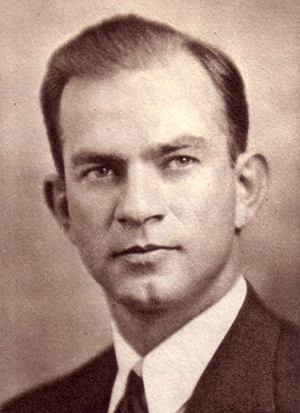
Congressman J. William Fulbright
As early as 1943, Americans as well as their politicians were thinking about what would happen in the post-war world. Most were haunted by the failure of international law to stop Axis aggression, and believed something stronger and more permanent than the League of Nations must be established, and must have the United States as an active player. Spearheading the resolution stating America’s postwar aims was Representative J. William Fulbright (D-Ark.), a freshman who was known as an intellectual proponent of internationalism.
Rep. Robert Sikes (D-Fla.) gave his support, Mr. Speaker, to win the war is not enough. We need not go far back in memory to recall another time when we fought and won a war against aggressor nations, a war to make the world safe for democracy. We thought we gave democracy to the world. Then we turned our backs, and in nation after nation freedom exploded into anarchy, dictators reaped the benefit of America’s good intentions. We must think ahead, for we cannot endure the horror and cost of war every 25 years. Human lives are too precious to be sacrificed in vain. This time we must also win the peace. If we are to win the peace, it is not a day too soon to start laying the groundwork for a peace that is lasting and just. Today as never before the world looks to this Nation for leadership. If we again refuse to accept the mantle of world leadership, it must fall to other shoulders, and world policies will again be shaped by other hands. God forbid that they be the hands of another Hitler, but wishful thinking will not make them friendly hands or kind hands” (Congressional Record, 7718).
Rep. Everett Dirksen (R-Ill.), who would later serve as Senate Republican leader, announced his support, “I favor collaboration, organized justice, the curbing and prevention of military aggression, the disarmament of Axis Powers, a clarification of peace aims now before it is too late, a strong United States Army and Navy, the use of constitutional processes, and the preservation of our national interests. Why not say so in language that all can understand? Must language be used to obscure rather than reveal our intent? Peace will come from the bottom up, not from the top down and the time is here to let the people know what we mean that they might speak their minds” (Congressional Record, 7709).
Opponents
Rep. Frederick C. Smith (R-Ohio), one of the most if not the most conservative member of the House, voiced opposition to the Fulbright Resolution on Constitutional grounds, stating, Mr. Speaker, I am impelled to vote against the Fulbright resolution that Congress favor the setting up of international machinery with power to establish and maintain peace among the nations of the world. It seems to me the lower House is attempting here to perform a function which does not properly belong to it. The subject matter of this resolution deals specifically with treaties. The Constitution definitely vests in the President the “power to make treaties,” but only “by and with the advice and consent of the Senate, provided two-thirds of the Senators present concur.” I think this is sufficient reason for voting against this resolution. The phrase in the Fulbright resolution, “international machinery with power adequate to establish and maintain * * * peace among the nations of the world * * * participation by the United States therein,” can mean but one thing, namely, creation of an international police force, with the United States participating, for maintaining an armed peace among the nations of the world. In my opinion, this is no time for the United States to be making any such commitments as this. There are entirely too many unknown factors at this juncture to safely undertake the formulation of so far-reaching and revolutionary a policy as this would involve. Moreover, those of us who take the position that the peace treaty should be made in strict conformity with the Constitution can hardly be consistent when at the same time we vote for the Fulbright resolution. It would be wholly incongruous to attempt to stand on constitutionalism in the writing of the peace, on the one hand, and to vote for the Fulbright resolution, on the other, since this resolution seeks to perform a duty which the Constitution vests exclusively in the upper Chamber. It may be expected the Senate will uphold its constitutional prerogative” (Congressional Record, 7708).
Despite Smith’s objections, this resolution was adopted 360-29 on September 21st, and it is rather interesting to point out some of the dissenters here:
Malcolm Tarver (D-Ga.), not a usual opponent of FDR’s foreign policy who opposed a number of New Deal measures. His opposition is rather curious, but if he was going the Constitutionalist route, it would have been based on Smith objecting to the House acting on such a matter.
Jessie Sumner (R-Ill.), the first woman to be reelected to the House from Illinois, and an extreme conservative.
Clare Hoffman (R-Mich.), a constant thorn in the side of President Roosevelt who badly wanted him indicted for sedition.
Roy Woodruff (R-Mich.), a former Bull Moose Progressive turned arch-conservative.
Harold Knutson (R-Minn.), a tax expert who had voted against the U.S. declaring war on Germany in 1917.
Daniel Reed (R-N.Y.), another tax expert, had voted against every major New Deal initiative that attracted ideological controversy.
William Lemke (R-N.D.), an agrarian radical who had run for president on the Union Party ticket in 1936 who got a bit more conservative in his later years.
The Senate Resolution
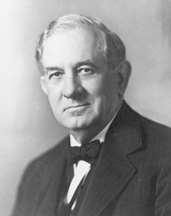
Senator Tom Connally
The Senate’s corresponding resolution was the Connally Resolution, sponsored by Tom Connally (D-Tex.). Support was overwhelming, and many non-interventionists were won over.
Senator David Walsh (D-Mass.) gave a reserved argument for, and he had opposed the Versailles Treaty and had been a non-interventionist. He stated, “I in tend to vote for the resolution. It is obvious that a vote against the resolution would be tan t amount to a denial of any willingness to cooperate with other free nations in the post-war world. Such a denial would in my opinion misrepresent the sentiments of the American people, and would misrepresent my own sentiments. But let there be no misunderstanding of the nature of the resolution and of my position in supporting it. The resolution is an offer – not a commitment. It is expressive of a desire for a just and honorable peace, and of a willingness to cooperate in its maintenance. But as to what is a just and honorable peace and as to ways and means for its maintenance, those are questions which cannot possibly be decided until the terms and conditions are resolved, and until the post-war international organization is translated from the realm of theory to the realm of fact” (Congressional Record, 9203).
Senator Carl Hayden (D-Ariz.), who had been consistent in his support of President Roosevelt’s foreign policy before Pearl Harbor, backed the resolution while expressing an understanding of the limit of its impact: “Mr. President, I intend to vote for Senate Resolution 192 as revised by the Committee on Foreign Relations, but I desire to make it perfectly clear that I know just what I am voting for. It is a simple resolution which does nothing more than express the idea that the Senate favors the establishment of a just peace throughout the world and is willing that the United States shall assume a fair share of the responsibility for the maintenance of such a peace. It does not bind any Senator to vote for or against any treaty, in whole or in part, which may hereafter be submitted to the Senate to implement this general declaration. And above all, even though adopted by a unanimous vote, the resolution does not amend the Constitution of the United States by merely repeating some of the words of the supreme law of the land” (Congressional Record, 9206).
Senator William Langer (R-N.D.) spoke in opposition, “Mr. President, when the distinguished chairman of the Committee on Foreign Relations introduced his resolution, we were urged to vote for
it because it was said to be so elastic that it could be construed to mean anything. That had a familiar sound to me. It reminds me of one of those smooth, slick salesmen we men in the West are so familiar with, who in the old days used to get some farmer behind the barn and give him a drink of rot gut, and get him to sign a contract to buy a $7,000 or $8,000 threshing machine and threshing engine. They would get him to sign the contract; and when the farmer said, “There is some fine print on the back
of this contract,” the smooth, slick salesman would say, “Oh, that does not mean anything.” When I was Governor, we finally got rid of those practices, by North Dakota statute “ (Congressional Record, 9201).
Langer’s words did not amount to much, as the vote came out 85-5 in favor of the Connally Resolution on November 5, 1943. The only senators who joined him in opposition were:
. Hiram Johnson (R-Calif.), one of the leaders of the opposition to the Versailles Treaty and Theodore Roosevelt’s running mate in 1912.
. Henrik Shipstead (R-Minn.), an old-time progressive who had returned to the Republican Party, become more conservative, and was resolutely against the U.S. taking the role of world policeman.
. Burton Wheeler (D-Mont.), one of the leaders of the opposition to FDR’s foreign policy before World War II and had come out early against his “court packing plan”.
. Robert R. Reynolds (D-N.C.), one of the few Southern non-interventionists who had a bad habit of associating himself with disreputable figures.
. Robert La Follette Jr. (P-Wis.) paired against the resolution. He had consistently opposed FDR’s pre-World War II foreign policy and his father, La Follette Sr., had been one of the irreconcilables in the Versailles Treaty debate. The communists later smeared him as a Nazi sympathizer.
Interestingly, unlike the House in which the vote had more of a core of hardcore conservatives, the only senator who was a hardcore conservative by this point who voted against was the aging Johnson, considerably past his old progressive days.
This resolution reminds me of the Emancipation Proclamation. Although the measure didn’t have immediate practical effect, it had a strong symbolic effect and much like the Emancipation Proclamation set the tone for the narrative of the War of the Rebellion from then on, the Fulbright and Connally Resolutions set the tone for the direction of the United States after World War II, which became the creation of the United Nations. The votes, as well as the DW-Nominate scores of the voting politicians, are included. A checkmark is a pair or announcement in favor and an “X” is a pair or announcement against.
Fulbright Resolution
Connally Resolution
References
Collaboration for Postwar Peace. (1943, November 5). Congressional Record, 9174-9222. Washington, D.C.: Government Printing Office.
Retrieved from
Participation in World Peace. (1943, September 21). Congressional Record, 7705-7729. Washington, D.C.: Government Printing Office.
Retrieved from
https://www.congress.gov/bound-congressional-record/1943/09/21/house-section
 Mad Politics: The Bizarre, Fascinating, and Unknown of American Political History