Believe it or not, it used to be possible for Democrats to win major statewide races in Idaho. From 1933 to 1951, and again from 1957 to 1981 at least one of Idaho’s senators was a Democrat. The most successful of these Democrats, and indeed the most successful national Democrat from Idaho was Frank Church. Church was a Great Society liberal, and although not the most liberal of Democrats, he was surprisingly liberal for that state. Something to bear in mind, however, is that in the western portion of the state, there was a strong union presence, and this presence helped Democrats win in the 1st district and could turn the tide statewide. However, the election James McClure to the district in 1966 as well as his reelection indicated that politics were changing in the area. Once Republican Senator Len Jordan decided to retire in 1972, McClure was elected as his successor. Elected as McClure’s successor was 34-year-old charismatic apple farmer and U.S. Marine veteran Steve Symms (1938-2024).
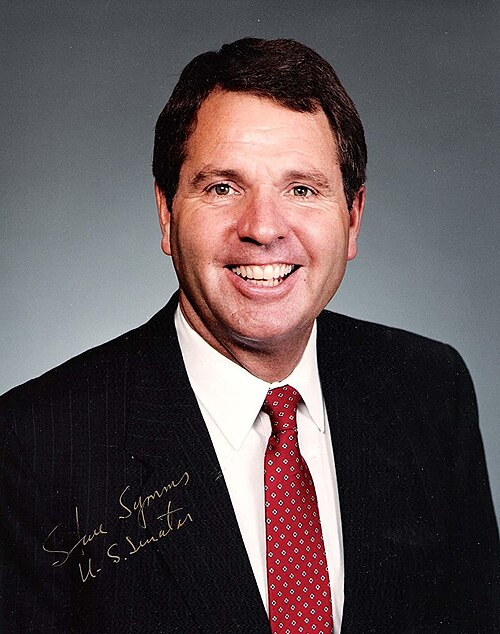
Symms’ slogan during his campaign had been “take a bite out of big government”, and his record proved that he meant it. A libertarian-leaning staunch conservative, he was an almost unbending advocate for free market principles. In his first year, Symms introduced measures to repeal the ban on private gold ownership and to end the Post Office monopoly on delivering first class postage (Ernsberger, Walter, and Morrone). The first cause was successful, the second not. For the latter, Symms staged a race between the U.S. Post Office and letter carriers on horseback to demonstrate the benefits of competition (Clark). While many conservative Republicans were successfully pushed to support Nixon when he was not so conservative, Symms was not among them. He refused to support extending price and wage controls in 1973 and that year sponsored a proposal to prevent government funding of grain sales to the USSR and China, contrary to President Nixon’s position. Ever the fiscal hawk, he offered an amendment reducing the raise of the debt ceiling that passed thanks to support from both conservative Republicans and liberal Democrats. In 1974, Symms was among the opponents of President Ford’s nomination of Nelson Rockefeller as his vice president. Only three Republican senators had voted against this nomination. Although the 1974 midterms were rough on Republicans, he was sufficiently independent from Nixon to not only avoid consequences numerous other Republicans faced but won reelection by a greater margin than he had won in 1972. Symms was a relentless foe of gun control and abortion, opposed increasing the power of organized labor, pushed against the reach of the Occupational Safety and Health Administration into small businesses, and defended the role of states as opposed to the use of the federal government. His most famous quote was, “freedom has always come from a box. If not the ballot box, and not the jury box, then at last resort, the cartridge box” (Clark). Although liberal critics interpreted this as a call for violence, this was not the gist of Symms’ quote. He was encouraging civic engagement so the cartridge box wouldn’t be necessary, and added “we’re still far from resorting to the cartridge box” (Clark).
1980: Frank vs. Steve
Frank Church had run well in Idaho; in his last reelection in 1974 he won by 12 points against Bob Smith, a Republican of Symms’ ideological persuasion. However, by 1980 problems were mounting for Democratic incumbents. Jimmy Carter had never been popular in western states and his popularity was only declining. Another problem, and a particularly big one for Church, was his leading role in getting the Panama Canal Treaties ratified in 1978. This was nationally unpopular and if anything it played worse in Idaho. Seeing an opportunity, Symms jumped into the race. and the contest between them became known as Frank vs. Steve. They were very different people; Symms was conservative while Church was liberal (although with a few exceptions like his opposition to gun control), Symms could easily relate to common Idahoans and was known for telling sometimes off-color jokes, while Church was eloquent in his speech and serious (Clark). Although Church had a lot of name recognition, accomplishments, the Reagan landslide brought Symms to a one-point victory.
Senator Symms
Senator Symms, much like in the House, could be counted as one of the most conservative senators, pushing for cutbacks in spending and reductions in taxes. In 1981, he sponsored a proposal to reinstate the purchase requirement for food stamps, that recipients had to pay for part of their food stamps, but it was rejected. Interestingly, he did back the Tax Equity and Fiscal Responsibility Act in 1982, partially rolling back the Reagan tax cuts in the name of reducing the deficit. Symms was mostly a supporter of free trade, but made an exception when he supported import quotas on casein (milk protein) in 1981.
Although an ideologue, Symms was, much like Reagan, a “happy warrior” and was not known to hold grudges. He also had to mind his constituency and deliver for them in Washington, including funds for highways, the Idaho National Laboratory, and the Mountain Home Airforce Base (Stevenson). In 1986, Symms, who could say things off the cuff, responded to the Chernobyl disaster by remarking that it was a pity that it hadn’t been much closer to Moscow (Deseret News). That year, he got a strong challenge for reelection from Governor John V. Evans, and although a number of Senate Republicans lost reelection, Symms prevailed by three points. During this time, he persuaded President Reagan to support his proposal for a 65 mile per hour allowance for rural roads as an exemption from the 55-mile-per hour limit enacted in 1974 to conserve fuel; he argued to Reagan that there was no good reason for the federal government to be telling towns like Nampa, Idaho what speed limit they should enact and that supporting this would be Reagan being Reagan (Clark). Although his amendment was not accepted in conference on the 1986 highway bill, it was adopted in the next Congress. Consistent with his belief in state authority, he voted against the National Minimum Drinking Age Act in 1984. Likewise, Symms frequently voted against civil rights legislation in his time, including having twice opposed extending the Voting Rights Act and voted against the Americans with Disabilities Act in 1990.
On foreign policy, he was a Cold War hawk, sponsoring a successful 1982 amendment making it U.S. policy to expose Cuban expansionism and led the successful push to repeal the Clark Amendment in 1985, which had blocked military assistance to the resistance group UNITA to fight against the Marxist Angola government, which was receiving Cuban support. In 1988, he was one of only five senators to vote against the INF Treaty with the USSR, which eliminated an entire class of nuclear weapons.
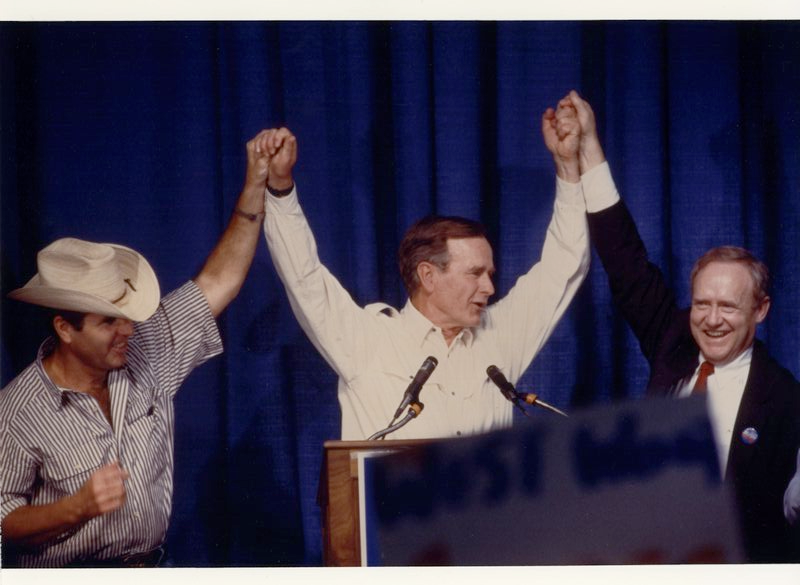
Symms, George Bush, and James A. McClure (R-Idaho) at a 1988 Boise barbecue.
In 1988, Symms made a splash in the presidential election when he stated that he’d heard rumors that there were photos of Kitty Dukakis burning an American flag during the Vietnam War, but later admitted he had no proof (Drew). He was a bane for the liberal Americans for Democratic Action, which he only voted with 2% of the time, but the conservative Americans for Constitutional Action greatly appreciated him as he voted with them 96% of the time, while his DW-Nominate score is a 0.687, making him the most conservative senator in the entire time he served in that legislative body.
By 1991, Symms was considering retirement as numerous personal issues had arisen. He and his wife Fran had separated in 1986 and she divorced him in 1990 over infidelity and his son Dan was being prosecuted for alleged violations of immigration law at the family ranch. Symms decided to retire, and after all he had not intended to be a lifelong legislator. At 54, his career in elective politics was over. In 1992, he married his former aide, Loretta Fuller, and subsequently became a lobbyist. In 2001, he joined up with Dennis DeConcini (D-Ariz.) to form the lobbying group Parry, Romani, DeConcini, & Symms.
On August 8, 2024, Symms died at his home in Leesburg, Virginia, where he had moved after his career in elective office ended. Governor Brad Little ordered flags lowered to half-mast and eulogized him thusly, “Sen. Steve Symms was a true patriot — a military veteran and dedicated public servant whose roots in agriculture helped informed his decisions back in D.C. representing Idaho’s interests,” Little said. “Symms routinely pushed back on government overreach, stood up for the working people of Idaho, and defended the freedoms we hold dear as Americans” (Stevenson). Symms makes it on my list of great conservatives as despite his personal imperfections, he proved a principled voice for libertarian-leaning conservatism and against the scourge of communism around the world.
References
ADA Voting Records. Americans for Democratic Action.
Retrieved from
Clark, T. (2023, August 11). Opinion: Steve Symms; Idaho’s conservative champion. Idaho State Journal.
Retrieved from
Drew, E. (1988, September 5). Letter from Washington. The New Yorker.
Retrieved from
https://www.newyorker.com/magazine/1988/09/12/letter-from-washington-276
Ernsberger, D., Walter, D., & Morrone, G. (1974, February 1). Libertarian Politics. Reason Magazine.
Retrieved from
https://reason.com/1974/02/01/libertarian-politics/
Stevenson, I.M. (2024, August 13). First a fruit farmer, then Congress. Former Idaho Republican senator dies at 86. Idaho Statesman.
Retrieved from
https://www.idahostatesman.com/news/politics-government/state-politics/article290929109.html
Symms, Steven Douglas. Voteview.
Retrieved from
https://voteview.com/person/14056/steven-douglas-symms
Symms Weighs Senate Retirement as Personal Troubles Mount. (1991, July 7). Deseret News.
Retrieved from
 Mad Politics: The Bizarre, Fascinating, and Unknown of American Political History