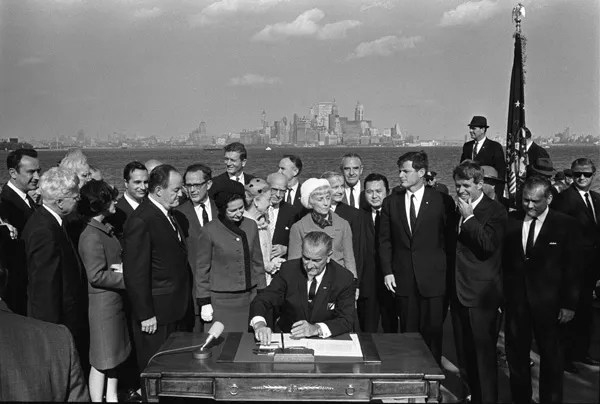
In 1924, Congress passed the Immigration Act of 1924, which established a permanent National Origins Quota system, which set a quota of 2% of immigration from nations, based on foreign-born populations that had been counted in the 1890 census. The relevance of the 1890 census was that this predated a massive influx of immigrants from Eastern and Southern Europe. Thus, opponents of stringent quotas on these people proposed the 1910 census be used as a basis instead, thus allowing considerably more people from these nations to be admitted. Also facing severe limitations were immigrants from Asia, Africa, and the Middle East, and Japan along with nations in the “Asiatic Barred Zone” faced complete exclusion. Interestingly, no quota was set for any immigrants from the Western Hemisphere.
This measure was quite popular when passed, indeed the vote in favor in the House had been 323-71 and the Senate 69-9. Support and opposition were both bipartisan, but it was clear that urban politicians stood most opposed. One of these politicians was 36-year-old Emanuel Celler of Brooklyn, a Democrat who was serving his first term in Congress. By 1965, the political situation changed monumentally. Celler was not a freshman in a minority party; he was now one of the most powerful members of Congress as the chairman of the Judiciary Committee and the national climate had changed considerably on the issues of race and immigration. In 1924, eugenics had been in vogue and fears abounded about anarchist and communist immigrants. By 1965, the American public and its intellectuals had mostly turned away from eugenics as it was now associated with Nazi genocide of Jews, Roma, the disabled, and numerous other minority groups. Senator Ted Kennedy (D-Mass.), a prominent proponent, argued that “The bill will not flood our cities with immigrants. “It will not upset the ethnic mix of our society” and Senator Hiram Fong (R-Haw.) claimed that the population of Asian Americans “will never reach 1 percent of the population” (Richwine).
The House version passed 318-95 on August 25th, with 209 Democrats and 109 Republicans voting for while 71 Democrats and 24 Republicans voted against. Nearly all of the Democratic votes against came from Border or Southern states. A similar pattern existed in the Senate, in which the bill was passed with amendment 76-18 on September 22nd. 52 Democrats and 24 Republicans voted for while 15 Democrats and 3 Republicans voted against in John Sherman Cooper of Kentucky (a curious dissenter given his past votes for liberally admitting postwar refugees), Norris Cotton of New Hampshire, and Strom Thurmond of South Carolina. This also included two pairs against from Republicans John Tower of Texas and Wallace Bennett of Utah. The only Democrats outside the South who voted against were Arizona’s Carl Hayden and West Virginia’s Robert Byrd. Hayden had also been supportive of expanding U.S. admittance of refugees after World War II. The House readily accepted the Senate’s changes on a vote of 320-70, with Democrats voting 202-60 for and Republicans 118-10. The House Republicans who were against were Jack Edwards, Glenn Andrews, John Buchanan, and James Martin of Alabama, James B. Utt of California, H.R. Gross of Iowa, Prentiss Walker of Mississippi, Charles Goodell of New York (an odd dissenter here), Albert Watson of South Carolina, and Jimmy Quillen and John Duncan of Tennessee. The only Democrats outside the South or Border states to oppose were Johnny Walker and Thomas Morris of New Mexico, Robert Secrest of Ohio, and Robert Nix of Pennsylvania (a very curious vote indeed!).
Interestingly, this law was not considered to be highly ideologically salient by liberals or conservatives of the day; neither ADA nor ACA counted the votes on this law as qualifying you as a liberal or a conservative. The measure got high marks per a Gallup poll conducted at the time with 70% approval, and few people considered immigration the issue of foremost importance at the time, with Medicare being the biggest focus (Kohut). In the backdrop of the civil rights movement, eliminating discrimination in immigration quotas seemed a logical choice.
Contrary to Kennedy’s arguments, after 1965 the percent of immigrants who came from Europe fell from over 80% to 13% in 2018. The elimination of the caps on immigration did not prove to be the issue that resulted in massive immigration from South of the border. Indeed, this law for the first time placed a cap on immigration from Mexico. Rather, a development that was occurring at around the same time; the demise of the Bracero Program, which had occurred in 1964, combined with provisions in the 1965 law that exempted from quotas family members of immigrants already in the nation, resulted in 25% of the US’s immigrants being from Mexico in 2018 while 25% more were from other Latin American nations. The Immigration and Nationality Act also resulted in higher levels of immigration from Asian nations; in 2018, 28% of immigrants to the United States were Asian. Furthermore, in 1965, 5% of the population were first-generation immigrants but in 2015 they came to represent 13% of the population (Chrishti, Hipsman, and Ball). The Immigration and Nationality Act of 1965 has, at its 60th year, been proven to have dramatically changed the demographic makeup of America.
References
Cadava, G.L. How Should Historians Remember the 1965 Immigration and Nationality Act? OAH.
Retrieved from
Chrishti, M., Hipsman, F., and Ball, I. (2015, October 15). Fifty Years On, the Immigration and Nationality Act Continues to Reshape the United States. Migration Policy Institute.
Retrieved from
Kohut, A. (2015, February 4). From the archives: In ‘60s, Americans gave thumbs-up to immigration law that changed the nation. Pew Research.
Massey, D.S. & Pren, K.A. (2012). Unintended Consequences of US Immigration Policy: Explaining the Post-1965 Surge from Latin America. Popul Dev Rev., 38(1)
https://pmc.ncbi.nlm.nih.gov/articles/PMC3407978/
To Agree to the Conference Report on H.R. 2580, The Immigration and Nationality Act. Voteview.
Retrieved from
https://voteview.com/rollcall/RH0890177
To Pass H.R. 2580, Immigration and Nationality Act Amendments. Voteview.
Retrieved from
https://voteview.com/rollcall/RS0890232
To Pass H.R. 2580, The Amended Immigration and Nationality Act. Voteview.
Retrieved from
 Mad Politics: The Bizarre, Fascinating, and Unknown of American Political History