Before the 1914 elections, as noted in a recent post, senators were constitutionally elected by state legislatures. This could produce some interesting results to say the least. In 1899 in the state of Montana, Democrat William Clark was elected and it was uncovered that bribery of state legislators was used to achieve this, including in very obvious ways such as handing legislators envelopes of cash on the floor of the legislature. The election of the man I’m going to talk about today didn’t involve such corruption, but rather the resolution of a stalemate.
The Democrats won the state legislature in the 1910 midterms, and they were set to find a replacement for Republican Thomas H. Carter. However, they had trouble finding a man who would unify the legislature. Name after name was proposed only to be deadlocked. For seven and a half hours the legislature continuously voted. A move to adjourn by Republicans, thus halting the election and leaving the Senate seat vacant, was defeated thanks to the vote against by rebel Republican Ronald Higgins of Missoula much to the joy of Democrats and the consternation of Republicans (Fergus County Democrat). Democratic Representative Woody had proposed on the 27th ballot Henry Lee Myers (1861-1943). Myers, who had been elected a judge in 1907 and had served in the state Senate from 1899 to 1903, had opposed the corrupt election of William A. Clark, despite both men being Democrats (The Great Falls Leader). The choice was met with acclaim and unified the Democrats, but it certainly surprised Myers who had not been a candidate up until this time. He accepted the legislature’s choice.
Senator Myers proved a supporter of President Woodrow Wilson and his New Freedom Agenda. He was supportive of women’s suffrage, but also voted for a Southern-backed amendment that would have restricted women’s suffrage to white women. Myers also supported Prohibition, solidly within the views of the state’s voters. On other key matters he was quite supportive of Wilson as well, backing both the Espionage Act of 1917 and the Sedition Act of 1918 as well as supporting the Versailles Treaty without reservations. However, Myers also backed the Esch-Cummins Act in 1920 returning railroads to the private sector under favorable conditions as well as its anti-strike clause, much to the distress of organized labor. That year, he announced that he would fight the left-wing Nonpartisan League, which had come to dominate the state Democratic Party that year, by supporting the entire Republican ticket in Montana for that year’s elections while still supporting the Cox-Roosevelt ticket nationally, stating, “Montana must be saved; the Democratic party of Montana must be saved. The gravest crisis that our beloved state has ever known in all of its history now confronts the people of this state. The are confronted with the prospect of ruination, disgrace, confiscation, and even with the overturning of our form of government” (The Montana Record-Herald).
During the Harding Administration, although Myers supported the 1921 Emergency Tariff for agriculture and supported higher tariffs for certain commodities of interest to Montana, he voted against the Fordney-McCumber Tariff. He also opposed the Fordney-Penrose tax reduction bill. Myers also voted against the veterans bonus bill in 1922. Myers retired that year, his DW-Nominate score having been a -0.223, indicating moderate liberalism. In 1927, he was appointed associate justice of Montana’s Supreme Court, but only served until 1929, choosing to resume practicing law. Myers died in Billings, Montana, on November 11, 1943, at the age of 82.
References
Death Takes Former Montana Senator. (1943, November 12). The Butte Daily Post, 3.
Senator Henry L. Myers Leads Regular Democrats in Organized Repudiation of Nonpartisan League Nominees. (1920, October 9). The Montana Record-Herald, 10.
Although South Carolina and progressivism are not two things that people commonly think of together, especially not contemporary progressivism, South Carolina did embrace the New Deal, and one of the New Deal’s foremost supporters in the state’s politics was Olin DeWitt Talmadge Johnston (1896-1965).
Born to a working class family, as a boy Johnston found himself working in a textile mill as did many working class people in the state at the time. Through his experience, he came to champion addressing the issues that befell mill workers. Johnston was an intelligent man, so he was able to work his way through college. However, before he could move into a political career, he responded to the call of service to his country and enlisted to fight in World War I in 1917. He served honorably and received a citation for bravery.
In 1922, while attending law school, Johnston won a seat in South Carolina’s House of Representatives but only served a term as he wanted to focus on practicing law. However, the call of politics came not long after and in 1926, he was again elected to the state House. Johnston championed the interests of mill workers, many who were supportive of progressive politics. Indeed, he did good work by them, most notably sponsoring and getting into law a measure that required mill owners to install sewers in their mill villages in which their workers lived. Such efforts made the young man a viable candidate for governor. In 1930, Johnston tried his hand at it and although he got the most votes on the first ballot, it wasn’t a majority, and he narrowly lost the runoff to Ibra Charles Blackwood. Governor Blackwood’s term would be troubled by a mill strike, which he responded to by calling out the National Guard. Johnston ran again in 1934, but he was up against an old hand at politics and his old hero in Coleman Blease. Blease was known for his racist demagoguery and his heavy courting of mill workers, indeed they had been central to his being elected governor and to the Senate. However, he was past his prime, and the youthful Johnston, who was with the New Deal spirit of the age, prevailed. He also had an able partner in politics in his wife, Gladys Atkinson, who would be his closet counsel.
Governor Johnston
Many South Carolinians supported both FDR and Johnston, the latter who was lauded as “South Carolina’s Roosevelt”. He strongly supported unions, and continued to help out mill workers. Under Johnston’s administration, worker’s compensation was increased, the South Carolina Public Welfare Act was passed, the South Carolina Rural Electrification Authority was created, and employment of children under 16 in industrial work was banned (National Governors Association). However, there was a controversial incident in his administration. Johnston came to believe that the State Highway Department was acting contrary to public interests and engaging in corruption, thus he ordered the National Guard to occupy the department, but no wrong-doing was found (National Governors Association). This incident would result in opponents calling him “Machine Gun Olin”, such as Senator Ellison DuRant “Cotton Ed” Smith.
FDR in 1938: I’m Helping! I’m Helping!
Although “Cotton Ed” Smith had initially supported the New Deal, he was becoming increasingly critical. His opposition to the “Death Sentence” clause of the Public Utilities Holding Company Act in 1935 and to FDR’s “court packing plan” stung Roosevelt, who wanted someone more like him. Olin Johnston was the man for the job, and Roosevelt made it very clear that he was supporting him over Smith. Roosevelt hoped to exercise more control over the party, and his efforts at a “purge” of recalcitrant Democrats in the 1938 election would be a good demonstration. However, Smith was able to effectively capitalize on numerous voters opposing FDR’s intervening in state primaries (it was a different time back then, wasn’t it?) and furthermore sit-down strikes were not engendering sympathy with organized labor, and Smith prevailed. Cotton Ed Smith was never a particularly popular senator and was despised by his colleague, Jimmy Byrnes, who nonetheless backed him in the hope that his preferred man, Burnet Maybank, could succeed Smith in 1944. It is entirely possible that if Roosevelt had just stayed out, he could have gotten his man in the Senate. Johnston was also temporarily out of office because of this run, with Maybank succeeding him as governor.
The 1941 Senate Race
In 1941, Senator Byrnes stepped down to accept a nomination to the Supreme Court, and Johnston ran to succeed him. However, Byrnes’ ideal man, Governor Maybank, won the Democratic primary. This loss and the 1938 loss for the Senate resulted in some doubt about whether Johnston was still a viable candidate. Thus, the next election was do or die for his career: the 1942 gubernatorial election.
Going for Governor Again
In running for governor, he faced state legislator Wyndham Manning, who was a real threat to win the primary and had twice before tried for governor. However, Johnston prevailed with nearly 52% of the vote, thus putting an end to Manning’s political career. The major issue that occupied this term was the subject of the white primary. On April 3, 1944, the Supreme Court announced the decision of Smith v. Allwright, which ruled the white primary unconstitutional. In response, Johnston proceeded to hold an emergency session of the state legislature in which all references to “white primary” were scrubbed, and within days 147 bills were passed that eliminated any legal connections between state government and primaries, and a constitutional amendment was proposed and adopted by the voters that the General assembly would not regulate state primaries (Moore). However, this private approach would too be ruled unconstitutional in the federal court decision Elmore v. Rice (1947), and the Supreme Court refused to take the case. Thus, the white primary was ended for good. This push gave him the springboard he needed for his third try at the Senate. During this time, Johnston also denied clemency for a 14-year-old black boy, George Stinney, who was sentenced to death for allegedly murdering two white girls. The conclusion of an investigation many decades later was that Stinney was innocent.
1944: Cotton Ed Runs Out of Steam
By 1944, Smith is 80 years old and is clearly on the decline. Furthermore, his record is now much more conservative than it was when FDR sought to purge him. Johnston was also able to more loudly and effectively capitalize on the issue of race, focusing his ire on Smith v. Allwright. By contrast, during one campaign speech, Smith spoke for a few minutes and then simply played on a record of a 1938 speech. He was just tired out and given that FDR was not “helping” Johnston this time, Smith lost, dying only three months later.
Senator Johnston
Interestingly, Johnston as a senator was not quite as liberal as he was earlier in his career. Although he got a 100% from Americans for Democratic Action in 1947, which meant he was one of the few Southern senators to oppose the Taft-Hartley Act that gave states the option to become “right to work”, he also was one of the strongest opponents of foreign aid on the Democratic side and even voted against the Marshall Plan in 1948. Johnston’s overall record by liberal standards was moderate, as he sided with Americans for Democratic Action 44% of the time. However, by conservative standards, Johnston was a moderate liberal, siding with Americans for Constitutional Action 30% of the time. His DW-Nominate score was a -0.166, making him one of the more liberal postwar Southern senators. In 1959, Johnston sponsored with Senator Styles Bridges (R-N.H.) an amendment that prohibited foreign aid to nations that expropriated US property without proper compensation. Although he opposed efforts to curb labor unions, supported strong minimum wage increases, supported public housing, supported public generation of power rather than private, and twice voted for Medicare, he also voted against federal aid for education, voted against two Area Redevelopment bills, supported domestic anti-communist measures, often voted for anti-communist amendments to foreign aid bills, and of course was against civil rights legislation. Johnston was also one of the most noted advocates for federal employees and butted heads with Senator Joseph McCarthy. Johnston was clearly interested in continuing to support meat and potatoes New Deal issues but was not friendly on some more recent liberal issues.
1950: A Serious Challenge
The year 1950 was a decidedly conservative year in American politics; many candidates Senator Joseph McCarthy endorsed won their races, and on the Democratic side of the aisle in the South some liberal officeholders fell to more conservative ones, most notably Senator Claude Pepper’s defeat by Congressman George Smathers in Florida and Senator Frank Porter Graham’s defeat by Willis Smith in North Carolina. Johnston risked meeting the same fate when up against Governor Strom Thurmond. By running against Johnston, Thurmond was breaking a promise not to run against him if he supported his campaign for governor in 1946, which he had. Johnston got his base of support in South Carolina’s northern, working class communities, while Thurmond got his support from the wealthier southern counties. The campaign was ugly, with accusations flying from both candidates, and both men tried to outdo each other in racist campaigning, including Thurmond claiming that Johnston was passive against President Truman’s civil rights pushes and Johnston condemning Thurmond for appointing a black doctor to the state’s medical board. Johnston won by single digits.
1962 Election and Decline
In 1962, Governor Fritz Hollings challenged Johnston for renomination, asserting that he was too liberal, but Johnston defeated him for renomination by a nearly 2 to 1 ratio. Interestingly, his bid for reelection proved more difficult, contrary to past years. He faced Republican journalist William D. Workman Jr., who campaigned against him as supporting socialist proposals, particularly on healthcare through his support of Medicare, but Johnston prevailed by nearly 15 points. By contrast, Johnston’s 1956 Republican opponent had pulled just under 18% of the vote. South Carolina wasn’t quite ready to elect a Republican senator. However, not all was well for him. After his reelection, he was diagnosed with cancer and by 1965 he was in serious decline. On April 17, 1965, his doctors announced that Johnston was suffering from viral pneumonia, was not responding to treatment, and had slipped into a coma. Johnston died the next day at the age of 68.
Columnist Ralph McGill (1965) praised Johnston as having had “a lot more intellectual courage than many of those whose names are better known. He not only had this courage, he showed it” and noted, “One of the tragedies of the Southern senators and congressmen, especially the more able, is that in the past they have had to join with, encourage and expand racial prejudice to win primaries in states where there was no Republican opposition and where Negro voters were so few as to be meaningless” (37). Johnston was also praised by his successor, Donald Russell. Russell held that “I have never known a warmer, more patient and steadfast friend than he. He was equally warm and gracious to all, the lowly and the mighty” (Hill). Johnston’s legacy would continue through his daughter, Liz Patterson, who served in Congress as a Democrat from 1987 to 1993.
References
ADA Voting Records. Americans for Democratic Action.
For people who make it into positions of great power, having a mentor is vital. The man I am writing about today, Winthrop Murray Crane (1853-1920), was not only a politician of great significance in his own right, but he also mentored a president. Born to family in the paper mill business, the Crane Paper Company, Crane went to work for his father upon completing school at 17, and worked his way up through the company, serving in multiple roles so he could fully understand the business. In 1872, Crane had his first major success in obtaining a wrapping paper contract for the Winchester Repeating Arms Company and seven years later he followed up by securing an exclusive contract for the Crane Paper Company to provide paper for the currency of the U.S. government, a role it still has today. After Crane’s father’s death in 1887 he took the reins of the business and managed to significantly increase his family’s wealth through wise investments.
In 1892, Crane entered politics when he served as a delegate to the Republican National Convention, and would take part in subsequent conventions. He was notably not big on public speaking and disliked the process of campaigning. Indeed, Crane never made a speech in his years campaigning for office (can you guess who he mentored?). His reticence did not hurt him in Massachusetts, and in 1897, he was elected lieutenant governor, followed up by his election in 1899 as governor, serving from 1900 to 1903. As governor, Crane practiced fiscal conservatism, succeeded in getting an asylum constructed, and mediated a strike by the Teamster’s Union. His success in resolving that strike got him national recognition, including from President Theodore Roosevelt, who brought him on to be among the negotiators to successfully mediate the national Anthracite Coal Strike in 1902. Crane also advised Roosevelt to publicly state that he would not seek a third term when running for reelection (Bent). Although Roosevelt asked him to be Secretary of the Treasury, he declined. Crane was described thusly by author Carolyn W. Johnson, “This Governor of Massachusetts, deep in public service, was by temperament a private man. In public reticent and unwilling to speak, he conversed constantly in closed meetings, in quiet conferences, and on the telephone….he never said more than he had to, and he said it once…His program was not one of sweeping changes, but one of small steps toward his goals: curtailed expenditures, reduced indebtedness, and increased legislative self-discipline…His administration was unspectacular and widely praised; he had not been expected, or elected to introduce grand reforms…He was the classic man-behind-the-scenes. Avoiding limelight and applause, he was a man who ‘knew,’ a collector of information, an acute observer who had many sources…With an easy private approach to individuals, he won their confidence; with sound perceptions, he gained their respect. His colleagues knew that he could keep a secret. He was honest, not extravagantly frank, and eminently sensible, with a deep knowledge of men and a wide grasp of affairs” (24, 29, 39). Crane chose not to run again for governor, but public office would again call to him.
In 1904, Senator George Frisbie Hoar, a longtime institution in Massachusetts and on Capitol Hill, died after several months of illness. Crane was appointed his successor by Governor John L. Bates, and the legislature elected him to a full term in 1907. In the Senate, he was known as a capable behind-the-scenes leader of the conservative wing of the GOP. This was attested to by his colleague, Chauncey Depew of New York, who wrote that he “never made a speech. I do not remember that he made a motion. Yet he was the most influential member of that body” (Abrams, 38). Crane also would often advise people not to act in certain situations. As he would tell people, “Do nothing” (Abrams, 39). Even though he was one of the Senate’s most conservative members in his day, he was known for his skills in persuasion and in bridging differences between the conservative and progressive wings of the party. Crane also could be direct in a way that his colleagues hesitated to be. For instance, after numerous Republicans had tried all sorts of indirect ways to divine how a fellow senator was going to vote on a crucial bill, Crane told his colleagues to “wait a minute”, strolled over to the senator and conversed with him briefly, then walked back and telling his fellow Republicans that “he’ll vote for the bill”, and when asked how he found out, he simply stated, “I asked him” (The Buffalo News). He was also inherently a high-tariff man, in line with traditional Republican economic philosophy, and voted for the Payne-Aldrich Tariff. However, Crane was also willing to vote for President Taft’s push for reciprocal trade relations with Canada, something that wouldn’t come to pass until the Reagan Administration. Crane was opposed to many reform proposals of his day, including publicizing campaign contributions, direct election of senators, and abolishing the electoral college. He could also engage in some behind-the-scenes maneuvering, possibly including Democratic Governor William L. Douglas not running for reelection. According to politician Charles Hamlin, Republicans had uncovered that Douglas had obtained by fraud an honorable discharge during the War of the Rebellion, and that Crane and Senator Lodge agreed to keep this a secret if he did not run again (Abrams, 120). Active at the Republican National Convention, Crane feared that William Howard Taft would be not be a sufficiently strong candidate, but he would fully back his reelection effort in 1912. By this point, Crane had declined to be a candidate for reelection and was succeeded by the also strongly conservative John W. Weeks. Crane’s DW-Nominate score stands at a 0.669, making him the second most conservative senator by that scale in all the time he was in office.
Mentoring a President
Crane took some interest in the career of a young state legislator who he saw as possessing great potential, this being none other than Calvin Coolidge. Although Coolidge was naturally a quiet person around strangers, Crane told him that this was the right path, advising that silence “avoids creating a situation where one would otherwise not exist” (Tacoma). Thus, Coolidge’s silence was both natural and political strategy. Coolidge noted about his mentor, “his influence was very great, but that it was of an intangible nature” (Abrams, 38). Both Crane and Coolidge were similar politically, as Coolidge was also a backer of high tariffs and both men were opposed to inflationary currency.
Crane’s Last Cause: The Versailles Treaty
Although Murray Crane had a long history of being a strong partisan, he nonetheless saw the establishment of the League of Nations and the US’s participation in it as vital. His position would be that of a mild reservationist, being for including some modest Republican reservations to the treaty before enacting it. This placed him at odds with his old colleague, Henry Cabot Lodge, who was for strong reservations to the treaty, and it is debatable whether Lodge would have really accepted a treaty in any form. Crane advocated for the adoption of a plank for the Republican Party to endorse the creation of the League of Nations with “proper reservations”, which was interpreted by journalist Mark Sullivan (1920) of the Des Moines Register to be as strong as Wilson’s as “proper” was a word that had a lot of room for interpretation (1). By this time, Crane’s health was fragile, and the hot summer of New England pushed him over the edge. On July 31, 1920, he collapsed in Northampton, Massachusetts prior to an event notifying Coolidge of his nomination for vice president, having been in the hot sun throughout the day. Although Crane recovered enough to be taken home, he found himself having several more collapses when he tried to work in subsequent days. As he himself said about the situation, “something gave out” (The Franklin Repository). The last two months of Crane’s life would be of increasing lethargy, and despite his family seeking the help of specialists he died on October 2nd of brain inflammation at his family home.
References
Abrams, R. (1964). Conservatism in a progressive era: Massachusetts politics 1900-1912. Cambridge, MA: Harvard University Press.
Bent, S. (1926, March 28). Murray Crane Was a Master of Politics. The New York Times.
Retrieved from
Crane, Whispering Giant of G.O.P., Dies. (1920, October 3). The Commercial Appeal, 1
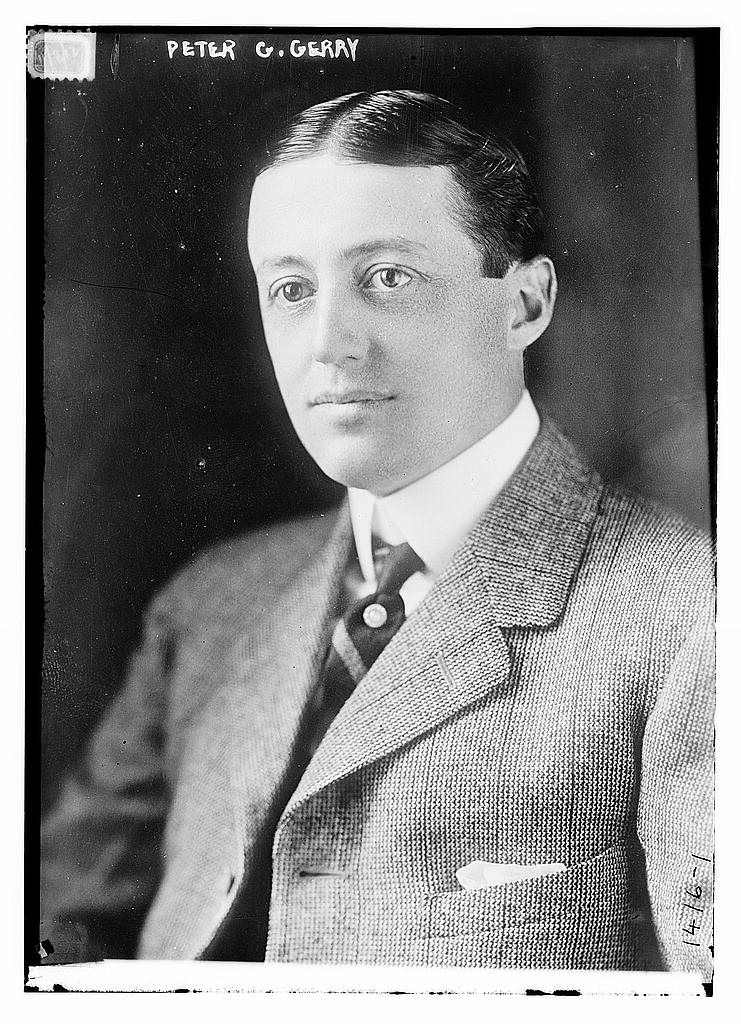
Peter G. Gerry was a clear beneficiary of the 17th Amendment. Had it not been enacted, Republican incumbent Henry Lippitt would have been a shoo-in for reelection in 1916 given the composition of the state legislature.
Every once in a blue moon we will hear a conservative call for the return of election of senators by state legislatures, although there will be no serious concerted movement towards this end, as it would require a constitutional change, and there is only one amendment that has ever been repealed in American history. After the Senate adopted the 17th Amendment, pushed strongly by progressives, it was ratified in 1913. Thus, the first Senate elections that would fall under the popular vote were in 1914. A question that came to my mind was did this have a significant ideological impact in the first elections?
In order to make this determination, I had to find out what party controlled the legislatures of these states, something that was a bit more difficult to accomplish than you might think and involved a mix of finding out who state House speakers were and who Senate presidents or pro tems were through Wikipedia or sources provided by state governments. Although it was by and large true that the voters of the states voted in the same party direction as their state legislatures would have, it is also true that the differences happened primarily in one direction: towards the Democrats. The only case I could find in which this arrangement benefited Republicans was the 1916 election in Maryland. A borderline case was the 1916 election in Delaware, which was won by Democrat Josiah O. Wolcott. The state House was Democratic, but the Senate was Republican at the time they would have been able to vote on a senator. Thus, whether the victor would have been a Democrat or Republican under the old rules is up to conjecture. However, I have my doubts that Republican incumbent Henry du Pont would have survived this process given that whoever got in would have likely been a compromise candidate, and it is unlikely that du Pont was someone that Democrats would have agreed to.
The 1914 Midterm: The Popular Vote Has Its Impact
Despite 1914 being a good midterm for Republicans in the House, the 17th Amendment resulted in Republicans losing rather than winning seats in that chamber. Democratic gains attributable to the 17th Amendment include the elections of James Phelan in California, Charles Thomas in Colorado, Francis Newlands in Nevada, George Chamberlain in Oregon, Edwin Johnson in South Dakota, and Paul Husting in Wisconsin. Had Senate elections remained with state legislatures, Republicans would have had a net gain of 3 rather than a net loss of 3. There is also a question surrounding the election in Illinois, as Republican Lawrence Sherman prevails, but the Illinois legislature is divided. Thus, whether Republicans would have won with the old system in this case is questionable. Also of issue in this is that the Progressive Party was running candidates and thus splitting elections for Republicans. Had the Progressive Party been taken out of the equation, it is hard to say what the results would have been.
The 1916 Midterms:
The 1916 midterms resulted in a net gain of 2 for Democrats because of the 17th Amendment. They achieved what they couldn’t in state legislatures with Andrieus Jones of New Mexico, Peter Gerry of Rhode Island, and John B. Kendrick of Wyoming, and only possibly Josiah O. Wolcott in Delaware given the divided legislature. Republicans made their gain with Maryland’s Joseph France.
The 1918 Midterms:
The impact of the 1918 midterms was +2 for Democrats in Massachusetts with David I. Walsh and Montana with Thomas J. Walsh and +1 in a special election in Idaho with John F. Nugent.
The 17th Amendment had an intention as well as its impact, that was at least in part to increase the power of progressives (in this case it was Wilsonian progressives). However, it did not turn out of office some of the conservatives proponents most wanted out, such as Republican leader Jacob Gallinger of New Hampshire and Pennsylvania’s Republican boss Boies Penrose in 1914. Indeed, although the latter had opposed the change, he found himself having an easier time with voters than his fellow politicians. After yet another win in 1920, he said to a reformer friend, “Give me the People, every time! Look at me! No legislature would ever have dared to elect me in the Senate, not even at Harrisburg. But the People, the dear People, elected me by a bigger majority than my opponent’s total vote of half a million. You and your ‘reformer’ friends thought direct election would turn men like me out of the Senate! Give me the People, every time!” (Kennedy)
References
Kennedy, J.F. (1956, February 21). Remarks of Senator John F. Kennedy at the New York Herald Tribune Luncheon. New York, New York. John F. Kennedy Presidential Library and Museum.
Among the New England states, New Hampshire long had a reputation as its most conservative, and there were numerous political figures who gave it this reputation. One of the earlier ones was Jacob Harold Gallinger (1837-1918). Although praised in his life by his supporters as fundamentally American in his values, Gallinger’s life didn’t begin in America, rather he was born in Cornwall, Ontario, British Canada, but he moved with his family to the US at a young age. In May 1858, he graduated Cincinnati Eclectic Medical Institute at the head of his class and three years later he started practicing as a homeopathic doctor and surgeon in Keene, New Hampshire, moving to Concord the next year. He was an active practitioner until 1885, and sincerely believed that homeopathy was the future.
While practicing, he began a political career in New Hampshire, being elected to the state’s House of Representatives in 1872, being reelected until his election to the state’s Senate, serving from 1878 to 1880, during which he was elected Senate President. During this time, Gallinger gained a reputation as a Stalwart, or an opponent of civil service reform, which for many years would put him in direct conflict with Half-Breed William E. Chandler. He derided proponents of civil service reform as “worshipers of Grover Cleveland” (Madura). In 1884, he was elected to the House, representing New Hampshire’s 2nd district. By 1888, Gallinger was prominent enough in the GOP to second the nomination of Benjamin Harrison at the Republican National Convention. In 1888, he was elected to the State Senate, and then to the State House in 1890, but didn’t remain as he was elected to the Senate by defeating incumbent Henry W. Blair in the primary.
As a senator, Gallinger was a faithful representative of the conservative wing of the Republican Party. According to his colleague, Democrat Henry Hollis, “He believed that any man of average intelligence could get on in the world if he would be sober, industrious, and thrifty. He did not believe that the country or the Government owed any man more than this opportunity” (Congressional Record, 10). Indeed, he had risen up from humble circumstances. Gallinger’s New York Times obituary (1918) described him as “…a conservative in most of his notions, narrow in some. He was an ancient enemy of civil service reform. He didn’t believe that railroads were an abomination and a curse. He held to the old Republican gospel of ship subsidies. Firm was his faith in a protective tariff, heaven-sent, heaven-high.” He naturally did not get on with populist or progressive causes of his day, and his conflict continued with Chandler, who was now his Senate colleague. In 1899, Chandler accused him of illegally soliciting money from federal officeholders (The New York Times, 1899). However, Gallinger wouldn’t have to worry about him for long, as Chandler had increasingly been voting independently and in 1901, he was denied renomination. Gallinger now was indisputably the most powerful figure in the politics of the Granite State. He served as a leading conservative figure in the Senate, although one who could now and again exercise independence during the presidency of Theodore Roosevelt.
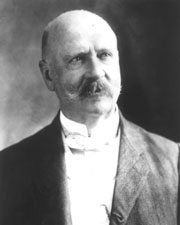
In 1911, Maine’s William Frye, a known conservative, stepped down from the Senate Pro Tem position as his health was deteriorating. Although the Senate Republican caucus supported Gallinger, eight progressive Republicans were against him, preferring Minnesota’s Moses Clapp. The Democrats wanted Georgia’s Augustus Bacon in this position, and no majority could be achieved. A strange deal was concocted in which Gallinger and Bacon would rotate in the Senate Pro Tem position on alternate days. Also serving as Pro Tem during this session were Senators Frank Brandegee (R-Conn.), Charles Curtis (R-Kan.), and Henry Cabot Lodge (R-Mass.). By the way, Gallinger and Bacon bore an amusing resemblance to each other:
Senator Gallinger
Senator Bacon
Behold! The Senate’s twin walruses!
As part of Gallinger’s deep-seated conservatism, he opposed constitutional amendments for the substitution of the electoral college with the popular vote for electing presidents and the direct election of senators. In 1912, he sided with Taft in the battle between him and Roosevelt for the Republican nomination. The following year, Gallinger was chosen by the Republicans to head the Senate Republican Conference. Before the positions of majority and minority leader existed, being the chairman of this conference translated to party leader. Thus, Gallinger led the Senate opposition to President Wilson’s New Freedom agenda. He voted against the Revenue Act of 1913 lowering tariffs and instituting an income tax, the Federal Reserve, and the Clayton Anti-Trust Act. On matters of national defense, he was a strong proponent of the growth of the US Navy, opposing efforts to cut battleship construction. In 1914, Gallinger faced his first popular election, but contrary to the hopes of the political left that popular elections would turn him out of office, he won reelection by 7 points.
His conservatism persisted after his reelection, and in 1915, the Montana Progressive characterized Gallinger as “about the most reactionary of republican senators” (1). Although most of the time he was resistant to change from what was when he came into politics, he didn’t oppose all change. For instance, Gallinger voted for women’s suffrage in 1914 and paired for the 18th Amendment (Prohibition) in 1918. As an influential senator, he was also able to wield power beyond his party numbers on occasion. For instance, in 1915, Gallinger opposed the nomination of progressive New Hampshire Republican George Rublee to the Federal Trade Commission and invoked Senatorial courtesy. Wilson was able to get him in as a recess appointment, but in 1916 his continuation had to come to a vote. Rublee had been a key figure in the establishment of the Federal Trade Commission in 1914 and had opposed Gallinger’s reelection. Under Senatorial courtesy, it is a custom of the Senate to reject nominees from a senator’s state if the senator announces that he finds the nomination is “personally offensive”. The Senate upheld the tradition of Senatorial courtesy by rejecting Rublee’s nomination 36-42. The rejection of Rublee was one of the factors that resulted in the FTC being considered ineffective in its early years by progressives. Indeed, Gallinger had been one of five senators to vote against the FTC’s establishment in 1914 (although there were numerous abstentions). In 1918, Gallinger voted for the France Amendment to protect speaking the truth under the Sedition Act and after its rejection he voted against the act itself. By this time, he was 81 years old and the oldest senator. Although Gallinger hoped and believed that he would live long enough to have a few years of retirement, that year his health was deteriorating from arteriosclerosis, and he died on August 17th. His DW-Nominate score was a 0.553, placing him solidly on the conservative wing of the GOP. He would be succeeded by the also staunchly conservative Henry Cabot Lodge of Massachusetts. Gallinger’s Democratic colleague from his state, Henry Hollis, praised him as being of “an optimistic temperament, wholesome, sane, uniformly cheerful and courteous” while noting another’s observation of his conservative nature, “He was sure not to be “the first by whom the new is tried,” and he was always among “the last to lay the old aside”” (Congressional Record, 9).
Gallinger, I must note, is yet another case of a Republican who got his start in politics in a time in which Reconstruction was occurring who nonetheless gets characterized as a conservative by the 20th century, and yes, including in ways we would recognize today. Perhaps…the history of politics isn’t quite how the MSM has you understand it?
References
Chandler vs. Gallinger; One New Hampshire Senator’s Charges Against the Other. (1899, July 12). The New York Times.
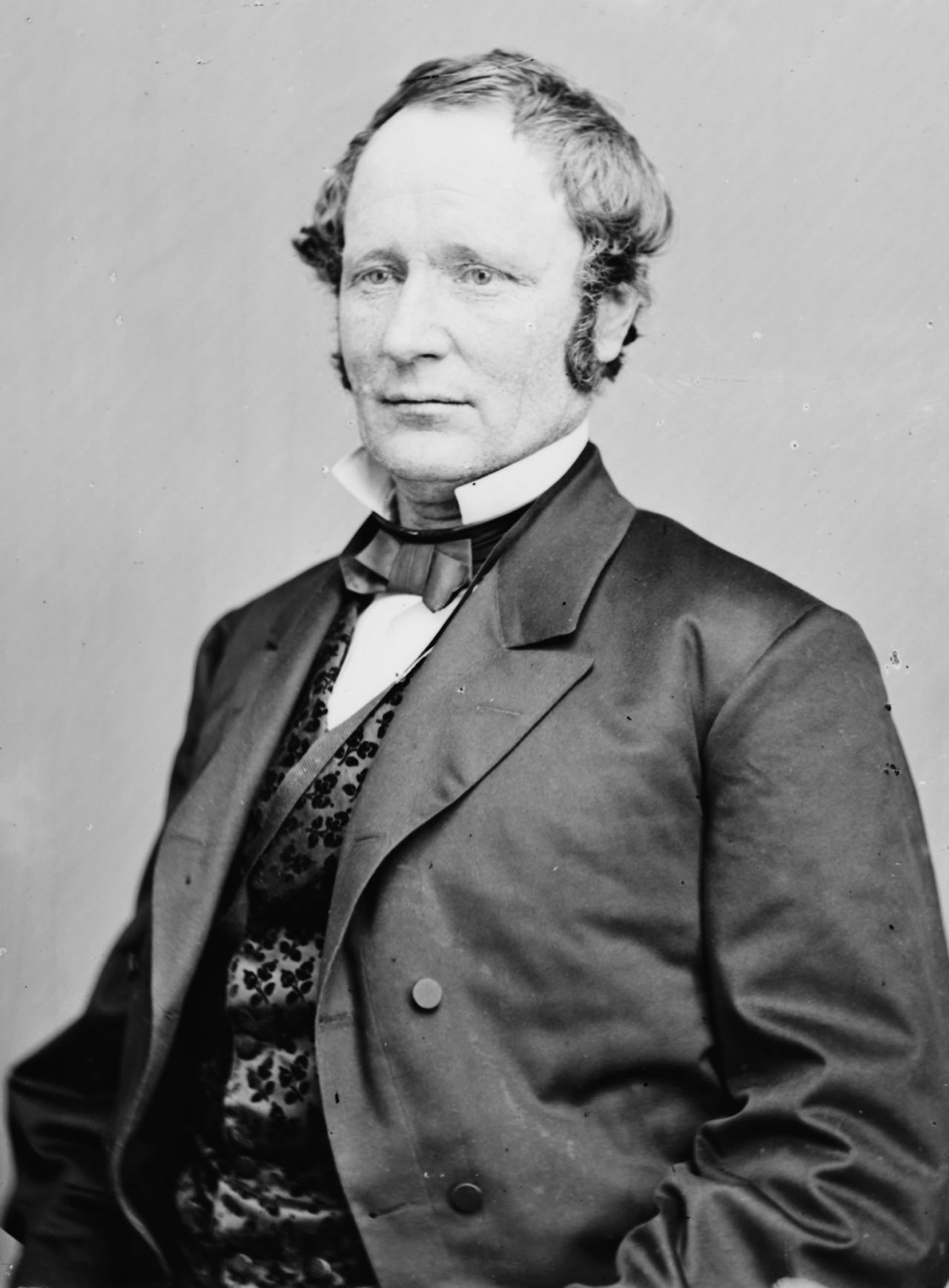
Vice Presidents are an easily forgotten group, especially when they don’t last long. Indiana’s Thomas Andrews Hendricks (1819-1885) only lasted eight months as vice president, but this obscures his lengthy political career in a state that in his time was politically tumultuous.
Hendricks was born for politics, as he was raised in a family that staunchly adhered to Jacksonian principles and he was politically connected as his uncle, William Hendricks, had served as Indiana’s governor. However, his uncle was anti-Jacksonian as opposed to the views of his immediate family. Hendricks married Eliza Morgan in 1845 and they had one child, Morgan, but he tragically died at the age of three.
In 1848, he had his first political success when he was elected to the Indiana State House, but he wasn’t there long, as in 1850 he won election to the U.S. House in a district that was normally aligned with the Whigs. Hendricks aligned himself with the foremost young Midwestern politician of his day in Senator Stephen Douglas of Illinois. Like Douglas, Hendricks believed in popular sovereignty as the answer to the issue of slavery; the people of the states get to decide whether they are slave or free states. In 1854, consistent with this belief, he voted for the Kansas-Nebraska Act, which repealed the Compromise of 1820 and permitted residents of the Kansas and Nebraska territories to decide whether they were to be free or slave states. This resulted in pro and anti-slavery settlers moving into Kansas to influence the state’s vote, and the result were numerous incidents of violence and massacres from 1854 to 1859 that became known nationally as “Bleeding Kansas” and was a preview of the War of the Rebellion. Hendricks was also opposed to repealing the Fugitive Slave law unless slavery were abolished. Despite his political skills, the 1854 midterms were bad for the Democrats and he lost his seat.
Hendricks was subsequently picked by President Pierce to serve as the U.S. Commissioner of the General Land Office. However, like Senator Stephen Douglas, he had differences with President Buchanan. For one, Hendricks was an advocate of a homestead law to encourage settlement of the west, which Buchanan opposed. He also objected to Buchanan’s catering to the interests of slavery, and resigned in 1859.
In 1860, he ran for governor, but narrowly lost to Republican Henry Lane. However, an opportunity would arise for Hendricks given the actions of Senator Jesse Bright. Bright, the de facto leader of the Democratic Party in Indiana, was discovered to have engaged in correspondence with Confederate President Jefferson Davis. In February 1862, the Senate expelled him for treason and the following year, the Indiana legislature elected Hendricks to the Senate. He was a unionist or “War Democrat”, opposing the Copperhead faction of the Democrats and voting for funds for the war, serving as the leader of the small Democratic opposition. However, Hendricks opposed emancipation as a war aim as well as draft legislation. He would not differ from his party in opposition to Reconstruction, having not only opposed the 14th and 15th Amendments but also the 13th Amendment. Hendricks accepted that slavery was no more but believed that the Southern states should be represented as he was of the view that they had never actually left the union. He held that it would be “unpropitious” to change the Constitution at that time (Gray). Had Hendricks gotten his way, the 13th Amendment would have faced a harder vote and the 14th and 15th Amendments would have likely been sunk. Indeed, enacting the amendments before the Southern states were readmitted would be an argument some Southern politicians would use against the legitimacy of the 14th and 15th Amendments in the future. Hendricks also expressed his beliefs that blacks were morally and intellectually inferior and unfit for citizenship and on numerous occasions he said, “This is the white man’s Government, made by the white man, for the white man” (Gray). Although President Lincoln and Senator Hendricks had many disagreements, Lincoln praised him for always having been respectful to his administration. In 1868, Hendricks again tried for governor, but narrowly lost to incumbent Conrad Baker. That year he was also considered for the Democratic nomination for president but that went to Horatio Seymour, who had twice been New York’s governor. By 1869, Republicans had regained control of the Indiana legislature, and Hendricks was out. His DW-Nominate score was a -0.436. Hendricks would subsequently focus his politics on supporting inflationary currency and federal aid to rural areas.
Thomas A. Hendricks was not only for easy money, but was also an easy candidate, regularly being available. Indeed, some Democrats thought him too available for the presidency. This, plus a reasonable belief that him at the top of the ticket with his soft currency stance would lose the Democrats New York, he was twice relegated to vice president. However, electors in Kentucky, Maryland, Tennessee, and Texas did cast their votes for him in 1872 after the Liberal Republican/Democratic candidate, Horace Greeley, died only weeks after the election. So technically, he did win four states and six electoral votes from Kentucky despite not officially being a candidate.
Hendricks in 1875.
In 1876, Hendricks got the nomination for vice president. The ticket of Tilden/Hendricks didn’t just win the popular vote, it also won the majority of the vote. Yet, Tilden/Hendricks lost to the Republican Hayes/Wheeler ticket by one electoral vote. The election was the most controversial in the nation’s history (yes, even more than the 2000 election) and there were widespread allegations of voter fraud, intimidation, and violence from both parties. This was the only election that was decided by a special created commission, the Electoral Commission, which produced the controversial result. Tilden and Hendricks opted not to contest this result in the name of keeping the nation from entering yet another War of the Rebellion. Nonetheless, Democrats were bitter after this election and were calling President Hayes “Rutherfraud B. Hayes” and “his fraudulency”. Hendricks declined to participate in the 1880 election on health grounds, but when 1884 rolled around, he was again available for the vice president nomination. Although some Democrats wanted to run Samuel J. Tilden again to redeem the 1876 election, he was 70 and in poor health, so he declined. Hendricks as vice president, however, was a replay of 1876 and Democrats were for that. What’s more, Hendricks provided a good balance as he was far more amenable to political machines than reformer Grover Cleveland and he was for using the government to help agriculture and inflationary currency as opposed to Cleveland, who did not want to intervene with agriculture and was a gold standard guy. Furthermore, both Cleveland and Hendricks were from states that were must-wins for Democrats, and indeed in 1884 they won both New York and Indiana as well as the election.
Vice President Hendricks
While vice president, Hendricks had a friendly relationship with Cleveland and said of him that he was “courteous and affable”, traits that Hendricks himself possessed. However, he issued strong objections to him initially refusing to dole out patronage out of his sense of good government. Eventually political reality forced Cleveland to engage in patronage to reward his party’s supporters. On September 8, 1885, Hendricks delivered a controversial speech in which he called for Ireland’s independence, which although was to the consternation of the British, a lot of Irish Americans appreciated the speech. On November 24, 1885, Hendricks reported feeling ill and he went to bed early. He never woke up as his heart had given out. Hendricks’ death was a shock to the public as he had appeared to be fine. The truth, however, was that his health had been declining over the past five years. Hendricks had suffered a stroke in 1880 which resulted in his right foot becoming lame, thus making it hard for him to stand. The truth of his health had been known only to his family and doctors. His funeral in Indianapolis was attended by hundreds of people, including President Cleveland. Hendricks’ death inspired a change to the law on succession for the presidency, as the next in line was the Senate president pro tempore, who at the time was a Republican as Republicans had a majority, and both Democrats and Republicans of the time recognized that it would not be suitable for whoever succeeded a dead president to be a member of a party that the public hadn’t voted for and removed Congressional leaders from succession, thus the Secretary of State became third in line for the presidency. This arrangement would hold until 1947, when Congressional leaders were put back on the succession order.
References
Caffrey, C. (2023). Thomas Andrews Hendricks. EBSCO.
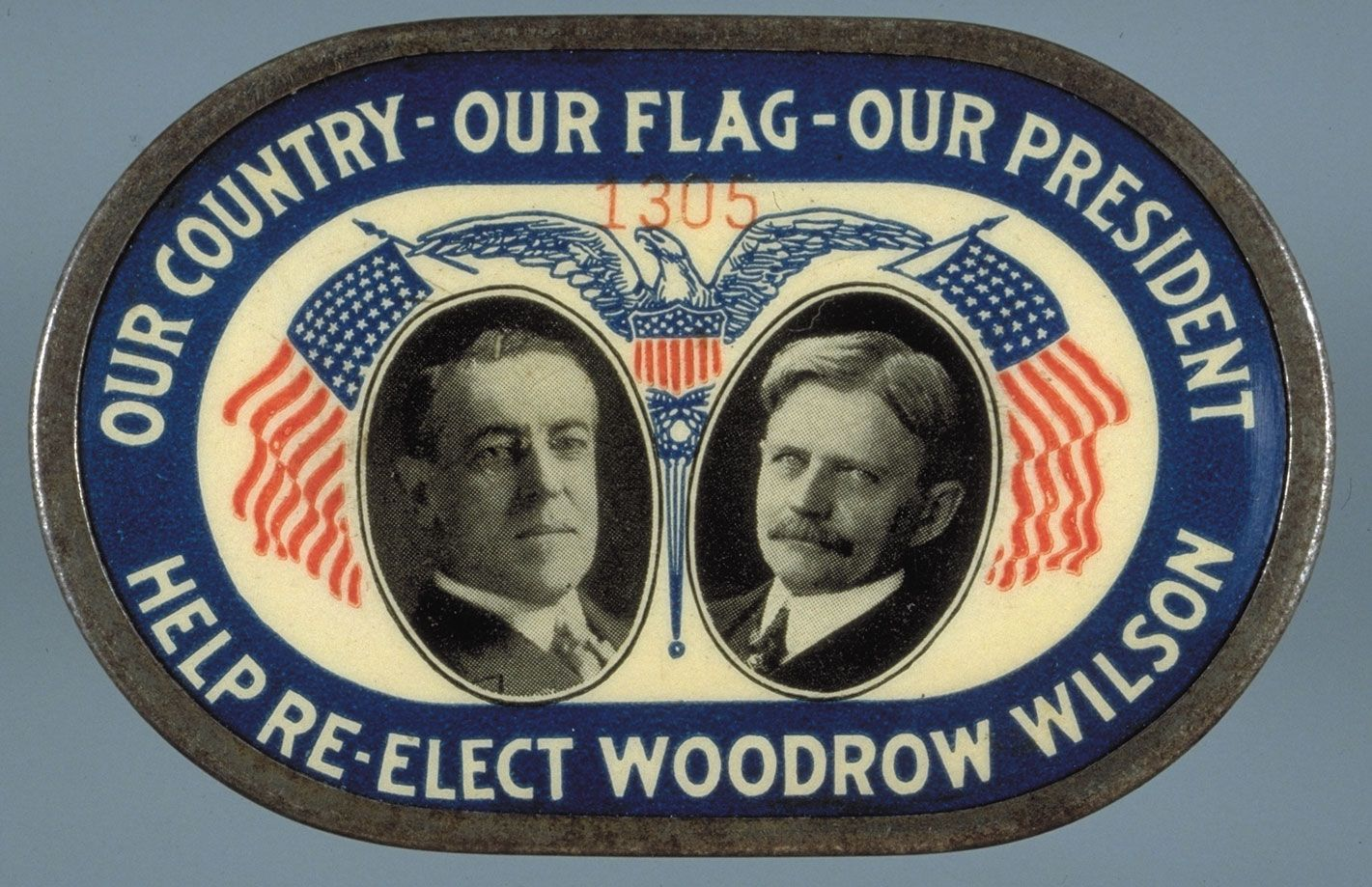
Although by 1916, Woodrow Wilson is a solid figure in the progressive era, particularly given his support of legislation aimed at the working man, such as the Adamson Act for maximum hours for railroad workers, this is still the era in which Republicans are dominating the presidency so he will have a tough fight. Although Republicans didn’t win majorities in the 1914 midterm, they did well nonetheless and established that they remained a force to be reckoned with. Wilson keeps his vice president, former Indiana Governor Thomas R. Marshall, while the Republicans select Justice Charles Evans Hughes, this being the one time that a party has nominated a justice of the Supreme Court and that a justice has resigned to run for president. Unlike Salmon P. Chase in the 1860s and 1870s, Hughes had not seen the Supreme Court as a steppingstone to the presidency. The candidate for vice president was again Indiana’s Charles W. Fairbanks, who had served as Theodore Roosevelt’s vice president and was known as a conservative stalwart. Although there were thoughts that the Progressive Party would run a candidate, Theodore Roosevelt was fully behind Hughes and refused to accept the party’s nomination for president, thus the Progressive Party was effectively hobbled, and although many Progressives went along with Roosevelt there were several prominent ones who went with Wilson. Wilson campaigned on having kept the United States out of war and for the measures he had gotten into law for working class Americans, while Hughes criticized Wilson’s intervention in Mexico, called for military preparedness, and voiced opposition to the Adamson Act.
Hughes campaigned considerably more to the conservative side of the GOP than the progressive side, and this approach may have been the difference between victory and loss in California. Hughes campaigned with party conservatives in California and thought he could pass on meeting with progressive Governor Hiram Johnson, who opted not to give an endorsement, and afterwards very narrowly lost the state. Indeed, Wilson’s performance west of the Mississippi was strong; of those states only Oregon and South Dakota voted for Hughes. This plus the Solid South won Wilson a second term. Hughes performed strongly in the Northeast with Wilson only pulling off New Hampshire and won 7 of the 11 Midwestern states. Although by the popular vote, Wilson had won by three points, if Hughes had won California he would have won the electoral vote and it would thus become the fourth time in the nation’s history that the candidate who got the highest popular vote didn’t win the election (that would have to wait until Bush v. Gore!). This would also be the last election in which North Dakota and South Dakota voted differently (seriously guys they’re not the same!). This election did prove something important; Democrats could win an election on Wilson himself given the lack of the Republican split.
The Senate
Democrats lose a net of two Senate seats in this election. Republicans gain some seats but lose others, and this leaves Democrats with a still comfortable 54-42 majority.
Republican Gains
In Indiana, Majority Leader John W. Kern lost reelection to Republican Harry S. New, part of the Republican sweep of the state.
In Maine, Charles F. Johnson lost reelection to Republican Frederick Hale, the son of Eugene Hale, the man he had defeated in 1910. The state had reverted back to its traditionally Republican politics.
In Maryland, Republican Joseph I. France defeated Democratic Congressman David J. Lewis, the latter who would later play a key role in crafting Social Security.
In New Jersey, James E. Martine, a Democrat who had been a bit of a thorn in the side of President Wilson, lost reelection by 16 points to Republican Joseph Frelinghuysen. Indeed, New Jersey was a bit of a disappointment for Wilson.
In New York, Republican William M. Calder defeats Democrat William F. McCombs for the open Senate seat.
Democratic Gains
In Delaware, Republican Henry du Pont lost reelection to Democrat Josiah Wolcott despite Wilson losing the state.
In New Mexico, Republican Thomas B. Catron lost renomination to the younger Frank A. Hubbell, who lost the election to Democrat Andrieus A. Jones.
In Rhode Island, Republican Henry F. Lippitt lost reelection to Democrat Peter G. Gerry, the first time a Democrat has been elected to the Senate since before the Republican Party’s existence. It is also the first time that Rhode Island had a vote of the people for their senator. Gerry ran considerably ahead of Wilson, who lost the state.
In Utah, Republican George Sutherland lost reelection to Democrat William H. King by 17 points. Wilson ran two points ahead of King. President Warren G. Harding would place Sutherland on the Supreme Court. Wilson had won the state, in contrast to it being one of President Taft’s two victories in 1912.
In West Virginia, Democrat William Chilton lost reelection to Republican Congressman Howard Sutherland. Wilson had lost the state.
In Wyoming, Republican Senator Clarence Clark lost reelection to Democrat John B. Kendrick by 6 points. Wilson had won the state.
Lost Renominations
In Minnesota, Progressive Republican Moses Clapp lost renomination to the more establishment-friendly Frank B. Kellogg, who won the election.
In Tennessee, Democrat Luke Lea lost renomination to Congressman Kenneth McKellar. McKellar was the junior partner of the powerful Crump machine in Memphis, and he would have a long career, being involved in secretly securing funding for the atomic bomb project and staying in office until 1953. The man who would defeat him in his primary in 1952? Albert Gore Sr.
House
The House provided a rather interesting situation, as Republicans overall made gains and they actually won one more seat than the Democrats. However, there were more than two parties in the House. Socialist Meyer London of New York, Progressives John Elston of California, Whitmell Martin of Louisiana and Melville Kelly of Pennsylvania, and the Prohibitionist Charles Randall of California caucused with the Democrats, giving them the majority.
Democratic Gains
In California, Democrats gain one seat in the 1st district as Clarence F. Lea succeeds the retiring Independent William Kent.
In Connecticut’s 1st district, future Senator Augustine Lonergan unseats Republican incumbent P. Davis Oakey.
In Delaware, Democrat Albert Polk very narrowly edges out incumbent Thomas W. Miller. Miller would later become one of the corrupt officials in the Harding Administration.
In New Mexico, Republican Benigno Hernandez loses reelection to Democrat William B. Walton.
In New York, Democrat Daniel C. Oliver defeated Republican incumbent William S. Bennet in the 23rd’ district. In the 28th district, Democrat George Lunn succeeded retiring Republican William Charles in the 30th district. Lunn had previously been the Socialist mayor of Schenectady and had been persuaded to switch to run for Congress.
In North Carolina’s 10th district, Republican James J. Britt loses reelection to Democrat Zebulon Weaver. The election is challenged, and Britt does win the challenge, but only serves the last two days of the term as Weaver indisputably wins the 1918 election.
In Ohio, Republican representatives J. Edward Russell, Edwin Ricketts, Seward Williams, and William C. Mooney are defeated for reelection by Benjamin Welty, Horatio Claypool, Elsworth Bathrick, and George White in the 4th, 11th, 14th, and 15th districts respectively.
In Pennsylvania, retiring Republican C. William Beales is succeeded by Democrat Andrew Brodbeck in the 20th district while Republicans Robert Hopwood and Andrew Barchfeld are defeated for reelection by Democrats Bruce F. Sterling and Guy Campbell in the 21st and 32nd districts.
In Utah, Republican Joseph Howell of the 1st district retires and Democrat Milton Welling succeeds him.
Republican Gains
In California, Republican Henry Z. Osborne wins the election to succeed Progressive William P. Stephens in the 10th district.
In Illinois’ 7th, 14th, 16th, and one of the at-Large districts, Democrats Frank Buchanan, Clyde Tavenner, Claude Stone, and William E. Williams lose to Republicans Niels Juul, William Graham, Clifford Ireland, and William E. Mason respectively.
In Indiana’s 2nd, 5th, 6th, 8th, 9th, 11th, and 12th districts Democrats lose seats. In the 2nd, 5th, 6th, 11th, and 12th William Cullop, Ralph Moss, Finly Gray, George Rauch, and Cyrus Cline lose to Republicans Oscar Bland, future secretary to Calvin Coolidge Everett Sanders, Daniel W. Comstock, Milton Kraus, and Louis Fairfield. In the 8th and 9th incumbents John Adair and Martin Morrison retire and are succeeded by Republicans Albert Vestal and Fred Purnell.
In Iowa, the only Democratic incumbent, Thomas J. Steele of the 11th district, loses to Republican George Scott.
In Kansas, Democrat Joseph Taggart of the 2nd district loses reelection to Republican Edward C. Little.
In Maine, Democrat Daniel McGillicuddy of the 2nd district loses reelection to Republican Wallace White. White would sponsor the first major radio regulation legislation in 1926 and he would serve as Senate Majority Leader from 1947 to 1949.
In Maryland, Republican Frederick Zihlman succeeds Democrat David J. Lewis, who lost the Senate election.
In Michigan’s 2nd district, Republican Mark Bacon defeats Democrat Samuel Beakes. However, Beakes successfully contests the election and the House seats him in the middle of the session.
In one of Montana’s at-Large districts, Republican Jeanette Rankin succeeds Democrat Tom Stout. She is the first woman to ever be elected to Congress and she would gain a deserved reputation as anti-war.
In New Jersey’s 6th district, Republican John Ramsey succeeds retiring Democrat Archibald Hart.
In New York’s 14th, 18th, 24th, and 42nd districts, Democratic incumbents Woodson Oglesby, and Daniel Driscoll lose reelection to Fiorello La Guardia, George Francis, Benjamin Fairchild, and William F. Waldow. Interestingly, of these three districts, the first four were in New York City, a bit of a subversion of expectations I would say! La Guardia would become one of New York City’s most famous and many historians argue, the best of their mayors.
In Ohio’s 2nd district, Republican Victor Heintz succeeds retiring Democrat Alfred G. Allen.
In Oklahoma’s 1st district, Republican Thomas Chandler defeats Democrat James Davenport for reelection. Tulsa is in this district and it is a strong swing district; until the 1932 election it would repeatedly change parties.
In Pennsylvania’s 12th and 19th districts, Republicans Thomas Templeton and John Rose defeat Democrats John Casey and Warren Bailey respectively. In the 25th district, Republican Henry Clark succeeded retiring Democrat Michael Liebel.
In West Virginia, Republican Stuart F. Reed gained the open seat of the 3rd district.
In Wisconsin’s 2nd, 6th, and 9th districts, Republicans Edward Voigt, James H. Davidson, and David Classon would defeat Democratic incumbents Michael Burke, Michael Reilly, and Thomas Konop, making the state’s House delegation all-Republican.
Other Gains
In Massachusetts, 9th district Republican Ernest W. Roberts lost reelection to Independent Alvan T. Fuller, who would later be a controversial Massachusetts governor over his handling of the Sacco and Vanzetti case.
In Pennsylvania, Progressive Melville Kelly defeated Republican incumbent William Coleman in the 30th district.
Lost Renominations
In Florida’s 3rd’ district, Democrat Walter Kehoe prevails over Emmett Wilson.
In Georgia’s 12th district, Democrat William Larsen defeats Dudley M. Hughes.
In one of Idaho’s two at-Large seats, Republican Robert McCracken is defeated for renomination by Burton French.
In Michigan’s 10th district, Republican George Loud is defeated for renomination by Gilbert Currie.
In Minnesota’s 5th district, conservative incumbent George R. Smith loses renomination to Progressive Republican Ernest Lundeen.
In New York’s 39th district, Republican Henry Danforth loses renomination to Archie Sanders.
In Pennsylvania’s 22th district, Republican incumbent Abraham Keister would lose renomination to Edward Robbins. Robbins would be one of three members of Congress who would die from the influenza pandemic. Republican S. Taylor North would also lose renomination in the 27th district to Nathan Strong.
In South Carolina’s 3rd district, Democrat Wyatt Aiken lost renomination to Frederick Dominick.
In Texas, Oscar Callaway, John Stephens, William Smith, and James Davis of the 12th, 13th, 16th, and At-Large districts lost renomination to James Wilson, J. Marvin Jones, Thomas Blanton, and Daniel Garrett respectively. Jones would sponsor the Agricultural Adjustment Act during the Roosevelt Administration and would be a champion of overall New Deal farm policy. Blanton would, as mentioned in a previous post, be a controversial figure and was even considered for expulsion from Congress for putting foul language in the Congressional Record.
President Wilson and the next Congress would have to contend with World War I and all the difficulties that arose from it, including taking control of railroads, the Espionage and Sedition Acts, and the influenza pandemic.
References
1916 United States House of Representatives elections. Wikipedia.
Something that a lot of people are inclined to forget about our elected officials is that in numerous ways they are quite representative of the public. We have elected literal murderers, thieves, and even a few madmen. The individual I am writing about did not start out among the latter, but he became among the latter in Charles William Jones (1834-1897).
Jones was Irish-born, and he and his mother immigrated to the United States in 1844 (his father, a British surgeon, had died). In 1854, Jones moved to Santa Rosa County, Florida, where he worked as a carpenter but also studied law. In 1861, he married Mary Ada Quigley, and the pair had eight children, but only half lived to adulthood. Jones associated himself with the Democratic Party as did many Southern whites and many first-generation immigrants. In 1872, Jones ran against Republican Congressman William Purman, but lost. However, the next election year was much better for Democrats, and Jones won a seat in the Florida House by a mere five votes. Jones wasn’t in this position long, as the state legislature was closely divided with several independent legislators holding the Senate election in the balance. Jones was elected to the Senate with the votes of all Democrats and Independents plus one Republican in early 1875 (127).
Jones was part of the Democratic “Redeemer” wave of politicians to be elected in the South, thus his rise was part of the start of the fall of Reconstruction. Like all elected national Democrats, Jones was opposed to Reconstruction. Jones was among the less partisan of Democrats overall though, being among the more favorable to business interests. Although his DW-Nominate score was a -0.353, but he was to the right of most of his Senate Democratic colleagues, at least per the DW-Nominate system. However, he considered himself a supporter of Jeffersonian Democracy, and in 1882 he delivered a speech in which he held that there was more work to do to attain Jeffersonian Democracy, warned against a growing tendency towards paternalism in government, and warned that the use of surplus revenues for expensive internal improvements would result in the demoralization of the American public and the subversion of the ends of democratic governance (York Democratic Press). In 1880, Jones suffered a loss when his wife died, but he persisted with his Senate work. His popularity was still holding as he was effective at allocating federal money to his state. For instance, Jones had succeeded in obtaining funds for a naval base in Pensacola, public buildings, and for more postal routes in the state (Etemadi, 123). Since voters and the politicians of Tallahassee approved of his work, he was reelected in 1881.
The Fall
In the spring of 1885 Jones had been working hard and announced that he was taking a vacation to Canada as well as Detroit, Michigan. However, his time in Michigan started in June and extended throughout the summer. When fall had arrived, Jones was still not back in the Senate. Absenteeism was a bit more common back then than it is now, and some senators were pretty bad about it; William Sharon of Nevada for instance was basically a senator in name only as he only voted 8% of the time during this Senate term and never once appeared before his constituents! However, Jones’ absence extended into February 1886, and he repeatedly refused the urgings of his colleagues to return. The truth is that he had become smitten and utterly obsessed with a wealthy Michigander woman in her 30s, Clotilde Palms. He had first seen her in 1882, and the following year after meeting her at a dinner party, Jones proposed but she declined (The Piqua Daily Call). Jones refused to leave his new residence, a Detroit hotel room, until he could win her over. Yet, she refused to see him and had no interest in him whatsoever despite his continued sending of letters to her as well as flowers. A letter by Palms’ father to leave his daughter alone, letters from other senators to return to the Senate, and a visit from his son Charles to convince him to resume his Senate duties produced no change. Jones refused to answer questions from a reporter as to why he was remaining in Detroit and justified his extended absence, stating, “I want no vindication. I am not the only senator that has been away. Cameron went to Europe, and Logan was in Illinois during the session of the Legislature, and I don’t see why I can’t do as others have done. It is nobody’s business” (The Piqua Daily Call). He furthermore would not indicate when or if he would return to Washington. Florida’s governor would not act to remove him from office as this situation was unprecedented. So even though he wasn’t in Washington or even in his home state and was doing no work, he continued to be a senator and receive pay until the end of his term in 1887. Jones would be evicted from his hotel room in December and for the next few years he was destitute and relying on the help of friends to sustain him. Despite Jones’s continued obsession with Palms, she married a Detroit surgeon in 1889. His letter to the editor of the Detroit Free Press dated March 20, 1890, was published, which read, “The newspapers seem to have forgotten that the ex-statesman from Florida, as the New York World has called me, was still in Detroit. The man who a few years ago attracted the attention of the whole country by leaving the Senate before his term of office expired and settling down in the city of the straits, has ceased to be an object of interest, although he maintains precisely the status to-day that he did then. He still holds the fort, and he is going to make it hot for his enemies. He shall neither ask quarter from them nor give it. He expects to be able to show up a political and social conspiracy the like of which was never known in this country before. He can tell the conspirators that Miss Clotilda Palms of this city is now in Nice, and that the publication of her marriage with a well-known character here a year ago in New York was a base, cowardly, false and atrocious calumny upon the character of one of the purest and most highly respected as well as devout Catholic ladies in the city. The ex-Senator can also tell the conspirators against his life and happiness that Miss Palms is, and has been for years, his affianced Catholic wife, and at the proper time he feels assured that they will come together at the holy altar of their holy church, and there before high heaven render to God their mutual vows as man and wife. Nothing but the most exceptional circumstances could have induced me to make this publication at this time” (Daily Territorial Enterprise).
Jones was clearly not the road to recovery. The Pittsburgh Post-Gazette described the state of his mind during these years in a May 21, 1890 article, “All this time he has been filled with the idea that he was the victim of a conspiracy on the part of certain persons to prevent his marrying a wealthy lady to whom he sought to pay attention immediately after he quite his seat in the Senate until she left town to escape his persecution. Six months ago she married and went to Europe. This fact did not change his opinions, and he has written many letters to individuals and newspapers full of incoherent charges and the vilest insinuations”. Jones was apprehended in May 1890 and after a medical evaluation he was diagnosed as suffering from monomania, or an extreme obsession with a single subject or person but otherwise would be sane, and the Detroit Probate Court ordered him to be institutionalized on the 20th. Jones was committed to a Dearborn asylum where he lived for the rest of his days, dying on October 11, 1897, at the age of 62.
References
A Paternal Government. (1882, May 12). York Democratic Press, 2.
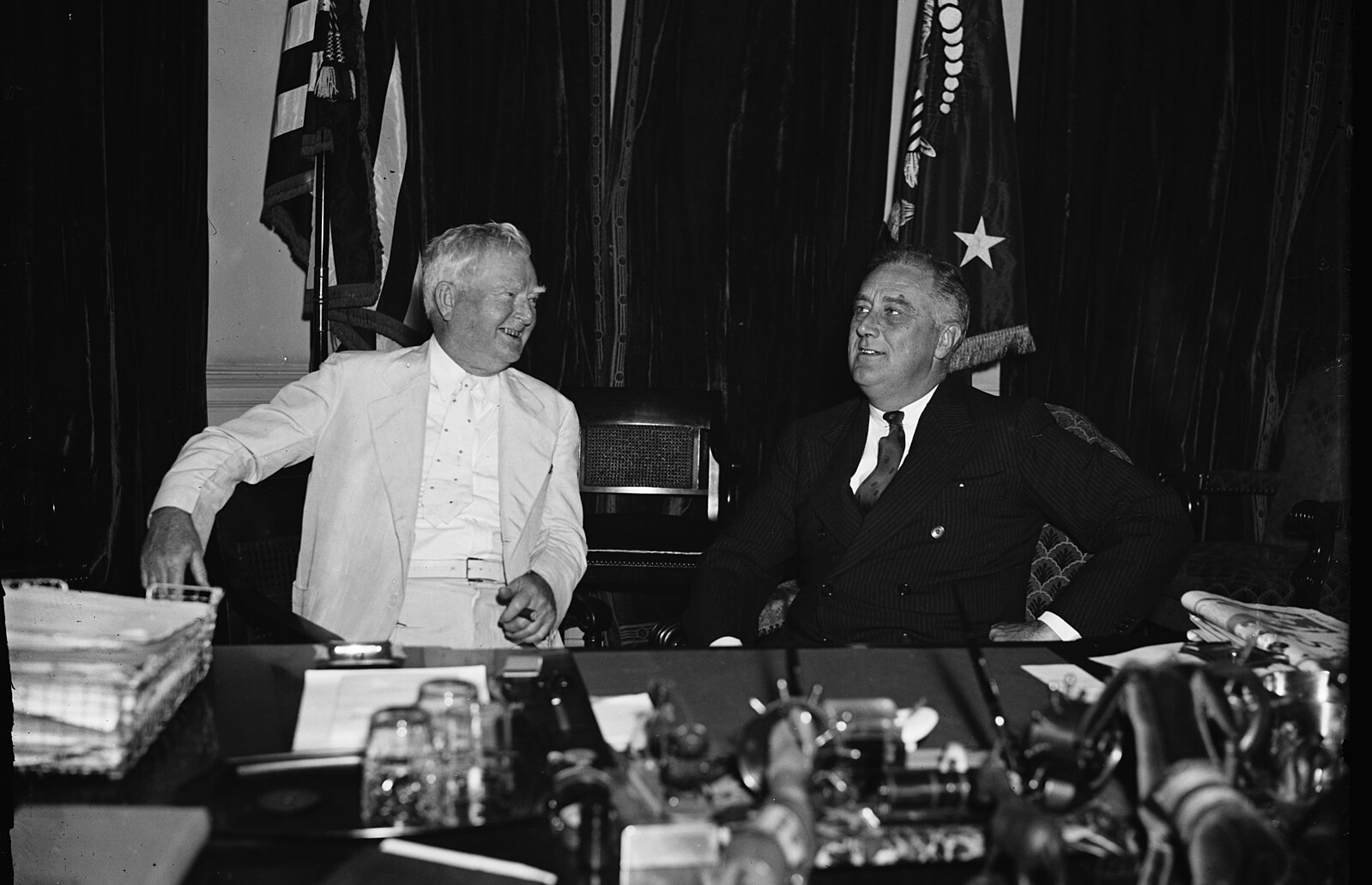
Vice President John Nance Garner and President Franklin Delano Roosevelt, the winners.
Every once in a while if things go badly for the GOP, some columnist will predict the end of the party. It turns out that Republicans are highly resilient, a lesson that should have been learned by the 1936 election, in which after they were at their lowest level of power since their foundation. The most obvious demolishing was FDR over Alf Landon. Landon, who ran on the slogan of “Life, Liberty, and Landon” and really had no issues to campaign on to effect save for critiquing government inefficiency and calling for less spending. FDR and his New Deal were so popular that he won over 60% of the vote and even defeated him in his home state of Kansas, winning every state except Maine and Vermont. Vermont at the time was the most Republican state in the nation and Maine had been strongly Republican save for a brief Democratic surge in the early 1910s. Many people had bad memories of the Hoover presidency and the Republicans were just not presenting an alternative that appealed to many at the time. As Virginia Senator Carter Glass quipped after the result, “It is well nigh impossible to beat a five billion dollar campaign fund”, referencing work relief spending (Hill). What’s more, money was short. What they could achieve was largely thanks to money provided from wealthy American Liberty League members. RNC chairman John D.M. Hamilton attested to this when after the election he said, “Without Liberty League money, we wouldn’t have had a national headquarters” (Pietrusza).
Democratic Gains:
In California, Republicans lost three seats. The 4th district’s (San Francisco) Florence Kahn was defeated by Progressive Franck Havenner, Sam Collins of the 19th district was defeated by Democrat Harry Sheppard, and the Democrats gained the open 20th district with Edouard Izac.
In Connecticut, down went both of the state’s House Republicans, William Higgins of the 2nd district to Democrat William Fitzgerald and Republican Schuyler Merritt of the 4th district to Democrat Alfred Phillips. However, the octogenarian Merritt had chosen not to campaign as he wasn’t that interested in reelection.
In Delaware, Republican Senator Daniel Hastings, definitely the most staunchly anti-New Deal of the senators, lost reelection to Democrat James Hughes. Republican freshman John G. Stewart also lost reelection to Democrat William F. Allen. Delaware’s sole seat would swing between the parties throughout the Roosevelt presidency.
In Michigan, Democrats picked up a seat, as Republican James Couzens, who had endorsed FDR for his reelection, had lost renomination in 1936 and then died. Democratic Congressman Prentiss Brown was elected. Republicans also incurred losses in the 6th and 13th districts, with Republicans William W. Blackney and Clarence G. McLeod losing reelection to Democrats Andrew Transue and George O’Brien. Blackney and McLeod would return in 1938.
In Minnesota, the Farmer-Labor Party’s Dewey Johnson picked up the open 5th district from the GOP, and Republican William Pittenger lost reelection in the 8th district to the Farmer-Labor Party’s John Bernard. Pittenger would return in 1938.
In New Hampshire, Democrat Alphonse Roy lost an election to the 1st district, which was open, to Republican Arthur B. Jenks, but this election was contested and the Democratic majority House voted to seat Roy towards the end of the 75th Congress. Jenks would win in 1938.
In New Jersey, Republican Senator William Barbour would lose reelection to Democrat William Smathers. However, Barbour would return in the 1938 election. House Republicans Isaac Bacharach of the 2nd district, Peter Cavicchia of the 11th district, and Frederick Lehlbach of the 12th district lost reelection to Democrats Elmer H. Wene, Edward O’Neill, and Frank Towey respectively.
In New York, Vito Marcantonio of the 20th district lost reelection to Democrat James Lanzetta. However, Marcantonio would make a comeback in 1938 as a member of the American Labor Party.
In Ohio, Republican representation in the House was reduced to two, as Republicans John Hollister of the 1st district, William Hess of the 2nd district, Leroy Marshall of the 7th district, John Cooper of the 19th district, and Chester Bolton of the 22nd district lost reelection to Democrats Joseph Dixon, Herbert Bigelow, Arthur Aleshire, Michael Kirwan, and Anthony Fleger respectively. Hess and Bolton would return in the 1938 election.
In Oregon, Portland’s Republican Congressman William Ekwall of the 3rd district would lose reelection to Democrat Nan Honeyman.
In Pennsylvania, a significant development occurred in Philadelphia: with the loss of all its Republican representatives, the city of brotherly love became represented entirely by Democrats! Republicans Harry Ransley of the 1st, William H. Wilson of the 2nd district, Clare G. Fenerty of the 3rd district, and George Darrow of the 7th district lost reelection to Democrats Leon Sacks, James McGranery, Michael Bradley, and Ira W. Drew respectively. Only Darrow would return in the 1938 election. Also losing in Pennsylvania were Charles Turpin of the 12th district and Isaac Doutrich of the 19th district to Democrats J. Harold Flannery and Guy J. Swope respectively.
In Rhode Island, Republican Senator Jesse Metcalf lost reelection to Democrat Theodore Green as did the 1st district’s Republican Charles Risk to Democrat Aime J. Forand. Risk would return in the 1938 election, but after 1940 no Republican would win a Senate seat from Rhode Island until 1976, and no Republican would get a House seat until 1980.
In Wyoming, Republican Senator Robert Carey lost reelection to Democrat Harry Schwartz. It was just as well, as he died only two months later.
Republican Gains
Not all was bad for Republicans in this election, although the wins they had far from made up for their big losses.
In Iowa, Republican Cassius C. Dowell, who had lost reelection in 1934, came back in winning the open 6th district.
In Kansas, Republican Edward H. Rees won the open 4th district.
In Maine, Republican James C. Oliver defeated Democrat Simon Hamlin for reelection in the 1st district, while Republican Clyde H. Smith won the open 2nd district. Yep, the Republicans did well in Maine!
In Massachusetts, Republicans scored their only Senate seat pickup: Republican Henry Cabot Lodge Jr. defeated Democrat James M. Curley. Roosevelt had come to despise Curley and his corrupt machine ways and refused to lift a finger for him. Republicans also picked up the open 2nd district with Charles R. Clason and Republican Robert Luce came back in the 9th district after his defeat by Democrat Richard Russell in 1934.
In New York, Democrat Fred Sisson of the 33rd district lost reelection to Republican Fred Douglas.
In Ohio, Democrat William Fiesinger of the 13th district lost renomination, and Republican Dudley White won the seat.
In Pennsylvania, Democrats Charles Dietrich of the 15th district and Denis J. Driscoll of the 20th district lost reelection to Republicans Albert Rutherford and Benjamin Jarrett respectively.
In South Dakota, Democrat Theodore Werner of the 2nd district was defeated for reelection by Republican Francis Case.
Renomination Losses
In Alabama’s 9th district, George Huddleston, who had served since 1915 and had become a critic of the New Deal, lost renomination to staunch New Deal liberal Luther Patrick. Since Alabama was a one-party state at the time, this was tantamount to election victory.
Multiple Democrats in Louisiana lost renomination, including Numa Montet in the 3rd district to Robert Mouton, Riley Wilson of the 5th district to Newt Mills, and Jared Y. Sanders Jr. in the 6th district to John K. Griffith.
In Michigan, Republican Verner Main of the 3rd district lost renomination to Paul Shafer, who won the seat.
In Missouri, Democrat James Claiborne of the 12th district, one of the least loyal Democrats, lost renomination to Charles Anderson, who won the seat.
In New York, Democrat Richard Tonry of the 8th district lost renomination to Donald O’Toole, who won the seat.
In Ohio, Democrat Warren Duffey of the 9th district lost renomination to John F. Hunter, who won the seat.
In Oklahoma, Democrat Percy Gassaway of the 4th district lost renomination to Lyle Boren, who won the seat.
In Pennsylvania, multiple Democrats lost renomination. Democrat William Richardson of the 14th district went down to Guy Moser, who won the seat. William Berlin of the 28th district also lost renomination to Robert G. Allen as did J. Twing Brooks of the 30th district to Peter De Muth. In Pennsylvania’s 32nd district, Theodore L. Moritz opted to run for reelection as a Progressive after losing renomination, but lost to Democratic nominee Herman P. Eberharter. In the prior two cases, the winners would turn out to be considerably more conservative than their predecessors.
In Texas, the voters of the 17th district finally had enough of Democrat Thomas Blanton being a lightning rod of controversy and dumped him for Clyde Garrett, who won the election.
In Virginia, Democrat Colgate Darden of the 2nd district, who had voted against Social Security, lost renomination to Norman Hamilton, but he would return in the 1938 election.
This election had significance not only as a public endorsement of the New Deal overall, but also as a signal to the Supreme Court that the laws they were striking down were part of what the public supported. After this election, Roosevelt would be able to replace retiring justices, changing the ideological landscape of the court in the direction of broad interpretation of the Commerce Clause. The New Deal programs would continue and the federal minimum wage under the Fair Labor Standards Act among other measures would be enacted.
References
1936 United States House of Representatives elections. Wikipedia.






 Mad Politics: The Bizarre, Fascinating, and Unknown of American Political History