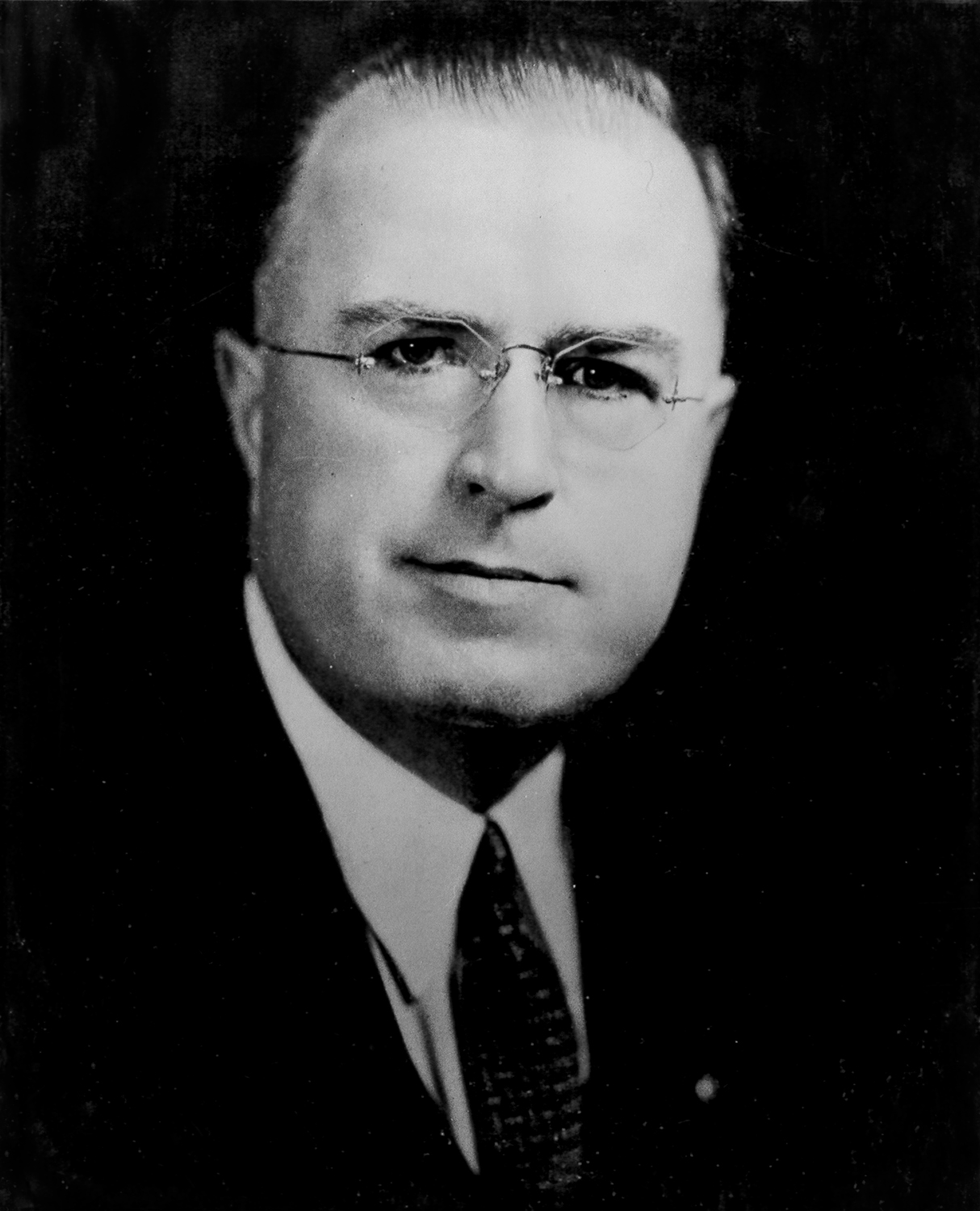
Sam Hobbs, sponsor of the Hobbs Act.
In 1934, Congress passed and FDR signed the Anti-Racketeering Act. This law, aimed at gangsters, contained an exemption for organized labor. The consequences of this would become apparent when members of the Teamsters Union sought to secure wages by rather unsavory means. As Chief Justice Harlan F. Stone wrote, “They [the members of the teamsters’ union], or some of them, lay in wait for trucks passing from New Jersey to New York, forced their way onto the trucks, and by beating or threats of beating the drivers procured payments to themselves from the drivers or their employers of a sum of money for each truck, $9.42 for a large truck and $8.41 for a small one, said to be the equivalent of the union wage scale for a day’s work. In some instances they assisted or offered to assist in unloading the truck and in others they disappeared as soon as the money was paid without rendering or offering to render any service” (The New York Times, 1942). The case against the union, Teamsters Local 807, made its way up to the Supreme Court as incidents had involved interstate commerce, and on March 2, 1942, they ruled 6-1 in United States v. Teamsters Local 807 that workers of the Teamsters Union had not been in violation of the Anti-Racketeering Act. The majority opinion being delivered by Justice James F. Byrnes, the majority’s holdings were:
“1. That the legislative history of the Act shows that it was intended to suppress terroristic activities of professional gangsters, and not to interfere with traditional labor union activities.
2. The exception is not limited to those who had acquired the status of employees prior to the time when they obtained, or attempted or conspired to obtain, the payment.
3. The exception is applicable to an agreement by members of a city union of truck drivers, who, for the purpose of obtaining employment at union wages in connection with “over the road” trucks entering the city, agree to tender their services in good faith to each truck owner and to do the work if he accepts their offer, but agree further that, should he refuse it, they will nevertheless, for the protection of their union interests, require him to pay them the wages, even by resort to threats and violence.
The test of the applicability of the exception in such case is whether the objective of the conspirators was to obtain “the payment of wages by a bona fide employer to a bona fide employee,” and not whether the intent of the truck owner in making payment was to pay for services, rather than for protection.
4. Labor union activities such as those disclosed by the record in this case are not beyond the reach of federal legislative control, and the use of violence such as that here disclosed is subject to the ordinary criminal law.
118 F.2d 684 reversed” (315 U.S. 521).
Given that Justices Owen Roberts and Robert Jackson were not participating in the case, Chief Justice Harlan F. Stone was the sole dissenter. Dissenting even more on this decision was Congress.
This particular act of racketeering by Teamster members unfortunately reflected a wider problem, and Representative Sam Hobbs (D-Ala.) opted to act (Neeley). Hobbs was a close ally of FBI director J. Edgar Hoover who specialized in law enforcement measures, responded by introducing legislation to apply the Anti-Racketeering Act to labor unions, thus prohibiting extortion and robbery in interstate commerce. American Federation of Labor President William Green opposed the legislation as “anti-labor” and argued that “there is no necessity for it” (The New York Times, 1942). The New York Times was for this measure, regarding it as necessary for the reputation of organized labor. Although Hobbs’ bill passed the House in 1943 by a vote of 270-107 (D 115-70, R 154-34, P 0-2, AL 0-1, FL 1-0) (yes there were five parties in the House at the time), it was not taken up in the Senate. Numerous Congressional allies of organized labor in Washington came out strongly against the Hobbs bill as overly broad. Representative Emanuel Celler (D-N.Y.), a frequent champion of liberalism, held that the bill’s definitions were “so broad that as to permit one to drive a coach and six through them” and Representative Luther Patrick (D-Ala.), one of the strongest of the Southern liberals, warned with this law “we are simply burning the house down…to get rid of a few rats” (CQ Almanac). However, there were some liberals who found merit in this measure as a way of improving the reputation of unions. Representative Jerry Voorhis (D-Calif.), normally a voice for liberalism, thought organized labor’s fears about the bill unjustified, stating, “when one attempts to read the bill with care it just is not possible to find in the bill the dangers that are alleged to be there” (CQ Almanac). In the next Congress, the key vote was to approve the rule for consideration, which was adopted 259-108 (D 113-93, R 146-13, P 0-1, AL 01). The Hobbs Act subsequently passed by voice vote in the House and Senate and President Truman found the provisions of this bill sufficiently acceptable to sign it into law the following year. With the exceptions of signing this measure and his bad-tempered push to draft strikers, he was known as a favorable president to organized labor for his pushing for increasing the minimum wage and his vetoes of the 1946 Case bill and the Taft-Hartley Act in 1947. The Hobbs Act is a relevant law to this day.
References
Anti-Racketeering Act Amendments. CQ Almanac 1945. Congressional Quarterly.
Retrieved from
https://library.cqpress.com/cqalmanac/document.php?id=cqal45-1403306
H. Res. 406. Resolution Providing for the Consideration of HR 32 to Amend the Act Entitle “An Act to Protect Trade and Commerce Against Interference by Violence, Threats, Coercion or Intimidation.”. Govtrack.
Retrieved from
https://www.govtrack.us/congress/votes/79-1945/h97
Neeley, G.R. (2017, November 15). Samuel Francis Hobbs. Encyclopedia of Alabama.
Retrieved from
https://encyclopediaofalabama.org/article/samuel-francis-hobbs/
To Curb Labor Racketeering. (1942, May 20). The New York Times.
Retrieved from
To Pass H.R. 653, a Bill to Make Extortion and Robbery in Interstate Commerce Unlawful. Govtrack.
Retrieved from
https://www.govtrack.us/congress/votes/78-1943/h23
United States v. Teamsters Local 807, 315 U.S. 521 (1942).
 Mad Politics: The Bizarre, Fascinating, and Unknown of American Political History