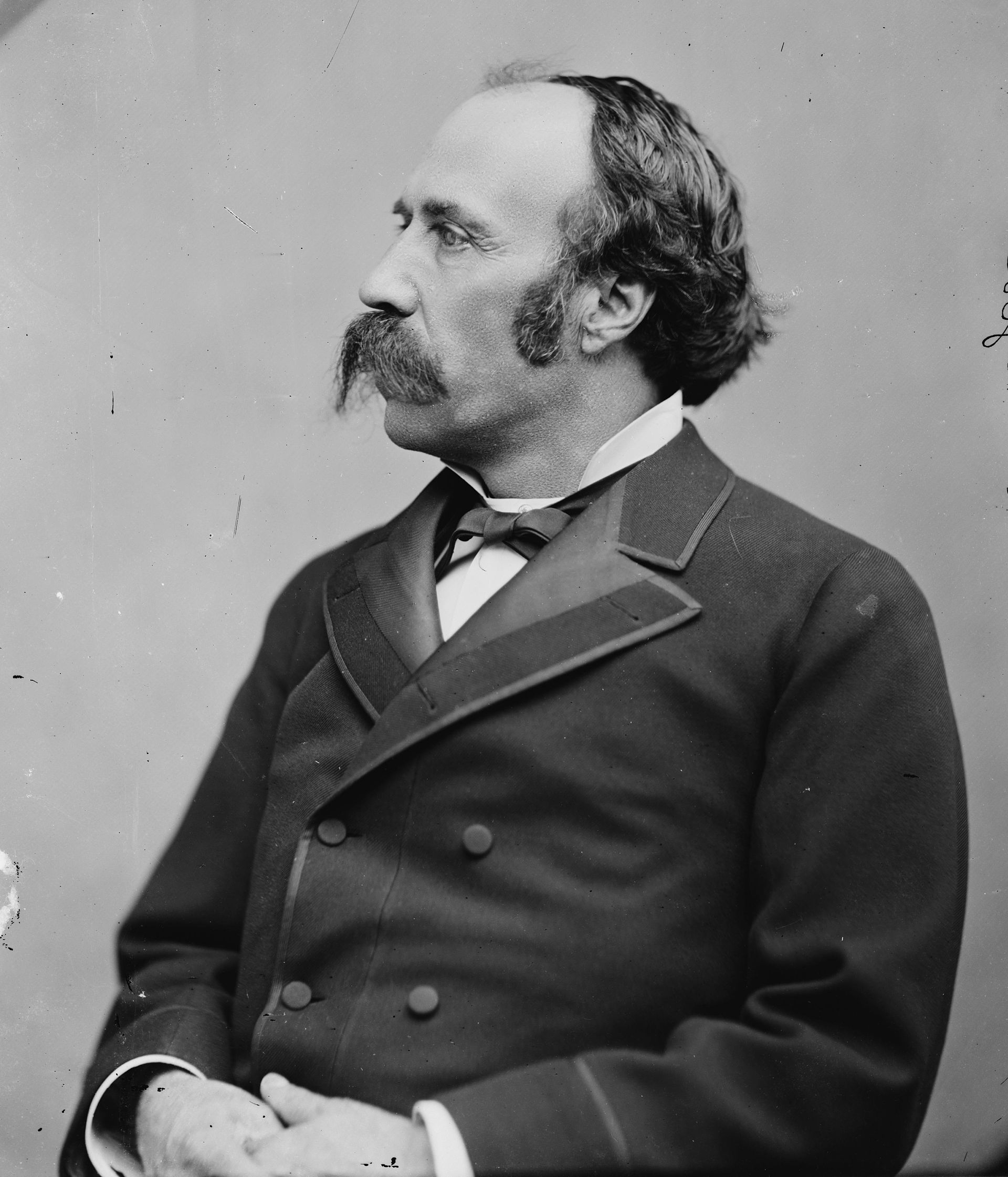
In the 1850s, many men went west to seek their fortunes through mining. Few got wealthy from it, but one of them was the politically interested Horace Austin Warner (“Haw”) Tabor (1830-1899), who became one of the richest men in Colorado.
Tabor’s political career began in 1854 with the Kansas-Nebraska Act, which repealed the Missouri Compromise. A firm opponent of slavery, he moved to Kansas to influence the territory’s vote to be a free state as part of what would become “Bleeding Kansas”. Tabor would, with vigilante John Brown, defend the town of Lawrence from an attack from pro-slavery settlers. He would serve in the Kansas legislature from 1856 to 1857. Today the valley in which he and his wife farmed in Kansas is called Tabor Valley. Tabor would move to the Colorado territory in 1859 for the Pike’s Peak gold rush and would later open up a general store in the mining town of Leadville. Incidentally, it was those who opened stores to supply the miners who tended to make the most money off silver and gold rushes. In 1877, two miners were unable to pay for their supplies at his general store, thus they instead gave him a 1/3 share of profit at the Little Pittsburg Mine. Agreeing to this proved immensely profitable for him, and that year he was elected the first mayor of Leadville.
Possibly the best year of “Haw” Tabor’s life was in 1878, which kicked off with the May 3rd discovery of massive silver deposits in the Little Pittsburg mine. This made him a multimillionaire, and he became known as “The Bonanza King of Leadville”. Although I am of the opinion that the political left overstates luck as a factor in getting wealthy, in this case, Tabor’s willingness to be compensated for his supplies for what was a mere chance at fortune resulted in his wealth. That year, he used his new wealth to construct the Tabor Opera House in only 100 days, a structure that remains standing. The town of Leadville, which he was mayor, was quite the boomtown, and in the 1880s the population and crime rose substantially. Tabor had two small armies to address such threats; the 64-man Tabor’s Highland Guard to guard his operation which wore “plaid kilts with daggers in their long red stockings; their Scottish bonnets topped off by white ostrich plumes that were held in place by buckles of pure silver” and the Tabor Light Calvary, which patrolled the city “in fancy blue coats and shiny silver helmets” with Tabor leading them with a gold-trimmed jacket (Harris). While leading this small army, he was also serving as lieutenant governor of Colorado. Tabor was ultimately able to bring the crime problem under control by hiring the feared gunfighter Mart Duggan to lead law enforcement (Durnett, 73). By 1879, his wealth was the equivalent of over $200 million. Everything was looking up for Tabor, and it would be so for a while. On January 27, 1883, Tabor was appointed to the Senate to serve the remainder of the term of Henry Teller, who had been confirmed as Secretary of the Interior, after leading enough people to march on Denver to convince the state legislature to do so (Harris). In the short time he was in the Senate, his record proved quite conservative, often backing high tariffs, with his DW-Nominate score being a 0.5. Efforts at winning election for governor afterwards, however, failed. Colorado’s governor didn’t like him, and he faced a scandal when it was discovered that he had secretly divorced his wife, Augusta (not even she knew about it!), for another woman in 1881 and had bribed the court clerk at the time to hide the evidence (Harris). This rendered him an outcast from Colorado high society, and he had to pay Augusta a large settlement. Yet, on March 1, 1883, two days before he was to leave the Senate, Tabor married his second wife, Elizabeth “Baby Doe” McCourt, and President Chester Arthur attended. As a wealthy man, although Tabor had enough sense to avoid getting swindled, he was an extravagant spender on himself and his second wife, “Baby Doe”, behavior characteristic of a man unaccustomed to handling great wealth. Because he was wealthy and the economy was good to him, he could continue doing so while continuing to grow his mining interests, acquiring numerous sites throughout the southwest, including at Aspen, Cripple Creek, Matchless, and the San Juan Mountains (Buck). However, the gravy train would come to a screeching halt in 1893.
Back to Rags
In 1893, the economy suffered a depression, the worst that it ever had up to that point. Tabor’s fortunes sank with President Cleveland’s response of signing of the repeal of the Sherman Silver Purchase Act. This meant that the U.S. Treasury was no longer obligated to purchase 4.5 million ounces of silver for coinage every month, instead reverting to the 2 to 4 million ounces of silver under the Bland-Allison Act. He had not properly invested or saved his money, having been, as mentioned before, an extravagant spender. Now, in his sixties, he returned to working in the mines. Although Tabor believed that his fortunes would rise again, they did not do so. However, he was rescued from his debts by a man he had helped in his journey to become rich in Colorado mining magnate Winfield Scott Stratton, who paid off his remaining debts and set him up with a home. Tabor then accepted an appointment as postmaster of Denver in 1898, but he wouldn’t be there long as a year later he died of appendicitis. Tabor’s funeral was attended by an estimated 10,000 Coloradoans; when he had his fortune, he was not only a profligate spender on himself and family but also on the public; he donated a lot of money for the construction of numerous buildings and improvements, thus he had been a popular citizen, even if the upper crust of society did not like him. His widow would live in a cabin outside of the Matchless mine until March 7, 1935, when she froze to death at 81 in her home during a blizzard. The Tabors have since been portrayed in the opera, “The Ballad of Baby Doe” and in the 1932 movie “Silver Dollar”.
References
Buck, S. Horace Tabor. Colorado Encyclopedia.
Retrieved from
https://coloradoencyclopedia.org/article/horace-tabor#id-field-article-image
Durnett, R.E. (2016). Mining tycoons in the age of empire, 1870-1945: entrepreneurship, high finance, politics and territorial expansion. Milton Park, UK: Routledge.
Harris, B. (2018, October 1). The Silver King of Leadville and Baby Doe. HistoryNet.
Retrieved from
History. Tabor Opera House.
Retrieved from
Tabor, Horace Austin Warner. Voteview.
Retrieved from
https://voteview.com/person/9147/horace-austin-warner-tabor
Winters, D. (2022, December 13). Pioneer Profiles: HAW Tabor. US Represented.
Retrieved from
 Mad Politics: The Bizarre, Fascinating, and Unknown of American Political History