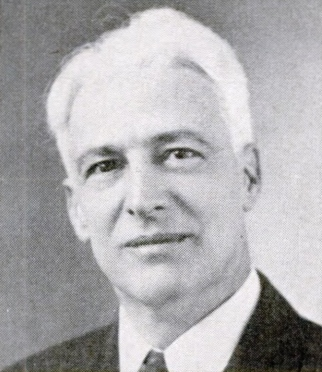
Many Americans have a desire for an independent candidate for public office. One who stands separate from political organizations or certain powerful lobbies. Although we have had no president since the rise of the Republican Party who wasn’t a Republican or a Democrat, there have been the occasional elected officials who were independent. In the last Congress, there were a whopping four senators who were identifying as independent, but two had long been known as Democrats in Kyrsten Sinema of Arizona and Joe Manchin of West Virginia. Now the Senate has Maine’s Angus King and Vermont’s Bernie Sanders. Ohio at one time had Congressman Henry Frazier Reams (1897-1971).
The 1950 election produced victories for the Republicans, but one result stood out, and that was in Ohio’s 9th district, based in Toledo. Democratic Congressman Thomas A. Burke, a staunch liberal, was likewise a firm friend of organized labor. However, attorney Frazier Reams, left the Democratic party in August to challenge Huber, accusing him of being a tool for prominent CIO labor leader Richard T. Gosser, while also blasting the Republican machine in Toledo (The Tennessean). Normally independents don’t get a whole lot of traction, but voters were responsive to Reams’ message. Rep. Michael J. Kirwan (D-Ohio) as chairman of the Democratic National Committee derided him as a “carpetbagger” given that he was from Tennessee, but he had in truth lived in Toledo for over 25 years and Reams responded by subsequently carrying a carpetbag with him to campaign events and rallies (Everett). Burke lost reelection that year, with Reams getting votes from both Democrats and Republicans. After his victory, he said, “The people merely proved that they were tired of special interests, whether on the Left or the Right, together with all the power-politics represented by both sides” (The Nashville Banner). Reams indeed sought to transcend left and right. He pledged after his victory that he would “sit in the middle of the aisle” (CQ Press). In office, Reams seemed to back a lot of the Democratic agenda on economic policy, supporting the retention of price and rent controls and backed the furtherance of government programs such as public housing and an increase in Social Security benefits. However, he did seem to be against measures that were criticized as being socialist, such as on public power. Reams also sided with Ohio Republicans in favor of using the Taft-Hartley Act’s injunction in the 1952 steel labor dispute and in 1953 he supported the Republicans in their push to end the Reconstruction Finance Corporation. He overall backed Americans for Democratic Action’s positions 76% of the time, and his DW-Nominate score was a -0.151. When it comes to independents, Reams reminds me a bit of Angus King, Maine’s independent senator, who considerably more often votes with Democrats (indeed he caucuses with them) but is not fully a party-line person. Reams could, however, not defy the two-party gravity for long.
In 1954, Reams lost a three-way election to Democrat Thomas Ashley. As Time Magazine (1954) reported, Reams miscalculated in his approach, writing “Reams made the mistake of thinking that Republican Candidate Irving Reynolds was his toughest opponent. Reams and Reynolds engaged in a bitter personal campaign, both dismissing the Democrat as “young Ashley”. Young Ashley, who had a nervous habit of giggling on television appearances, won by 4,000 votes over Reams and 8,000 over Reynolds”. The district has had a long Democratic history since, as the only non-Democrat to win the seat since was Republican Ed Weber in 1980, who was defeated in 1982 by Marcy Kaptur, who still holds the seat. However, a Republican may very well succeed Kaptur as Ohio has gotten more Republican over the years, and Ohio’s 9th is just the sort of district that has been moving increasingly into the Republican column. Reams himself would continue the practice of law and would head up his own broadcasting company, Reams Broadcasting Corporation. His last years were spent in Oakland, California, where he died on September 15, 1971.
References
ADA Voting Records. Americans for Democratic Action.
Retrieved from
Democrats Retain Control, But GOP Gains 5 In Senate, 27 In House. CQ Almanac 1950. CQ Press.
Retrieved from
https://library.cqpress.com/cqalmanac/document.php?id=cqal50-1378704#_=_
Everett, G.D. (1950, November 19). Ohio Elects ‘Carpetbagger’ From Franklin. The Tennessean, p. 16.
Retrieved from
https://www.newspapers.com/image/109835398/
National Affairs: The Midwest. Time Magazine.
Retrieved from
https://time.com/archive/6885152/national-affairs-the-midwest/
Political Warrior Relaxes at Franklin After Ohio Win. (1950, November 17). The Nashville Banner, p. 14.
Retrieved from
https://www.newspapers.com/image/602826650/
Reams, Henry Frazier. Voteview.
Retrieved from
 Mad Politics: The Bizarre, Fascinating, and Unknown of American Political History