The state of Washington is not known as a Republican much a less conservative place, but 1946 was an exception. That year was the first time the GOP won control of both the House and the Senate since 1928, and numerous people were elected who in other circumstances would not have likely won. This could be said for Harry Pulliam Cain (1906-1979).
A banker by profession, Cain did not start his life in politics on the Republican side, rather he was a New Deal Democrat, fervently backing FDR in 1932 and becoming the chairman of the Pierce County Young Democrats. However, he became disillusioned with Roosevelt’s second-term policies and his “court-packing plan” and would recall, “I had respect for Roosevelt at first. His program was bold and imaginative – just what we needed when the country was sick. But he continued to treat us sick even when we had become well again. I thought the third term was a terrible thing” (Smith, 2023). From 1935 to 1936, Cain and his wife took a long trip to Europe, and he was in the audience of several Nazi mass rallies. The speeches he heard from Hitler and other leading Nazis convinced him that the Nazis were a danger to the world, and made over 150 speeches on the subject back in the US (Smith, 2011, 28-37). In 1940, Cain was elected Tacoma’s mayor and although the mayoral position in Tacoma was not a strong one, he increased his power by making direct appeals to the people, hosting a weekly radio program, and engaging in a few publicity stunts, such as walking across the newly rebuilt Tacoma Narrows Bridge. Cain also stood out as one of only two elected officials on the West coast to oppose Japanese internment, consistent with his core belief in individual freedom. This translated to him protecting Tacoma’s Japanese business district (Smith, 2023). He was also a reformer as he wanted to crack down on vice and pushed for long-term city planning. Reelected in 1942, Cain would take a leave of absence in 1943 to serve in the military, where he would serve with heroism and distinction, rising to the rank of colonel. In 1945, he delivered a tremendously impactful speech to 5,000 Germans at a former concentration camp on the massive extent of the crimes of Nazi Germany, which brought the crowd to tears (Smith, 2023).
Eyes on the Senate
In 1944, Cain announced his candidacy for the Republican nomination for the Senate. However, his principled nature by insisting on not answering political questions and not personally campaigning while serving in the army contributed to his loss to Congressman Warren G. Magnuson. 1944 was also not the best year for the GOP, but the next election…that would be a different story.
In 1946, Cain ran for the Senate as a Republican, and the Democrats were in a uniquely poor position in Washington for multiple reasons. First, the unpopularity of Truman in 1946 given meat shortages, and incumbent Hugh Mitchell, who was not charismatic, was in a weak position as he had not been elected to his position, rather appointed after the resignation of Senator Mon C. Wallgren as he had been elected governor. This combination of factors resulted in the election of Cain.
Senator Cain

As a senator, Cain stood as more conservative than the standard Republican from Washington. He was the only Washington politician, for instance, who voted against funding a new Tennessee Valley Authority steam plant in 1948. Many voters in the state of Washington were supportive of public ownership and generation of power rather than private, and Cain was firmly on the side of private development. Indeed, he was a strong supporter of the free market as opposed to government regulation and control. Cain also gained a reputation as the staunchest supporter of the real estate industry in the Senate, and this translated into him being prominent in opposition to rent control and public housing. In 1948, he unsuccessfully attempted to kill the Taft-Ellender-Wagner Housing bill. This would instead be done in the House, but the bill would become law in the next Congress. Cain also voted for the Taft-Hartley Act, which was not a popular statewide position in given that Washington was the second-highest unionized state in the nation. However, he saw himself as a Burkean legislator who does not surrender his judgment to the voters, and stated in 1949, “I had decided to listen only to my conscience and my instinct and do what seemed right at the time. Why not? A man in public office might as well play it the way he thinks he should. There is no sure way to stay in public office” (Derieux, 65).
On foreign policy, Cain did back aid to Greece and Turkey and supported the Marshall Plan while opposing efforts to cut the program. However, he would not be in favor of Point IV aid to poor nations and would support foreign aid cuts. Cain stood opposed to the US taking in generous numbers of displaced persons from Europe, and in 1950 he voted against a bill taking in an increased number of such people. Yet, he also supported civil rights at home, voting to end a Southern filibuster against a Fair Employment Practices bill and opposing a Southern effort to undermine army desegregation.
Cain also notably held two solo filibusters: a six-and-a-half hour nonstop filibuster against Mon C. Wallgren to head the National Security Resources Board, which was successful as he withdrew after the Senate Armed Services Committee voted to reject the nomination. Cain believed that Wallgren was unqualified for the role, but this would harm his standing among Washington voters. The following year, Cain performed another solo filibuster, for 12 hours and 8 minutes against legislation extending rent control, but rent control would be extended.
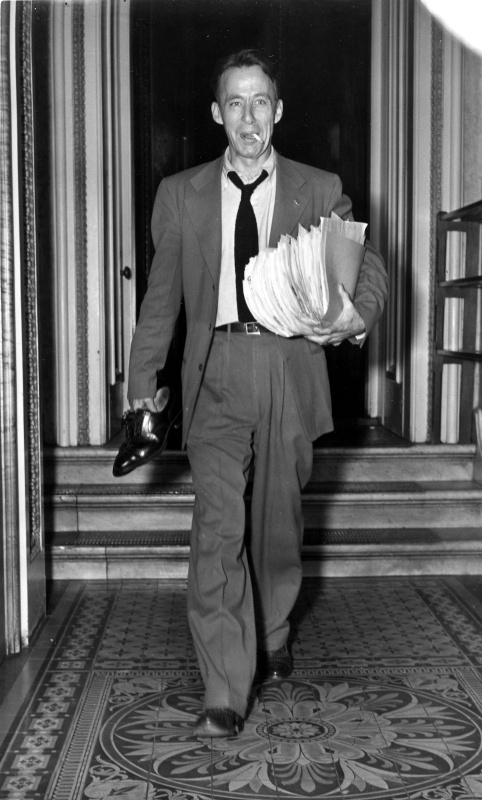
Cain, after his filibuster of Wallgren.
In the 1952 election, even though Eisenhower won resoundingly including in the state of Washington, four Republican senators lost reelection, and Cain lost the biggest of all of them, with Congressman Henry Jackson winning the election by 13 points. He would later reflect that he had talked too much and listened too little (Smith, 2023). Cain’s DW-Nominate score was a 0.352, higher than that of other Washington Republicans serving at the time, and he only sided with the liberal Americans for Democratic Action 18% of the time. Cain would in 1971 letter to C.J. Skreen explain how he voted thusly, “as a reactionary I reacted strongly against measures believed to be adverse to the public interest. It seldom bothered me that a number of my positions were supported only by a small minority. Had I been concerned with self rather than country I would have acted much differently. I was often angry and too impatient for my own good”.
Post-Senate
After departing the Senate, President Eisenhower appointed him to head the Subversive Activities Control Board. Although Cain had been a staunch supporter of Senator Joseph McCarthy (R-Wis.) and was a close personal friend, he turned into a liberal reformer on the board. He came to oppose the Eisenhower Administration’s internal security program, found the Attorney General’s List of Subversive Organizations too broad to be relied on in loyalty cases, and came out against the loyalty oath that all government employees were required to take (Smith, 2023). He did so publicly, and this became known as the “Cain Mutiny”. He also criticized McCarthy for his term “Fifth Amendment communist” as disrespecting the Constitution (Bird). Despite this, Cain and McCarthy remained friends until the latter’s death. Cain was not reappointed, although he read the writing on the wall and had not sought to be reappointed.
Florida Politics
In 1957, Cain moved to Florida where he continued his work in the banking sector and was active in the state’s Republican Party. He decided to run for public office again in 1972, when he determined that his position of County Commissioner of Dade County would not be confined to a mere interim role, finding the call to public service irresistible, “…I was struck by the great need for public services – sewers, transportation and so forth – and I concluded that unless something is done, within 10 years this government will be unmanageable and this splendid community will be undesirable to live in” (The New York Times). His philosophy was although still economically conservative, more liberal on social issues, particularly civil rights. That year, he described himself as “basically a political pragmatist – from time to time and for different reasons a conservative, militant, liberal, moderate, purist, radical and now and again what some call a populist. The record consists of doing the best I could when confronted by any situation demanding action” (Cardwell). Cain won the election. While commissioner, he successfully pushed for bilingualism given the considerable Cuban population and was even an early supporter of gay rights. Cain also successfully pushed for a smoking ban in all indoor public facilities. The latter was quite personal for him, as he had for many years smoked two packs a day. Unfortunately, Cain had not quit in time to avoid serious consequences for his health. By 1976, his health was in decline and he lost reelection. Cain would make return trips to Tacoma throughout his later years, and he did so one last time in December 1977 to accept an award honoring his stand against Japanese-American internment. He died from complications of emphysema on March 3, 1979.
References
12 Hours, 8 Minutes. (1950, June 19). Time Magazine, 20.
Bird, M. (1979, March 4). Ex-Senator Harry Cain Dies at 73; A Critic of McCarthy-Era Excesses. The New York Times.
Retrieved from
https://www.nytimes.com/1979/03/04/archives/exsenator-harry-cain-dies-at-73-critic-of-mccarthyera-excesses.htmlrom
Derieux, J.C. (1949, August 13). Hurry Cain Out of the West. Collier’s.
Cardwell, R. (1972, July 16). He’s Back in Politics. Tacoma News Tribune.
Ex-Senator Runs for County Post. (1972, September 10). The New York Times.
Retrieved from
Harry P. Cain, letter to C.J. Skreen, December 9, 1971. C.M. Smith collection.
Smith, M.C. (2011). Raising Cain: the life and politics of Senator Harry P. Cain. Book Publishers Network.
Smith, M.C. (2023, May 15). Cain, Harry Pulliam. History Link.
Retrieved from
 Mad Politics: The Bizarre, Fascinating, and Unknown of American Political History