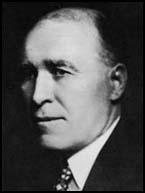
It is not wrong to say that the parties have changed, but what people often don’t understand is that there was a flip of regions regarding what part of the Republican Party went to the left. From the late 19th century to the 1930s, the Midwest was the area in which there were more likely to be rebels to Republican conservatism. Think Senators George Norris and Robert La Follette, from Nebraska and Wisconsin respectively. These today are not thought of as the homes of progressive Republicanism. Norris and La Follette were liberal populists in orientation, and this brand of Republican could be readily elected to the Midwest. La Follette was one of two of these sorts of Republicans to run for president third party, the other was North Dakota’s William Lemke (1878-1950).
In 1915, Lemke joined the newly formed Non-Partisan League, serving as its legal advisor. Although like today, Republicans dominated North Dakota politics, the real parties were the two factions within the state GOP, which was the previously mentioned Non-Partisan League from the left and the Independent Voters Association from the right. Lemke was a hard worker and the brains out of the outfit, putting in at times 18 hours a day and he was regarded as “the political bishop” (BND). Lemke, however, made two mistakes during this time. Per the Bank of North Dakota,
“Using money from the League’s Home Builders Association, Lemke built a house for himself and his family in Fargo that exceeded the HBA’s cap on public loans for private dwellings in North Dakota. That blunder became a symbol of League corruption and ineptitude. He also let himself be elected chairman of the Republican Party in North Dakota in 1916, Attorney General, a member of the critically-important Industrial Commission in 1920. This violated Townley’s [founder of Non-Partisan League] rule that League leaders would not stand for public office, to assure the farmer-citizens of North Dakota that their purposes were altruistic, not personal aggrandizement”.
In 1921, Lemke was recalled along with Governor Lynn Frazier due to poor economic conditions as well as widespread accusations that the Non-Partisan League government was Bolshevik in nature. Like with Frazier, this would not be the end of Lemke’s career.
The Great Depression helped the political fortunes of Lemke and other Non-Partisan Leaguers, and he was elected to Congress in 1932 as one of two at-large representatives, having defeated the more conservative Thomas Hall for renomination. He had supported FDR’s candidacy, and he backed most of the New Deal, including the Agricultural Adjustment Act, the Tennessee Valley Authority, and the National Industrial Recovery Act. Lemke also was a consistent defender of organized labor. In 1935, he made an exception by voting against Social Security, albeit from the left; he preferred the more expensive and mathematically challenged Townsend Plan. Lemke did, however, stick with traditional Republicanism in his opposition to the Reciprocal Trade Act in 1934. He also contributed to the New Deal through the Frazier-Lemke Farm Bankruptcy Act in 1934, limiting the ability of banks to repossess farms, the Supreme Court unanimously struck it down in Louisville Joint Stock Land Bank v. Radford (1935) as in violation of the 5th Amendment, as creditors were denied their property rights. Another measure was enacted that instead of stopping foreclosures postponed them. After Roosevelt opposed efforts at a third Frazier-Lemke Act and the bill was defeated, Lemke ran for president under the Union Party ticket. He no longer supported Roosevelt, saying of him, “I look upon Roosevelt as a bewildered Kerensky of a provisional government. He doesn’t know from or where he’s going” (Simkin). Although Lemke was the presidential nominee, in truth he was not the focus of the campaign. The campaign was a coalition of populist influencers in preacher Gerald L.K. Smith, Father Charles Coughlin, and Dr. Francis Townsend. The venture was a complete and utter disaster, as Smith and Coughlin aggressively competed for dominance in the party and the former tried to poach Dr. Townsend’s followers from under him. Lemke was also pretty far from central casting as a presidential candidate; his appearance was unkempt and shabby, and he was an underwhelming public speaker (Jeansonne, 55). At the same time Lemke was defeated, he was reelected to his Congressional seat. He would continue his record of supporting New Deal measures but opposed any efforts that were seen by Roosevelt opponents as power grabs, such as the proposed 1938 reorganization plan, and he was, as other North Dakota federal politicians of the time were, an opponent of FDR’s foreign policy.
Attempt at the Senate and Continuing Congressional Career
In 1940, Lemke ran for the Republican nomination for the Senate, but the real contest was between incumbent Lynn Frazier and former Governor William Langer, which the latter won. He was able to return in the 1942 midterms, and around 1945 his record shifted a bit to the right, namely in his willingness to support federal government measures impacting the economy through price control and his willingness to support income tax reduction. However, Lemke continued to defend labor unions and in 1947 he voted to sustain President Truman’s veto of the Taft-Hartley Act. Americans for Democratic Action graded Lemke in 1947, 1948, and 1949, and his scores come out as 42%, 25%, and 33%. Had ADA counted his score for 1950 based on the votes and pairs he had, he would get a 67%. His DW-Nominate score is a 0.032, lower than any current serving Republican. Lemke would die in office on May 30, 1950.
References
ADA Voting Records. Americans for Democratic Action.
Retrieved from
Jeansonne, G. (1997). Gerald L.K. Smith: minister of hate. Baton Rouge, LA: Louisiana State University Press.
Lemke, William. Voteview.
Retrieved from
https://voteview.com/person/5602/william-lemke
Simkin, J. (1997). William Lemke. Spartacus Educational.
Retrieved from
https://spartacus-educational.com/USAlepke.htm
William Lemke. Bank of North Dakota.
Retrieved from
 Mad Politics: The Bizarre, Fascinating, and Unknown of American Political History