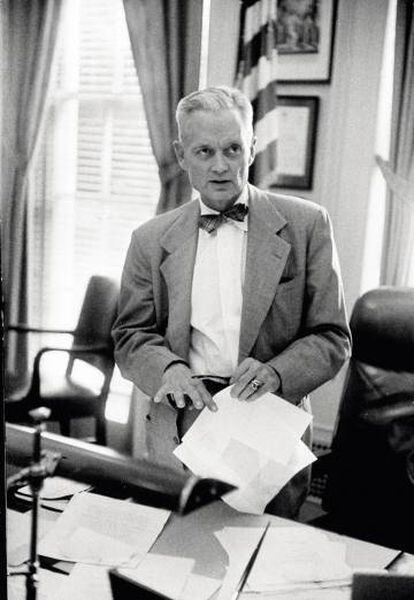
One forgotten aspect of the Truman Administration was that there was a significant level of corruption within it. President Truman, for all the favorable coverage he gets from historians, was not that good at picking the right people for positions and felt strong feelings of loyalty to those he picked (Boylan). Thus, the corruption in the Truman Administration was a campaign point in 1952 for Republicans, and the following administration was corruption free, but one controversy threatened the squeaky-clean image of the administration, and that was the case of Eisenhower’s chief of staff, Sherman Adams (1899-1986).
Sherman Adams: An Underlooked Figure
Although Richard Nixon was vice president and everyone knows who Nixon was, it was in truth Sherman Adams, a man now forgotten by the public, who was Eisenhower’s de facto assistant president. Adams had served in Congress from 1945 to 1947 as well as served as New Hampshire’s governor from 1949 to 1953. In the latter role, he signed into law the measure that made New Hampshire one of the key early contests for presidential primaries (New England Historical Society). He had been one of Eisenhower’s earliest backers in the Republican primary, and Eisenhower appreciated him greatly, and this resulted in him being appointed chief of staff. Adams controlled access to the president and save for cabinet officials and a few other important administration figures, he could deny requests for visits, which he more did more often than not, giving him a reputation as “the abominable no-man” (The Los Angeles Times). He was also no-nonsense and a bit gruff. This included him hanging up the phone when he thought the conversation was over and not saying “hello” or “goodbye” on phone calls (Langeveld). Adams’ approach did not win him friends in Washington, including fellow Republicans, whose requests to see Eisenhower he often denied. His power was such that a joke that circulated among Washington D.C. insiders at the time was, “Wouldn’t it be terrible if Eisenhower died and Nixon became president?” followed by the punchline, “Yeah, but what if Sherman Adams died and Eisenhower became president?” (Elving) Eisenhower would eventually have to do without Adams at his side, and it involved most notably, a vicuna coat.
An Uncomfortable Connection
In 1958, a Congressional subcommittee discovered that Adams had made a few calls to regulatory agencies regarding the legal issues that a friend of his was having. This friend was Bernard Goldfine, a wealthy Massachusetts textile businessman and influence-peddler who owned two mills in New Hampshire and was having issues with the Federal Trade Commission and the Securities and Exchange Commission. Adams had set up a meeting between him and the chairman of the Federal Trade Commission to discuss these issues, but both Goldfine denied that Adams had exercised any influence on the regulatory agencies (Time Magazine). You know what hit the fan for the Eisenhower Administration when it was discovered that Adams had received gifts from Goldfine. He had paid for a few of Adams’ stays at hotels including the Waldorf-Astoria in New York City, had lent him a luxurious Oriental rug, and gifted him a vicuna coat (The Los Angeles Times). Although Adams was not discovered to have committed any crime and defended his connection to Goldfine as a friendship and insisted that he had not been influenced to any favorable action by him, the connection was unseemly in appearance. Given that the midterms were looming as well as Adams’ unpopularity among Congressional Republicans, they were fine with sacrificing him if it would help them avoid an electoral drubbing. Although President Eisenhower and Vice President Nixon defended Adams, this was seen by Democrats and many voters as hypocritical and in September 1958 the political gravity of the situation became apparent when Senator Frederick G. Payne of Maine, who had accepted a substantial loan from Goldfine that he hadn’t paid back and hadn’t been able to satisfactorily explain, was badly defeated for reelection (Langeveld). It was after this that Eisenhower with a heavy heart asked Adams to resign. This, by the way, did not prevent a midterm drubbing for the GOP. Bernard Goldfine would eventually be convicted of tax evasion and lose his fortune.
An Overblown Scandal?
Compared to later scandals, however, the Adams scandal is frankly quite mild. It is so mild in fact, that Adams’ acceptance of gifts was not that unusual for his time, with Goldfine having paid hotel bills for at least three representatives and Eisenhower having accepted gifts himself, including to decorate his Gettysburg farm as well as vicuna cloth from none other than Goldfine (Langeveld). Adams never held public office again and wrote in defense of his connection to Goldfine. He would also successfully lobby for Mount Pleasant in New Hampshire’s Presidential Range to be changed to Mount Eisenhower, which occurred in 1972, and Adams is honored with the summit building on Mount Washington being named after him (Langeveld).
References
Boylan, J. (2021, February/March). Truman Dogged by Charges of “Favoritism and Influence”. American Heritage, 66(2).
Retrieved from
https://www.americanheritage.com/truman-dogged-charges-favoritism-and-influence
Elving, R. (2005, July 18). Frequent Falls For Top Aides in the White House. National Public Radio.
Retrieved from
https://www.npr.org/2005/07/18/4760096/frequent-falls-for-top-aides-in-the-white-house
Investigations: Bernard Goldfine’s Two Faces. (1958, July 14). Time Magazine, p. 2.
Retrieved from
https://content.time.com/time/subscriber/article/0,33009,868553-2,00.html
Langeveld, D. (2009, September 24). Sherman Adams: a coating of scandal. The Downfall Dictionary.
Retrieved from
https://downfalldictionary.blogspot.com/2009/09/sherman-adams-coating-of-scandal.html
Sherman Adams Dies at 87 in N.H.: Forced Out as Top Eisenhower Aide in Vicuna Coat Scandal. (1986, October 28). The Los Angeles Times.
Retrieved from
https://www.latimes.com/archives/la-xpm-1986-10-28-mn-7917-story.html
Sherman Adams, The New Hampshire Logger Who Ran the White House…Until he disgraced himself with a coat. New England Historical Society.
Retrieved from
 Mad Politics: The Bizarre, Fascinating, and Unknown of American Political History