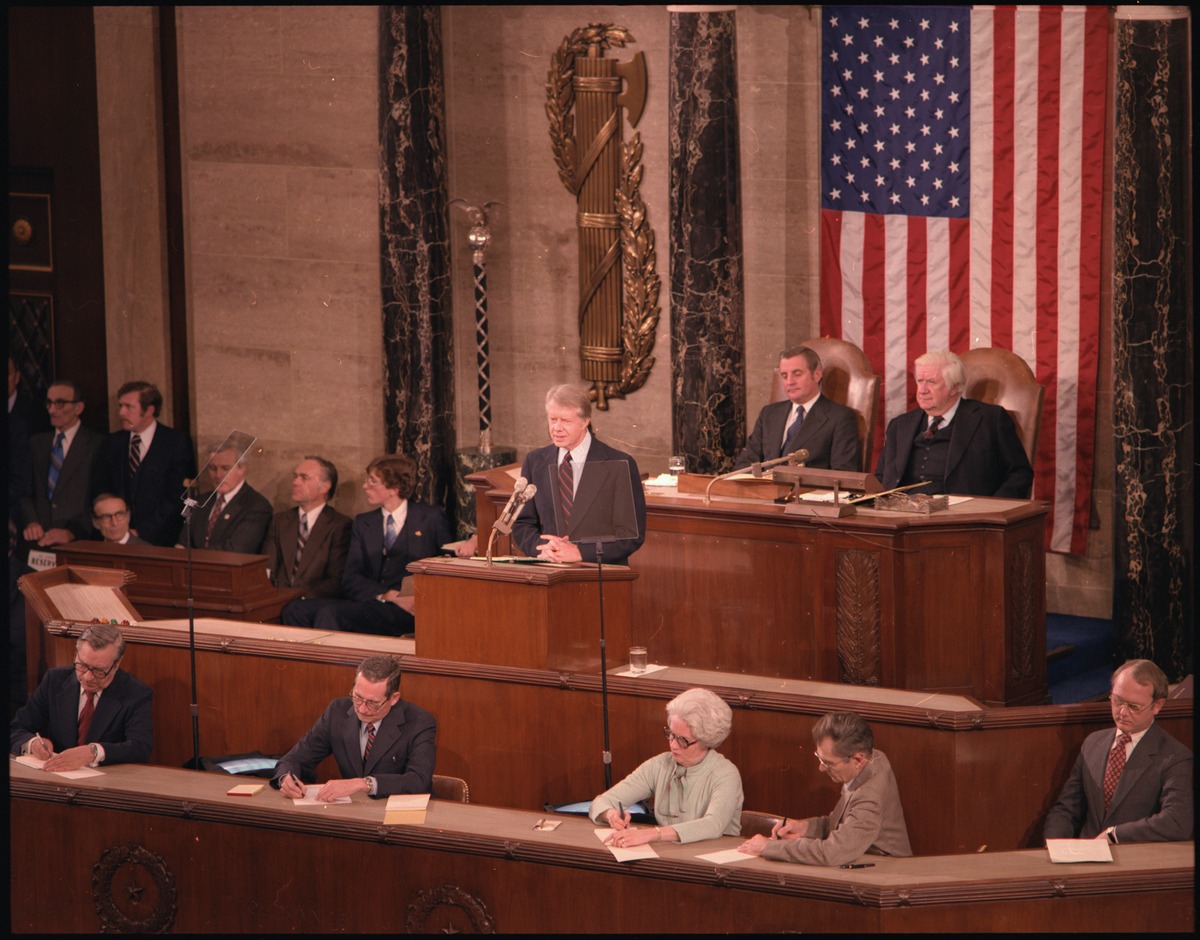
President Carter’s final two years were marked, per Americans for Constitutional Action, by many Democrats playing ball a bit more with the administration. Some strong conservatives did get elected to the Senate in 1978, most notably Bill Armstrong of Colorado and Gordon Humphrey of New Hampshire, but that election year seemed in some ways a bit of a wash, as in some cases staunch conservatives were replaced by less conservative people, such as Democrat Dave Boren succeeding Republican Dewey Bartlett in Oklahoma. Minnesota was a strange case with Republicans taking both Senate seats, replacing liberal Democrats with moderate conservative Rudy Boschwitz and centrist Dave Durenberger. President Carter himself scores 0 in both chambers in 1979 and a 12 in the House in 1980 and a 33 in the Senate in 1980. ACA and Carter agreed on the reinstatement of the selective service, against Warren Magnuson’s (D-Wash.) restricting amendment on trucking deregulation, for Jake Garn’s (R-Utah) amendment deleting middle income housing subsidies, against Daniel Patrick Moynihan’s (D-N.Y.) amendment making eligible private school students for federal education grants, and against Paul Simon’s (D-Ill.) amendment denying funds for an MX missile basing system.
A key point of difference among the House and Senate’s strongest conservatives was the matter of selective service. In a rather unusual instance for ACA, they sided with President Carter over figures such as Phil Crane (R-Ill.) and John Rousselot (R-Calif.). Another interesting point for the ACA was that on three occasions in 1980, what they counted as the correct position was also what Americans for Democratic Action counted as the correct position in their scorecard. In the House, Representative Devine’s (R-Ohio) motion to delete the Energy Mobilization Board was supported by both ACA and ADA. In the Senate, Senator Garn’s (R-Utah) proposal to eliminate subsidies for middle-income housing was supported by both ACA and ADA, and both opposed Senator Moynihan’s (D-N.Y.) proposal to make private school students eligible for Basic Educational Opportunity Grants.
One notable case in the Senate of increased cooperation with Carter was that of Harry Byrd Jr. (Ind.-Va.), who while he was a political independent, he caucused with the Democrats. While in 1977 and 1978 he scored a 96 and a 100 respectively, making him the most conservative of the Senate’s non-Republicans, his scores tumbled to a 74 and a 69 respectively in 1979 and 1980. Part of this is that he assisted the Carter Administration in a few critical votes, such as securing the 3/5’s vote necessary to end Senator Orrin Hatch’s (R-Utah) filibuster on the important nomination of AFL-CIO-backed William A. Lubbers as counsel of the National Labor Relations Board, despite voting against the nomination shortly after. Despite voting against the windfall profits tax in 1980, Byrd also voted against Senator Bob Dole’s (R-Kan.) motion to recommit the bill for hearings. Incidentally, Byrd is still the strongest conservative among the Senate Democratic caucus.
Issues counted in this Congress included the establishment of the Department of Education, the establishment of a windfall profits tax on oil, releasing sanctions on Zimbabwe-Rhodesia, food stamp funding, a Constitutional amendment to prohibit busing, prohibiting foreign aid to Nicaragua, implementing the Panama Canal treaties, the bailout of the Chrysler Corporation, and the tax-exempt status of private schools. As always with ACA, abortion was excluded as an issue.
The Senate’s all-star for the 96th Congress was Jesse Helms of North Carolina, who is the only one to score 100 in both years. In the House, Dan Lungren and Bill Dannemeyer of California, Larry McDonald of Georgia, and Robert Daniel of Virginia did no wrong by ACA standards for the entirety of the session. Some notable freshmen this session include future Speaker of the House Newt Gingrich of Georgia and future Vice President Dick Cheney of Wyoming. In 1980, only Representative Charles Diggs (D-Mich.) scored a 0 in the House, once again demonstrating that ACA frequently made their scores hard to completely succeed or fail on.
KEY
+ – A vote for the conservative position.
+ – A pair or announcement for the conservative position.
– – A vote against the conservative position.
– – A pair or announcement against the conservative position.
? – No vote or opinion.
Democrats are in plain text, Republicans are in bold italics.
Vote Descriptions:
ACA-Index Scoresheets:
 Mad Politics: The Bizarre, Fascinating, and Unknown of American Political History