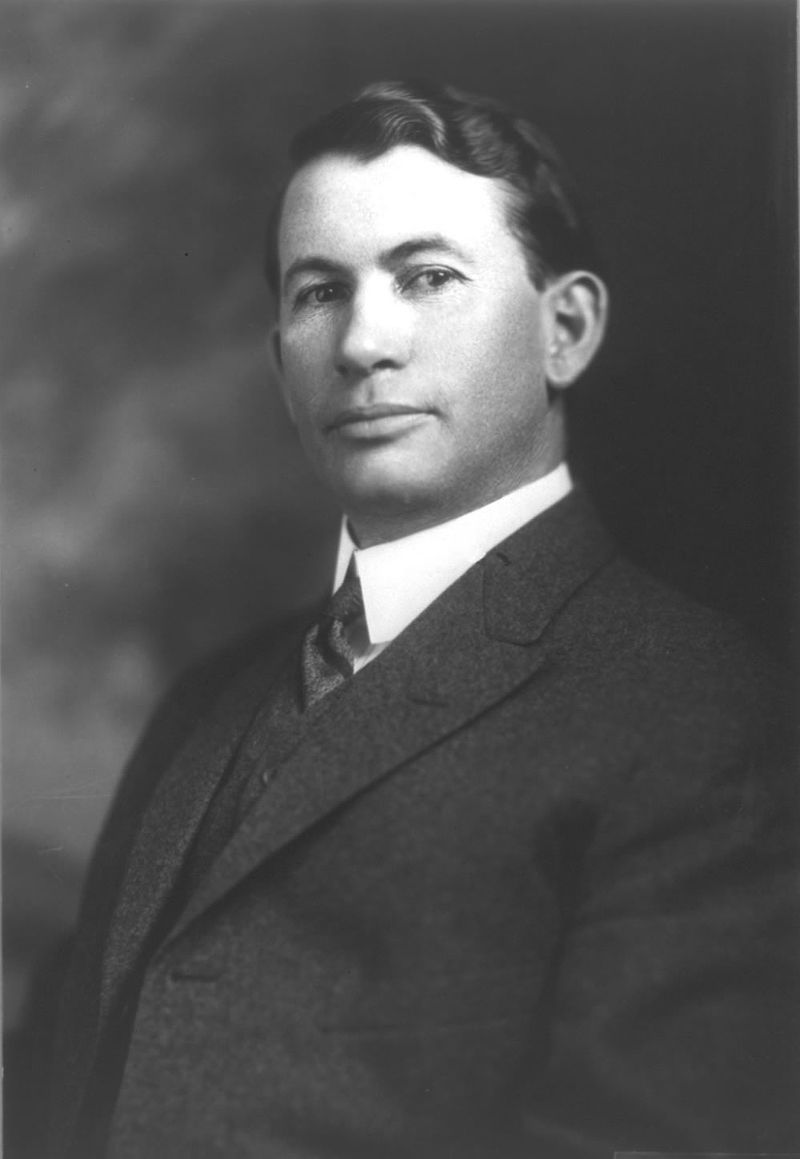
A young Alben Barkley in Congress, 1913.
On February 28, 2024, Senate Minority Leader Mitch McConnell announced he would be stepping down as leader at the end of the year. With his departure from political leadership, he will certainly be remembered as one of the three most influential Kentuckians in the Senate. The most remains the “Great Compromiser” Henry Clay. The Kentuckian who rivals McConnell in influence and impact is Alben William Barkley (1877-1956).
Barkley was one of those politicians, who, like Lincoln, was born in a log cabin in Kentucky. Although initially born Willie Alben Barkley, he opted to from a young age to go by “Alben William” and legally changed his name as an adult. He was raised in a religious household and this informed his opposition as an adult to betting on horse races (a difficult stance in Kentucky) as well as support for Prohibition.
Barkley got his start professionally working for Congressman Charles K. Wheeler, who at the time was supportive of free coinage of silver while he identified as a Gold Democrat. He worked without pay in exchange for access to Wheeler’s law library, where he studied and read law, being admitted to the bar in 1901. Barkley would also attend the University of Virginia School of Law.
Political Beginnings
On December 19, 1904, Barkley announced that he was running for county attorney of McCracken County. Since the region he lived was overwhelmingly Democratic, the Democratic primary was tantamount to election. He went up against incumbent Eugene A. Graves, and managed to win due to his likeability, his strong oratorical talent, and his hard work in his campaign. In 1908, Barkley mainstreamed himself with the Democratic Party by endorsing William Jennings Bryan. That year he ran for county judge, a position in Kentucky that controlled funds and patronage, so a very politically powerful role. Barkley won that contest too.
In 1912, Barkley was elected to Congress from Kentucky’s 1st district, which included Jackson Purchase, a portion of the state that had been most sympathetic to the Confederacy. While in the House, he could be thought of as a pragmatic Wilsonian progressive. Barkley would later reflect that Wilson was the “greatest statesman and greatest president” of his lifetime (U.S. Senate). Barkley’s career also reflected the significant change of the Democratic Party on race. While in the House he was quite against civil rights measures. He voted to ban interracial marriage in Washington D.C. in 1915, to ban immigration of blacks and Africans from the United States in the same year, and in 1916 he voted for segregation of Washington D.C. youth probation departments. In 1922, Barkley voted against anti-lynching legislation. Although Barkley opposed women’s suffrage in 1915, he voted for it in 1918 and 1919. His stance on civil rights would change considerably later in his career, which I will cover in the next post. Barkley also favored Prohibition and delivered speeches on behalf of the Anti-Saloon League.
Although Barkley was quite supportive of Woodrow Wilson’s New Freedom programs, although during the 1920s he wasn’t a hardline Democratic partisan in how he voted. He did, however, push strongly for measures that crossed the railroads, including the Howell-Barkley bill for labor dispute settlements and his proposal to prohibit the railroads from charging customers a Pullman car fee. Barkley also regarded the Harding Administration as well as the succeeding Republican administrations as too favorable to big business. In 1923, he said of the Harding Administration that if it had returned America to “normalcy”, “then in God’s name let us have abnormalcy” (U.S. Senate). That year, Barkley had his first and only defeat when he lost the Democratic Party nomination for governor, but better things would prove to be ahead for him.
The Senate
Barkley’s campaign style was the stuff of legends. He would put in 16 hour days and had given up to sixteen speeches a day, or as people of his time would call it, his “Iron Man Style”. Barkley went up against incumbent Richard P. Ernst, who had won by less than a point in the Republican landslide of 1920. Ernst was a conservative corporate lawyer who had voted against soldier bonuses and had refused to defend Republican Congressman John W. Langley, who had been convicted of assisting in bootlegging (Harrison & Klotter, 355). However, Ernst was not the easiest to take down even in a midterm year, but Barkley did pull off the win by over three points. Barkley got some Republican votes too, as there were Republicans unhappy that Ernst refused to defend Congressman John W. Langley, who had been convicted of assisting in bootlegging.
References
Barkley, Alben William. Voteview.
Retrieved from
https://www.voteview.com/person/437/alben-william-barkley
Harrison, L.H. & Klotter, J.C. (1997). A new history of Kentucky. Lexington, KY: The University Press of Kentucky.
Hill, R. Alben W. Barkley of Kentucky. The Knoxville Focus.
Retrieved from
Senate Leaders: Alben Barkley. U.S. Senate.
Retrieved from
https://www.senate.gov/about/origins-foundations/parties-leadership/barkley-alben.htm
 Mad Politics: The Bizarre, Fascinating, and Unknown of American Political History