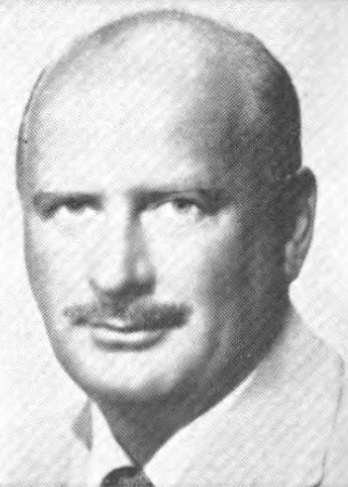
RINOs from American History #15: Seymour Halpern


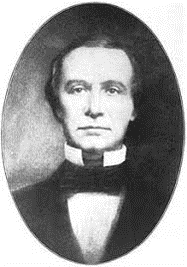
In 1958, Representative Henry J. Latham of the northeastern portion of Queens was calling it quits to serve on the New York Supreme Court. That year shaped up to be, as I have written before, a horrible one for the GOP, but like John Lindsay had kept Manhattan’s “Silk Stocking” district in GOP hands, Seymour “Sy” Halpern (1913-1997) kept this one in the fold in a close race.

Although in Halpern’s first year, Americans for Constitutional Action gave him a 63%, his score tumbled to a 20% in the following year and he would gain a reputation as quite a liberal Republican. The liberal lobbying group Americans for Democratic Action in 1961 and 1962 gave him 100% for his record, and he could be basically considered a Kennedy Republican. Americans for Constitutional Action would give him a 0% in 1969. Halpern’s DW-Nominate score was a -0.094, which for a Republican, is incredibly low and he was only outdone in liberalism by this standard by Senator Jacob Javits. Indeed, Halpern basically accepted New Deal policies and more with perhaps mild revisions. This was quite a contrast to his predecessor Latham, who scored an 89% and 100% in 1957 and 1958 by ACA, but whose overall record since 1945 could be described as moderately conservative. He was something of an unconventional legislator in other ways. In one instance, to verify that the conditions of the Creedmoor State Hospital for the mentally ill were as dismal as alleged, he dressed himself with rumpled clothes and went unshaven to pose as a patient’s relative (Thomas). On foreign policy, Halpern could prove a bit more conservative. Although he consistently backed foreign aid legislation, he was supportive of some foreign aid cuts as well as of anti-communist amendments, such as opposing guaranteeing funds for exports of agricultural commodities to the USSR in 1963.

Halpern would be among the sponsors of the Civil Rights Act of 1964 and Medicare (his proudest accomplishments), voted against Republican substitutes to Medicare and the Voting Rights Act, and would be one of only four Republican representatives to consistently back rent subsidies. Although Halpern supported every civil rights measure in the 1960s, he voted for two amendments limiting busing in 1972, the Ashbrook “neighborhood schools” amendment and the Green amendment permitting a revision of busing cases based on anti-busing legislation under consideration. Despite his liberal record, he refused to consider joining the Democratic Party. After all, the party was a family tradition and his father, Ralph, had served for a term in the New York State Assembly. Furthermore, the Republican Party at the time could attract liberals who were unalterably opposed to political bossism, which in New York City took the form of the infamous Tammany Hall, which produced such massively corrupt figures as Fernando Wood, William “Boss” Tweed, and Mayor Jimmy Walker. His voting record, in addition to his attentiveness to constituent service on matters great and small, certainly helped him survive the 1964 Democratic landslide, which toppled six New York House Republicans. He would regularly win both the Republican and Liberal Party nominations.

Conflict of Interest? & The End

Before the 1970 midterms, a report by the Wall Street Journal came out that Halpern was over $100,000 in debt (he made only $42,500 annually as a member of Congress) that included a $40,000 loan at a highly favorable interest rate from a bank that had lobbied extensively against a measure that Halpern also opposed (Thomas). Despite this report, he and his constituents shrugged and he was easily reelected with 77% of the vote, with his only opposition being a member of New York’s Conservative Party.

In 1972, Halpern’s district was merged with that of Democrat Lester Wolff, so he opted to retire instead of running against him. With his departure left the last remaining Republican in New York City’s House delegation. When he had first been elected to Congress in 1958, he was one of six Republicans representing New York City. Halpern subsequently worked in the advertising business and died of pneumonia on January 10, 1997 at 83. While New York City does now have one Republican representative in Nicole Malliotakis of Staten Island, Staten Island has now become pretty much the only place Republicans in New York City have an edge. Halpern is also, like the others in this series, instructive regarding the alleged habitation of RINOs in the current GOP, a habitation which often is implied to constitute a MAJORITY of the current GOP elected officials. There is a certain lack of self-awareness among many extremists, in that they see everyone who does not think like them extremists on the other side. If I fully expounded my views on economics and probably social issues, many would think I was extreme, and I would tell them that they are right to think so, because I have the awareness to know! This is the fruit of living in areas throughout my whole life in which the Democratic Party has had varying degrees of electoral advantage…I’m not normal, I know it, and I still think I am right. Anyway, there is no currently serving Republican legislator federally who is as liberal as Sy Halpern was.

References

ADA Voting Records. Americans for Democratic Action.

Retrieved from

https://adaction.org/ada-voting-records/

Halpern, Seymour. Voteview.

Retrieved from

https://voteview.com/person/3967/seymour-halpern

Thomas, R.M. (1997, January 11). Seymour Halpern, 83, Dies; Served Queens in Congress. The New York Times.

Retrieved from

The Great Comeback: Grover Cleveland’s 1892 Campaign

After the New Hampshire primary, Donald Trump looks like he is going to make history in being one of only two Republicans nominated three times by the party, and if he wins the election, only the second president in history to serve non-consecutive terms. It will be a comeback like Cleveland’s. How did that go, anyway?

1888 was a year of sore disappointment for Democrats. In the previous presidential election, 1884, they had elected their first president since James Buchanan in 1856 (Andrew Johnson, although a Democrat, was not elected president). That year, the Republicans won back the White House with Benjamin Harrison. The victory was won in Cleveland’s home state of New York, thanks in large part to his campaign manager, Matthew Quay, carefully examining Tammany Hall activity thereby hindering their operations. What’s more, a letter appeared in the final two weeks of the election by British ambassador Sir Lionel Sackville-West to a “Charles F. Murchison” in response to his letter in which he identified himself as a naturalized American citizen from Britain regarding which candidates was best for British interests, in which he held that Cleveland was the optimal pick. This original letter was written by George Osgoodby, a California Republican, with the aim of getting a response to motivate Irish-Americans to vote Republican, which they did that election (Mitchell). In other words, a dirty trick played perhaps a decisive role in Harrison’s 1888 victory. However, by 1892 the political environment was quite different.

The 1888 election had produced unified government for the Republicans, and they pushed a controversial agenda in the 51st Congress. Passed was the unpopular McKinley Tariff as well as ways of spending the revenue from the tariff and out of the budget surplus that attracted public criticism. Republicans also pushed the Lodge Federal Elections bill to make the 15th Amendment an enforceable reality in the South. In addition to the use of violence and intimidation, means of depriving blacks of the ballot in the South included, according to Wendy Hazard (2004), “the stuffing of ballot boxes, tampering with returns, doctoring registration rolls, changing polling places without prior notification, and locating the polls miles from where African-Americans lived” (2). This measure was in equal parts a voting rights and an anti-fraud measure, so it would also cover political machines in major cities, but it died in the Senate due to Western Republican defections (Soderstrum). Democrats saw this as a blatantly partisan bill and unified in opposition, with Grover Cleveland making it a major issue of the 1892 campaign, denouncing as the “Force Bill”. Cleveland’s campaign also focused against tariffs, trusts, the 10% tax on state bank issues, and corporate control over public lands (through railroad grants).

The process of choosing a party nominee worked a bit differently back in 1892 than it does now with party primaries and caucuses, as nominations were decided at the party convention. Like with Trump, Cleveland did have those who challenged him, including Senator David Hill of New York and Iowa’s Democratic Governor Horace Boies. These people represented factions of the Democratic Party displeased with Cleveland’s policies in some way or another. Hill represented Tammany Hall’s dissatisfaction with Cleveland’s opposition to bossism. Boies represented the dissatisfaction of many Western and Southern Democrats over his opposition to free coinage of silver. However, Cleveland was seen as highly electable…after all he had been president before and won the popular vote in the 1888 election. What’s more, free coinage of silver was a plank guaranteed to lose in New York. Hill had the benefit of the great orator Bourke Cockran speaking against nominating Cleveland again, asserting that he was popular “every day in the year, except one, and that is election day… It is a popularity based upon the fact that his opponents speak well of him, but will not vote for him. So it is delusive. It may “arouse enthusiasm four months before election” but produces “disappointment for four years after election” (Troy). Despite this, the first ballot at the convention was not close; Cleveland pulled away with 617.33 votes, with his nearest rival, Hill, only mustering 114 votes and Boies following with 103. To win support from the supporters of free coinage of silver, Cleveland picked Adlai Stevenson I, a supporter of the policy, as his running mate. Stevenson would be doing much of the campaigning that year, as President Harrison was largely not campaigning due to his wife’s deteriorating health and Cleveland didn’t want to capitalize on his opponent’s absence himself. This election was also marked by the entry of a third-party candidate in Populist James B. Weaver. By the way, a third-party candidate who pulls significant support from the electorate is historically a bad development for the president’s party and 1892 was no exception. Weaver would win 22 electoral votes and the states of Colorado, Idaho, Nebraska, and Nevada while getting one electoral vote from North Dakota and Oregon each. Democrats had already had a strong House majority from the 1890 midterms and this was reduced although retained in 1892 and Democrats won the Senate that year.

References

1892 Democratic Party Platform. The American Presidency Project.

https://www.presidency.ucsb.edu/documents/1892-democratic-party-platform

Hazard, W. (2004, August 1). Thomas Brackett Reed, Civil Rights, and the Fight for Fair Elections. Maine History, 42(1).

Retrieved from

Click to access 289200384.pdf

Mitchell, R. (2018, June 20). The fake letter historians believe tipped a presidential election. The Washington Post.

Retrieved from

https://www.washingtonpost.com/news/retropolis/wp/2018/06/20/the-fake-letter-that-historians-believe-tipped-a-presidential-election/

Soderstrum, T.J. Force Bill (1890). Reference Encyclopedia.

Retrieved from

https://reference.jrank.org/populism/Force_Bill_1890.html

Troy, G. (2018, January 28). W. Bourke Cockran, The Forgotten Democratic Congressman Who Championed Churchill & Free Trade. The Daily Beast.

Retrieved from

https://www.thedailybeast.com/the-forgotten-democratic-congressman-who-championed-churchill-and-free-trade

Isaac Sherwood: A Link to the Past


There are not many politicians who can claim to have served in politics in the 1870s and 1920s, but along with Joe Cannon, a figure who I have previously discussed and find to be of great use in historical research, there is Isaac Sherwood (1835-1925) of Ohio. Since the Harding Administration has a much closer connection to our contemporary politics than the Grant Administration in relatability, we can have an idea how someone who voted a very conservative line could have voted in the time in which you had many Lincoln Republicans, of which Cannon and Sherwood were. Yet, Cannon and Sherwood went down different paths.


Isaac Sherwood in his youth.

Sherwood’s political career began when in 1860 he was elected probate judge of Williams County, Ohio, but on the outbreak of the War of the Rebellion, he joined the Union Army. Although he started as a private, he was an accomplished solider and by the end he was a brevet brigadier general. Sherwood resumed his political career when in 1868 he was elected Ohio’s Secretary of State and won reelection in 1870. Two years later, Isaac Sherwood is elected to Congress as a Republican. That election year is also Joe Cannon’s first. In this term, he proves supportive of inflationary currency and opposes legislation favorable to railroads. Sherwood doesn’t run for reelection in 1874, and while out of office he reevaluates his political affiliation and affiliates himself for a time with the Greenback Party, which pushed for fiat currency. However, by 1879, with Reconstruction behind the nation and economic issues more pressing, he becomes a Democrat. However, Sherwood doesn’t make his return to Congress until the 1906 election, by which time he is 71 years old.

Isaac Sherwood as an older man.

Sherwood throughout his life retains a degree of independence, and although he is of the Democratic Party, he remained faithful to his views on race relations as a Lincoln Republican; in 1915 he is one of only seven Democrats to vote against banning interracial relations in Washington D.C., and in 1916 he voted against a motion providing for segregation in D.C. probation offices. Other examples of independence during the Wilson Administration include his votes against federal licensing of cotton warehouses and for civil liberties protections during wartime. Sherwood proves a supporter of women’s suffrage as well, voting for amendments in 1915, 1918, and finally its adoption in 1919. Although there are many reforms he supports, one of them isn’t Prohibition, and he votes against the amendment as well as the enforcing Volstead Act. However, the controversial vote that causes a lot of voter anger against Sherwood is his vote against American entry into World War I. Numerous legislators suffered political consequences for this vote, an example being Republican Henry Cooper of Wisconsin, who had served since 1893 and lost renomination in 1918, only to win another election in 1920. This, plus the Republican wave of 1920, has him lose reelection to Republican William Chalmers. Although by 1922, Sherwood is 87 years old, he nonetheless runs for another term, and wins. In his last term, he supported measures reducing the power of railroads, including the Howell-Barkley bill and the Barkley proposal to prohibit railroads from adding the Pullman car surcharge to tickets. In 1924, he again loses reelection to Chalmers and dies only seven months after leaving Congress at the age of 90.

Sherwood was among the last of Union veterans to serve in Congress, with the final one, Senator Francis Warren of Wyoming, dying in 1929. It is almost unreal that Sherwood first is elected to a major political office at 33 and leaves his last at 89. If I were to defend the pop history party switch narrative, Sherwood would be an example I would cite, as he was a Lincoln Republican who moved to the Democrats over economics, similar to Benjamin Butler, thus one may argue that Republicans abandoned an egalitarian economic philosophy in the name of benefiting big business. However, one would still have to explain why he wasn’t a Teddy Roosevelt Republican (who Democrats of today would allegedly be in accord on so much) and why he supported Woodrow Wilson, a figure young Democrats are very keen on running away from given his racism, even though Wilson was thought of for the longest time as a liberal. What’s more, FDR, who I regard as the patron saint of modern liberalism, was Wilson’s protege and ideal of a young, energetic bureaucrat.

References

Sherwood, Isaac R. Voteview.

Retrieved from

https://www.voteview.com/person/8463/isaac-r-sherwood


The State of Congress 100 Years Ago: The 68th

Start of the 68th Congress

The 68th Congress was, although not a Democratic Congress, one that was far more ideologically competitive than the overwhelmingly Republican 67th Congress given the election results, and Speaker Frederick Gillett (R-Mass.) faced a serious challenge to his leadership at the start. Although big city districts turned Republican in the 1920 election, many reverted back to their Democratic ways, especially in New York City. Democrats also got a boost in the Midwest, which was continuing to struggle to the post-war environment for agriculture, which was marked by excesses in production and thus low food prices. Measures supported by progressives included reducing the power of railroads through the Howell-Barkley bill and prohibiting them from placing a Pullman car surcharge on tickets. They also pushed for a veterans’ bonus bill that became law after Congress overrode President Coolidge’s veto. There was also an interesting focus on conservation regarding salmon fishing and migratory bird refuges. The Senate also considered repealing the Railroad Labor Board, which was defeated. There were a number of notable deaths in this session as well, such as Majority Leader Henry Cabot Lodge (R-Mass.) and the suicide of Frank Brandegee (R-Conn.). You might also note a significant exclusion, and that is of the Child Labor Amendment. The issue of child labor is primarily regional, as prohibitions impacted the South much deeper than the North.

The scoring of legislators, per MC-Index:

House


100%:

Merritt, R-Conn.
Britten, R-Ill.
Moores, R-Ind.
Guyer, R-Kan.
Winslow, R-Mass.
Underhill, R-Mass.
Leach, R-Mass.
Anderson, R-Minn.
Bacon, R-N.Y.
Mills, R-N.Y.
Ward, R-N.Y.
Parker, R-N.Y.
Snell, R-N.Y.
Snyder, R-N.Y.
Hall, R-N.D.
Butler, R-Penn.
Watson, R-Penn.
Phillips, R-Penn.
Magee, R-Penn.

0%:


Hill, D-Ala.
Steagall, D-Ala.
Jeffers, D-Ala.
Oliver, D-Ala.
Allgood, D-Ala.
Almon, D-Ala.
Reed, D-Ark.
Park, D-Ga.
Upshaw, D-Ga.
Lee, D-Ga.
Thomas, D-Ky.
Wolff, D-Mo.
McNulty, D-N.J.
O’Brien, D-N.J.
Dickstein, D-N.Y.
Stevenson, D-S.C.
Schafer, R-Wis.

Senate

100%:


Means, R-Colo.
Bingham, R-Conn.
Fernald, R-Me.
Moses, R-N.H.
Wadsworth, R-N.Y.
Reed, R-Penn.
Metcalf, R-R.I.
Smoot, R-Utah

0%:

Heflin, D-Ala.
Ashurst, D-Ariz.
Trammell, D-Fla.
Harris, D-Ga.
Stanley, D-Ky.
Wheeler, D-Mont.
Jones, D-N.M.
Simmons, D-N.C.
Mayfield, D-Tex.
La Follette, R-Wis.

MC-Index for 68th Congress:

68th Congress MC-Index Vote Descriptions:

Congressional Oddities on Race: Parker and Stafford

In 1915, Congress voted for an anti-miscegenation law for Washington D.C. The vote was not close, passing with almost all Democrats in support and Republicans split. The most that could be said against the bill by its opponents, led by Minority Leader James Mann (R-Ill.), was that although they found interracial relationships personally objectionable, such a law would be oppressive to black people. Seven years later, Congress voted for the Dyer Anti-Lynching Bill, which met the same fate as the anti-miscegenation law: passed overwhelmingly in the House but failed to pass the Senate. One would assume that those who voted against anti-lynching legislation would also vote against interracial marriage, right? You’d be correct in all but two cases, those of Republicans R. Wayne Parker of Newark, New Jersey and William Stafford of Milwaukee, Wisconsin.

Similarities

Both Parker and Stafford had some striking similarities that tell us perhaps a good deal of why they voted against the Dyer bill. In 1918, the two voted against both the Prohibition Amendment and the Women’s Suffrage Amendment to the Constitution. In 1921, both voted against the Sheppard-Towner Maternity Act. In these regards, they sided with people who emphasized state’s rights. Both were strongly inclined against high government spending and supported income tax reduction. Both men also did not reside in safe districts and were persistent in their political careers. However, there were some substantial differences between the men.

Differences


Parker was extremely conservative, voting for expanding the navy to prepare for war, against the eight-hour day law for railroad workers, and for World War I but against raising the income tax to fund it. His DW-Nominate score is a 0.621. He was also the only legislator in the House from above the Mason-Dixon line to vote against the Keating-Owen Act limiting working hours for children and forbidding interstate sale of goods produced by child labor. Parker had also been chairman of the House Judiciary Committee during the 61st Congress. Although he lost reelection in 1910, he returned to office in a 1914 special election in a plurality, in which the Democrats had the misfortune of having two candidates from their party. A strange incident occurred in the following year when he had a public outburst that he should go to Washington and take over the affairs of Secretary of State Robert Lansing and that he wanted to see the German Ambassador Count von Bernstorff and that he had equipped “four horses” for the purpose and was briefly placed in an asylum at the behest of his wife (The Philadelphia Inquirer).

In 1918, Parker lost reelection to Democrat Daniel Minahan but bounced back in the 1920 Harding landslide. However, the 1922 midterms went strongly against the Republicans and Parker again lost reelection to Minahan. He might have tried for his seat again, but he died in Paris on November 28, 1923, during an operation for peritonitis. The district he represented is now a solidly Democratic area. The last Republican any part of his old district elected to Congress appears to have been William Martini in 1994.

Stafford

Stafford was willing to vote for some of Woodrow Wilson’s New Freedom legislation and was regarded as an independent-minded legislator. He sometimes supported the La Follette wing of the party and notably voted against American entry into World War I, although most of Wisconsin’s elected officials did so as well. Stafford was also a supporter of independence for the Philippines. His DW-Nominate score is a 0.314.

He often battled for representing his district with Socialist Victor Berger. Stafford had first won his seat in 1902, but lost reelection in 1910 in a Democratic wave with Berger becoming the first member of the Socialist Party to be elected to Congress. However, Stafford got returned to office in 1912 only to lose in 1918 to Berger. Although elected, Berger was not seated over claims of disloyalty to the United States and his conviction of sedition (it was overturned), thus leaving Wisconsin’s 5th without representation during the 66th Congress. In 1920, Stafford was elected again and had a mixed record in supporting President Harding’s policies, notably being against higher tariffs. However, he lost to Berger in 1922. Stafford tried again in 1926 but fell short as the midterms, while not bad for Republicans, were not favorable either. He tried again in 1928 and a three-way election produced a plurality for him. He didn’t face another challenge from Berger in 1930, as he had been killed in a cable car accident, but he came close to losing to another Socialist. The Great Depression, however, was too much for Stafford to politically survive and he lost renomination in 1932.

Although in 1938 he ran for the Republican nomination for the Senate, he was defeated by businessman Alexander Wiley, who would win the election. Stafford would live for quite a bit longer, dying on April 22, 1957. His district would only see fit to send two more Republicans to the House in non-interventionist Lewis Thill (1939-1943) and moderate Charles Kersten (1947-1949, 1951-1955). It has since become a Democratic stronghold.


References

Obituary – Richard Wayne Parker. (1923, November 29). The Philadelphia Inquirer.

Retrieved from


https://www.newspapers.com/article/the-philadelphia-inquirer-obituary-rich/127487655/

Parker, Richard Wayne. Voteview.

Retrieved from

https://voteview.com/person/7203/richard-wayne-parker

Stafford, William Henry. Voteview.

Retrieved from

https://voteview.com/person/8823/william-henry-stafford

Stafford, William Henry 1869-1957. Wisconsin Historical Society.

Retrieved from

https://www.wisconsinhistory.org/Records/Article/CS13283

Wildstein, D. (2022, November 30). For extreme political junkies: the Parker vs. Minahan wars. New Jersey Globe.

Retrieved from

https://newjerseyglobe.com/congress/for-extreme-political-junkies-the-parker-vs-minahan-wars/

The Socialists And How They Scored by DW-Nominate

Robert Dale Owen (D-Ind.)

The term “socialism” or “socialist” gets bandied about quite a bit, but we do have actual socialists in Congress and some people who identified with the Socialist Party historically before going to a different party. Two were Populists before they became members of the Socialist Party. Interestingly, there is some variation in scoring, although at least one of these inclusions is questionable. I have also added George Rhodes (D-Penn.), as he had a past in Pennsylvania’s Socialist Party. One figure I am excluding is John Travers Wood, who although he was the Socialist mayor of Coeur d’Alene, Idaho way back in the 1910s, by the time he was elected to Congress in 1950 as a Republican he was about as far as you could get from a socialist.

Alexandria Ocasio-Cortez (D-N.Y., 2019- ) – -0.297

Perhaps the media’s most stylish if not the most touted socialist, Ocasio-Cortez’s score is strangely high given that she and “The Squad” have on some occasions voted “nay” with Republicans on Democratic legislation as it wasn’t sufficient for them.

Danny Davis (D-Ill., 1997- ) – -0.486

Danny Davis has long represented his Chicago district and has been a member of Democratic Socialists of America.

Rashida Tlaib (D-Mich., 2019- ) – -0.288

Another member of The Squad, she represents a Detroit district and like Ocasio-Cortez, she has voted “nay” on certain Democratic proposals.

Ilhan Omar (D-Minn., 2019 – ) – -0.293

Representing Minneapolis, Omar is also a member of “The Squad”.

Cori Bush (D-Mo., 2021- ) – -0.247

Cori Bush, representing urban St. Louis, became part of “The Squad” after her election in 2020.

Major Owens (D-N.Y., 1983-2007) – -0.569

Owens was a major NYC leftist and objected to the electoral vote count of Ohio for Bush in 2004. He also was the floor manager for the Americans with Disabilities Act in 1990.

Jamaal Bowman (D-N.Y., 2021- ) – -0.356

Bowman, representing New York City, is yet another member of “The Squad”.

Summer Lee (D-Penn., 2023- ) – -0.375

Elected to Congress in 2022, Summer Lee was a member of the Democratic Socialists of America and was elected with their support.

Greg Casar (D-Tex., 2023- ) – -0.378

Representing territory from East Austin to West San Antonio and formerly of the Austin City Council, Casar has been affiliated with the Democratic Socialists of America.

Bernie Sanders (I-Vt., 1989- ) – -0.539

Bernie Sanders is certainly America’s most famous contemporary socialist. He is interestingly not lower on DW-Nominate as there has been the occasional issue he has sided with the GOP on, such as auditing the Fed or opposition to funding research into human cloning.

Horace Greeley (W-N.Y., 1847-49) – 0.429 – Horace Greeley actually served as a member of Congress shortly, but I actually have strong doubts about Greeley’s “socialism”, as it seems like he entertained the idea rather than embraced it, and he tended to include ideas he entertained in his newspaper. His DW-Nominate score indicates that if he was a socialist, he was by far the most right-wing socialist to ever serve in Congress.

Robert Dale Owen (D-Ind., 1843-1847) – -0.232 – This is more of an actual socialist from Greeley’s time period, as his father, Robert Owen, was a major socialist theorist, his sort being a utopian socialism. Owen throughout his life stood for socialism. Yet as a member of Congress he had a reputation as not exceptional as far as Democrats went. Owen I find an interesting example not only because he was a Democrat in the time it was thought of as the party of Jackson, but also because he identified as a socialist before The Communist Manifesto existed.

Victor Berger (S-N.Y., 1911-13, 1923-29) – 0.176 – Berger of Milwaukee represents one of the DW-Nominate anomalies for sure, as his score is above that of red hunter Richard Nixon. He faced off regularly against Republican William Stafford.

Meyer London (S-N.Y., 1915-19, 1921-23) – -0.026 – One of the official members of the Socialist Party, he appears more conservative than most Democrats, and part of that may be his opposition to Democratic war measures, including his opposition to cracking down on civil liberties.

Andrew Biemiller (D-Wis., 1945-47, 1949-51) – -0.484 – Formerly a Socialist representative in the Wisconsin Assembly, Biemiller fairly seamlessly made the transition to a staunchly liberal Democrat in Congress. Both times he lost reelection it was to Republican Charles Kersten, the last Republican to represent Milwaukee in Congress.

David Bonior (D-Mich., 1977-2003) – -0.547

Although a member of Democratic Socialists of America, Bonior rose up to be the third-ranking Democrat in the House during the Bush Administration and was known as a major opponent of NAFTA. Interestingly, he was pro-life in his voting record.

Ron Dellums (D-Calif., 1971-98) – -0.644

Elected to represent Berkeley, California, in 1970, Dellums was a self-described socialist, staunchly anti-Vietnam War, and almost never voted for military appropriations bills.

John Conyers (D-Mich., 1965-2017) – -0.658

John Conyers long represented Detroit in Congress and notably introduced legislation to investigate the idea of reparations.

Leo Isacson (ALP-N.Y., 1948-49) – -1

Isacson won a special election in a normally staunchly Democratic district. He was left-wing to the hilt on domestic policy and his vote against the Marshall Plan can be seen as a vote friendly to the USSR.

Hugh De Lacy (D-Wash., 1945-47) – -0.501

De Lacy was one of two “secret communists” of Congress and represented Seattle for a term and was the leader of the pro-communist Washington Commonwealth Federation within the Democratic Party. However, he lost reelection in 1946, a time in which Seattle wasn’t relentlessly left-wing.

John Bernard (FL-Minn., 1937-39) – -0.353

Bernard was another of the two “secret communists” of Congress, although he would later publicly call himself a communist. He represented the Iron Range in Minnesota, now a Republican area.

Jerry J. O’Connell (D-Mont., 1937-39) – -0.396

Jerry O’Connell was known as a supporter of the Republican forces in the Spanish Civil War and was a communist fellow-traveler. He later associated with Hugh De Lacy’s wing of the Democratic Party, the Washington Commonwealth Federation.

Homer T. Bone (D-Wash., 1933-44) – -0.047

Bone had a past in Washington’s Socialist Party before winning election to the Senate as a Democrat. As a senator, although he was a New Dealer, he strongly opposed FDR’s foreign policy.

George Rhodes (D-Penn., 1949-69) – -0.369

Rhodes had a history in Pennsylvania’s Socialist Party, but the future was brighter with the Democrats and he defeated Republican Frederick Muhlenberg for reelection in 1948, serving 20 years and being a staunch supporter of Democratic programs.


Fiorello LaGuardia (R-N.Y., 1917-19, 1923-25, Prog. 1925-27, R-N.Y., 1927-33) – 0.208

LaGuardia is one of the people that I would question a full-on labeling of “socialist”. Although he did win election to Congress on a fusion Progressive/Socialist ticket in 1924, but ran as a Republican again in 1926.


George Lunn (D-N.Y., 1917-19) – -0.181

Lunn had been the Socialist Party mayor of Schenectady, New York, before Democrats approached him to run for Congress on their ticket. He would lose reelection in 1918.


Harry Lane (D-Ore., 1913-17) – -0.154

Lane was a rather independent-minded progressive senator and got into a whole lot of hot water for voting against American participation in World War I in 1917. He died before there were electoral consequences.

Freeman Knowles (P-S.D., 1897-99) – -0.281

Knowles started out as a Populist but would later join the Socialist Party.

Kittel Halvorson (P-Minn., 1891-93) – -0.153

Halvorson was just like Knowles in trajectory.

Henry Smith (UL-Wis., 1887-89) – -0.148

Smith had been a Socialist in the Wisconsin Assembly and, like in Congress, represented Milwaukee. He at differing times ran on the Democratic, Union Labor, Greenback Party, and Socialist tickets.

Jerry Voorhis (D-Calif., 1937-47) – -0.329

Jerry Voorhis was a loyal New Dealer but is also notable for being defeated by Richard Nixon for reelection in 1946. Interestingly, it was Nixon’s anti-communist politicking against Voorhis that turned Governor Earl Warren, a personal friend of Voorhis, against him throughout his political career.

Vito Marcantonio (R-N.Y., 1935-37, ALP 1939-51) – -0.415

Interestingly, Marcantonio was once a Republican! He was also one of the few openly pro-communist legislators out there, but his excellent constituent service helped keep him in office until Republicans and Democrats ran a fusion candidate to defeat him in 1950.

Interestingly, it has only been relatively recently that socialists got elected to office and stayed consistently long. Milwaukee figures as having multiple socialist figures representing the district as they had a particularly strong pull there.

References

Voteview.

Retrieved from

https://voteview.com/

When the US Had Too Much Money in the Treasury

In November 2023, the federal government operated at a $314 billion deficit. We have largely known deficits rather than anything else in recent decades given Congress not wanting to raise taxes and/or reduce spending. However, there was a time in which we had the opposite problem, one that some legislators may wish for now, having a surplus in the US Treasury instead of a debt. Such was the case in the politics of the late 1880s and early 1890s.

Along with opposing the spread of slavery, one of the founding issues of the Republican Party was the protective tariff. These tariffs were ostensibly for the purpose of continuing with Alexander Hamilton’s American System, in which tariffs were to fund internal improvements, thereby helping domestic industry grow both through protection from foreign competition and development of roads, bridges, and canals. Once the War of the Rebellion was over, slavery abolished, and then Reconstruction ended, tariffs became the central issue (although not the only) that separated the Democratic and Republican parties. The politics of the late 19th century were rather odd in the sense that partisanship was high but ideologically the parties, at least compared to today, don’t seem THAT different. Tariffs, however, resulted in growing Treasury surpluses, and this was seen as a problem because money just sitting in there just…well…sits there, not contributing to the economy. In 1889, President Benjamin Harrison stated, “while a Treasury surplus is not the greatest evil, it is a serious evil” (DiBacco). While it could have been used to retire debt, this would result in, according to economist Thomas V. DiBacco (1981), “buying securities at premium prices investors in this favorable position demanded. In this instance the government could be criticized for using public funds to reward big investors”.


Democrat Grover Cleveland wanted to reduce tariffs to lower the surplus, while Benjamin Harrison wanted to further raise tariffs but use the surplus on veterans’ pensions. The 1888 Republican platform explicitly supported protection, while supporting reducing domestic taxes and tariffs on items that cannot be made in the United States, even asserting “If there shall remain a larger revenue than is requisite for the wants of the government we favor the entire repeal of internal taxes rather than the surrender of any part of our protective system at the joint behests of the whiskey trusts and the agents of foreign manufacturers” (The American Presidency Project, Republican Party Platform). The Democratic platform, on the other hand, decried the protective tariff system. The platform held that “Judged by Democratic principles, the interests of the people are betrayed, when, by unnecessary taxation, trusts and combinations are permitted and fostered, which, while unduly enriching the few that combine, rob the body of our citizens by depriving them of the benefits of natural competition. Every Democratic rule of governmental action is violated when through unnecessary taxation a vast sum of money, far beyond the needs of an economical administration, is drawn from the people and the channels of trade, and accumulated as a demoralizing surplus in the National Treasury.

The money now lying idle in the Federal Treasury, resulting from superfluous taxation amounts to more than $125,000,000, and the surplus collected is reaching the sum of more than $60,000,000 annually” (The American Presidency Project, Democratic Platform). The Democratic platform also charged the Republicans with pushing numerous spending proposals of dubious value, materially and constitutionally, to reduce the surplus.


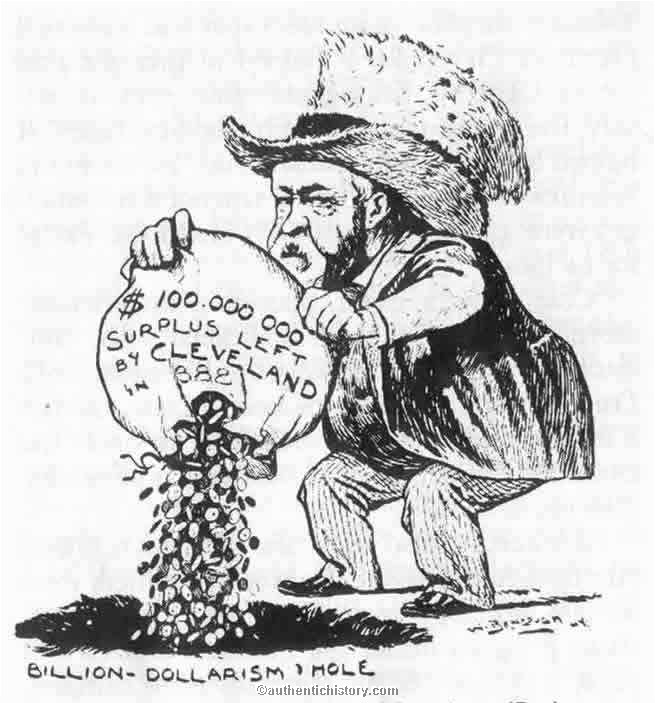
The 1888 election saw the victory of Benjamin Harrison and it all hinged on the state of New York. Harrison won New York thanks largely to the efforts of his campaign manager Matthew Quay. Harrison was also blessed with a Republican majority, and this majority was eager to spend the surplus. One measure was the Dependent and Disability Pension Act, which expanded pensions to all Union veterans who honorably served for at least 90 days and were unable to physically work. Others included a major expansion of the navy and more funds for internal improvements. The Congress also narrowly passed the McKinley Tariff. While all this did succeed in nearly eliminating the budget surplus, the Congress was criticized as the “Billion Dollar Congress”, to which Speaker Thomas Brackett Reed (R-Me.) responded, “This is a billion-dollar country” (NPS). The Democrats also charged that this spending was wasteful, and such a criticism is reflected in the below 1892 cartoon from the humorous Democratic magazine Puck.

While the 51st Congress was quite productive and efficient in what they sought to achieve, namely the 1888 Republican platform, this attracted a lot of opposition, and the 1890 midterms were nasty due to the recession from the Panic of 1890, caused by the near collapse of London’s Barings Bank. Although Grover Cleveland would again be elected president in 1892, a lot of his presidency would see deficits due to the reduced revenues from the Panic of 1893 and the depression that followed.


References

Benjamin Harrison Home. National Parks Service.

Retrieved from

https://www.nps.gov/nr/travel/presidents/benjamin_harrison_home.html

Democratic Party Platform of 1888. The American Presidency Project.

Retrieved from

https://www.presidency.ucsb.edu/documents/1888-democratic-party-platform

DiBacco, T.V. (1981, September 28). Reagan May Long for a Surplus, But Some Presidents Abhorred It. The Washington Post.

Retrieved from

https://www.washingtonpost.com/archive/business/1981/09/28/reagan-may-long-for-a-surplus-but-some-presidents-abhorred-it/2166c421-53e4-4ad7-8eca-a46b66bb4a81/

Republican Party Platform of 1888. The American Presidency Project.

Retrieved from

https://www.presidency.ucsb.edu/documents/republican-party-platform-1888

Weigand, R.E. (1988, June 23). Protectionism and Ben Harrison. The Chicago Tribune.

Retrieved from

https://www.chicagotribune.com/news/ct-xpm-1988-06-23-8801090829-story.html

The Other Coolidge of Massachusetts

The most known Coolidge in American politics was of course President Calvin Coolidge, a conservative Republican who served from 1923 to 1929. However, did you know that there was another branch of Coolidges, kind of like the Democratic and Republican Roosevelts? The foremost elected official in this family was Democrat Marcus A. Coolidge (1865-1947), also from Massachusetts. While they were related and they do have some facial similarities, it was a relation that was “distant” (The Washington Post).

Coolidge had served as mayor of Fitchburg, Massachusetts for two terms and was well-liked by President Wilson, who picked him as envoy to Poland after World War I and was supportive of FDR (Hennessy). In 1920, he ran for lieutenant governor against Republican Alvan T. Fuller but lost as the Republicans had a boom year. Although the 1920s would be primarily years of political fortune for the Republicans, the Great Stock Market Crash of 1929 started their massive downfall.

In 1930, Senator Frederick Gillett, by this time nearing 80, was calling it quits. Not only that, but the Great Depression was also hitting the country. Coolidge saw it as his chance to run, and although the GOP picked Calvin Coolidge’s friend and former Senator Willliam M. Butler and Coolidge campaigned for him, Marcus Coolidge had former Democratic nominee Al Smith campaign for him. Both Calvin Coolidge and Smith had won Massachusetts in their elections. The Democrats, however, were ascendant, and Marcus Coolidge prevailed by over 10 points. This made it the first time in the history of Massachusetts that both of its senators were Democrats. Coolidge was supportive of the classic Democratic plank of tariff reduction and kept his options open on the question of the League of Nations (The New York Times). Coolidge, rather similar to Calvin, had some fiscally conservative points to him; he opposed veterans bonus legislation repeatedly until voting to override President Roosevelt’s veto in 1936. He would also vote against US entry into the World Court in 1935 despite voting against all proposed reservations.

Coolidge was largely a supporter of FDR’s First 100 Days legislation, such as voting for the Agricultural Adjustment Act, the Tennessee Valley Authority Act, and the National Industrial Recovery Act. He also voted for FDR’s “wealth tax” of 1935, but had some independence in his voting record, especially in his last two years. This included voting against the “Death Sentence” clause of the Public Utilities Holding Company Act, against bituminous coal regulation, and against the Revenue Act of 1936. Despite such independence, his DW-Nominate score was a -0.355. Coolidge might have had another term had Massachusetts’ governor not been Jim Curley. Curley wanted the Senate seat and, according to Time Magazine, “Senator Coolidge was simply dumped by the wayside; the Democratic convention automatically endorsed Mr. Curley” (Time Magazine, 1936). This reflected Curley’s power flexing but also perhaps his identity politics as although Coolidge was a Democrat, he was also a WASP. This didn’t end up working out for Curley and this was the only Senate seat picked up by a Republican that year in Henry Cabot Lodge Jr., and a Democrat would not be elected to this Senate seat again until 1978. In a reflection of his career in the Boston Globe, he was regarded as a “grand old 20th Century puritan” (Hennessy).

References


Hennessy, M.E. (1947, February 2). Round About. The Boston Globe.

Retrieved from

https://bostonglobe.newspapers.com/article/the-boston-globe-column-of-career-of-mar/77885137/

Marcus A., Candidate in Massachusetts, Distant Kin to Calvin. (1930, October 12). The Washington Post.

Retrieved from

https://pqasb.pqarchiver.com/washingtonpost_historical/access/226416702.html?dids=226416702:226416702&FMT=ABS&FMTS=ABS:FT&date=OCT+12%2C+1930&author=&pub=The+Washington+Post&desc=Marcus+A.%2C+Candidate+in+Massachusetts%2C+Distant+Kin+to+Calvin.&pqatl=google

Marcus A. Coolidge. Voteview.

Retrieved from

https://www.voteview.com/person/2035/marcus-allen-coolidge

Massachusetts: Flesh v. Blood. (1936, September 28). Time Magazine.

Retrieved from

https://content.time.com/time/subscriber/article/0,33009,756708,00.html

M. Coolidge Plans Activity in Senate; Bay State Democrat Asserts He Will Not Be ‘Rubber Stamp’ for Senator Walsh. (1931, July 12). The New York Times.

Retrieved from
https://www.nytimes.com/1931/07/12/archives/m-coolidge-plans-activity-in-senate-bay-state-democrat-asserts-he.html

Political Notes; Coolidge v. Smith. Time Magazine.

Retrieved from

https://content.time.com/time/subscriber/article/0,33009,740633,00.html

RINOs from American History #14: Daniel Ellison


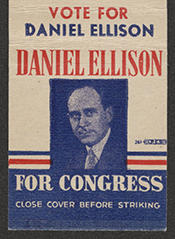
Baltimore has historically been a place in which Republicans have seldom found themselves electable in its history. The most notable Republican to come out of Baltimore was none other than Spiro Agnew, who benefited from divisions regarding race within the state’s Democratic Party at the time. One figure who managed to do quite well before Agnew was Daniel Ellison (1886-1960). In 1923, he was elected to represent the fourth council district and most of the time he was in office he was the only Republican on the city council. He managed to stay through even during the Great Depression, a testament to his popularity. Ellison was also a bit of a rarity as a Republican in that he was Jewish. Jews have a long history of voting Democratic and although this may weaken with controversy regarding the Israel-Hamas war, I don’t generally count on super-dramatic shifts.

Ellison in Congress

In 1942, incumbent Democrat John A. Meyer lost renomination to Democrat Joseph Wyatt. Had Meyer been renominated, perhaps the seat would have stayed in Democratic hands. After all, the 4th district had a very long history of electing Democrats, the last time the district elected a Republican was in 1900. Ellison resigned his seat on the city council and narrowly won in the Republican wave year of 1942. To this day, Ellison is the last Republican to have held a seat on the Baltimore City Council and the last to have represented a significant portion of Baltimore in Congress.

Ellison’s DW-Nominate score was a -0.099, an astonishingly low score for a Republican, with only Charles La Follette of Indiana and Richard Welch of California having lower scores than him. He was perhaps the most consistent Republican supporter of maintaining wartime price control, voted against funding the House Committee on Un-American Activities, voted against the Smith-Connally Act on wartime labor disputes, voted against the Hobbs (D-Ala.) anti-racketeering bill opposed by organized labor in 1943, voted to retain agricultural subsidies, and for U.S. participation in the United Nations Relief and Rehabilitation Administration. On the conservative side, he voted against increasing funds for agricultural programs, voted to revoke FDR’s wage freeze in 1943, and voted for tax relief over President Roosevelt’s veto in 1944. Ellison was yet another figure in the storied history of dissident Republicans from Maryland, perhaps the most notable one being Charles Mathias, a major irritant to the Nixon White House who would serve in the House from 1961 to 1969 and the Senate from 1969 to 1987. Ellison’s overall liberal record wasn’t enough to stop him from losing reelection in 1944 by almost 20 points.

References

Ellison, Daniel. Voteview.

Retrieved from

https://www.voteview.com/person/2930/daniel-ellison