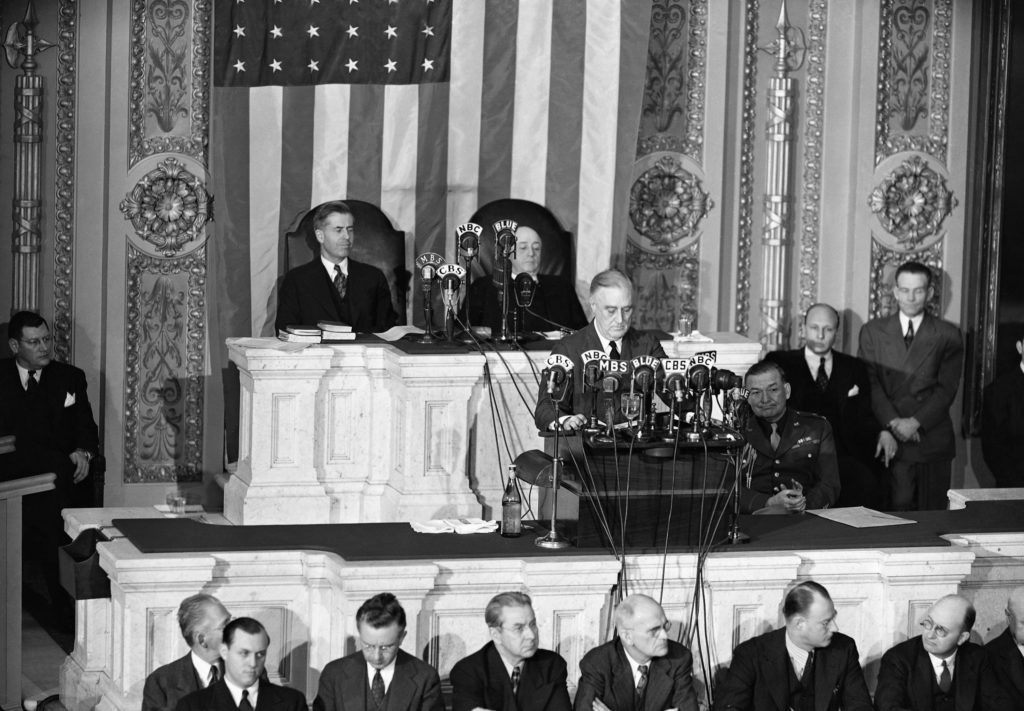
While we have positive images of President Roosevelt’s wartime leadership and national unity, US victory in World War II was far from considered a certainty in 1942. Dissatisfaction with the progress of the war effort gained the Republicans 47 seats in the House as well as 9 seats in the Senate. Republicans now held all House seats from Connecticut, Iowa, Kansas, Nebraska, and Oregon. Every Illinois House seat outside of Chicago was now held by a Republican, Republicans gained five seats from Democrats in Missouri, and for the first time since the Hoover Administration Republicans won House seats in Maryland and Washington. While Republicans were still far behind in the latter chamber, the Democrats had a mere 13 seat majority in the House after.
The situation wouldn’t have been such an issue for the domestic situation of the Roosevelt Administration had the parties operated the way they do now. They did not, as many Southern Democrats had shifted to the right and were now part of the Conservative Coalition, with House Minority Leader Joe Martin (R-Mass.) and Rules Committee’s second ranking Gene Cox (D-Ga.) at the helm. Although the chairman was liberal Adolph Sabath (D-Ill.), the committee had such supporters of Cox as Howard Smith of Virginia and William Colmer of Mississippi, who aligned with the committee’s Republicans, all conservatives. Indeed, this Congress saw a significant rise in conservatism among Southern Democrats.
This Congress revoked the wage freeze by President Roosevelt, fought consumer subsidies, passed the Smith-Connally Act permitting the seizure of plants of critical industries for defense if there is a strike or a threat of one over President Roosevelt’s veto, passed a soldier voting bill that fell far short of the comprehensive measure the Roosevelt Administration wanted, fought to limit price control, and passed tax relief over President Roosevelt’s veto. The latter would be the first time in American history that Congress passed a revenue measure over a presidential veto. He also reluctantly signed a bill freezing the payroll taxes under the Social Security Act to 1% for 1945. This was also, however, the Congress that paved the way to US participation in the UN as it passed the bill providing for American participation in the UN Relief and Rehabilitation Administration. Despite being in the midst of World War II, it was Roosevelt’s least favorable Congress. The situation would improve for FDR as Democrats would gain seats in the 1944 election. He was undoubtedly deeply satisfied to see bitter foes Rep. Hamilton Fish (R-N.Y.) and Sen. Gerald Nye (R-N.D.) lose reelection. Roosevelt, however, wouldn’t enjoy the new Congress or his new term for long, as he died on April 12, 1945 of a cerebral hemorrhage.
In the House and Senate, 34 votes for each chamber have been counted to create these ratings, and the following legislators represent the extremes of this Congress:
House
The 100%:
Johnson, R-Ill.
Chiperfield, R-Ill.
McMillen, R-Ill.
Vursell, R-Ill.
Harness, R-Ind.
Scrivner, R-Kan.
Hoffman, R-Mich.
Jonkman, R-Mich.
Knutson, R-Minn.
Short, R-Mo.
Buck, R-N.Y.
Culkin, R-N.Y.
Jones, R-Ohio
Clevenger, R-Ohio
Smith, R-Ohio
Rizley, R-Okla.
Ditter, R-Penn.
Ellis, R-W.V.
The 0%:
Outland, D-Calif.
Ford, D-Calif.
Holifield, D-Calif.
Izac, D-Calif.
Sadowski, D-Mich.
Rooney, D-N.Y.
Delaney, D-N.Y.
O’Leary, D-N.Y.
Capozzoli, D-N.Y.
Klein, D-N.Y.
Marcantonio, ALP-N.Y.
Torrens, D-N.Y.
Fitzpatrick, D-N.Y.
Kirwan, D-Ohio
Feighan, D-Ohio
Crosser, D-Ohio
McGranery, D-Penn.
Bradley, D-Penn.
Scanlon, D-Penn.
Weiss, D-Penn.
Jackson, D-Wash.
Coffee, D-Wash.
McMurray, D-Wis.
Senate
The 100%:
Hawkes, R-N.J.
Bushfield, R-S.D.
The 0%:
Wagner, D-N.Y.
Murdock, D-Utah
Wallgren, D-Wash.
Highest Scoring Democrat, House:
Disney, Okla. – 90%
Highest Scoring Democrat, Senate:
Byrd, Va. – 88%
Lowest Scoring Republican, House:
Burdick, N.D. – 7%
Lowest Scoring Republican, Senate:
Langer, N.D. – 21%
KEY
Republicans are in italics.
Democrats are in plain text.
+ – Vote for the conservative position
+ – Pair or announcement for the conservative position.
– – Vote against the conservative position.
– – Pair or announcement against the conservative position.
? – No vote, pair, or announcement.
78th Congress MC-Index House, Senate, & Vote Descriptions:
 Mad Politics: The Bizarre, Fascinating, and Unknown of American Political History
Very interesting analysis; my own analysis of the Southern Democratic shift from the 1920s to the 40s allegedly away from the left concludes that the “rightward” trend was less of a change in them, rather the defining standards of left-right politics. It seems that this was highly evident in virulent white supremacists Bilbo and Rankin, who were lifelong progressives allegedly up until the 1940s. It seems that there were both racial and economic components motivating the “shift” caused by WWII, as you mentioned before. On the economic side, wartime price controls hindered rural interests (if I recall reading correctly in “Bilbo’s Final Senate Years”), alienating the old populist-progressive bloc whose Jeffersonianism began to resent the increasing direct, big government approach of FDR.
And of course, with war efforts helping advance racial equality most notably via the FEPC, the association between New Deal liberalism and civil rights in the 1940s, contrary to FDR’s quiet opposition to civil rights in the 30s to appease Southern Democrats, that must’ve been the major factor causing old-school Southern progressives to become all but disenchanted with the new direction of left-wing politics especially by Truman’s presidency. Essentially, liberalism/leftism, taking a new direction as a result of the political impacts of WWII, forced the diehard racist old-school progressive Southerners to choose whether they stick with progressive economics or racism, and of course, they chose the latter.
I’ve noticed in my research into the Dixiecrats that, contrary to the mainstream academic narrative repeating J. Lister Hill’s line that they were economic conservatives, included many members who were New Deal liberals in the 1930s. The infamous Bull Connor, for one, continued calling FDR a “fine president” even in the 1940s! At a Mississippi college in 1948, student George Maddox told a group of Thurmond/Wright supporters, “You have never objected to flood control programs, subsidies for farmers and education, and TVA or any of the other things the government has brought in to your profit.” (Kari Frederickson, “The Dixiecrat Revolt and the End of the Solid South, p. 145) Well, so much for Hill’s conspiracy theory that Dixiecrats were en masse conspiring to overturn TVA; why would any prominent Southern Democratic politician expect to be elected especially as a third party candidate if they opposed the popular TVA of all programs? Clearly, a college student at that time understood what most of our modern-day scholars either don’t understand or deliberately hide from!